
Walk down any row of rooftop solar panels and you will see two kinds of blue. Some panels are a deep, uniform blue-black with rounded cell corners. Others are a speckled, mosaic blue with sharp square cells. The first are monocrystalline panels, the second are polycrystalline panels — and the difference is not cosmetic. It comes from how the silicon inside each cell was grown, and it decides how much power you get from every square foot of roof, how much you pay, and how long the panels keep working.
This guide compares monocrystalline and polycrystalline solar panels head to head: how each type is made, real efficiency and cost numbers, how they behave in heat, how long they last, and a worked example that turns the efficiency gap into dollars. If you are still deciding how big your system should be, our guide on off-grid vs on-grid solar explains the system choices around the panels themselves.
What Are Monocrystalline Solar Panels?
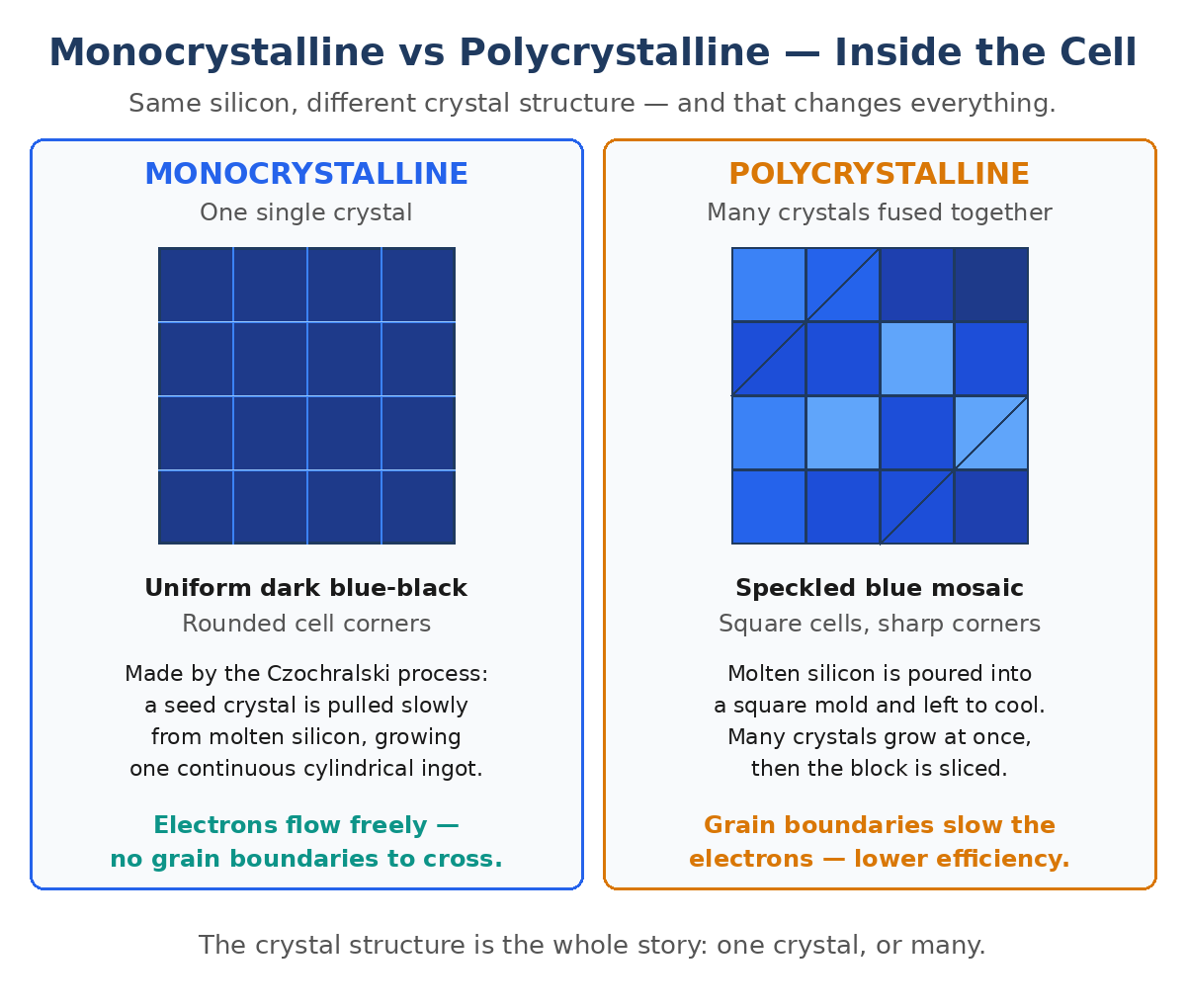
A monocrystalline solar panel is made from a single, continuous crystal of silicon. Manufacturers grow it with the Czochralski process: a small seed crystal is dipped into a vat of molten silicon and slowly pulled upward while rotating, growing into one long cylindrical ingot of pure single-crystal silicon. The ingot is then sliced into thin wafers, and each wafer becomes a solar cell. Because the crystal is continuous, electrons freed by sunlight can flow through the cell with almost nothing in their way.
You can recognize a mono panel at a glance. The cells are a uniform dark blue or black, and the corners are rounded — a leftover of the cylindrical ingot the wafers were cut from. Mono panels are the premium option in residential solar today, and they dominate new installations in the United States, because they squeeze the most watts out of a limited roof.
What Are Polycrystalline Solar Panels?
A polycrystalline solar panel — also called a multicrystalline panel — is made by melting silicon fragments together in a square mold and letting the mixture cool and solidify. Many crystals grow at once, side by side, and the solid block is then sliced into wafers. Each cell therefore contains many small crystals instead of one big one, and the boundaries between those crystals are visible as a speckled blue mosaic.
The casting process is simpler and wastes less silicon than growing a single crystal, so polycrystalline panels cost less to make — and less to buy. The trade-off is the grain boundaries: every boundary between two crystals is a small obstacle for the electrons, so a poly cell converts a smaller share of the sunlight hitting it into electricity. Poly panels are the budget option, and they still make sense when roof space is plentiful and the budget is tight.
Efficiency Compared: How Much Power per Square Foot?
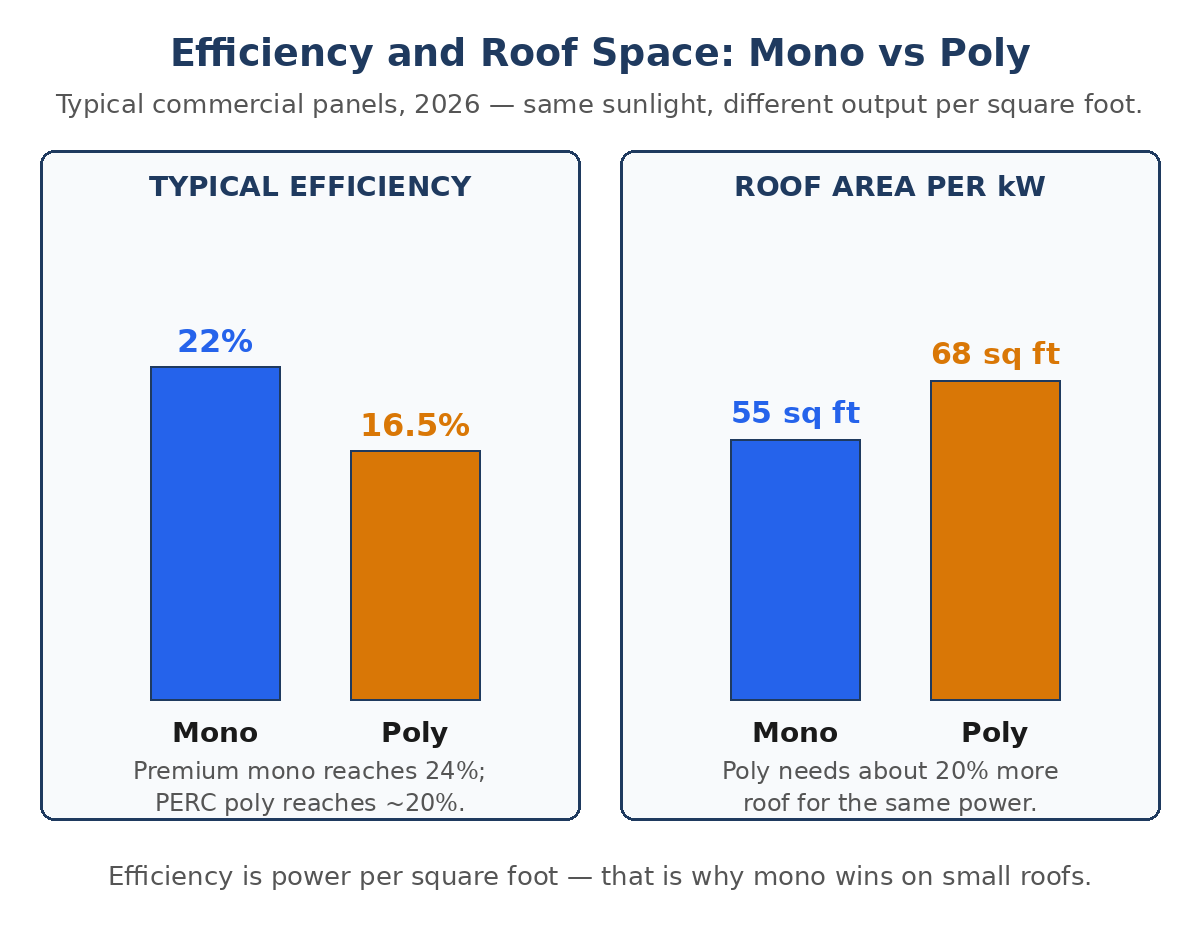
Efficiency is the share of sunlight hitting a panel that comes out as electricity, and it is the single most important difference between the two types. Typical commercial monocrystalline panels today reach 19–24% efficiency, with premium models from manufacturers such as SunPower, Panasonic, and REC exceeding 24%. Typical commercial polycrystalline panels reach 15–18%. Newer PERC (Passivated Emitter and Rear Cell) technology has pushed some poly panels to about 20–21%, narrowing the gap — but mono still leads.
What does that mean on a real roof? A 400 W mono panel and a 400 W poly panel produce the same power — the wattage rating is the wattage rating. The difference is size: to reach 400 W, the poly panel has to be physically larger, because each square foot of it converts less sunlight. Homeowners with a small roof feel this immediately. Poly panels need roughly 20% more roof area for the same system size — about 60–75 square feet per kilowatt, versus 50–60 square feet per kilowatt for mono.
Cost Compared: What Do Mono and Poly Panels Cost?
Polycrystalline panels are cheaper, panel for panel. At the panel level, mono typically costs about $1.00–$1.50 per watt, while poly costs about $0.90–$1.00 per watt — a premium of roughly 15–25% for mono. For a full installed system the gap shrinks in percentage terms, because panels are only part of the total: installed residential systems in the US generally run about $2.40–$3.50 per watt, and the inverter, racking, wiring, and labor cost the same whichever panel you choose. Our guide to MPPT vs PWM charge controllers covers one of those other system costs in detail.
The honest way to compare cost is not the price per watt — it is the price per kilowatt-hour over the life of the system. A mono system costs more up front but produces more electricity from the same roof, year after year. On a roof with limited space, the extra energy often pays back the premium well within the panels’ lifetime, as the worked example below shows. On a large roof with plenty of room, the cheaper poly panels can produce the same total energy for less money — you just need more of them.
| Feature | Monocrystalline | Polycrystalline |
|---|---|---|
| Typical efficiency | 19–24% (premium over 24%) | 15–18% (PERC up to ~20–21%) |
| Panel cost per watt | $1.00–$1.50 | $0.90–$1.00 |
| Roof area per kW | 50–60 sq ft | 60–75 sq ft |
| Cell appearance | Uniform dark blue-black, rounded corners | Speckled blue mosaic, square cells |
| Temperature coefficient | About −0.4% per °C | About −0.36% per °C |
| Lifespan | 25–40 years | 25–35 years |
| Performance warranty | Typically 25 years | Typically 25 years |
| Best for | Small roofs, maximum output | Large roofs, tight budgets |
Temperature, Lifespan, and Degradation
Solar panels lose a little output as they get hotter, and the rate is called the temperature coefficient. Poly panels have a slight edge here: a typical poly panel loses about 0.36% of its output per degree Celsius above the 25 °C test temperature, while a typical mono panel loses about 0.4% per °C. On a 65 °C rooftop in summer, that is a difference of roughly 1.6% of output — real, but small compared with the 5–6 point efficiency gap that mono starts with.
Both types last a long time. Mono panels typically last 25–40 years, poly panels 25–35 years, and both usually carry a 25-year performance warranty that guarantees at least 80–90% of original output after 25 years. Mono panels also degrade slightly more slowly — roughly 0.5% per year versus about 0.8% per year for poly — so after 25 years a mono panel is typically still producing a few percent more of its original output than a poly panel of the same age. The difference is modest, but over a quarter century it adds up.
One more practical point: panels keep producing through their whole life, and the electricity they make offsets your bill. If your utility offers net metering — where surplus solar power sent to the grid earns you credit — the extra kilowatt-hours from a mono system are worth the same as any other kilowatt-hour. Our net metering guide explains how that credit works, and our renewable energy overview puts rooftop solar in the wider context of clean power.
Worked Example: One Roof, 20 Panels
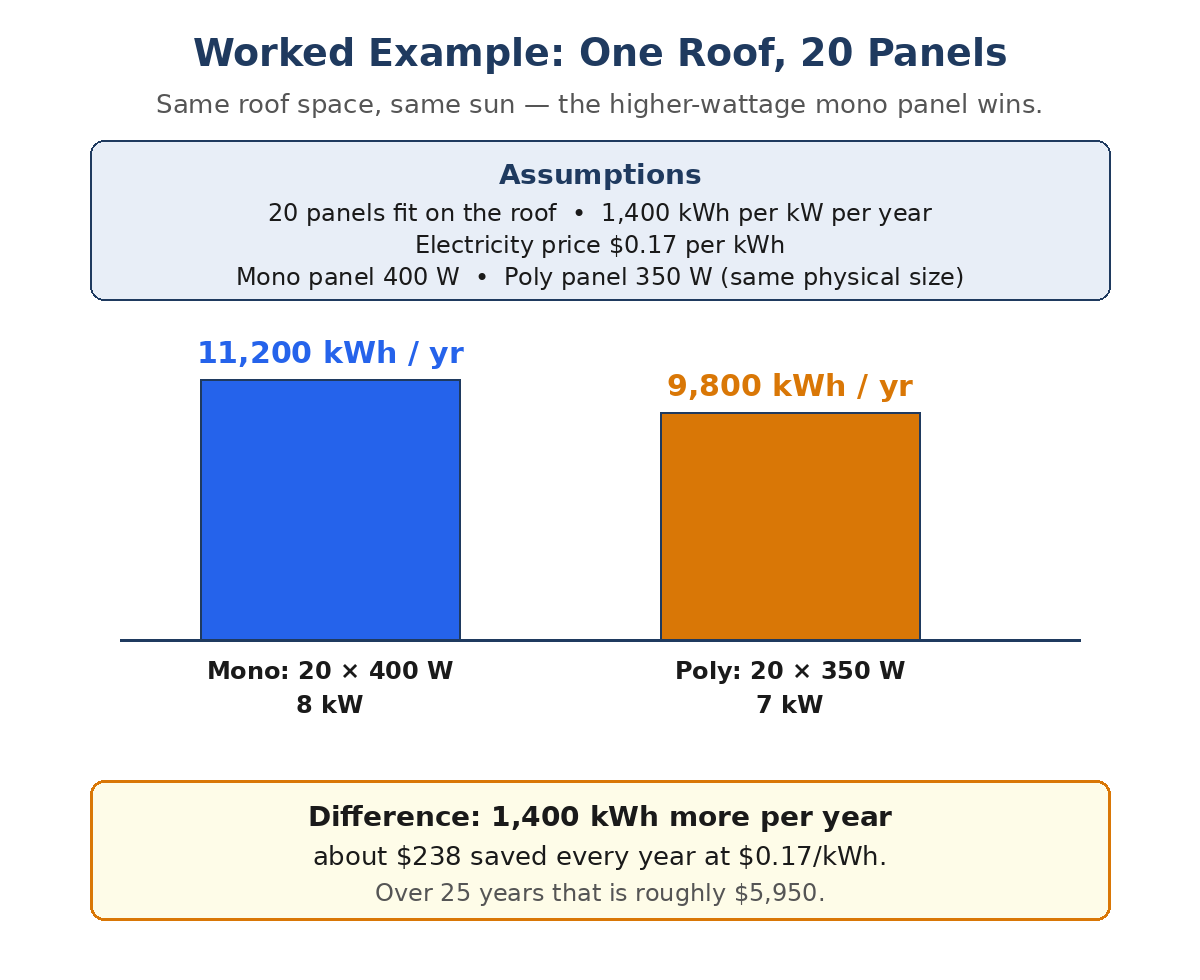
Suppose your roof fits exactly 20 panels, and you are choosing between standard residential sizes: a 400 W mono panel and a 350 W poly panel of the same physical size. The mono system is 20 × 400 W = 8 kW. The poly system is 20 × 350 W = 7 kW. That 1 kW difference is the efficiency gap, expressed in watts.
Now assume the site produces 1,400 kWh per kilowatt per year — a typical US average — and electricity costs $0.17 per kWh. The mono system produces 8 × 1,400 = 11,200 kWh per year. The poly system produces 7 × 1,400 = 9,800 kWh per year. The difference is 1,400 kWh per year, worth 1,400 × $0.17 = $238 every year. Over the 25-year warranty period that is about $5,950 — usually more than the extra money the mono panels cost in the first place. On a space-limited roof, mono pays for itself. On a roof with room to spare, you could simply add three more poly panels (3 × 350 W ≈ 1 kW) and close the gap — if the roof and the budget allow it.
Which Panel Should You Choose?
- Choose monocrystalline if your roof is small — you need every square foot to work as hard as possible, and mono’s higher efficiency is worth the premium.
- Choose monocrystalline if you want maximum lifetime output — slower degradation and a longer life mean more total kilowatt-hours over 25–30 years.
- Choose polycrystalline if your roof is large and your budget is tight — you can fit enough extra panels to match a mono system’s output for less money up front.
- Choose polycrystalline for ground mounts and large open spaces — where area is free, the cost per watt matters more than the efficiency per square foot.
Either way, check the panel’s datasheet, not just the type name. A high-quality PERC poly panel can outperform a cheap mono panel, and the panel’s temperature coefficient, degradation rate, and warranty matter as much as the headline efficiency. The federal solar tax credit — 30% of the installation cost — applies to both types equally, so it does not change the comparison.
Frequently Asked Questions
Which is better, monocrystalline or polycrystalline?
Monocrystalline is better on efficiency, lifespan, and output per square foot — typically 19–24% efficient versus 15–18% for poly. Polycrystalline is better on price, costing roughly 15–25% less per watt. The right choice depends on your roof size and budget, not on the panel type alone.
How can I tell mono and poly panels apart?
Look at the cells. Mono cells are a uniform dark blue or black with rounded corners, cut from a cylindrical single-crystal ingot. Poly cells are a speckled blue mosaic with sharp square corners, cast from many crystals in a square mold.
Do monocrystalline panels last longer?
Yes, slightly. Mono panels typically last 25–40 years and degrade at about 0.5% per year, while poly panels typically last 25–35 years and degrade at about 0.8% per year. Both usually carry a 25-year performance warranty.
Are polycrystalline panels still worth buying?
Yes, when roof space is plentiful. Poly panels produce the same total energy as mono if you install enough of them, and they cost less per watt. They are a good choice for large roofs, ground mounts, and tight budgets — and modern PERC poly panels reach about 20–21% efficiency, closing much of the old gap.
Do mono panels work better in hot weather?
Not quite — poly has a marginally better temperature coefficient (about −0.36% per °C versus about −0.4% per °C for mono), so poly loses slightly less output in extreme heat. But the difference is small, roughly 1–2% on a very hot roof, and mono’s higher base efficiency more than makes up for it.
Conclusion
Monocrystalline and polycrystalline panels do the same job with the same silicon — the difference is the crystal structure. One continuous crystal gives mono panels 19–24% efficiency, more power per square foot, slower degradation, and a longer life, at a 15–25% price premium. Many fused crystals make poly panels cheaper per watt but less efficient, so they need about 20% more roof for the same system. If your roof is small, mono is almost always the better buy: our worked example showed 20 mono panels producing 1,400 kWh more per year than 20 poly panels on the same roof, worth about $238 a year. If your roof is big and your budget is tight, poly still delivers the same total energy for less money. Either way, compare datasheets — efficiency, temperature coefficient, degradation, and warranty — and not just the panel type. For a detailed side-by-side with more performance data, see Monocrystalline vs Polycrystalline Solar Panels: Performance Comparison on PVGIS.