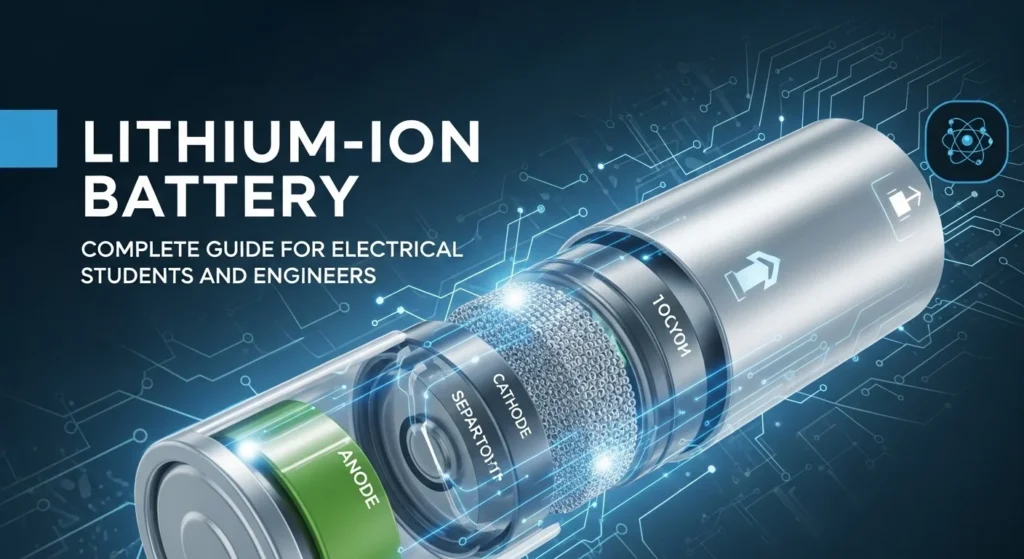

Think about the moment when you charge your smartphone at night and use it throughout the next day without worrying about power. The same technology that powers your phone also runs laptops, electric vehicles, drones, and even large renewable energy storage systems. This technology is based on the Lithium-Ion Battery.
In modern electrical and electronic systems, lithium-ion batteries have become one of the most important energy storage solutions. Their lightweight design, high energy capacity, and long life have made them the preferred choice for portable devices and advanced technology applications.
For electrical students, technicians, and engineers, understanding the Lithium-Ion Battery working principle and structure is essential. As industries move toward electric vehicles and renewable energy storage, lithium-ion batteries are becoming even more important.
In this article, you will learn what a Lithium-Ion Battery is, how it works, its main components, different types, advantages and disadvantages, applications, comparison with other batteries, and practical troubleshooting tips. The goal is to explain the concept clearly so beginners can understand this important modern battery technology.
2. What is Lithium-Ion Battery?
A Lithium-Ion Battery is a rechargeable battery that stores and releases electrical energy using lithium ions moving between two electrodes.
In simple words, it is an energy storage device that uses lithium ions as charge carriers to transfer energy during charging and discharging.
Unlike traditional batteries, lithium-ion batteries are lightweight and can store a large amount of energy in a small size.
Practical Example
Your smartphone battery is a lithium-ion battery. When you charge your phone, electrical energy is stored in the battery. When you use the phone, the battery releases this stored energy to power the device.
Because of their efficiency and compact design, lithium-ion batteries are widely used in modern electronic devices and renewable energy systems.
Lithium-Ion Battery: Working Principle Explained
The working principle of a lithium-ion battery is based on the reversible movement of lithium ions between two electrodes, known as the anode and the cathode. This movement generates and stores electrical energy efficiently, making lithium-ion batteries widely used in modern electronics.
Battery Structure
A lithium-ion battery consists of the following main components:
- Anode (Negative Electrode): Usually made of graphite, it stores lithium ions during charging.
- Cathode (Positive Electrode): Made of lithium metal oxide, it releases lithium ions during discharge.
- Electrolyte: A chemical medium (liquid or gel) that allows lithium ions to move between the anode and cathode.
- Separator: A thin layer that prevents direct contact between electrodes while allowing ion flow.
Discharging Process (Power Supply Mode)
When the battery is connected to a device and supplying power:
- Lithium ions move from the anode to the cathode through the electrolyte
- Electrons flow through the external circuit, creating electric current
- This flow of electrons powers the connected device
- Stored chemical energy is converted into electrical energy
Charging Process (Energy Storage Mode)
When the battery is connected to a charger:
- Electrical energy forces lithium ions to move from the cathode back to the anode
- Electrons return through the external circuit in the opposite direction
- Energy is stored inside the battery for future use
- The battery becomes ready for the next discharge cycle
Simple Analogy
Imagine lithium ions as passengers traveling between two stations (anode and cathode).
During charging, they travel to one station and store energy. During discharging, they return to the other station, releasing energy that powers devices.
If you want, I can also convert this into SEO article format (with headings, keywords, and meta tags) or make it 200–300 word exam notes version.
4. Types / Classification of Lithium-Ion Battery
Lithium-ion batteries come in several different chemical types depending on the materials used in the cathode.
Lithium Cobalt Oxide (LCO) Battery: Structure, Working, Applications, Advantages and Limitations
This is one of the earliest lithium-ion battery types.
Characteristics:
- High energy density
- Commonly used in smartphones and laptops
- Limited thermal stability
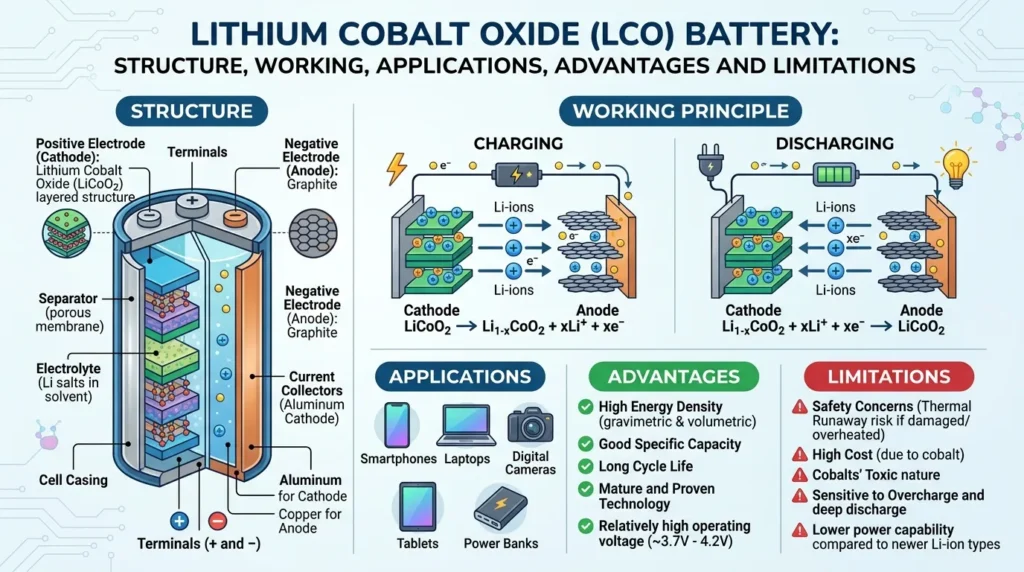
Lithium Cobalt Oxide (LCO) battery is one of the most widely used types of lithium-ion batteries, especially in portable electronic devices. It uses lithium cobalt oxide (LiCoO₂) as the cathode material and graphite as the anode. LCO batteries are known for their high energy density, stable performance, and lightweight design, making them ideal for compact electronics.
Structure of LCO Battery
An LCO battery consists of the following main components:
- Cathode (Positive Electrode): Lithium cobalt oxide (LiCoO₂)
- Anode (Negative Electrode): Graphite
- Electrolyte: Lithium salt in an organic solvent
- Separator: Prevents direct contact between electrodes while allowing ion movement
These components work together to store and release electrical energy efficiently.
Working Principle
The working of an LCO battery is based on the movement of lithium ions between electrodes:
- During discharging, lithium ions move from the anode to the cathode, producing electrical energy that powers devices.
- During charging, lithium ions move back from the cathode to the anode, storing energy for future use.
This reversible ion movement allows repeated charging and discharging cycles.
Applications of LCO Battery
Lithium cobalt oxide batteries are commonly used in:
- Mobile phones and smartphones
- Laptops and tablets
- Cameras and portable devices
- Small electronic gadgets
Their compact size and high energy density make them suitable for consumer electronics.
Advantages of LCO Battery
- High energy density
- Lightweight and compact design
- Stable voltage output
- Suitable for portable devices
Disadvantages of LCO Battery
- Expensive compared to other lithium-ion types
- Limited thermal stability (can overheat)
- Shorter lifespan compared to other lithium batteries
- Lower safety under high load conditions
Lithium Cobalt Oxide (LCO) batteries are highly efficient for small electronic devices due to their high energy density and compact size. However, their safety concerns and limited lifespan restrict their use in high-power applications like electric vehicles.
Lithium Iron Phosphate (LFP) Battery: Structure, Working, Applications, Advantages and Disadvantages
This type is known for safety and long life.
Features:
- Excellent thermal stability
- Long cycle life
- Used in solar energy systems and electric buses
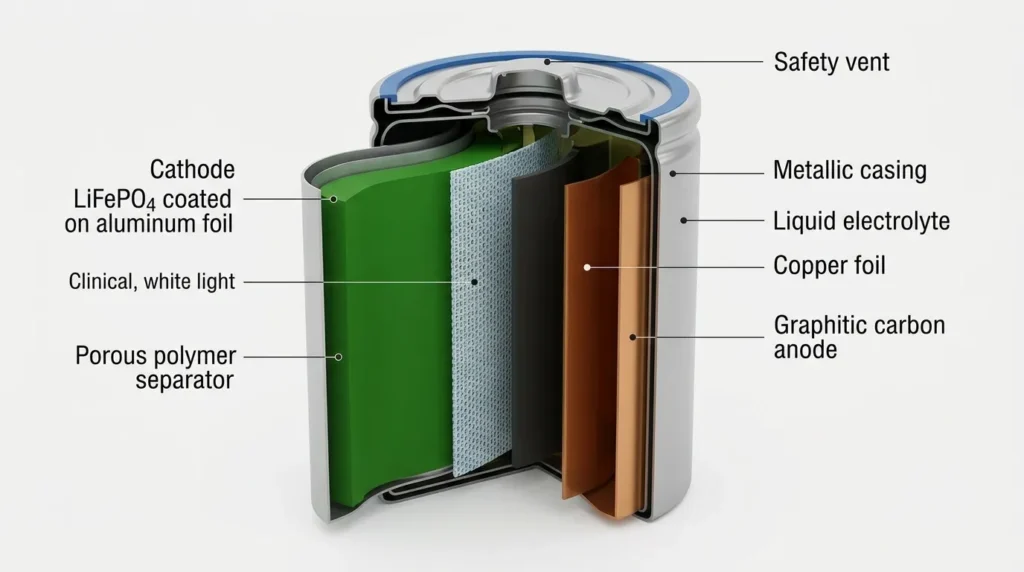
Lithium Iron Phosphate (LFP) battery is a type of lithium-ion battery that uses lithium iron phosphate (LiFePO₄) as the cathode material. It is widely known for its high safety, long cycle life, and excellent thermal stability. Due to these features, LFP batteries are commonly used in electric vehicles, solar energy storage systems, and industrial applications.
Structure of LFP Battery
An LFP battery consists of the following main components:
- Cathode (Positive Electrode): Lithium Iron Phosphate (LiFePO₄)
- Anode (Negative Electrode): Graphite
- Electrolyte: Lithium salt in an organic solution
- Separator: Prevents direct contact between electrodes while allowing ion flow
These components work together to enable efficient energy storage and release.
Working Principle
The working principle of an LFP battery is based on the movement of lithium ions between the anode and cathode:
- During discharging, lithium ions move from the anode to the cathode, producing electrical energy that powers the load.
- During charging, lithium ions move back from the cathode to the anode, storing electrical energy for later use.
This reversible ion movement allows the battery to be rechargeable for many cycles.
Applications of LFP Battery
LFP batteries are commonly used in:
- Electric vehicles (EVs)
- Solar energy storage systems
- UPS (Uninterruptible Power Supply) systems
- Power tools and industrial equipment
- Backup power systems
Their safety and durability make them ideal for large-scale energy storage.
Advantages of LFP Battery
- High safety and thermal stability
- Long cycle life (thousands of charge cycles)
- Environmentally friendly (no cobalt)
- Good performance under high temperature
- Stable voltage output
Disadvantages of LFP Battery
- Lower energy density compared to LCO and NMC batteries
- Heavier for the same capacity
- Lower performance in cold temperatures
- Slightly higher initial cost in some applications
Lithium Iron Phosphate (LFP) batteries are one of the safest and most durable lithium-ion battery types. Although they have lower energy density, their long lifespan and strong thermal stability make them ideal for electric vehicles, renewable energy storage, and industrial power systems.
Lithium Nickel Manganese Cobalt (NMC) Battery: Working, Uses, Advantages & Disadvantages
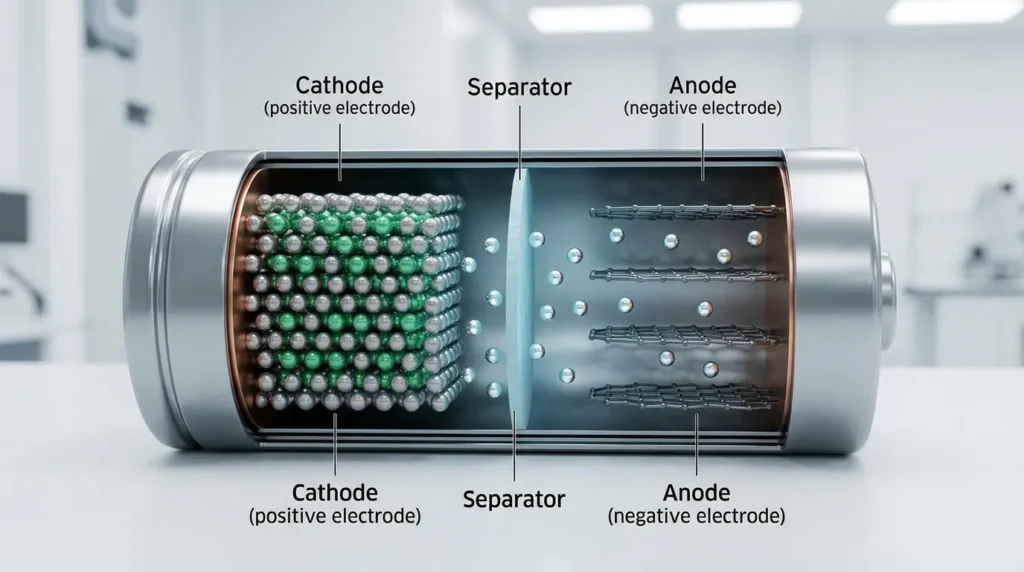
NMC batteries balance performance, safety, and cost.
Advantages:
- High energy density
- Long lifespan
- Widely used in electric vehicles
Lithium Nickel Manganese Cobalt (NMC) battery is a popular type of lithium-ion battery that uses a combination of nickel (Ni), manganese (Mn), and cobalt (Co) in its cathode material. It is widely used in electric vehicles, power tools, and energy storage systems due to its balanced performance, high energy density, and good thermal stability.
Structure of NMC Battery
An NMC battery consists of the following main components:
- Cathode (Positive Electrode): Lithium Nickel Manganese Cobalt Oxide (LiNiMnCoO₂)
- Anode (Negative Electrode): Graphite
- Electrolyte: Lithium salt dissolved in an organic solvent
- Separator: Prevents direct contact between electrodes while allowing ion movement
The combination of nickel, manganese, and cobalt improves overall battery performance and stability.
Working Principle
The working of an NMC battery is based on the movement of lithium ions between the anode and cathode:
- During discharging, lithium ions move from the anode to the cathode, producing electrical energy to power devices.
- During charging, lithium ions move from the cathode back to the anode, storing electrical energy for later use.
This reversible ion movement enables repeated charging cycles with high efficiency.
Applications of NMC Battery
NMC batteries are widely used in:
- Electric vehicles (EVs)
- Hybrid electric vehicles (HEVs)
- Power tools
- Portable electronics
- Grid energy storage systems
They are preferred where a balance of energy density, safety, and lifespan is required.
Advantages of NMC Battery
- High energy density
- Good thermal stability and safety
- Long cycle life
- Balanced performance (power + capacity)
- Suitable for high-performance applications
Disadvantages of NMC Battery
- Higher cost due to cobalt content
- Thermal runaway risk under extreme conditions
- Performance can degrade at high temperatures
- Requires advanced battery management systems (BMS)
Lithium Nickel Manganese Cobalt (NMC) batteries offer a strong balance between energy density, safety, and lifespan. Due to their versatility, they are widely used in electric vehicles and modern energy storage systems, making them one of the most important lithium-ion battery technologies today.
Lithium Nickel Cobalt Aluminum (NCA) Battery: Working, Uses, Advantages & Disadvantages
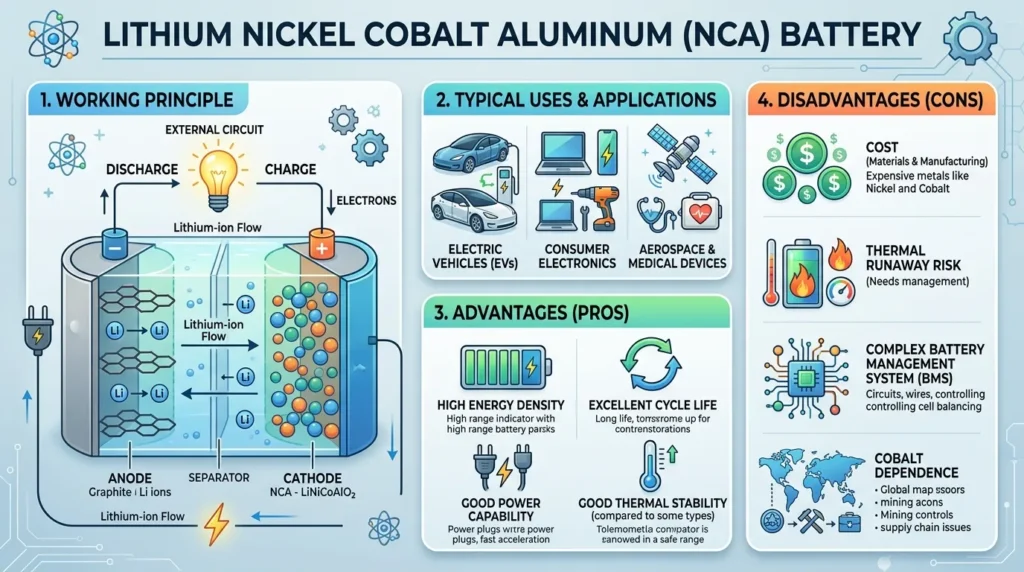
NCA batteries provide very high energy density.
Applications include:
- Electric vehicles
- Large energy storage systems
Lithium Nickel Cobalt Aluminum (NCA) battery is a type of lithium-ion battery that uses a combination of nickel (Ni), cobalt (Co), and aluminum (Al) in its cathode material. It is known for its very high energy density, strong performance, and long lifespan. NCA batteries are widely used in electric vehicles and high-energy storage applications where long range and high efficiency are required.
Structure of NCA Battery
An NCA battery consists of the following main components:
- Cathode (Positive Electrode): Lithium Nickel Cobalt Aluminum Oxide (LiNiCoAlO₂)
- Anode (Negative Electrode): Graphite
- Electrolyte: Lithium salt dissolved in an organic solvent
- Separator: A thin layer that prevents direct contact between electrodes while allowing lithium ion movement
The aluminum in the cathode improves stability and structural strength, while nickel increases energy density.
Working Principle
The working principle of an NCA battery is based on the movement of lithium ions between electrodes:
- During discharging, lithium ions move from the anode to the cathode, generating electrical energy to power devices.
- During charging, lithium ions move back from the cathode to the anode, storing electrical energy for reuse.
This reversible ion movement allows the battery to be recharged many times with high efficiency.
Applications of NCA Battery
NCA batteries are commonly used in:
- Electric vehicles (especially long-range EVs)
- Tesla electric cars and energy storage systems
- Power tools
- Aerospace and industrial applications
- High-performance portable electronics
They are preferred where high energy density and long driving range are important.
Advantages of NCA Battery
- Very high energy density
- Long cycle life
- Excellent performance in electric vehicles
- Lightweight compared to other chemistries
- High efficiency and good power output
Disadvantages of NCA Battery
- High cost due to cobalt and nickel content
- Requires advanced cooling and safety systems
- Thermal stability is lower compared to LFP batteries
- Risk of overheating under extreme conditions
- Complex manufacturing process
Lithium Nickel Cobalt Aluminum (NCA) batteries are high-performance energy storage systems designed for applications requiring maximum energy density and long range. Although they are expensive and require strong safety management, they remain a top choice for electric vehicles and advanced energy systems.
Lithium Titanate (LTO) Battery: Working, Uses, Advantages & Disadvantages
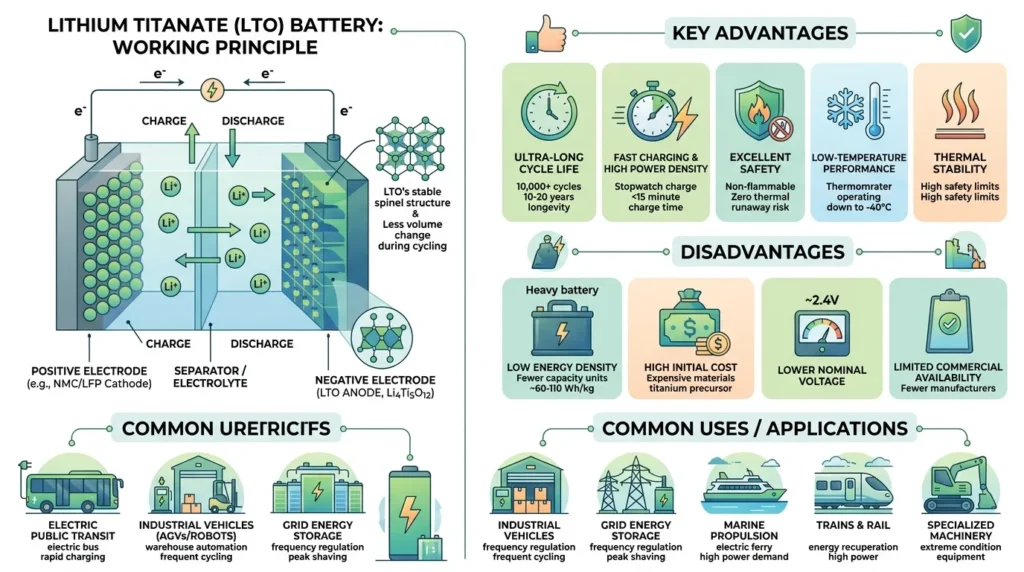
These batteries offer extremely fast charging capability.
Characteristics:
- Long lifespan
- High safety
- Used in specialized industrial applications
Lithium Titanate (LTO) battery is an advanced type of lithium-ion battery that uses lithium titanate (Li₄Ti₅O₁₂) as the anode material instead of graphite. This unique design gives LTO batteries exceptional safety, very fast charging capability, and an extremely long cycle life. They are widely used in applications where reliability and rapid charging are more important than energy density.
Structure of LTO Battery
An LTO battery consists of the following main components:
- Cathode (Positive Electrode): Lithium metal oxide (such as LCO, NMC, or LFP depending on design)
- Anode (Negative Electrode): Lithium Titanate (Li₄Ti₅O₁₂)
- Electrolyte: Lithium salt in organic solvent
- Separator: Prevents direct contact between electrodes while allowing ion flow
The lithium titanate anode provides high stability and prevents major structural changes during charging and discharging.
Working Principle
The working of an LTO battery is based on the movement of lithium ions between electrodes:
- During discharging, lithium ions move from the anode to the cathode, producing electrical energy to power the load.
- During charging, lithium ions move back from the cathode to the lithium titanate anode, storing energy for future use.
Because of the stable anode structure, the battery can handle very fast ion movement without damage.
Applications of LTO Battery
LTO batteries are commonly used in:
- Electric buses and commercial EVs
- Fast-charging electric vehicles
- Grid energy storage systems
- UPS (Uninterruptible Power Supply) systems
- Military and aerospace applications
- Industrial equipment and heavy-duty systems
They are preferred where high safety and fast charging are critical.
Advantages of LTO Battery
- Extremely fast charging capability
- Very long cycle life (can exceed 10,000 cycles)
- High safety and thermal stability
- Excellent performance in extreme temperatures
- Low risk of thermal runaway
Disadvantages of LTO Battery
- Lower energy density compared to other lithium-ion batteries
- Higher initial cost
- Larger size for the same energy capacity
- Not suitable for compact consumer electronics
- Lower nominal voltage
Lithium Titanate (LTO) batteries are one of the safest and most durable lithium-ion technologies available. Although they have lower energy density, their ultra-fast charging ability and long lifespan make them ideal for electric transport systems, industrial applications, and large-scale energy storage solutions.
5. Main Components of a Lithium-Ion Battery (Detailed Explanation)
A lithium-ion battery is a complex electrochemical device made up of several carefully designed components. Each part has a specific role in storing, transferring, and controlling electrical energy safely and efficiently.
1. Anode (Negative Electrode)
The anode is typically made of graphite (carbon-based material) because it can easily store lithium ions between its layers.
Function and Working:
- During charging, lithium ions move from the cathode and are stored in the anode structure.
- During discharging, these lithium ions leave the anode and move toward the cathode.
- Electrons are released from the anode and flow through the external circuit, producing electric current.
Importance:
- Determines how much energy the battery can store
- Affects charging speed and cycle life
- Must have high stability to handle repeated ion movement
2. Cathode (Positive Electrode)
The cathode is made from lithium metal oxide materials such as LCO, NMC, LFP, or NCA depending on battery type.
Function and Working:
- During discharging, it receives lithium ions from the anode
- During charging, it releases lithium ions back to the anode
- It also acts as the main source of voltage in the battery
Importance:
- Directly affects battery capacity, power output, and performance
- Different cathode materials decide battery type and application
- High-quality cathodes improve energy density and efficiency
3. Electrolyte
The electrolyte is a chemical medium made of lithium salts dissolved in organic solvents.
Function and Working:
- Allows movement of lithium ions between anode and cathode
- Blocks the movement of electrons inside the battery
- Maintains internal chemical balance during charging and discharging
Importance:
- Essential for ion transfer inside the battery
- Influences battery efficiency and safety
- Must be stable to avoid chemical breakdown
4. Separator
The separator is a very thin, porous, and insulating membrane placed between the electrodes.
Function and Working:
- Prevents direct contact between anode and cathode (avoids short circuit)
- Allows lithium ions to pass through its microscopic pores
- Acts as a safety barrier inside the battery
Importance:
- One of the most critical safety components
- Prevents internal damage and thermal runaway
- Improves battery reliability and lifespan
5. Battery Management System (BMS)
The Battery Management System (BMS) is an intelligent electronic control unit used in modern lithium-ion batteries.
Function and Working:
- Controls charging and discharging processes
- Monitors voltage, current, and temperature in real time
- Prevents overcharging, over-discharging, and overheating
- Balances energy between battery cells
Importance:
- Increases battery safety and reliability
- Extends battery life and performance
- Essential for electric vehicles and large battery packs
The lithium-ion battery works efficiently because all its components—anode, cathode, electrolyte, separator, and BMS—work together in a perfectly controlled system. Each part plays a vital role in ensuring high energy storage, safe operation, and long-lasting performance in modern applications.
Lithium-Ion Battery Advantages and Disadvantages
Understanding Lithium-Ion Battery advantages and disadvantages helps engineers select the right battery technology for different applications.
| Advantages | Disadvantages / Limitations |
|---|---|
| High energy density | Higher cost compared to lead-acid batteries |
| Lightweight design | Sensitive to high temperature |
| Long lifespan | Requires protection circuits (BMS) |
| Fast charging capability | Risk of overheating if damaged |
| Low maintenance | Limited lifespan after many charge cycles |
| High efficiency | Performance degradation over time |
| Suitable for portable electronics | Safety risks if improperly handled |
| Environmentally cleaner than older batteries | Requires proper recycling system |
Lithium-ion batteries offer excellent performance, efficiency, and portability, but they require proper safety management and cost consideration for long-term use.
Lithium-Ion Battery Applications: Consumer Electronics, Electric Vehicles, Renewable Energy, and Industrial Uses
Lithium-ion batteries play a very important role in modern technology due to their high energy density, lightweight design, and rechargeable nature. Today, they are widely used in almost every sector of daily life and industry.
Consumer Electronics Applications
Lithium-ion batteries are the primary power source for most portable electronic devices, including:
- Smartphones
- Laptops
- Tablets
- Smartwatches
- Wireless earbuds and portable gadgets
These devices require compact, long-lasting, and fast-charging energy sources, which lithium-ion batteries provide efficiently.
Electric Vehicle Applications
One of the most important uses of lithium-ion batteries is in transportation:
- Electric cars (EVs)
- Electric bikes and scooters
- Electric buses and commercial vehicles
They provide high energy output, longer driving range, and improved efficiency, making them essential for modern electric mobility systems.
Renewable Energy Storage Systems
Lithium-ion batteries are widely used to store renewable energy, such as:
- Solar energy storage systems
- Wind energy storage systems
They store excess energy during production and supply it when needed, helping to balance energy demand and improve grid stability.
Industrial Applications
In industrial sectors, lithium-ion batteries are used in:
- Power tools (drills, cutters, and machinery)
- Drones for surveillance and delivery
- Medical devices and equipment
Their reliability and portability make them suitable for demanding industrial environments.
Home Applications
At home, lithium-ion batteries are commonly used in:
- Portable electronic devices
- Backup power systems (UPS)
- Emergency lighting systems
They provide reliable backup and uninterrupted power during electricity failures.
Lithium-ion batteries have become a core technology in modern life. From small electronic devices to large-scale energy storage systems, they provide efficient, reliable, and sustainable power solutions across all major sectors.
9. Comparison Section
Difference Between Lithium-Ion Battery and Lead-Acid Battery
| Feature | Lithium-Ion Battery | Lead-Acid Battery |
|---|---|---|
| Weight | Lightweight | Heavy |
| Energy Density | High | Low |
| Lifespan | Long | Shorter |
| Charging Speed | Fast | Slower |
| Maintenance | Low | Requires maintenance |
| Cost | Higher | Lower |
This comparison helps engineers understand which battery type suits different applications.
10. Lithium-Ion Battery Selection Guide (Detailed Explanation)
Selecting the right lithium-ion battery is very important for achieving safe operation, better performance, and long service life. Engineers and users must consider several technical and practical factors before choosing a battery for any application.
1. Battery Capacity
Battery capacity indicates how much electrical energy a battery can store.
It is measured in:
- Ampere-hours (Ah)
- Watt-hours (Wh)
Importance:
- Higher capacity means longer backup time
- Essential for high-energy applications like EVs and solar systems
- Must be selected according to load requirement
Example:
- Small devices (phones, watches) → low capacity
- Electric vehicles → very high capacity
2. Application Type
The type of application directly affects battery selection.
Different Requirements:
- Smartphones & Laptops: Compact size, lightweight, moderate capacity
- Electric Vehicles (EVs): High energy density, long cycle life, fast charging
- Industrial Equipment: High power output and durability
- Renewable Energy Systems: Large capacity and long lifespan
Importance:
Each application needs a different balance of size, power, and efficiency.
3. Safety Features
Safety is one of the most important factors in lithium-ion battery selection.
Key Safety Requirements:
- Battery Management System (BMS)
- Overcharge protection
- Over-discharge protection
- Temperature monitoring
- Short circuit protection
Importance:
- Prevents overheating and battery failure
- Increases battery lifespan
- Ensures safe operation in all conditions
4. Budget and Cost
Lithium-ion batteries are more expensive than traditional batteries, but they offer better performance.
Cost Considerations:
- Higher initial cost
- Lower maintenance cost
- Longer lifespan reduces replacement frequency
Importance:
- Balance between cost and performance is essential
- High-quality batteries provide better long-term value
Selecting the right lithium-ion battery requires careful consideration of capacity, application type, safety features, and budget. A properly selected battery ensures high efficiency, long life, and safe operation in all modern electrical and electronic systems.
11. Common Problems & Solutions
Even advanced batteries may face operational problems.
Problem 1: Battery Not Charging
Possible causes:
- Faulty charger
- BMS protection activated
Solution:
- Check charger compatibility
- Reset battery management system.
Problem 2: Battery Overheating
Cause:
- Excessive charging current
- Poor ventilation
Solution:
- Use proper charger
- Avoid high temperature environments.
Problem 3: Reduced Battery Capacity
Cause:
- Aging of battery cells
- Frequent deep discharge
Solution:
- Avoid full discharge cycles
- Replace battery when capacity becomes very low.
Problem 4: Battery Swelling
Cause:
- Internal chemical damage
Solution:
- Stop using battery immediately
- Replace the battery safely.
12. Future Trends in Lithium-Ion Battery Technology
Lithium-ion battery technology is continuously evolving to meet the growing demand for clean energy, electric mobility, and advanced electronic devices. In the coming years, several key trends are expected to shape the future of this technology.
1. Solid-State Batteries
Solid-state batteries are considered the next major advancement in battery technology.
Key Improvements:
- Replace liquid electrolyte with solid electrolyte
- Higher energy density compared to traditional lithium-ion batteries
- Improved safety with reduced risk of leakage and fire
- Longer lifespan and better thermal stability
Impact:
These batteries are expected to revolutionize electric vehicles and portable electronics by offering faster charging and higher efficiency.
2. Expansion of Electric Vehicles (EVs)
The demand for lithium-ion batteries is rapidly increasing due to the global shift toward electric transportation.
Key Factors:
- Growth of electric cars, buses, and bikes
- Government support for clean energy transportation
- Advances in fast-charging battery technology
Impact:
This expansion will significantly increase battery production and innovation in energy storage systems.
3. Renewable Energy Storage Growth
Lithium-ion batteries are becoming essential for storing renewable energy.
Applications:
- Solar energy storage systems
- Wind energy storage systems
- Grid stabilization and backup power systems
Impact:
They help balance energy supply and demand, making renewable energy more reliable and efficient.
4. Advanced Recycling Technologies
Recycling of lithium-ion batteries is becoming increasingly important for sustainability.
Key Developments:
- Recovery of lithium, cobalt, nickel, and other valuable materials
- Environmentally friendly recycling processes
- Reduction in raw material dependency
Impact:
Recycling will reduce environmental pollution and lower the cost of battery production in the future.
The future of lithium-ion battery technology is focused on higher efficiency, improved safety, sustainability, and large-scale energy applications. Innovations such as solid-state batteries, EV expansion, renewable energy storage, and advanced recycling will play a major role in shaping the global energy landscape.
13. Conclusion
The Lithium-Ion Battery has become one of the most important energy storage technologies in modern electrical and electronic systems. From smartphones and laptops to electric vehicles and renewable energy storage, lithium-ion batteries play a critical role in powering today’s world.
Understanding the Lithium-Ion Battery working principle, structure, types, and applications is essential for electrical students and engineers. These batteries operate through the movement of lithium ions between electrodes, allowing efficient energy storage and delivery.
Although lithium-ion batteries have certain limitations such as higher cost and temperature sensitivity, their high energy density, lightweight design, and long lifespan make them superior to many traditional batteries.
For anyone studying electrical engineering or working in modern technology industries, learning about lithium-ion batteries is an important step toward understanding the future of energy storage systems.