
Imagine a factory installing a new transformer to power several machines. If the transformer is too small, it may overheat and fail. If it is too large, the installation cost increases unnecessarily. This is why transformer rating calculation is one of the most important tasks in electrical engineering. It helps engineers select a transformer that can safely handle the required electrical load while operating efficiently.
Whether you are an electrical engineering student, technician, electrician, or beginner, understanding transformer rating calculation is an essential skill. A correctly rated transformer improves system reliability, reduces energy losses, extends equipment life, and prevents costly downtime.
In this guide, you will learn what transformer rating calculation is, why transformers are rated in kVA instead of kW, the formulas used for single-phase and three-phase transformers, step-by-step calculation methods, practical examples, different transformer ratings, major components that affect rating, and important selection tips. By the end of this article, you will be able to calculate transformer ratings confidently for most common electrical applications.
What is Transformer Rating Calculation?
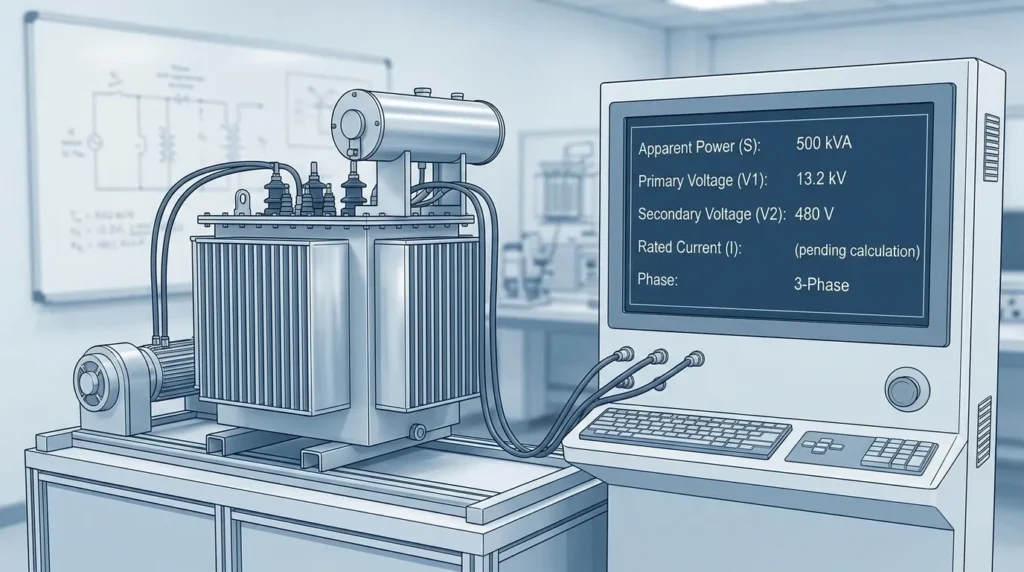
Transformer rating calculation is the process of determining the amount of electrical power a transformer can safely deliver under normal operating conditions. The transformer rating is usually expressed in kilovolt-amperes (kVA) rather than kilowatts (kW) because a transformer transfers both active and reactive power.
A transformer’s rating depends on factors such as:
- Supply voltage
- Load current
- Number of phases
- Cooling method
- Temperature rise
- Operating conditions
Simply put, transformer rating calculation helps you choose the correct transformer size for a specific electrical load.
Practical Example
Suppose a workshop requires 80 A at 415 V using a three-phase supply. Before purchasing a transformer, an engineer calculates the required transformer rating to ensure it can safely supply the equipment without overheating or becoming overloaded.
Transformer Rating Calculation Working Principle
The transformer rating calculation working principle is based on the relationship between voltage, current, and apparent power.
A transformer does not generate electrical energy. Instead, it transfers electrical power from one circuit to another using electromagnetic induction.
The transformer rating indicates the maximum apparent power it can continuously deliver without exceeding its designed temperature limits.
Step-by-Step Working Principle
- Determine the supply voltage.
- Measure or estimate the load current.
- Identify whether the system is single-phase or three-phase.
- Apply the appropriate transformer rating formula.
- Select the nearest standard transformer size above the calculated value.
Simple Analogy
Think of a transformer like a water pipe.
- Voltage is similar to water pressure.
- Current is similar to water flow.
- Transformer rating represents the maximum amount of water the pipe can safely carry.
If too much water flows through a small pipe, it may burst. Likewise, an undersized transformer may overheat and fail.
Why Are Transformers Rated in kVA Instead of kW?
This is one of the most common questions asked by electrical students.
Transformers are rated in kVA (kilovolt-amperes) because their heating depends mainly on:
- Voltage
- Current
The transformer does not know the power factor of the connected load. Since power factor varies depending on the type of equipment, manufacturers rate transformers in apparent power (kVA), not real power (kW).
Relationship Between kW and kVA
kW = kVA × Power Factor
For example:
- Transformer Rating = 100 kVA
- Power Factor = 0.8
Output Power:
100 × 0.8 = 80 kW
Transformer Rating Calculation Formula
Single-Phase Transformer Formula
kVA = (Voltage × Current) ÷ 1000
Example
Voltage = 240 V
Current = 100 A
kVA = (240 × 100) ÷ 1000
= 24 kVA
A 25 kVA transformer would normally be selected.
Three-Phase Transformer Formula
kVA = (√3 × Voltage × Current) ÷ 1000
Where:
- √3 = 1.732
- Voltage = Line Voltage
- Current = Line Current
Example
Voltage = 415 V
Current = 100 A
kVA = (1.732 × 415 × 100) ÷ 1000
= 71.88 kVA
The nearest standard transformer size would usually be 75 kVA.
Step-by-Step Transformer Rating Calculation
Step 1
Determine the supply voltage.
Example:
- 230 V (Single Phase)
- 415 V (Three Phase)
Step 2
Determine the expected load current.
Example:
80 A
Step 3
Identify the electrical system.
- Single Phase
- Three Phase
Step 4
Apply the correct formula.
Step 5
Choose the next higher standard transformer rating.
Always allow extra capacity for future load expansion.
Standard Transformer Ratings
Manufacturers produce transformers in standard sizes.
Common ratings include:
- 5 kVA
- 10 kVA
- 15 kVA
- 25 kVA
- 50 kVA
- 75 kVA
- 100 kVA
- 160 kVA
- 250 kVA
- 500 kVA
- 750 kVA
- 1000 kVA
- 1500 kVA
- 2500 kVA
Choosing a standard rating reduces cost and improves availability.
Types of Transformer Rating
Dry-Type Transformer Rating
Dry-type transformers use air for cooling.
They are commonly installed inside buildings where fire safety is important.
Suitable for:
- Schools
- Hospitals
- Offices
- Shopping malls
Oil-Immersed Transformer Rating
Oil-filled transformers use insulating oil for cooling.
They are widely used outdoors because they can handle larger loads.
Common applications include:
- Industries
- Electrical substations
- Power distribution
Distribution Transformer Rating
Distribution transformers usually range from 25 kVA to 500 kVA.
They supply electricity to homes, shops, and small industries.
Power Transformer Rating
Power transformers typically exceed 500 kVA.
They are used in transmission networks and large industrial plants where high electrical power is required.
Main Components That Affect Transformer Rating
Several components influence how much electrical load a transformer can safely carry.
Core
The laminated steel core provides a path for magnetic flux.
A larger and better-designed core improves efficiency and supports higher power ratings.
Primary Winding
The primary winding receives electrical energy from the input supply.
Its conductor size affects the current-carrying capacity.
Secondary Winding
The secondary winding delivers power to the connected load.
It must be designed to handle the rated output current safely.
Insulation System
High-quality insulation prevents electrical breakdown between windings and increases transformer reliability.
Cooling System
Cooling methods such as air cooling or oil cooling remove heat generated during operation.
Efficient cooling allows transformers to operate safely at their rated capacity for long periods.
Transformer Tank
In oil-filled transformers, the tank protects internal components and holds insulating oil that helps with cooling and insulation.
Advantages of Transformer Rating Calculation
Accurate transformer rating calculation offers many benefits for electrical systems. It helps engineers select the correct transformer size, improves efficiency, and ensures reliable operation.
Improved Safety
A correctly rated transformer operates within its designed limits, reducing the risk of overheating, insulation failure, and electrical fires.
Better Energy Efficiency
An accurately sized transformer minimizes power losses and improves overall system efficiency, leading to lower electricity costs.
Longer Equipment Life
Operating a transformer within its rated capacity reduces mechanical and thermal stress, extending the lifespan of the transformer and connected equipment.
Cost Savings
Selecting the right transformer avoids unnecessary spending on oversized equipment while preventing expensive repairs caused by overloaded transformers.
Reliable Power Supply
A properly rated transformer provides stable voltage and dependable performance for residential, commercial, and industrial applications.
Supports Future Expansion
Engineers often include a safety margin during transformer rating calculation, allowing additional loads to be connected later without replacing the transformer immediately.
Disadvantages / Limitations
Although transformer rating calculation is essential, there are some practical limitations to consider.
- Incorrect load estimation can result in selecting the wrong transformer size.
- Future load growth may require transformer replacement if additional capacity is not considered.
- Environmental factors such as high ambient temperatures can reduce the effective transformer capacity.
- Harmonic-producing loads may require special transformer designs.
- Oversized transformers increase installation and operating costs.
- Undersized transformers may overheat, reducing efficiency and service life.
Proper planning and accurate calculations help overcome these limitations.
Transformer Rating Calculation Applications
Transformer rating calculation applications are found in nearly every electrical installation, from small homes to large power systems.
Residential Applications
- Home electrical distribution
- Solar power systems
- Backup generators
- Electric vehicle charging systems
Commercial Applications
- Office buildings
- Shopping malls
- Hospitals
- Hotels
- Educational institutions
Industrial Applications
- Manufacturing plants
- Production lines
- Motor control centers
- Welding equipment
- Large compressors
- Industrial automation systems
Utility Applications
- Distribution substations
- Transmission substations
- Renewable energy plants
- Wind farms
- Solar farms
- Smart grid systems
Modern Technology Applications
- Data centers
- Cloud computing facilities
- AI infrastructure
- Battery energy storage systems
- Electric vehicle charging stations
Difference Between Transformer Rating Calculation and Load Calculation
Many beginners confuse these two concepts. Although related, they serve different purposes.
| Feature | Transformer Rating Calculation | Load Calculation |
|---|---|---|
| Purpose | Determines transformer size | Determines total electrical demand |
| Unit | kVA | kW, VA, or Amps |
| Used For | Selecting transformers | Designing electrical systems |
| Includes Safety Margin | Yes | Usually No |
| Based On | Voltage and Current | Connected electrical equipment |
| Main Goal | Safe transformer operation | Accurate load estimation |
Load calculation is usually performed first. The transformer rating is then selected based on that calculated load.
Selection Guide
Choosing the correct transformer involves more than simply applying a formula.
Know Your Load
Calculate the total connected electrical load before selecting a transformer.
Identify the System Type
Determine whether your system is:
- Single-phase
- Three-phase
The formula changes depending on the system.
Consider Future Expansion
Leave approximately 20–25% spare capacity if future equipment may be added.
Check the Cooling Method
Choose between:
- Dry-type transformer
- Oil-immersed transformer
The installation environment often determines the best choice.
Verify Voltage Ratings
Ensure both primary and secondary voltages match your electrical system.
Consider Installation Location
Outdoor installations generally require weather-resistant transformers, while indoor installations often use dry-type transformers.
Tips for Beginners
- Always calculate the maximum expected load.
- Never select a transformer smaller than the calculated requirement.
- Use standard transformer ratings whenever possible.
- Consider power factor when converting between kW and kVA.
- Follow local electrical standards and manufacturer recommendations.
Common Problems & Solutions (FAQs)
1. Why is my transformer overheating?
Possible Causes:
- Overloading
- Poor ventilation
- High ambient temperature
- Faulty cooling system
Solution:
Reduce the load, improve ventilation, inspect the cooling system, and ensure the transformer is operating within its rated capacity.
2. Why are transformers rated in kVA instead of kW?
Because transformer losses depend mainly on voltage and current, not the load power factor.
3. Can I use a larger transformer than required?
Yes. A slightly larger transformer provides additional capacity for future expansion. However, an excessively oversized transformer increases cost and may operate less efficiently at very light loads.
4. How much safety margin should I include?
Most engineers recommend keeping 20–25% spare capacity for future load growth and unexpected demand.
5. What happens if a transformer is undersized?
An undersized transformer may:
- Overheat
- Experience excessive voltage drop
- Trip protective devices
- Have a shorter service life
- Fail prematurely
6. Does power factor affect transformer rating calculation?
Transformer ratings are expressed in kVA, which is independent of power factor. However, power factor is important when converting between kVA and kW.
7. Which formula is used for three-phase transformer rating calculation?
The standard formula is:
kVA = (√3 × Voltage × Current) ÷ 1000
This formula is widely used for three-phase electrical systems.
Future Trends
Transformer technology continues to evolve as power systems become smarter and more energy efficient.
Smart Transformers
Modern smart transformers use sensors and communication systems to monitor temperature, voltage, current, and load in real time.
Digital Monitoring
Cloud-based monitoring allows engineers to detect faults early and schedule preventive maintenance before failures occur.
Eco-Friendly Transformers
Manufacturers are developing transformers with biodegradable insulating fluids and environmentally friendly materials to reduce environmental impact.
Higher Energy Efficiency
New core materials and improved winding designs reduce energy losses and improve transformer performance.
Renewable Energy Integration
Transformer rating calculations are becoming increasingly important for integrating solar farms, wind power plants, battery storage systems, and electric vehicle charging infrastructure into modern power grids.
Artificial Intelligence and Predictive Maintenance
AI-powered monitoring systems can analyze transformer operating data, predict failures, and optimize maintenance schedules, improving reliability while reducing operating costs.
Conclusion
Understanding Transformer Rating Calculation is essential for anyone working with electrical systems. A correctly rated transformer improves safety, increases efficiency, reduces energy losses, and ensures reliable operation in residential, commercial, and industrial applications. By learning the correct formulas for single-phase and three-phase systems, understanding the transformer rating calculation working principle, and considering factors such as future load growth, cooling methods, and operating conditions, engineers can select the most suitable transformer for any project. Whether you are a student learning the basics or an experienced technician designing electrical installations, mastering transformer rating calculation is a valuable skill that supports safe, efficient, and cost-effective power distribution. Continue practicing calculations with real-world examples to build confidence and improve your electrical engineering knowledge.