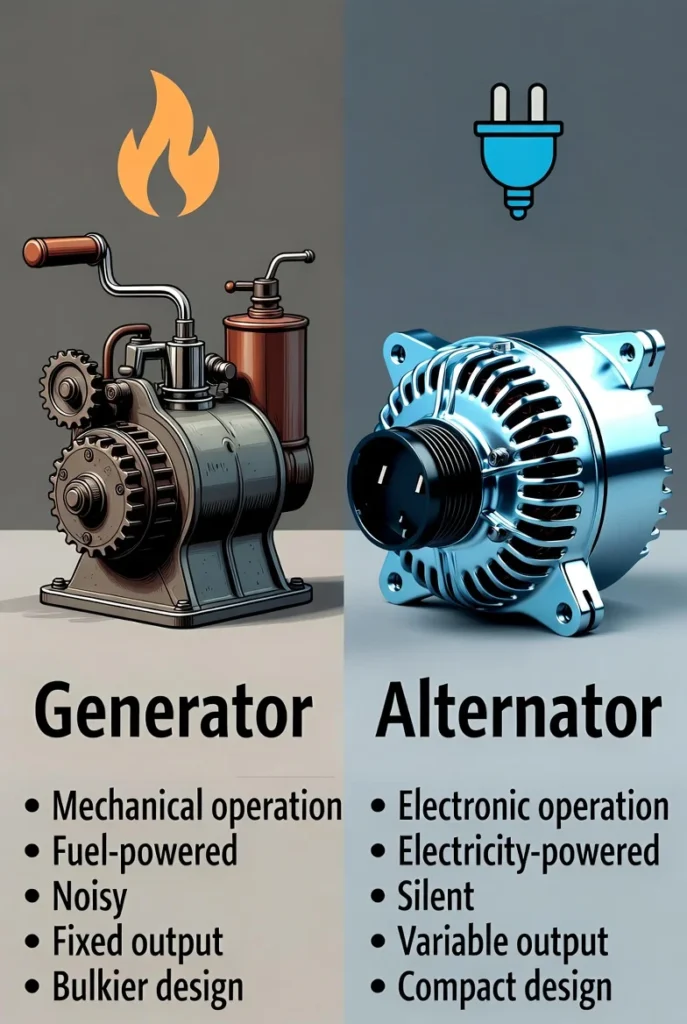

Imagine driving an old classic car on a long road trip. The battery starts draining because the lights, radio, and wipers are on, but the engine is idling at a stoplight. In older vehicles with a generator, charging might be weak or stop at low speeds, risking a dead battery. Switch to a modern car with an alternator, and it keeps charging efficiently even at idle, powering everything smoothly. This everyday scenario shows why understanding the difference between a generator and an alternator matters so much.
The topic of generator vs alternator is key in electrical engineering and automotive work. Both convert mechanical energy to electrical energy, but their designs lead to big differences in performance, efficiency, and use. Knowing these helps students, engineers, technicians, and beginners choose the right device, avoid common mistakes, and improve systems safely.
In this article, you’ll learn clear definitions, the generator vs alternator working principle, types, main components, advantages and disadvantages, applications, and a direct comparison. We’ll cover selection tips, troubleshooting, and future trends. By the end, you’ll confidently explain and apply these concepts in real projects or repairs
What is Generator vs Alternator?
Generator vs alternator refers to two devices that produce electricity from mechanical motion, but they differ mainly in output type and design.
A generator is a broad term for any machine converting mechanical energy into electrical energy. It can produce direct current (DC) or alternating current (AC). In common use, especially older contexts, “generator” often means a DC generator or dynamo.
An alternator is a specific type of generator that always produces alternating current (AC). It uses a rotating magnetic field around stationary windings.
A practical example: In a car, the alternator charges the battery and powers accessories while the engine runs. An old tractor might use a DC generator for similar tasks, but with less efficiency at low speeds.
Working Principle
The generator vs alternator working principle relies on electromagnetic induction: moving a conductor in a magnetic field creates current.
Both use Faraday’s law, but the setup differs.
Think of a bicycle dynamo (a small generator). Pedaling spins wires in a fixed magnet field, lighting the bulb.
- Generator (DC type): The armature (wire coils) rotates inside a stationary magnetic field. This induces AC in the armature. A commutator (split rings) and brushes flip connections to make DC output. Like switching direction to keep current one way.
- Alternator: The rotor (with electromagnets) spins inside a stationary stator (wire coils). This creates AC directly in the stator. Slip rings and brushes supply power to the rotor field. Diodes rectify AC to DC if needed (like in cars).
Step-by-step for alternator:
- Engine spins rotor.
- Rotor creates rotating magnetic field.
- Field cuts stator coils, inducing AC.
- Rectifier converts to DC for battery/loads.
This design makes alternators more efficient.
Types / Classification
Generators and alternators come in types based on use, output, and design.
DC Generators
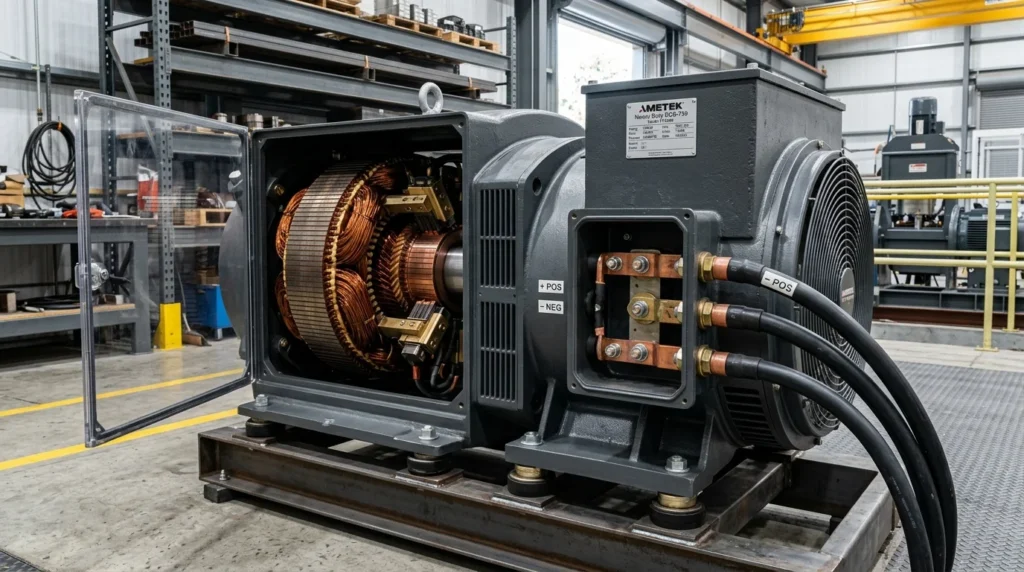
A DC generator (Direct Current generator) is an electrical machine that converts mechanical energy into direct current (DC) electrical energy. It works on the principle of electromagnetic induction, which states that when a conductor moves in a magnetic field, an electric current is induced in it. DC generators are widely used in battery charging, electroplating, welding, and small power applications where DC supply is required.
The main components of a DC generator include the armature, field system, commutator, and brushes. The armature is the rotating part where electricity is generated. The field system provides a magnetic field, either using permanent magnets or electromagnets. The commutator is a key part that converts the alternating current (produced inside the armature) into direct current. Brushes help transfer the current from the rotating commutator to the external circuit.
When the armature rotates inside the magnetic field, it cuts the magnetic lines of force, and an electromotive force (EMF) is induced. This generated current is collected and supplied as DC output. The direction of current remains the same due to the action of the commutator.
There are different types of DC generators, such as series, shunt, and compound generators, based on how the field winding is connected. Each type is used for specific applications depending on voltage and load requirements.
DC generators are used in applications like charging batteries, powering DC motors, supplying excitation to alternators, and laboratory experiments. They are also used in special industrial processes where stable DC supply is required.
However, DC generators have some limitations. They require regular maintenance due to brush and commutator wear, and they are less efficient compared to modern AC systems. Because of these drawbacks, they are less commonly used in large-scale power generation today.
Overall, a DC generator is an important electrical machine that provides reliable DC power by converting mechanical energy into electrical energy using electromagnetic principles.
These produce direct current. Common in older vehicles or simple setups. They use commutators for DC output.
AC Generators (Synchronous)
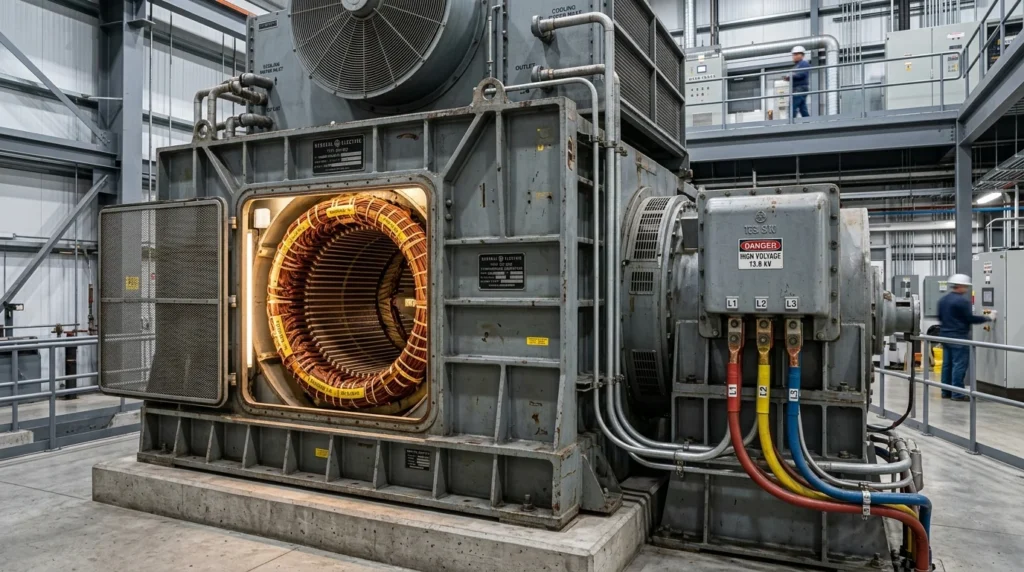
An AC generator (Synchronous generator) is an electrical machine that converts mechanical energy into alternating current (AC) electrical energy. It is one of the most important machines used in power plants for large-scale electricity generation. These generators work on the principle of electromagnetic induction, where a changing magnetic field inside a coil induces an alternating voltage.
In a synchronous generator, the rotor rotates at a constant speed called synchronous speed, which is directly related to the frequency of the AC output. The main components include the stator, rotor, field winding, and armature winding. The stator is the stationary part where AC voltage is produced, while the rotor produces a magnetic field either through DC excitation or permanent magnets.
When the rotor rotates inside the stator, it creates a rotating magnetic field that cuts the stator windings. This induces alternating voltage in the stator coils, producing AC electricity. The frequency of the output depends on the speed of rotation and the number of poles in the generator.
There are mainly two types of rotors used in synchronous generators: salient pole rotors and cylindrical rotors. Salient pole rotors are used in low-speed applications like hydroelectric plants, while cylindrical rotors are used in high-speed steam turbine generators.
Synchronous generators are widely used in power stations such as thermal, hydro, nuclear, and wind power plants. They are preferred because they produce stable frequency and high-quality electrical power suitable for transmission and distribution systems.
One of the main advantages of AC synchronous generators is their high efficiency, reliability, and ability to generate large amounts of power. However, they require precise speed control and complex excitation systems, which can increase cost and maintenance requirements.
Overall, AC synchronous generators are essential machines in modern power systems, playing a key role in generating the majority of the world’s electrical energy efficiently and reliably.
Large power plants use these. They produce AC at fixed frequency, matching grid needs.
Automotive Alternators
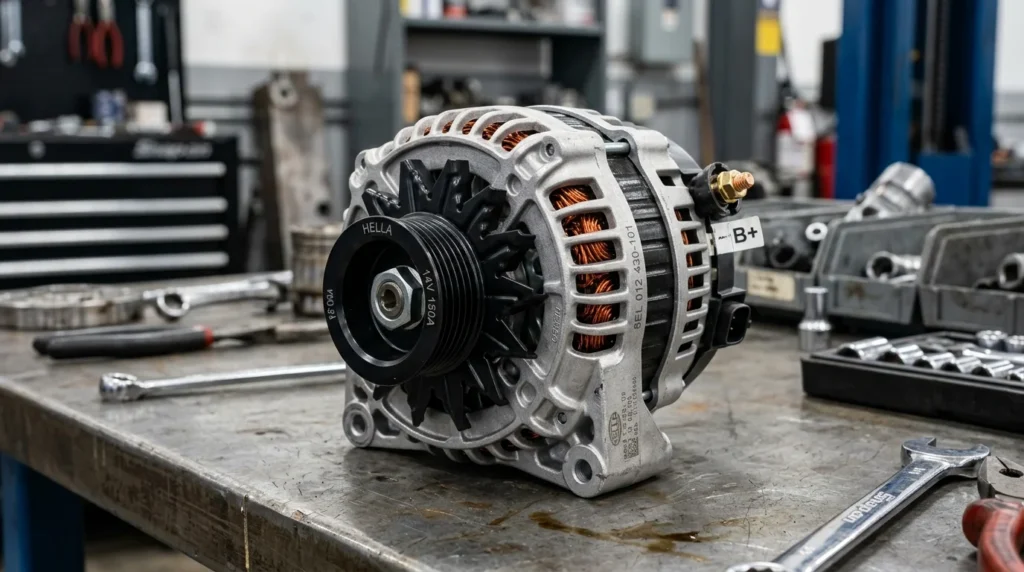
An automotive alternator is an electrical device used in vehicles to generate alternating current (AC) and then convert it into direct current (DC) to charge the battery and power electrical systems. It is one of the most important components in modern automobiles because it ensures continuous power supply to systems such as headlights, ignition system, air conditioning, infotainment systems, and sensors while the engine is running.
The alternator works on the principle of electromagnetic induction. It consists of two main parts: the rotor (rotating part) and the stator (stationary part). The rotor is supplied with DC current through slip rings, creating a magnetic field. When the engine rotates the alternator belt, the rotor spins inside the stator, producing alternating current in the stator windings.
Since vehicles require DC power, the AC produced by the alternator is converted into DC using a rectifier (diode bridge). After conversion, the output is regulated by a voltage regulator, which maintains a stable voltage level (usually around 12V or 24V depending on the vehicle system).
Automotive alternators are typically belt-driven from the engine crankshaft, meaning their output depends on engine speed. When the engine runs faster, the alternator produces more electricity. However, the voltage regulator ensures that the battery is not overcharged.
Modern alternators are compact, efficient, and capable of supplying sufficient power even when multiple electrical devices are in use. They are designed for durability and long service life under varying temperature and vibration conditions.
Overall, automotive alternators play a crucial role in vehicle electrical systems by continuously generating power, charging the battery, and supporting all electrical loads, making them essential for smooth and reliable vehicle operation.
Used in modern cars. They output AC, rectified to DC. Compact and high-output.
Brushless Alternators
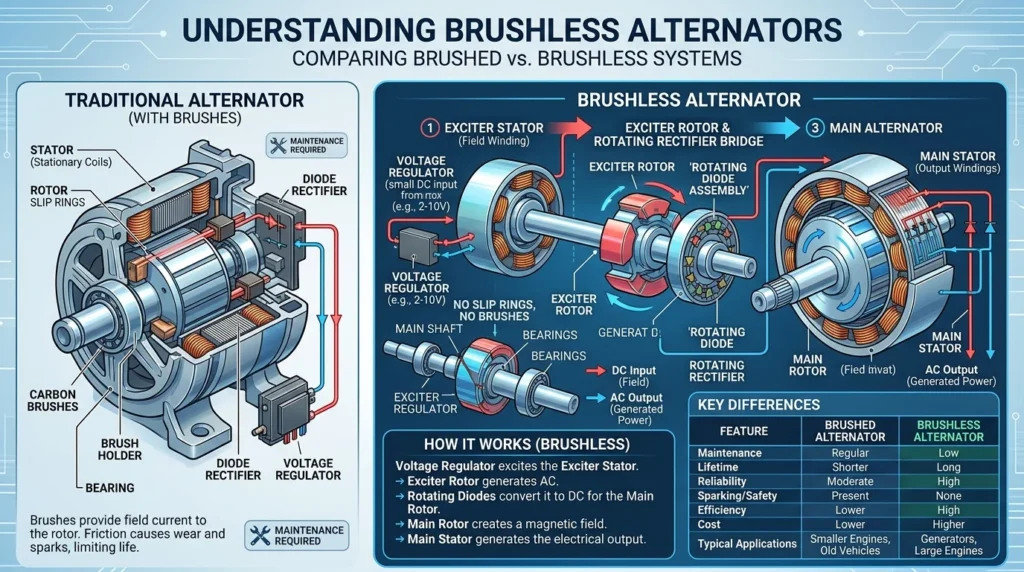
A brushless alternator is an advanced type of electrical generator used to produce alternating current (AC) without using carbon brushes or slip rings for the main power transfer. It is widely used in modern power systems, standby generators, aircraft, marine systems, and industrial applications because of its high reliability, low maintenance, and long service life.
The working principle of a brushless alternator is based on electromagnetic induction. It consists mainly of three parts: the main alternator, the exciter, and the rotating rectifier assembly. In this system, the excitation current is supplied without physical contact, which eliminates the need for brushes.
The process starts with the exciter, which generates a small amount of AC power. This AC power is then converted into DC using a rotating rectifier mounted on the rotor. The DC is supplied to the main rotor winding, creating a strong magnetic field. As the rotor spins inside the stator, it induces AC voltage in the stator windings, which becomes the output power.
One of the biggest advantages of a brushless alternator is that it does not have brushes or slip rings, which means there is no sparking, less wear and tear, and very low maintenance. This makes it highly suitable for continuous and long-term operation in critical systems.
Brushless alternators also provide high efficiency, stable voltage output, and better durability under harsh conditions such as high temperature, vibration, and dust. They are commonly used in diesel generator sets, backup power systems, and aircraft electrical systems where reliability is very important.
However, brushless alternators are more complex in design and can be more expensive compared to conventional alternators. Repairing internal components may also require skilled technicians.
Overall, brushless alternators are highly efficient and reliable machines that provide stable electrical power with minimal maintenance, making them ideal for modern industrial and power generation applications.
No brushes or slip rings. Excitation via another small generator. Low maintenance, used in industrial sets.
Permanent Magnet Alternators
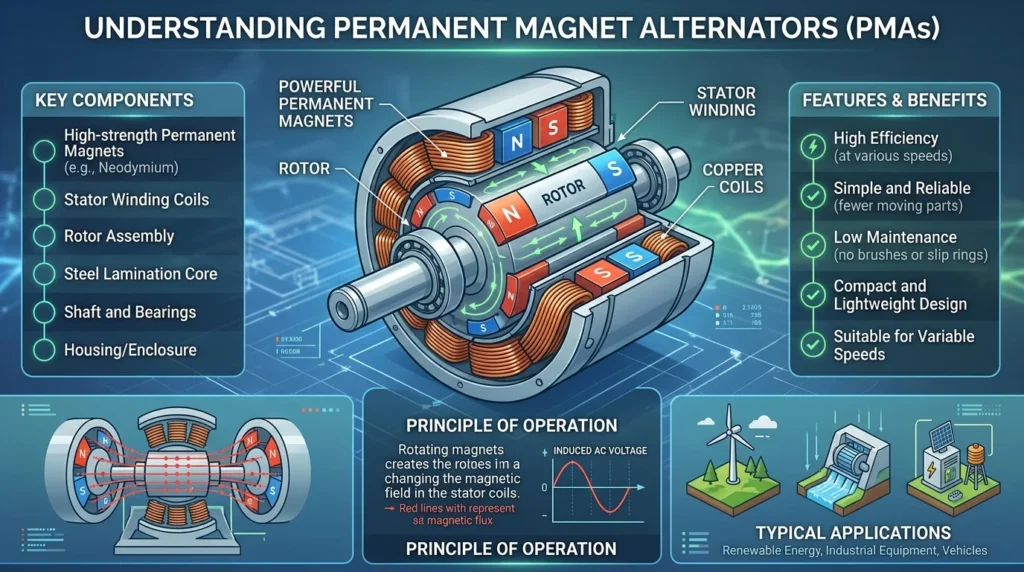
A Permanent Magnet Alternator (PMA) is an electrical machine that generates alternating current (AC) using permanent magnets to create the magnetic field instead of using external DC excitation. It is widely used in small wind turbines, hydro systems, motorcycles, bicycles, and renewable energy applications because of its simple design, high efficiency, and low maintenance requirements.
The working principle of a permanent magnet alternator is based on electromagnetic induction. It consists mainly of a stator and a rotor fitted with permanent magnets. When the rotor rotates, the magnetic field from the permanent magnets moves past the stator windings. This changing magnetic field induces an alternating voltage in the stator coils, producing AC electricity.
Unlike traditional alternators, PMAs do not require an external power source for excitation because the magnetic field is permanently present. This makes the system more efficient, especially at low speeds. The output frequency and voltage depend on the speed of rotation and the strength of the magnets used in the rotor.
Permanent magnet alternators are commonly used in renewable energy systems, especially small wind turbines and micro-hydro generators. They are also found in automotive and motorcycle charging systems, where compact size and efficiency are important. In some cases, they are used in portable generators and experimental energy systems.
One of the main advantages of PMAs is their high efficiency, simple construction, and low maintenance, since there are no brushes or external excitation systems. They also perform well at low speeds, making them suitable for wind and water energy applications.
However, PMAs also have some limitations. Their output voltage is not easily controlled, and they may require additional electronic regulation systems. Also, strong permanent magnets can increase cost, and their performance may decrease at very high temperatures.
Overall, Permanent Magnet Alternators are efficient, reliable, and simple electrical machines widely used in modern renewable energy and small-scale power generation systems.
Use strong magnets instead of electromagnets. Efficient for wind turbines or small devices.
Portable Generators
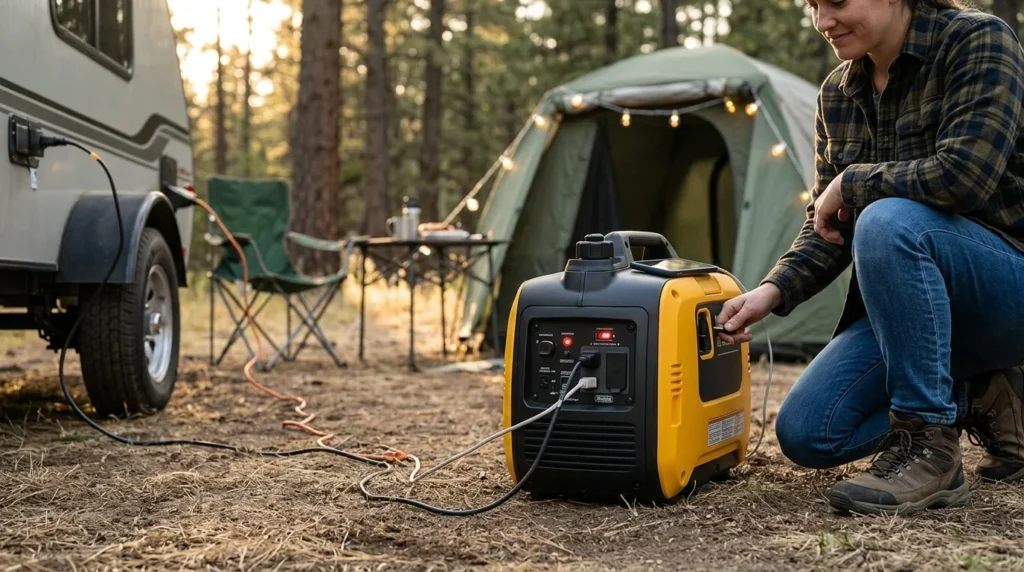
A portable generator is a compact and mobile power generation device used to supply temporary electricity during power outages or in places where grid electricity is not available. It is commonly used in homes, construction sites, outdoor events, shops, and emergency situations. Portable generators are designed for easy transport, usually having wheels and handles, making them convenient for short-term and backup power needs.
The working principle of a portable generator is based on electromagnetic induction. It converts mechanical energy into electrical energy. The generator consists of an engine (which runs on petrol, diesel, or gas), an alternator, a fuel system, a control panel, and an outlet system. When the engine runs, it rotates the alternator, which generates electricity. This electrical output is then supplied to connected appliances through sockets.
Portable generators are available in different power ratings depending on usage requirements. Small generators are used for household appliances like lights, fans, and mobile charging, while larger models can power tools, refrigerators, and even small industrial equipment.
One of the main advantages of portable generators is their mobility and convenience. They can be easily moved and used wherever power is needed. They also provide quick backup power during outages, making them very useful in emergencies. In addition, they are relatively easy to operate and maintain.
However, portable generators also have some disadvantages. They produce noise and exhaust emissions, especially fuel-based models. They also require regular fuel refilling and maintenance. Overloading the generator can cause damage or reduce its lifespan. Proper ventilation is necessary when using them indoors to avoid harmful gases like carbon monoxide.
Overall, portable generators are practical and reliable power solutions for temporary electricity needs. Their flexibility, ease of use, and emergency backup capability make them an essential tool for homes, businesses, and outdoor applications.
Combine engine and alternator (often AC output). For backup power.
Main Components
Both share basics, but details vary.
The rotor spins to create motion. In alternators, it’s the field (electromagnet); in DC generators, it’s the armature.
The stator holds windings. In alternators, it’s stationary for output; in generators, it provides the field.
Brushes and rings: Alternators use slip rings (smooth, less wear); generators use commutators (segmented, more wear).
Rectifier (diodes) in alternators converts AC to DC.
Voltage regulator controls output to match needs, preventing overcharge.
Bearings support rotation smoothly.
Housing protects parts.
Advantages
- Higher Efficiency: Alternators produce more power with less waste, especially at low speeds.
- Better Low-Speed Performance: Alternators charge batteries even at idle; generators struggle.
- Compact and Lightweight: Alternators fit modern designs better.
- Higher Output: Deliver more amps for the same size.
- Less Maintenance: Slip rings wear slower than commutators.
- Reliable Charging: Consistent voltage under varying loads.
These generator vs alternator advantages make alternators dominant today.
Disadvantages / Limitations
DC generators can self-excite without battery and handle spikes better.
Alternators need initial excitation (often from battery) and are sensitive to reverse polarity or spikes.
Generators may be simpler in basic setups but heavier and larger.
Both require mechanical drive, so no output when stopped.
High initial cost for quality units.
Alternators need rectification, adding complexity.
Applications
In homes, portable generators (with alternators) provide backup during outages.
Industries use large AC generators for power plants or standby sets.
Modern cars rely on alternators to charge batteries and run electronics.
Trucks and heavy vehicles use high-output alternators.
Renewable energy: Wind turbines use permanent magnet alternators.
Aviation: Some older planes used generators; modern ones prefer alternators.
Comparison Section
Here’s a clear table comparing generator (focusing on DC type) vs alternator:
| Feature | Generator (DC) | Alternator (AC, often rectified) |
| Output Current | DC | AC (converted to DC) |
| Rotating Part | Armature | Rotor (field) |
| Stationary Part | Field magnets | Stator windings |
| Commutator/Slip Rings | Commutator (high wear) | Slip rings (low wear) |
| Efficiency | Lower | Higher |
| Low-Speed Output | Poor | Good |
| Size/Weight | Larger/heavier | Smaller/lighter |
| Maintenance | Higher (brush/commutator) | Lower |
| Output Power | Lower for size | Higher for size |
The difference between generator and alternator is clear: alternators win in most modern uses.
Selection Guide
Choose based on needs. For vehicles, pick alternator for better charging.
For backup power, select generator set with alternator head for AC output.
Calculate required amps: Add loads like lights, fridge.
Consider speed range: Alternators suit variable RPM.
For beginners, start with automotive alternators – easy to find and understand.
Check voltage (12V/24V) and mounting.
Look for brushless if low maintenance is key.
Always match to engine power.
Common Problems & Solutions
Q: No charging at idle?
A: Likely generator issue. Upgrade to alternator or check regulator.
Q: Battery drains while running?
A: Faulty rectifier in alternator. Test diodes; replace if bad.
Q: Noisy operation?
A: Worn bearings or loose belt. Inspect and tighten/replace.
Q: Overcharging battery?
A: Bad voltage regulator. Replace it.
Q: Sparks or wear?
A: Commutator problem in generator. Clean or switch to alternator.
Q: Low output?
A: Weak field excitation. Check connections and regulator.
These fix most issues quickly.
Future Trends
Alternators evolve with permanent magnets for higher efficiency and no excitation needs.
Brushless designs grow in renewables and EVs.
Smart regulators with sensors optimize charging.
Integration with hybrid systems blends alternator functions with motors.
Efficiency pushes toward higher outputs in smaller packages.
The shift continues to alternators in all sectors.
Conclusion
We’ve explored generator vs alternator, from basics and working principles to types, components, advantages and disadvantages, and applications. Alternators outperform in efficiency, size, and modern needs, while generators suit specific legacy or simple cases.
As a senior electrical engineer, I’ve seen alternators transform vehicle and backup systems. Start small – test a car alternator or study diagrams. Hands-on work builds real skill.
Keep learning; the electrical field advances fast. Master these basics, and you’ll handle power challenges with confidence