
Picture yourself pedaling a bicycle with a dynamo light attached to the wheel. As you pedal faster, the light gets brighter. Slow down, and it dims. Stop pedaling, and the light goes out. This simple real-life example shows electromagnetic induction at work – motion creates changing magnetic fields that produce electricity to light the bulb.
Faraday’s law is the foundation of how we generate most of the world’s electricity. It explains why generators produce power, transformers change voltages, and many devices work. Without understanding this law, modern electrical systems, from power plants to phone chargers, would not exist. It’s essential for electrical students, engineers, technicians, and beginners because it connects basic physics to real-world technology.
In this article, you’ll learn what Faraday’s law is, its working principle, key ideas like magnetic flux, applications, and practical insights. We’ll cover Faraday’s law working principle step-by-step, real-world uses, advantages and disadvantages in context, and tips for beginners. By the end, you’ll see how this 19th-century discovery powers today’s world and why it’s worth mastering.
What is Faraday’s Law?
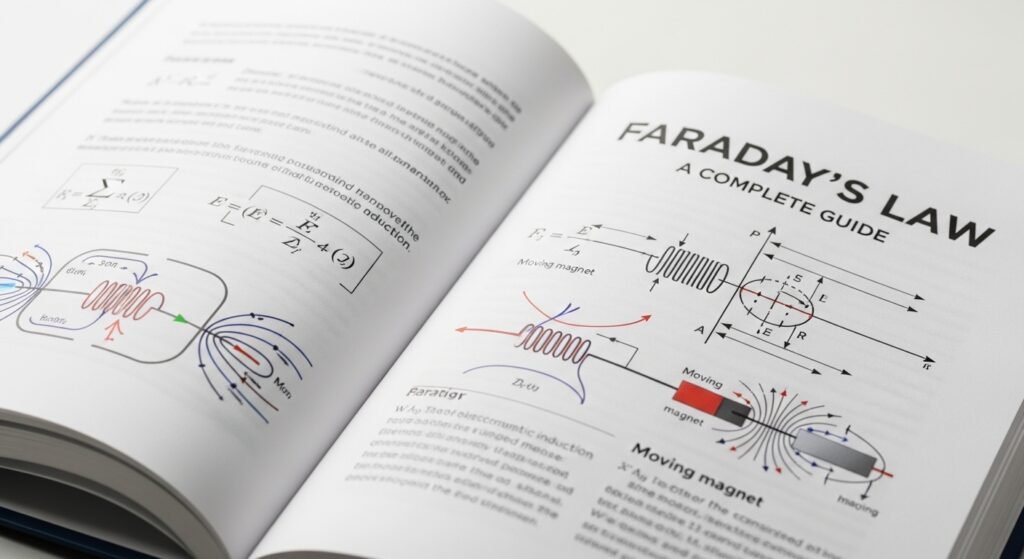
Faraday’s law, or Faraday’s law of electromagnetic induction, states that a changing magnetic field induces an electromotive force (EMF or voltage) in a conductor or circuit.
In simple words, when magnetic lines passing through a loop change – by moving a magnet, changing field strength, or altering the loop – it creates voltage. If the circuit is closed, current flows.
A practical example is dropping a strong magnet through a copper coil connected to a bulb. As the magnet falls, the bulb flashes briefly. The changing magnetic field through the coil induces voltage, lighting the bulb. This shows induction in action without batteries or wires from a power source.
Working Principle
The Faraday’s law working principle is based on magnetic flux change producing induced EMF. Magnetic flux is the amount of magnetic field passing through an area, like water flow through a pipe.
Think of flux like sunlight through a window. More light (stronger field or larger area) means more flux. If you move the curtain (change flux), the room brightness changes quickly.
Step-by-step:
- Magnetic Flux Definition: Flux Φ = B × A × cosθ, where B is field strength, A is area, θ is angle between field and area normal.
- Change in Flux: Flux changes if B varies, A changes, or θ changes (like rotating coil).
- Induced EMF: EMF = – (change in flux) / time. Faster change means higher voltage. The negative sign (Lenz’s law) shows opposition to change.
- Current Flow: In closed loop, EMF drives current. Direction opposes flux change.
Bullet points for ways to induce EMF:
- Move magnet toward/away from coil.
- Change magnetic field strength (turn electromagnet on/off).
- Rotate coil in fixed field (like generator).
- Change coil area (expand/contract loop).
This principle powers generators and more.
Types / Classification
Faraday’s law has two main statements, often called Faraday’s laws of electromagnetic induction.
Faraday’s First Law
Whenever magnetic flux linked with a circuit changes, an EMF is induced. The EMF lasts as long as flux changes. If circuit closes, current flows. This qualitative law comes from Faraday’s experiments with magnets and coils.
Faraday’s Second Law
The magnitude of induced EMF equals the rate of change of magnetic flux linkage. For N turns, EMF = -N × (dΦ/dt). This quantitative law gives exact voltage calculation. Flux linkage is N × Φ for multi-turn coils.
Some sources combine them as one law with Lenz’s rule for direction.
Main Components
Faraday’s law involves key elements in setups.
Magnetic field source: Permanent magnet, electromagnet, or Earth’s field provides B.
Conductor or coil: Wire loop or multi-turn coil where EMF induces. More turns increase EMF.
Area enclosed: Larger surface captures more flux.
Galvanometer or load: Detects or uses induced current.
In generators: Rotating coil (armature), stationary magnets (field), slip rings/commutator for output.
In transformers: Two coils on iron core; changing current in primary changes flux, inducing in secondary.
These parts turn flux change into useful electricity.
Advantages
- Enables Power Generation: Most electricity comes from generators using this law.
- Efficient Energy Conversion: Mechanical to electrical without direct contact.
- Versatile: Works in many setups – rotation, linear motion, varying fields.
- Scalable: From tiny sensors to huge power plants.
- No Fuel in Some Cases: Renewable sources like wind/hydro use it cleanly.
- Foundation for Devices: Transformers step voltage up/down efficiently.
These make Faraday’s law advantages huge in electrical engineering.
Disadvantages / Limitations
Faraday’s law requires changing flux – no static field produces EMF.
Induced EMF opposes change (Lenz’s law), creating drag or back torque in machines.
Efficiency losses from resistance, eddy currents, hysteresis in cores.
In small setups, weak fields give tiny voltages hard to use.
Direction and magnitude depend on setup – needs careful design.
Over time, mechanical wear in moving parts reduces reliability.
Applications
Faraday’s law applications power daily life.
In homes: Induction cooktops heat pots directly via changing fields.
Industry: Electric generators in power plants convert turbine motion to electricity.
Transformers step voltage for transmission and distribution.
Electric motors (reverse process) use induction principles.
Modern tech: Wireless charging pads, guitar pickups, electromagnetic flowmeters.
Renewables: Wind turbines and hydroelectric generators rely on it.
Comparison Section
Faraday’s law differs from other induction or related concepts. Here’s a table:
| Aspect | Faraday’s Law | Lenz’s Law | Ampere’s Law |
| Focus | Magnitude of induced EMF | Direction opposes change | Magnetic field from current |
| Equation | EMF = -dΦ/dt (or -N dΦ/dt) | Included in negative sign | ∮ B · dl = μ₀ I |
| Use | Calculate voltage/current | Determine current direction | Calculate fields around wires |
| Key Feature | Rate of flux change | Conservation of energy | Current produces magnetism |
The difference between Faraday’s law and Lenz’s law is magnitude vs direction.
Selection Guide
“Selecting” Faraday’s law means applying it correctly in designs.
For beginners: Start with simple coil-magnet experiments to see induction.
Choose setups: Use multi-turn coils for stronger EMF.
Calculate needs: Know required voltage – more turns or faster change helps.
For generators: Pick rotating coil for steady output.
In transformers: Select core material to reduce losses.
Tips: Always consider Lenz’s opposition – add load to test.
Practice with simulations or kits before real projects.
Common Problems & Solutions
Q: No induced voltage in coil experiment?
A: Flux not changing – move magnet faster or use stronger one.
Q: Very small EMF observed?
A: Few turns or slow change. Add turns or increase speed/field.
Q: Induced current direction confusing?
A: Use right-hand rule or remember opposes change (Lenz).
Q: Overheating in transformer?
A: Eddy currents – use laminated core to reduce.
Q: Generator not producing enough power?
A: Low RPM or weak field. Increase speed or field strength.
These solve typical setup issues.
Future Trends
Faraday’s law drives advances in wireless power transfer and efficient generators.
Superconducting materials reduce losses in high-field setups.
Nanogenerators harvest tiny motions for wearables.
Integration with AI optimizes flux changes in smart grids.
Renewable focus: Better wind/hydro designs for higher efficiency.
The law remains core as we move to sustainable, smart energy.
Conclusion
Faraday’s law explains how changing magnetic flux induces EMF, powering generators, transformers, and induction devices. We’ve covered its definition, working principle, applications, and practical aspects like advantages and disadvantages.
As a senior electrical engineer, I’ve used this law in countless designs – from fixing generators to teaching juniors. It turns abstract physics into real power. Start experimenting: Grab a coil, magnet, and multimeter.
Master Faraday’s law, and you’ll understand electricity’s heart. Keep exploring – the future of energy builds on this foundation.
Learn Faraday’s law of electromagnetic induction, working principle, applications, advantages and disadvantages in this complete guide.