
Imagine you switch off a transformer or motor, yet it still behaves as if a tiny magnetic force is present inside it. This is not a fault—it is a natural phenomenon called residual magnetism. In practical electrical work, this small leftover magnetism can have a big impact, especially in machines like generators, transformers, and relays.
Residual magnetism plays a critical role in starting generators, maintaining magnetic memory in materials, and even influencing measurement accuracy in sensitive instruments. Many beginners overlook this concept, but experienced engineers know that understanding it can prevent system failures and improve performance.
In this article, you will learn what residual magnetism is, how it works, its types, advantages, limitations, and real-world applications. We will also cover practical troubleshooting and future trends, so you can confidently apply this concept in electrical engineering projects.
Residual Magnetism
Residual magnetism is the small amount of magnetism that remains in a magnetic material even after the external magnetizing force has been removed. In electrical machines like generators and motors, this phenomenon plays an important role in their operation, especially during the starting process. Residual magnetism occurs because magnetic materials such as iron or steel do not completely lose their magnetic properties when the magnetizing current is switched off. A part of the magnetic alignment of domains inside the material remains, creating a weak but useful magnetic field. This concept is closely related to Magnetic Hysteresis, which explains how magnetic materials retain some magnetization after the external field is removed.
In practical applications, residual magnetism is very important in self-excited generators. When a generator starts rotating, the small residual magnetic field in the poles produces a tiny voltage in the armature windings. This initial voltage helps to build up the field current, which gradually increases the magnetic field strength and leads to full voltage generation. Without residual magnetism, the generator would fail to build up voltage on its own and may require external excitation. This is why maintaining residual magnetism in generator poles is essential for proper operation.
However, residual magnetism can sometimes be lost due to long periods of inactivity, mechanical shocks, or incorrect connections. In such cases, the generator may not produce any output voltage. To restore it, a process called “field flashing” is used, where a small DC voltage is applied to the field winding to re-establish magnetism.
Overall, residual magnetism is a small but crucial property of magnetic materials that ensures the smooth starting and operation of electrical machines. It helps in voltage build-up, reduces dependency on external sources, and supports reliable performance in generators and other electromagnetic devices.
What is Residual Magnetism?
Residual magnetism refers to the small amount of magnetism that remains in a magnetic material even after the external magnetic field is removed.
Simple Explanation
When a magnetic field is applied to materials like iron or steel, their internal magnetic domains align. After removing the field, some domains stay aligned, leaving behind a weak magnetic field. This remaining magnetism is called residual magnetism.
Practical Example
- In a DC generator, residual magnetism helps produce a small initial voltage when the machine starts.
- This small voltage builds up the magnetic field further, allowing the generator to function properly.
Without residual magnetism, many electrical machines would fail to start automatically.
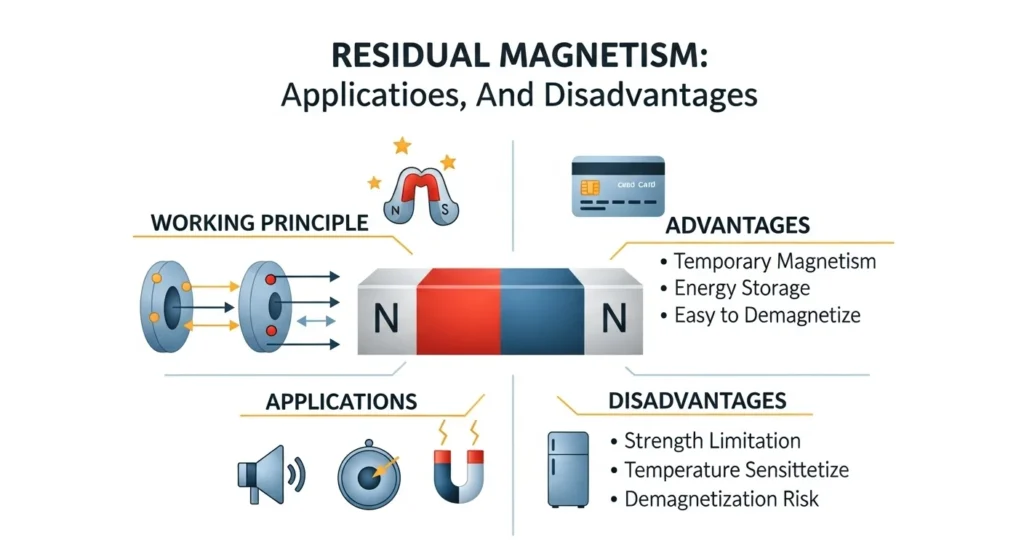
Residual Magnetism Working Principle
The residual magnetism working principle is based on the behavior of magnetic domains inside ferromagnetic materials.
Step-by-Step Explanation
- When current flows through a coil, it creates a magnetic field.
- This field aligns magnetic domains inside the core material.
- When the current is removed, not all domains return to their original random positions.
- Some domains remain aligned, creating a weak magnetic field.
Easy Analogy
Think of iron filings near a magnet:
- When the magnet is present, all filings align.
- When the magnet is removed, some filings stay slightly aligned.
- That leftover alignment represents residual magnetism.
Key Points
- Depends on material type
- Stronger in hard magnetic materials
- Weaker in soft magnetic materials
- Important for self-excited machines
Types of Residual Magnetism
Residual magnetism can be understood based on how strongly a magnetic material retains magnetization after the external magnetic field is removed. The amount of retained magnetism depends mainly on the material’s retentivity, coercivity, and magnetic properties.
1. Strong Residual Magnetism
Some magnetic materials retain a significant amount of magnetism after the external magnetic field is removed. These materials generally have high retentivity and are suitable for applications where magnetic retention is desirable.
Characteristics
- Retains magnetization for a long period.
- Has relatively high retentivity.
- Requires a stronger opposing field to demagnetize.
- Suitable for permanent magnetic applications.
Applications
- Permanent magnets
- Magnetic sensors
- Magnetic storage materials
- Magnetic holding devices
2. Weak Residual Magnetism
Some magnetic materials retain only a small amount of magnetization after the external field is removed. Soft magnetic materials are designed to magnetize and demagnetize easily, so their residual magnetism is generally low.
Characteristics
- Low residual magnetization.
- Easily demagnetized.
- Low coercivity.
- Suitable for applications involving repeated magnetization.
Applications
- Transformer cores
- Motor and generator cores
- Electromagnetic relays
- Inductors
- Contactors
3. Residual Magnetism After Magnetic Cycling
Residual magnetism can also result from repeated magnetization and demagnetization cycles. When the external magnetic field changes, the material follows a magnetic hysteresis loop. Some magnetization remains when the external field returns to zero.
This retained magnetization is known as remanent magnetization or residual magnetism.
Factors That Affect It
- Magnetic material properties
- Strength of the applied magnetic field
- Magnetic field direction
- Previous magnetization history
- Temperature
- Demagnetizing conditions
Understanding these factors is important when analyzing electrical machines, transformers, magnetic sensors, and other electromagnetic equipment.
Factors Affecting Residual Magnetism
The amount of residual magnetism in a material depends on its magnetic properties and the conditions under which it was magnetized. Several factors determine how much magnetization remains after the external magnetic field is removed.
1. Magnetic Material
The type of magnetic material has a major effect on residual magnetism. Different materials have different levels of retentivity and coercivity.
- Soft magnetic materials generally have low retentivity and are easy to demagnetize.
- Hard magnetic materials generally have higher retentivity and retain magnetization for longer periods.
For example, transformer cores are designed to minimize unwanted magnetic retention, while permanent magnets are designed to retain strong magnetization.
2. Magnetic Domains
Magnetic domains are small regions within a ferromagnetic material where atomic magnetic moments are aligned.
When an external magnetic field is applied, more domains become aligned with the field. After the external field is removed, some of these domains may remain aligned, producing residual magnetism.
The greater the retained domain alignment, the stronger the residual magnetism.
3. Retentivity
Retentivity is the ability of a magnetic material to retain magnetization after the external magnetic field has been removed.
A material with high retentivity can retain a stronger residual magnetic field, while a material with low retentivity loses most of its magnetization more easily.
Retentivity is particularly important when selecting materials for permanent magnets, electrical machine cores, and electromagnetic devices.
4. Coercivity
Coercivity is the strength of the reverse magnetic field required to reduce a material’s magnetization to zero after it has been magnetized.
Materials with high coercivity are more resistant to demagnetization. Materials with low coercivity can be demagnetized more easily.
Together, retentivity and coercivity help describe the magnetic behavior of a material and its ability to retain residual magnetism.
5. Magnetizing Field Strength
The strength of the original magnetic field can affect the amount of magnetization retained by a material.
A stronger magnetizing field can drive the material closer to magnetic saturation. After the field is removed, the material may retain a greater amount of magnetization depending on its magnetic properties.
6. Temperature
Temperature can affect the magnetic properties of materials. As temperature increases, magnetic behavior can change, and sufficiently high temperatures can significantly reduce or eliminate magnetization.
This is why temperature must be considered when designing and operating electrical machines and other magnetic devices.
7. Magnetic History
Residual magnetism depends partly on the previous magnetic conditions experienced by the material. Repeated magnetization and demagnetization can change the material’s magnetic state.
This behavior is explained by the magnetic hysteresis phenomenon and is represented using a hysteresis loop.
Understanding these factors helps engineers select appropriate magnetic materials and control unwanted residual magnetism in electrical and electromagnetic systems.
Advantages of Residual Magnetism
Residual magnetism can be useful in electrical machines and magnetic devices when it is present at an appropriate level. Some important advantages include:
- Helps self-excited generators build initial voltage by providing an initial magnetic field.
- Supports magnetic memory in materials used for certain storage and sensing applications.
- Reduces the need for an external excitation source during the initial voltage-building process of some self-excited generators.
- Provides useful magnetic retention in permanent magnetic materials and devices.
- Supports the operation of certain magnetic sensors and electromagnetic systems.
The benefits depend on the application and the magnetic properties of the material.
Disadvantages and Limitations of Residual Magnetism
Residual magnetism can also create problems when it is unwanted or stronger than expected. Common limitations include:
- Can contribute to transformer inrush current during energization when residual core flux combines with newly produced flux.
- Can affect the accuracy of sensitive magnetic measuring instruments.
- May cause unwanted magnetic interference in nearby sensitive equipment.
- Can prevent some electrical machines from behaving as expected if the retained magnetic field is excessive or improperly controlled.
- May require demagnetization or controlled switching in applications where residual magnetism causes operational problems.
How to Control Unwanted Residual Magnetism
Depending on the application, unwanted residual magnetism can be controlled by:
- Using magnetic materials with appropriate retentivity and coercivity.
- Applying suitable demagnetization techniques.
- Using controlled transformer energization methods.
- Following correct maintenance procedures for electrical machines.
- Keeping sensitive magnetic equipment properly isolated from strong magnetic fields.
Therefore, residual magnetism is neither always beneficial nor always harmful. Its effect depends on the material, magnetic history, equipment design, and application.
Residual Magnetism Applications
Residual magnetism has several important applications in electrical engineering and magnetic technology. Its effects are especially important in generators, transformers, magnetic storage, measuring instruments, and electromagnetic devices.
1. DC Generators
Residual magnetism is particularly important in self-excited DC generators. A small amount of retained magnetism in the field poles provides the initial magnetic field when the generator starts rotating.
This initial field produces a small generated voltage, which supplies current to the field winding. The stronger field then produces more voltage, allowing the generator to build up its normal output.
Key benefits:
- Helps initiate voltage buildup.
- Supports self-excitation.
- Reduces dependence on an external excitation source.
- Helps the generator start producing voltage.
2. Transformers
Residual magnetism in a transformer core can affect the magnetic flux during re-energization. If the retained flux combines unfavorably with the new flux, it can contribute to a high transformer inrush current.
This is important when designing transformer protection and controlled switching systems.
Potential effects include:
- Higher energization current.
- Temporary voltage disturbances.
- Unwanted protective-device operation.
- Additional mechanical and thermal stress.
3. Magnetic Storage
Residual magnetism is fundamental to many forms of magnetic data storage. Magnetic materials can retain different magnetic states after the external magnetic field is removed.
These retained states can be used to represent stored information.
Examples include:
- Hard disk drives.
- Magnetic tape.
- Other magnetic recording media.
The ability to retain magnetic information without continuous electrical power makes magnetic storage a form of non-volatile storage.
4. Magnetic Measuring Instruments
Residual magnetism can influence instruments that use magnetic materials or magnetic circuits. In some applications it can contribute to the instrument’s magnetic behavior, while excessive or unwanted residual magnetism can introduce measurement errors.
Sensitive instruments may therefore require suitable magnetic materials, shielding, calibration, or demagnetization procedures.
Examples include:
- Analog meters.
- Galvanometers.
- Magnetic sensors.
- Specialized measurement equipment.
5. Relays and Electromagnetic Devices
Residual magnetism can affect the operation of electromagnetic relays, contactors, solenoids, and other magnetic actuators.
In some designs, controlled magnetic retention can be useful. However, unwanted residual magnetism may prevent an armature from releasing properly after the coil is de-energized.
Therefore, the magnetic characteristics of the core and armature must be selected according to the application’s requirements.
6. Electrical Machine Testing and Maintenance
Residual magnetism is also considered during the testing and maintenance of electrical machines.
Technicians may check for retained magnetism when troubleshooting:
- Generator voltage buildup problems.
- Unexpected magnetic behavior.
- Transformer energization issues.
- Magnetic measurement errors.
When residual magnetism is unwanted, appropriate demagnetization or maintenance procedures can be used to restore the equipment to the required magnetic condition.
Why Residual Magnetism Is Important
Residual magnetism can be either useful or undesirable, depending on the application. In self-excited generators, it helps initiate voltage generation. In transformers and sensitive equipment, however, retained magnetic flux can contribute to unwanted operating effects.
Understanding where residual magnetism occurs and how it affects equipment helps electrical engineers and technicians improve system reliability, troubleshooting, and equipment design.
Comparison Section
Difference Between Residual Magnetism and Induced Magnetism
| Feature | Residual Magnetism | Induced Magnetism |
|---|---|---|
| Definition | Magnetism left after field removal | Magnetism during field presence |
| Duration | Temporary or permanent | Only while field exists |
| Strength | Weak | Strong |
| Application | Generators, cores | Electromagnets |
Selection Guide
Choosing the right material for residual magnetism is important.
Tips for Beginners
- Use soft iron for low residual magnetism applications
- Use steel for high retention needs
- Check retentivity and coercivity values
- Avoid high residual materials in precision instruments
- Consider temperature effects
Common Problems Caused by Residual Magnetism and Solutions
Residual magnetism is useful in some electrical applications, but unwanted or excessive retained magnetism can also cause operational problems. The effects depend on the type of equipment, magnetic material, and operating conditions.
1. Generator Fails to Build Voltage
A self-excited DC generator requires a small amount of residual magnetism to initiate voltage buildup. If the residual magnetism is lost or becomes insufficient, the generator may fail to produce its normal output voltage.
Common Causes
- Long periods of inactivity.
- Incorrect field connections.
- Reverse current through the field winding.
- Improper maintenance.
- Demagnetization of the field poles.
Effects
- Little or no generated voltage.
- Failure of the excitation process.
- Generator unable to supply the required load.
Solution
A qualified technician may use field flashing to restore the required magnetic field. This involves applying an appropriate DC voltage to the field winding with the correct polarity and following the generator manufacturer’s procedure.
2. Transformer Inrush Current
Residual magnetic flux in a transformer core can contribute to a high inrush current when the transformer is energized.
Common Causes
- Residual flux remaining in the transformer core.
- Switching at an unfavorable point on the AC voltage waveform.
- Core flux and newly generated flux combining in the same direction.
Effects
- High temporary current.
- Nuisance operation of protective devices.
- Temporary voltage disturbances.
- Additional mechanical and thermal stress.
Solution
Engineers can reduce the effects of residual flux by using techniques such as:
- Controlled transformer switching.
- Suitable protection settings.
- Residual-flux measurement or estimation.
- Pre-insertion or controlled switching methods where appropriate.
3. Measurement Errors
Unwanted residual magnetism can affect some magnetic measuring instruments and produce inaccurate or offset readings.
Common Causes
- Retained magnetism in magnetic components.
- Exposure to strong external magnetic fields.
- Repeated magnetic cycling.
- Improper calibration.
Effects
- Incorrect readings.
- Measurement offsets.
- Reduced accuracy in sensitive equipment.
Solution
Depending on the instrument, technicians may use appropriate demagnetization and calibration procedures. Always follow the equipment manufacturer’s instructions before applying a demagnetization method.
4. Unwanted Magnetic Interference
Residual magnetism can create unwanted magnetic fields around electrical equipment. These fields may interfere with nearby sensitive devices.
Possible Effects
- Signal interference.
- Measurement errors.
- Unwanted magnetic coupling.
- Unstable operation of sensitive equipment.
Solution
Possible methods for reducing magnetic interference include:
- Increasing the distance between sensitive equipment and magnetic sources.
- Using appropriate magnetic shielding.
- Selecting suitable magnetic materials.
- Demagnetizing components when required.
5. Electromagnetic Relay Fails to Release Properly
In some relays and contactors, unwanted residual magnetism can cause the armature to remain attracted after the coil is de-energized.
Possible Effects
- Delayed contact release.
- Contacts remaining closed.
- Unexpected switching behavior.
- Reduced equipment reliability.
Solution
The relay or contactor should be inspected for mechanical problems, incorrect components, excessive residual magnetism, or manufacturer-specific issues. Replace damaged components and follow the manufacturer’s maintenance procedure.
Important Safety Note
Do not apply field flashing, demagnetization, or other electrical procedures without confirming the equipment manufacturer’s requirements. Incorrect voltage, polarity, or connection can damage electrical equipment or create a safety hazard.
Future Trends in Residual Magnetism
Residual magnetism will remain important as electrical equipment becomes more efficient, measurable, and easier to monitor. Future developments will focus mainly on controlling, measuring, and reducing unwanted residual magnetic effects.
1. Advanced Magnetic Materials
New magnetic materials with improved retentivity, coercivity, and lower energy losses can provide better control of residual magnetism in transformers, motors, generators, and magnetic devices.
2. Better Transformer Monitoring
Modern transformer systems increasingly use sensors and monitoring equipment to detect magnetic conditions during energization. Improved residual-flux measurement can help reduce inrush current and improve protection.
3. Improved Generator Excitation Systems
Modern excitation and voltage-control systems can improve the reliability of generators that depend on residual magnetism for initial voltage buildup. Better monitoring can also help identify excitation problems earlier.
4. More Accurate Magnetic Sensors
Advances in magnetic sensing technology can make it easier to measure small levels of residual magnetism. This can improve testing, calibration, equipment maintenance, and fault diagnosis.
5. Predictive Electrical Maintenance
Residual magnetism measurements can become part of condition-monitoring programs for electrical machines and transformers. Tracking magnetic behavior over time can help maintenance teams identify abnormal conditions before they cause equipment problems.
6. Better Control of Energization
Controlled switching and improved power-system monitoring can help manage the effects of residual flux when transformers and other magnetic equipment are energized.
Overall, future developments will focus less on increasing residual magnetism itself and more on measuring, controlling, and managing it effectively in electrical and magnetic systems.
Conclusion
Residual magnetism is a small but powerful concept in electrical engineering. It plays a vital role in the operation of generators, transformers, and many magnetic devices. Understanding the residual magnetism working principle helps engineers design more reliable systems and troubleshoot issues effectively.
While it offers advantages like self-starting capability and energy efficiency, it also comes with challenges such as unwanted voltage and measurement errors. By selecting the right materials and applying proper techniques, these issues can be minimized.
For any electrical student or technician, mastering residual magnetism is essential. It not only improves technical knowledge but also enhances practical problem-solving skills in real-world applications.