
Imagine you are repairing a sensitive electronic circuit board. Everything looks fine, but after installation, the device suddenly fails. You check all connections, but the fault remains unclear. In many such cases, the real cause is electrostatic discharge (ESD)—a tiny, invisible spark from your body that damages delicate electronic components.
This is where an ESD Wrist Strap becomes essential. It is a simple but powerful safety device used by engineers, technicians, and even beginners to prevent static electricity from damaging electronic equipment.
In modern electronics, components like microchips and semiconductors are extremely sensitive. Even a small static charge that you cannot feel can permanently damage them. That’s why industries such as electronics manufacturing, repair labs, and assembly units strictly use ESD protection tools.
In this article, you will learn everything about the ESD Wrist Strap, including its working principle, types, components, advantages, applications, and how to select the right one. This guide is designed to give you practical, real-world understanding like a senior engineer explaining to a junior.
2. What is an ESD Wrist Strap?
Definition
An ESD Wrist Strap is a safety device worn on the wrist that safely discharges static electricity from the human body to the ground, protecting sensitive electronic components.
Simple Explanation
When you walk, move, or work, your body builds static charge. The wrist strap connects your body to the ground so that this charge flows away safely instead of damaging electronics.
Practical Example
If you are assembling a computer motherboard, wearing an ESD wrist strap ensures that your body does not accidentally discharge electricity into delicate circuits.
3. ESD Wrist Strap Working Principle
Understanding the ESD wrist strap working principle is very important.
Basic Concept
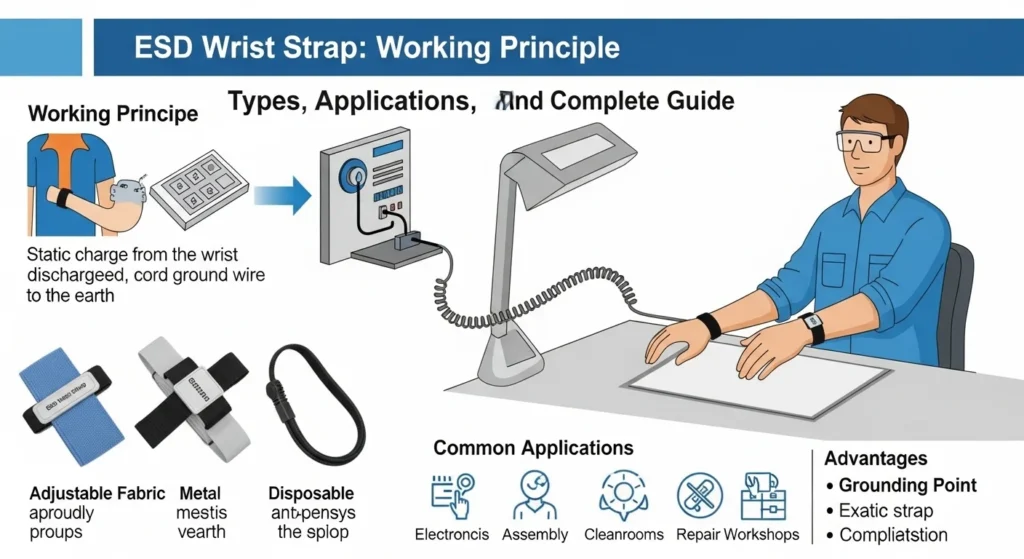
The strap provides a controlled path for static electricity to flow from your body to the earth (ground).
Step-by-Step Working
- Static charge builds up on your body
- You wear the wrist strap on your skin
- The strap connects to a grounding wire
- The wire is connected to a grounded point
- Static electricity safely flows to the ground
Important Points
- It does not allow sudden discharge
- It uses a resistor for safety
- Protects both user and equipment
Simple Analogy
Think of it like a water pipe releasing pressure slowly instead of bursting suddenly.
4. Types / Classification of ESD Wrist Straps
Metal Wrist Strap
- Made of stainless steel links
- Durable and long-lasting
- Provides strong conductivity
Fabric (Elastic) Wrist Strap
- Made of soft conductive fabric
- Comfortable for long use
- Adjustable size
Wireless ESD Wrist Strap
- Does not use a grounding wire
- Works using air ionization
- Used in special environments
Disposable Wrist Strap
- Low-cost and single-use
- Used in temporary setups
5. Main Components of ESD Wrist Strap
1. Wrist Band
- Worn around the wrist
- Made of conductive material
- Ensures skin contact
2. Grounding Cord
- Connects strap to ground
- Flexible and insulated
3. Resistor (Safety Resistor)
- Usually 1 mega-ohm
- Controls current flow
- Prevents electric shock
4. Grounding Point
- Connected to earth
- Can be a grounded outlet or mat
6. Advantages of ESD Wrist Strap
The ESD wrist strap advantages and disadvantages are important for understanding its value.
Advantages
- Protects sensitive electronic components
- Prevents costly equipment damage
- Easy to use
- Affordable safety tool
- Improves workplace safety
- Essential for electronics manufacturing
7. Disadvantages / Limitations
- Requires proper grounding
- Limited mobility due to wire
- Needs regular checking
- Not effective if worn incorrectly
8. Applications of ESD Wrist Strap
The ESD wrist strap applications are widespread in modern industries.
Home Use
- Computer assembly
- Mobile repair
- DIY electronics
Industrial Use
- Electronics manufacturing
- PCB assembly
- Semiconductor industries
Modern Technology
- Data centers
- Robotics
- Aerospace electronics
9. Comparison Section
Difference Between ESD Wrist Strap and ESD Mat
| Feature | ESD Wrist Strap | ESD Mat |
|---|---|---|
| Purpose | Protects user body | Protects work surface |
| Mobility | Limited | Fixed |
| Usage | Personal safety | Workspace safety |
| Connection | Direct to wrist | Table grounding |
10. Selection Guide
How to Choose the Right ESD Wrist Strap
- Choose comfortable material (fabric or metal)
- Check cord length
- Ensure proper grounding system
- Look for built-in resistor
- Select adjustable strap
Tips for Beginners
- Always test before use
- Ensure skin contact
- Use with ESD mat for better safety
11. Common Problems & Solutions
Problem: Strap Not Working
Solution: Check grounding connection
Problem: Loose Contact
Solution: Adjust strap tightly
Problem: Electric Shock Concern
Solution: Ensure resistor is present
Problem: Wire Damage
Solution: Replace grounding cord
12. Future Trends
- Wireless ESD protection systems
- Smart wrist straps with monitoring
- Improved materials for comfort
- Integration with automation systems
13. Conclusion
An ESD Wrist Strap is a simple yet essential tool in the world of electronics. It protects sensitive components from invisible static damage and ensures safe working conditions. Whether you are a beginner assembling circuits or an experienced engineer working in advanced industries, using proper ESD protection is non-negotiable.
Understanding the ESD wrist strap working principle, types, and applications helps you avoid costly mistakes and improves your professional skills. While it has minor limitations, its benefits far outweigh them.
Always remember, in electronics, even a tiny spark can cause big damage—so using an ESD wrist strap is not just a precaution, it is a necessity.