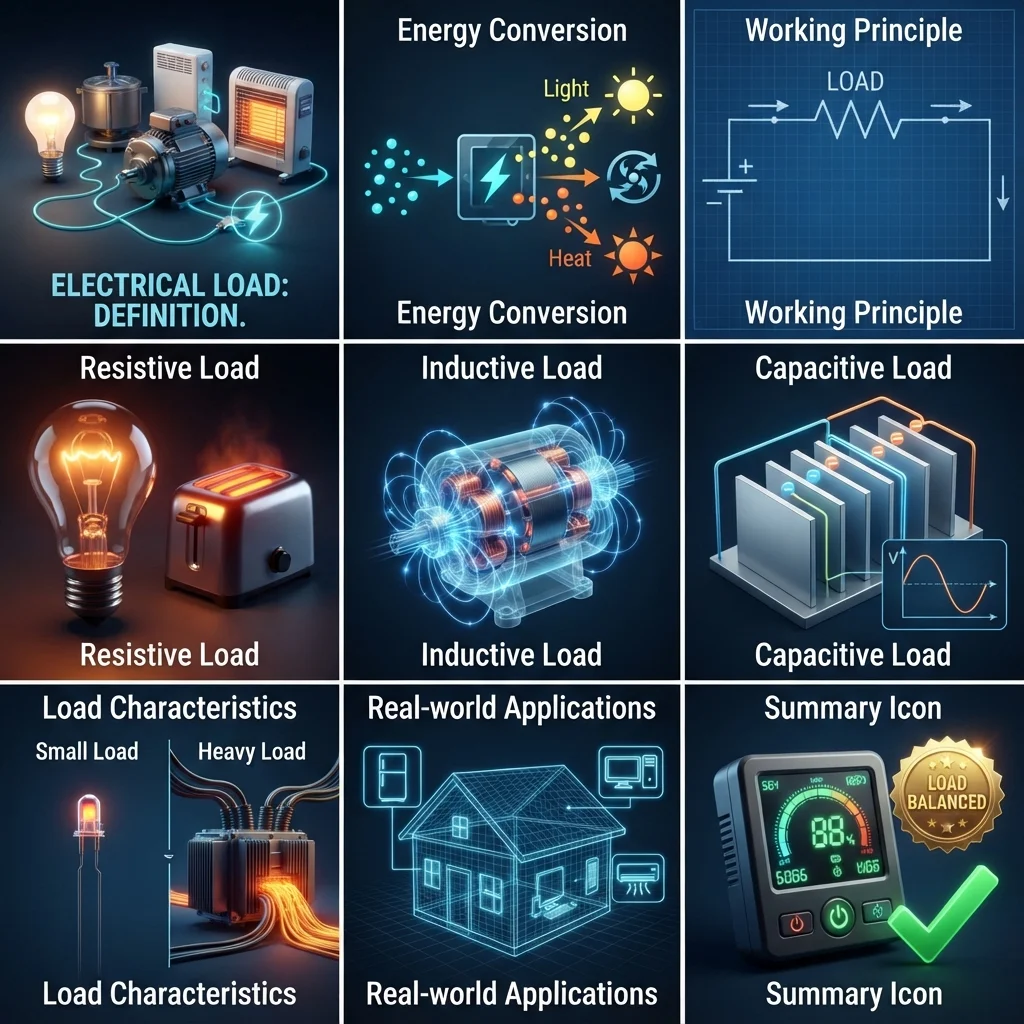

Imagine switching on an air conditioner, refrigerator, lights, and water pump at the same time. All these devices use electrical energy. Together, they create a demand on the electrical supply. This demand is known as an electrical load.
Understanding Electrical Load Meaning is one of the first concepts electrical students, technicians, and engineers need to learn. Load calculations are important when selecting cables, circuit breakers, transformers, generators, distribution panels, and other electrical equipment. A wrong load estimate can cause overheating, voltage drops, nuisance tripping, poor equipment performance, or even serious electrical hazards.
Electrical load does not only mean the amount of power used by a single appliance. It can describe the combined demand of many devices in a home, building, factory, or power system.
In this article, you will learn what an electrical load is, how it works, its major types, important characteristics, advantages and limitations, practical applications, load calculations, selection guidelines, common problems, and future trends. The goal is to make electrical load concepts easy to understand and useful for real-world electrical work.
2. What Is Electrical Load Meaning?
Electrical load is any device, equipment, or system that consumes electrical power from a source.
In simple words:
An electrical load is anything that uses electrical energy to perform useful work.
Examples include:
- Electric lamps
- Fans
- Motors
- Heaters
- Refrigerators
- Air conditioners
- Pumps
- Computers
- Industrial machines
When a load is connected to an electrical source, it draws current.
For example, a 1,000-watt heater connected to a suitable supply consumes electrical power and converts it mainly into heat.
Simple Example
Suppose a room contains:
- 4 lights of 10 W each
- 1 fan of 70 W
- 1 television of 100 W
The connected load is:
(4 × 10) + 70 + 100 = 210 W
So, the total connected load is 210 watts.
This does not always mean the room will continuously consume exactly 210 W. Some equipment may be switched off, and different appliances may operate at different times.
This distinction is important when designing electrical systems.
Load and Power
Electrical load is commonly described using:
- Watts (W)
- Kilowatts (kW)
- Volt-amperes (VA)
- Kilovolt-amperes (kVA)
- Megawatts (MW)
The correct unit depends on the type of calculation and the nature of the load.
3. Electrical Load Working Principle
The electrical load working principle is based on the conversion or use of electrical energy.
A source provides voltage. When a load is connected, the voltage causes current to flow through the load.
The load then uses electrical power.
Step-by-Step Operation
Step 1: Electrical Source Provides Voltage
The source may be:
- Utility supply
- Generator
- Battery
- Solar inverter
- UPS
The source provides the electrical potential needed to operate the load.
Step 2: Load Is Connected
A device is connected to the electrical supply through appropriate conductors and protective equipment.
For example:
Supply → Circuit breaker → Cable → Motor
Step 3: Current Flows
When the circuit is complete, current flows through the load.
The amount of current depends on factors such as voltage, power, resistance, power factor, and load type.
Step 4: Load Uses Electrical Power
Different loads convert electrical energy in different ways.
For example:
- Heater → heat
- Lamp → light
- Motor → mechanical motion
- Speaker → sound
- Computer → electronic processing
Step 5: Protection Controls Abnormal Conditions
Circuit breakers, fuses, overload relays, and other protective devices help protect the circuit when abnormal current or other faults occur.
Easy Analogy
Think of an electrical supply as a water system.
- Voltage is similar to water pressure.
- Current is similar to water flow.
- Cable is similar to a pipe.
- Electrical load is similar to equipment using the water.
A larger electrical load generally requires more electrical capacity from the supply system.
4. Types / Classification of Electrical Loads
Electrical loads can be classified in several ways. Understanding these types helps engineers choose suitable equipment and calculate electrical demand.
4.1 Resistive Load
A resistive load mainly converts electrical energy into heat.
Common examples include:
- Electric heaters
- Toasters
- Electric kettles
- Incandescent lamps
- Heating elements
For an ideal resistive load, voltage and current are in phase.
Power factor is close to 1.
4.2 Inductive Load
An inductive load contains equipment such as coils or windings.
Examples include:
- Induction motors
- Transformers
- Chokes
- Solenoids
- Some pumps
Inductive loads normally draw reactive power and have a lagging power factor.
Large inductive loads can therefore affect system efficiency and voltage conditions.
4.3 Capacitive Load
A capacitive load has characteristics associated with capacitance.
Examples include:
- Capacitor banks
- Certain electronic circuits
- Power-factor correction equipment
Capacitive current leads the voltage in an ideal capacitive circuit.
Capacitors are often deliberately installed to improve the power factor of inductive systems.
4.4 Lighting Load
Lighting loads include electrical devices used to provide illumination.
Examples include:
- LED lamps
- Fluorescent lights
- Street lighting
- Industrial lighting
Modern LED lighting generally consumes much less power than older incandescent lighting.
However, electronic lighting drivers can introduce power-quality considerations.
4.5 Motor Load
Motors convert electrical energy into mechanical energy.
Examples include:
- Pumps
- Compressors
- Fans
- Conveyors
- Machine tools
Motor loads are important in industrial systems because starting current can be much higher than normal running current.
4.6 Electronic Load
Electronic loads use power supplies and electronic circuits.
Examples include:
- Computers
- Servers
- Televisions
- Battery chargers
- Variable-speed drives
- LED drivers
These loads can have nonlinear current characteristics and may produce harmonics.
4.7 Continuous and Non-Continuous Loads
A continuous load operates for a long period.
Examples include:
- Security lighting
- Ventilation systems
- Data-center equipment
- Certain industrial processes
A non-continuous load operates for shorter or intermittent periods.
Understanding operating time helps engineers calculate realistic demand.
4.8 Balanced and Unbalanced Loads
In a three-phase system, a balanced load has approximately equal loading on all three phases.
An unbalanced load has different loading on the phases.
Good load distribution helps reduce voltage imbalance and unnecessary neutral current.
5. Main Components Related to Electrical Load
An electrical load is usually part of a larger power system. Several components work together to supply and control it.
Power Source
The source provides electrical energy.
Examples include:
- Utility grid
- Generator
- Transformer
- Battery
- Solar PV system
Conductors
Cables and wires carry current from the source to the load.
Their size must be selected according to current, installation conditions, voltage drop, temperature, protection, and applicable standards.
Switchgear
Switchgear controls and isolates electrical circuits.
Examples include:
- Circuit breakers
- Disconnect switches
- Contactors
- Fuses
Distribution Panel
A distribution panel divides electrical power among multiple circuits.
It may contain separate breakers for lighting, sockets, motors, HVAC equipment, and other loads.
Protective Devices
Protection devices help protect electrical equipment and conductors from abnormal conditions.
Examples include:
- MCBs
- MCCBs
- Fuses
- Overload relays
- RCDs
- Protective relays
Load Equipment
This is the equipment that actually consumes electrical power.
Examples include motors, heaters, lamps, pumps, and electronic equipment.
Measuring Equipment
Electrical technicians and engineers may use:
- Clamp meters
- Multimeters
- Power meters
- Energy meters
- Power-quality analyzers
These instruments help determine actual load behavior.
6. Electrical Load Advantages
Electrical loads are not normally described as having “advantages” in the same way as a technology. However, properly selected and managed loads provide important practical benefits.
- Useful energy conversion: Loads convert electrical energy into useful work.
- Flexible operation: Electrical equipment can be switched and controlled easily.
- High efficiency: Modern motors, LEDs, and electronic equipment can provide efficient operation.
- Automation: Electrical loads can be controlled automatically.
- Easy measurement: Power and energy consumption can be measured with electrical meters.
- Scalability: Electrical systems can supply anything from small household loads to large industrial equipment.
- Remote control: Modern electrical loads can often be monitored and controlled remotely.
- Energy management: Measuring load demand helps reduce unnecessary energy use.
7. Electrical Load Disadvantages / Limitations
Electrical loads also create challenges that must be considered during system design.
High Current Demand
Large loads draw substantial current.
This may require larger cables, breakers, transformers, and generators.
Voltage Drop
Long cables and high currents can cause voltage drop.
Excessive voltage drop may affect equipment performance.
Starting Current
Motors can draw high current during starting.
This can cause voltage dips and protective-device operation if the system is poorly designed.
Power Factor
Inductive loads can reduce power factor.
A low power factor can increase current for the same useful power.
Harmonics
Electronic loads can produce harmonic currents.
High harmonic levels can affect transformers, cables, neutral conductors, and sensitive equipment.
Load Imbalance
Unequal phase loading can create voltage imbalance and increased neutral current.
These factors form an important part of understanding electrical load advantages and disadvantages.
8. Electrical Load Applications
Electrical loads are present almost everywhere electricity is used.
Home Applications
Residential loads include:
- Lights
- Fans
- Refrigerators
- Washing machines
- Air conditioners
- Water heaters
- Microwaves
- Computers
- Televisions
Before installing a new high-power appliance, the existing electrical capacity should be checked.
Commercial Applications
Commercial buildings have loads such as:
- Office lighting
- Elevators
- HVAC systems
- Computers
- Servers
- Pumps
- Refrigeration equipment
- Security systems
Commercial load calculations help determine transformer and distribution requirements.
Industrial Applications
Industrial facilities can have very large loads.
Examples include:
- Motors
- Compressors
- Pumps
- Furnaces
- Welding equipment
- Conveyor systems
- Cranes
- Industrial heating systems
Industrial engineers must consider connected load, maximum demand, starting current, power factor, harmonics, and future expansion.
Renewable Energy
Solar and battery systems must also consider load demand.
A solar installation should be sized according to the expected energy consumption and operating conditions.
Electric Vehicles
EV chargers are becoming important electrical loads.
Several high-power chargers operating together can create significant demand on a building’s electrical supply.
9. Difference Between Connected Load and Maximum Demand
One of the most important distinctions in electrical design is the difference between connected load and maximum demand.
| Feature | Connected Load | Maximum Demand |
|---|---|---|
| Meaning | Total rated power of connected equipment | Highest actual demand during a period |
| Based on | Equipment ratings | Actual or estimated simultaneous use |
| Usually | Higher | Lower or equal |
| Example | All installed appliances | Maximum power used at one time |
| Used for | Initial load inventory | System capacity planning |
Example
Suppose a building has:
- 5 kW lighting
- 10 kW HVAC
- 5 kW sockets
- 20 kW motors
The connected load is:
5 + 10 + 5 + 20 = 40 kW
But all equipment may not operate at full power simultaneously.
If the highest expected simultaneous demand is 28 kW, then the maximum demand is approximately 28 kW.
Engineers use demand factors and diversity factors to estimate realistic system requirements.
10. Selection Guide for Electrical Load Systems
Before selecting cables, transformers, generators, or protective devices, determine the electrical load carefully.
1. Identify the Equipment
Make a list of every major load.
Record:
- Rated voltage
- Rated power
- Current
- Phase
- Power factor
- Operating time
2. Calculate Connected Load
Add the rated power of the equipment.
This provides a starting point for design.
3. Estimate Maximum Demand
Determine which loads are likely to operate simultaneously.
Use appropriate engineering demand factors rather than simply assuming every load operates continuously.
4. Consider Starting Current
For motors and other equipment, check starting requirements.
The starting condition may require more capacity than normal operation.
5. Check Power Factor
For larger installations, determine whether power-factor correction is needed.
6. Consider Future Loads
Leave suitable capacity for future expansion where practical.
Tips for Beginners
Always create a load schedule.
A basic load schedule can include:
| Load | Quantity | Rating | Total |
|---|---|---|---|
| LED light | 10 | 15 W | 150 W |
| Fan | 5 | 70 W | 350 W |
| AC | 2 | 1,500 W | 3,000 W |
| Refrigerator | 1 | 500 W | 500 W |
This simple table makes load calculations easier.
11. Common Problems & Solutions
Why Does a Circuit Breaker Keep Tripping?
Possible causes include:
- Overload
- Short circuit
- Earth fault
- Faulty equipment
- Incorrect breaker selection
Solution: Do not repeatedly reset the breaker. Isolate the circuit and investigate the cause using proper electrical testing procedures.
Why Does a Motor Draw High Current?
Possible causes include:
- Mechanical overload
- Low voltage
- Phase imbalance
- Incorrect connection
- Motor fault
- High starting current
Solution: Compare measured current with the motor nameplate data and inspect the mechanical and electrical conditions.
Why Does Voltage Drop When a Large Load Starts?
A large load, especially a motor, can draw high starting current.
The resulting voltage drop can affect other equipment.
Solution: Check conductor size, transformer capacity, supply impedance, starting method, and system voltage.
Why Is Neutral Current High?
Possible causes include:
- Unbalanced single-phase loads
- Harmonic currents
- Incorrect wiring
- Excessive electronic loads
Solution: Measure phase and neutral currents and investigate the source of imbalance or harmonics.
Why Is a Transformer Overloaded?
A transformer may be overloaded when the connected demand exceeds its practical capacity.
Solution: Measure demand, review the load schedule, and consider load redistribution, demand management, or additional capacity.
Can I Add a High-Power Appliance to an Existing Circuit?
Not without checking the circuit first.
You should verify:
- Cable capacity
- Breaker rating
- Supply voltage
- Existing load
- Outlet rating
- Voltage drop
For permanent installations, use a qualified electrician where required by local regulations.
12. Future Trends in Electrical Load Management
Electrical loads are changing rapidly because of renewable energy, electric vehicles, smart buildings, and advanced electronics.
Smart Load Management
Smart systems can measure electrical demand in real time.
They can automatically reduce or shift non-essential loads when demand becomes high.
Demand Response
Utilities and large consumers can adjust electricity use based on grid conditions.
This can reduce peak demand and improve grid efficiency.
Smart Meters
Smart meters provide more detailed information about energy consumption.
Users can identify high-demand periods and improve energy management.
Electric Vehicle Charging
EV chargers can create large new loads.
Smart charging systems can schedule charging when electricity demand is lower.
Battery Energy Storage
Battery systems can store energy and provide power during high-demand periods.
This can reduce peak demand in some installations.
Renewable Energy Integration
Solar and wind systems can change the way loads receive electricity.
Future electrical systems will increasingly combine:
- Solar generation
- Battery storage
- Smart loads
- Grid power
- Automated control
Artificial Intelligence and Load Forecasting
Advanced software can analyze historical consumption and predict future demand.
This can help engineers plan capacity, reduce peak demand, and identify abnormal load behavior.
13. Conclusion
Electrical Load Meaning refers to equipment or systems that consume electrical power to perform useful work. Lights, motors, heaters, pumps, computers, air conditioners, and chargers are all examples of electrical loads.
Understanding electrical load is essential for selecting cables, breakers, transformers, generators, panels, and other equipment. Different loads behave differently. Resistive loads mainly consume active power, while inductive and capacitive loads also involve reactive power.
Engineers must consider connected load, maximum demand, starting current, power factor, harmonics, voltage drop, and load balance when designing a reliable electrical system. Modern technologies such as EV chargers, solar systems, batteries, and smart buildings are making load management even more important.
For beginners, the best starting point is simple: identify every load, record its rating, calculate the total demand, and always verify the design against applicable electrical standards and safety requirements.