
Imagine driving a car or operating an industrial machine. When the engine or motor produces power, that power must be transferred to another component to perform useful work. For example, in a vehicle, the engine generates rotational energy that must reach the wheels to move the car. The component responsible for transferring this power is called the drive shaft.
A drive shaft is a critical mechanical component used in many machines, including vehicles, electric motors, industrial equipment, and power transmission systems. It plays a vital role in transferring rotational motion and torque from one part of a machine to another.
For electrical students, engineers, technicians, and beginners, understanding the drive shaft working principle is important because many electrical machines rely on rotating shafts to deliver mechanical power. Motors, pumps, compressors, and generators often use drive shafts to connect rotating components.
In this article, you will learn what a drive shaft is, how the drive shaft working principle operates, and the different types used in modern machines. We will also explore drive shaft applications, its advantages and disadvantages, important components, troubleshooting tips, and how to select the right drive shaft for a machine.
What is a Drive Shaft?
A drive shaft is a mechanical component that transmits rotational power and torque from a power source, such as an engine or motor, to another part of a machine.
It is usually a long cylindrical shaft made of strong materials like steel or aluminum. The drive shaft rotates and transfers mechanical energy between components.
Simple Explanation
In simple terms, the drive shaft acts like a power bridge between two machine parts. It connects the power source to the driven equipment and allows rotational energy to move efficiently.
Practical Example
In a car, the engine produces power. That power is transferred through the transmission system and then through the drive shaft to the wheels. Without the drive shaft, the wheels would not receive the power needed to move the vehicle.
Similarly, in industrial machines, drive shafts transfer power from electric motors to pumps, compressors, or conveyors.
Drive Shaft Working Principle
The drive shaft working principle is based on the transmission of rotational motion and torque from one component to another.
When the motor or engine rotates, the drive shaft rotates as well, transferring mechanical power along its length.
Step-by-Step Operation
- The motor or engine generates rotational power.
- The drive shaft is connected to the power source through a coupling or transmission system.
- As the power source rotates, the drive shaft also rotates.
- The shaft transfers torque to the connected machine component.
- The receiving component performs useful work, such as moving wheels or operating machinery.
Simple Analogy
Think of the drive shaft like a rotating stick connecting two wheels. When one wheel turns, the stick rotates and forces the second wheel to turn as well. This is similar to how a drive shaft transfers power.
Types / Classification of Drive Shafts
Drive shafts come in different designs depending on machine requirements.
Single-Piece Drive Shaft
A single-piece drive shaft is a continuous drive shaft made from a single solid or tubular section without any intermediate joints, center support bearings, or separations along its length. It is designed to transmit rotational torque directly from the transmission or power source to the differential or driven component through one uninterrupted shaft. Due to its simple construction, a single-piece drive shaft offers excellent strength, high reliability, and efficient power transmission with fewer mechanical components that require maintenance. The absence of additional shaft sections and center support bearings reduces mechanical complexity, making installation easier and minimizing the number of potential failure points. Single-piece drive shafts are commonly manufactured from high-strength steel, alloy steel, aluminum, or carbon fiber composites, depending on the application’s strength, weight, and performance requirements. They are precision-balanced to ensure smooth rotation, reduce vibration, and improve drivetrain efficiency at normal operating speeds. Because they have a relatively simple design, they require less maintenance and generally provide a longer service life when properly installed and maintained. However, single-piece drive shafts are most suitable for short power transmission distances, as excessively long shafts can experience bending, critical speed issues, and increased vibration during high-speed operation. For this reason, they are widely used in passenger cars, light commercial vehicles, compact machinery, agricultural equipment, industrial machines, pumps, compressors, and other applications with short driveline lengths. Regular inspection for damage, corrosion, imbalance, and proper alignment helps maintain optimal performance and prevent premature wear of connected drivetrain components. Modern single-piece drive shafts are engineered using advanced manufacturing techniques to achieve higher strength, lower weight, improved durability, and greater resistance to fatigue. Because of their simple design, high strength, low maintenance requirements, and efficient torque transmission, single-piece drive shafts remain one of the most widely used solutions for small machines and short power transmission systems in both automotive and industrial applications.
Two-Piece Drive Shaft
A two-piece drive shaft is a drive shaft assembly that consists of two separate shaft sections connected by a center support bearing. This design is commonly used in vehicles and machinery that require a longer drive shaft, where a single-piece shaft would be too long, heavy, or prone to excessive vibration. The center support bearing provides additional support at the midpoint of the assembly, helping to keep both shaft sections properly aligned during operation. As the engine or motor transmits power through the transmission, the front section of the drive shaft transfers torque to the rear section, which then delivers the rotational force to the differential or driven component. The center support bearing absorbs vibration, reduces shaft deflection, and distributes mechanical loads more evenly, resulting in smoother and more reliable power transmission. Compared with a single-piece drive shaft, a two-piece design offers improved stability, better balance, and enhanced performance over long transmission distances. It also reduces drivetrain vibration, minimizes noise, and lowers stress on universal joints, bearings, and other drivetrain components. Two-piece drive shafts are widely used in pickup trucks, buses, commercial vehicles, heavy-duty trucks, long-wheelbase passenger vehicles, construction equipment, agricultural machinery, and industrial power transmission systems where long driveline lengths are required. They are typically manufactured from high-strength steel or lightweight aluminum alloys to provide excellent durability while maintaining structural strength. Modern two-piece drive shafts are precision-balanced and engineered to withstand high torque, heavy loads, and continuous operation under demanding conditions. If the center support bearing or shaft sections become worn or damaged, symptoms such as excessive vibration, knocking noises, poor power transmission, and drivetrain instability may occur. Regular inspection, proper lubrication, and timely replacement of worn components help ensure smooth operation and extend the service life of the entire drive shaft assembly. Because of its ability to support long transmission systems, reduce vibration, and improve drivetrain reliability, the two-piece drive shaft remains a preferred solution for many modern automotive and industrial applications.
Slip-in-Tube Drive Shaft
A Slip-in-Tube drive shaft is a specialized type of drive shaft designed to adjust its length automatically during operation as the distance between drivetrain components changes. It consists of two telescoping shaft sections that slide smoothly inside one another, allowing the drive shaft to expand and contract without interrupting power transmission. This design is particularly useful in vehicles and machinery where suspension movement, axle travel, or chassis flex causes continuous changes in the distance between the transmission and the differential. As the vehicle accelerates, brakes, or travels over uneven roads, the slip-in-tube mechanism compensates for these movements while maintaining proper shaft alignment and smooth torque transfer. By allowing controlled axial movement, it reduces mechanical stress on the transmission, differential, universal joints, and other drivetrain components, helping to improve overall reliability and extend service life. Slip-in-tube drive shafts are widely used in passenger cars, pickup trucks, sport utility vehicles (SUVs), buses, agricultural equipment, construction machinery, and heavy-duty commercial vehicles where drivetrain flexibility is essential. They are typically manufactured from high-strength steel or alloy steel to withstand heavy loads, high torque, and continuous operation under demanding conditions. Modern slip-in-tube drive shafts are precision-engineered to minimize vibration, reduce noise, and provide smooth rotational performance even at high speeds. Regular lubrication and inspection of the sliding splines are important to prevent wear, corrosion, and binding that could affect shaft movement. A worn or damaged slip-in-tube assembly may cause vibration, clunking noises, poor power transmission, or difficulty accommodating suspension travel. Because of its ability to allow length adjustment during suspension movement while maintaining efficient power transfer, the Slip-in-Tube drive shaft remains an important component in modern automotive and industrial power transmission systems, offering improved flexibility, durability, and driving comfort.
Constant Velocity (CV) Drive Shaft
A Constant Velocity (CV) drive shaft is a specialized type of drive shaft that uses constant velocity (CV) joints instead of conventional universal joints to transmit power smoothly between drivetrain components. The primary advantage of a CV drive shaft is its ability to maintain a constant rotational speed while operating at different angles, ensuring efficient and uninterrupted power transmission even when the suspension moves or the steering wheels turn. Unlike universal joints, which can experience slight fluctuations in rotational speed at larger operating angles, CV joints provide smooth and uniform torque transfer with minimal vibration and power loss. This makes CV drive shafts the preferred choice for front-wheel-drive (FWD), all-wheel-drive (AWD), and many modern four-wheel-drive (4WD) vehicles. During vehicle operation, the CV drive shaft continuously adjusts to changes in wheel position caused by steering, acceleration, braking, and suspension movement while maintaining consistent power delivery to the wheels. It also helps reduce noise, vibration, and mechanical stress, resulting in improved driving comfort, better handling, and enhanced drivetrain efficiency. CV drive shafts are typically constructed from high-strength alloy steel and are protected by flexible rubber or thermoplastic boots filled with specialized grease. These protective boots keep dirt, dust, and moisture away from the CV joints while ensuring proper lubrication for long service life. If a CV boot becomes damaged or torn, grease can leak out and contaminants can enter the joint, leading to excessive wear, clicking noises during turns, vibration, and eventual joint failure. Regular inspection of CV boots and timely replacement of damaged components are essential for maintaining reliable performance. Because of their smooth rotation, reduced vibration, excellent flexibility, and ability to transmit power efficiently at varying operating angles, constant velocity drive shafts have become an essential component in modern automotive engineering, providing superior performance, durability, and driving comfort.
Main Components of a Drive Shaft
A drive shaft system includes several components that work together to transfer power.
Shaft Tube in a Drive Shaft
The shaft tube is the main cylindrical component of a drive shaft and serves as the primary structure responsible for transmitting rotational torque from the power source to the driven component. It is typically manufactured from high-strength steel, alloy steel, aluminum, or carbon fiber composite materials, depending on the application’s load capacity, operating speed, and performance requirements. The shaft tube connects important drivetrain components such as the transmission, universal joints, slip yoke, and differential, forming the central link in the power transmission system. As the engine or electric motor generates rotational force, the shaft tube carries this torque efficiently through the drivetrain while maintaining structural strength and stability. Its tubular design provides an excellent balance between strength and weight, allowing it to withstand high torsional loads without excessive bending or deformation. In modern vehicles and industrial machinery, the shaft tube is carefully engineered and precision-balanced to minimize vibration, reduce rotational inertia, and improve overall drivetrain efficiency. It also helps maintain proper alignment between connected components, ensuring smooth power transfer during acceleration, braking, and varying load conditions. Shaft tubes are widely used in passenger cars, trucks, buses, agricultural machinery, construction equipment, industrial machines, marine propulsion systems, wind turbines, and electric vehicles, where reliable mechanical power transmission is essential. A damaged or bent shaft tube can cause excessive vibration, unusual noise, drivetrain imbalance, power loss, and accelerated wear of bearings, universal joints, and other connected components. Regular inspection for cracks, dents, corrosion, and imbalance is important to maintain safe and efficient operation. Modern shaft tubes are often manufactured using advanced materials and precision engineering techniques to achieve higher strength, lighter weight, improved durability, and better resistance to fatigue. Because of its ability to transfer rotational torque efficiently while connecting the power source to the driven component, the shaft tube remains one of the most important structural elements of a modern drive shaft assembly.
Universal Joint (U-Joint) in a Drive Shaft
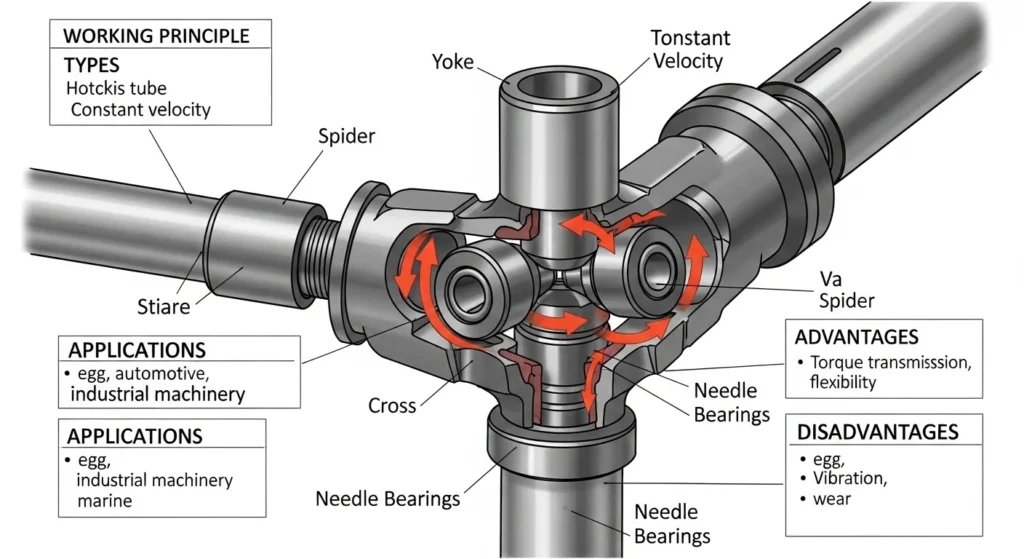
A universal joint (U-joint) is one of the most important components of a drive shaft assembly. It is designed to transmit rotational power between two shafts that are positioned at different angles, allowing the drivetrain to operate smoothly even when the transmission and differential are not perfectly aligned. A universal joint consists of a cross-shaped center piece, commonly called a spider, with bearing caps mounted on each end. This flexible design allows the connected shafts to move up and down or change angles while continuing to transfer torque efficiently. In vehicles, suspension movement, road conditions, acceleration, and braking constantly change the angle between drivetrain components. The universal joint compensates for these changes, ensuring continuous power transmission without interrupting the rotation of the drive shaft. It also reduces mechanical stress on the transmission, differential, and other drivetrain components while improving overall vehicle stability and driving comfort. Universal joints are widely used in cars, trucks, buses, agricultural machinery, construction equipment, industrial machines, marine propulsion systems, and heavy-duty power transmission applications where flexibility and reliable torque transfer are essential. They are typically manufactured from high-strength alloy steel and precision bearings to withstand heavy loads, high rotational speeds, and demanding operating conditions. Over time, lack of lubrication, contamination, excessive wear, or heavy loading can cause a universal joint to fail, resulting in symptoms such as vibration, clunking noises, squeaking sounds, difficulty turning, or poor power transmission. Regular inspection, proper lubrication, and timely replacement of worn universal joints are essential for maintaining drivetrain efficiency and preventing costly mechanical damage. Because of their ability to maintain smooth rotation between misaligned shafts and provide flexibility during operation, universal joints remain an indispensable component in modern automotive, industrial, agricultural, and heavy machinery drive shaft systems.
Slip Yoke in a Drive Shaft
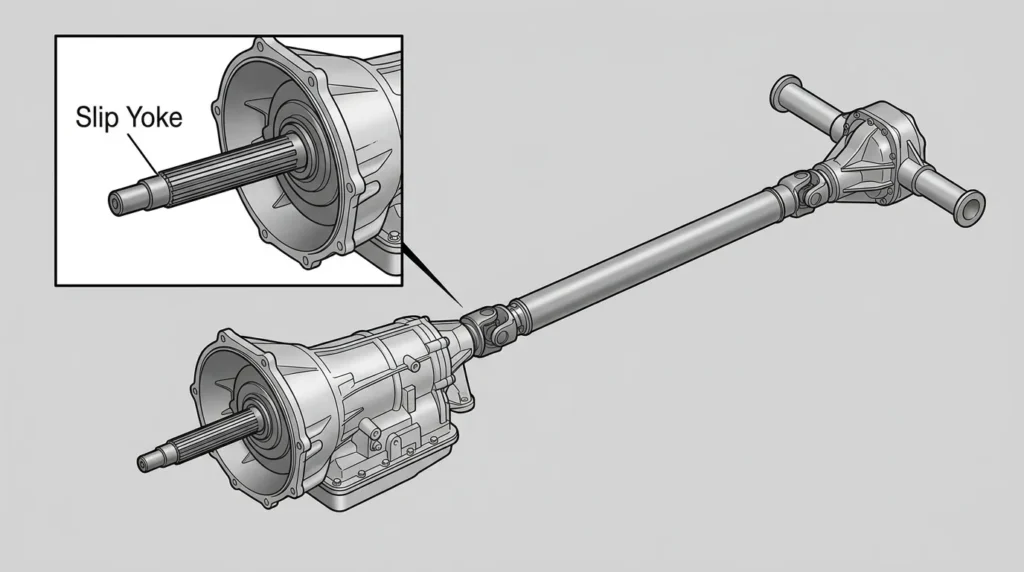
A slip yoke is an essential component of a drive shaft assembly that allows the drive shaft to change its effective length during vehicle or machine operation. It is typically installed at the transmission end of the drive shaft and features internal splines that slide smoothly over the external splines of the transmission output shaft or slip shaft. This sliding action enables the drive shaft to move forward and backward as the suspension travels, the axle shifts, or the distance between drivetrain components changes. Without a slip yoke, the drive shaft would be unable to compensate for these movements, leading to excessive stress, vibration, and possible damage to the transmission, differential, or universal joints. By allowing controlled axial movement, the slip yoke ensures smooth and continuous power transmission while maintaining proper alignment throughout the drivetrain. It also absorbs minor changes in shaft length caused by road conditions, vehicle acceleration, braking, and suspension movement, helping to reduce mechanical shock and improve overall driving comfort. Slip yokes are widely used in rear-wheel-drive vehicles, four-wheel-drive vehicles, trucks, buses, agricultural machinery, and industrial power transmission systems, where drivetrain flexibility is essential. They are commonly manufactured from high-strength alloy steel with precision-machined splines to provide excellent durability, wear resistance, and reliable performance under heavy torque loads. A worn or damaged slip yoke may cause symptoms such as vibration, clunking noises, transmission fluid leakage, difficulty in power transfer, or excessive drivetrain play. Regular inspection, proper lubrication of the splines, and timely replacement of worn components help maintain efficient operation and extend the lifespan of the entire drive shaft assembly. Because of its ability to compensate for movement, maintain alignment, and ensure smooth power transfer, the slip yoke is a vital component in modern automotive and industrial drivetrain systems.
Flange Yoke in a Drive Shaft
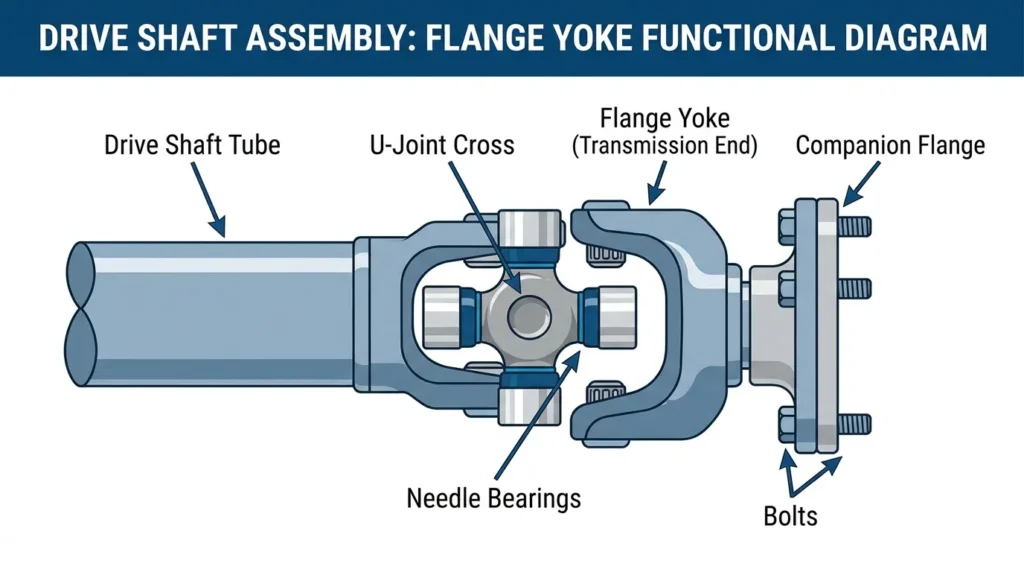
A flange yoke is a critical component of a drive shaft assembly that provides a strong and secure connection between the drive shaft and other drivetrain components, such as the transmission, transfer case, differential, or gearbox. It is typically manufactured from high-strength forged steel or alloy steel to withstand heavy torque loads and continuous rotational forces. The flange yoke features a flat circular flange with precisely machined bolt holes, allowing it to be firmly bolted to the mating flange of the connected component. As the engine or motor generates power, the flange yoke transfers the rotational force through the drive shaft to the differential or driven equipment, ensuring efficient and reliable power transmission. It also helps maintain accurate shaft alignment, minimizing vibration, reducing mechanical stress, and improving the overall stability of the drivetrain. In automotive applications, flange yokes are commonly found in passenger cars, trucks, buses, and off-road vehicles, while in industrial systems they are widely used in conveyors, pumps, compressors, agricultural machinery, and heavy equipment. Their rigid construction enables them to handle high torque, shock loads, and demanding operating conditions without compromising performance. A damaged or worn flange yoke can cause excessive vibration, unusual noise, loose connections, power loss, or premature wear of universal joints and other drivetrain components. Regular inspection of mounting bolts, flange surfaces, and connection points is essential to ensure safe operation and long service life. Modern flange yokes are precision-machined and balanced to improve rotational stability, reduce maintenance requirements, and enhance the efficiency of power transmission systems. Because of their strength, durability, and ability to securely connect the drive shaft to the transmission or differential, flange yokes remain an essential component in modern automotive, industrial, agricultural, and heavy-duty mechanical power transmission applications.
Center Support Bearing in a Drive Shaft
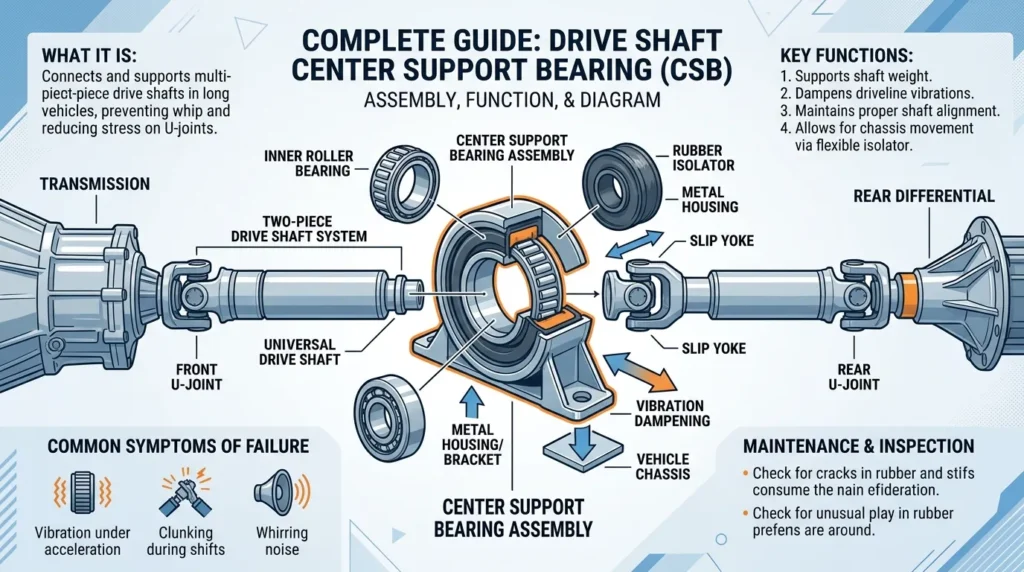
A center support bearing is an important component used in long drive shaft assemblies, particularly in rear-wheel-drive vehicles, trucks, buses, commercial vehicles, and heavy industrial machinery. Its primary purpose is to provide additional support to the drive shaft by holding it securely at the center, especially when the shaft is divided into two sections. Without a center support bearing, a long drive shaft can experience excessive bending, vibration, and misalignment during operation, which may reduce power transmission efficiency and increase wear on other drivetrain components. The center support bearing is typically mounted inside a strong rubber cushion and attached to the vehicle chassis or machine frame. This rubber mounting absorbs shocks, reduces noise, and minimizes vibrations generated while the drive shaft rotates at high speed. As the drive shaft transfers rotational power from the transmission to the differential or driven equipment, the center support bearing keeps the shaft properly aligned and allows it to rotate smoothly under varying load conditions. It also helps distribute mechanical stress evenly across the shaft, reducing strain on universal joints, couplings, and bearings. In addition to improving drivetrain stability, the center support bearing extends the service life of the entire drive shaft assembly by preventing excessive shaft deflection and premature component wear. A damaged or worn center support bearing may cause symptoms such as excessive vibration, knocking noises, squeaking sounds, poor power transmission, and drivetrain instability, especially during acceleration or high-speed operation. Regular inspection and timely replacement of worn bearings are essential to maintain safe and efficient vehicle or machine performance. Modern center support bearings are manufactured using high-strength steel, precision bearings, and durable rubber insulators that provide excellent load-carrying capacity, long service life, and resistance to harsh operating environments. Because of its ability to improve shaft alignment, reduce vibration, and support long drive shafts, the center support bearing remains a vital component in modern automotive, industrial, and heavy-duty power transmission systems.
Advantages of Drive Shaft
Drive shafts offer several benefits in mechanical and electrical systems.
Drive shaft advantages include:
- Efficient power transmission
- Simple mechanical design
- High strength and durability
- Capable of transmitting high torque
- Reliable operation in heavy machines
- Suitable for long-distance power transmission
These advantages make drive shafts widely used in vehicles and industrial machines.
Disadvantages / Limitations
Like all mechanical components, drive shafts also have limitations.
Drive shaft advantages and disadvantages must be considered during machine design.
Drive Shaft Disadvantages
- Requires precise alignment
- May produce vibration at high speed
- Needs regular lubrication and maintenance
- Heavy in large applications
- Failure may cause machine damage
Proper installation and maintenance are essential for reliable operation.
Drive Shaft Applications
Drive shafts are essential mechanical components used in a wide variety of machines, vehicles, and industrial systems to transmit rotational power from one component to another. They enable efficient power transfer while maintaining smooth operation, even when the driving and driven components are separated by a distance. Thanks to their strength, durability, and versatility, drive shafts are widely used in automotive, industrial, agricultural, aerospace, and renewable energy applications.
Automotive Applications
The automotive industry is one of the largest users of drive shafts. In rear-wheel-drive, four-wheel-drive, and all-wheel-drive vehicles, the drive shaft transfers power from the transmission to the differential, which then drives the wheels. Drive shafts are also used in trucks, buses, motorcycles, construction vehicles, and off-road equipment, where they ensure efficient power delivery under varying driving conditions.
Household and Home Applications
Drive shafts are commonly found in many household appliances and small machines. They are used in washing machines, power tools, lawn mowers, garden equipment, and other motor-driven devices to transfer rotational motion from the electric motor to the working components. Their reliable operation helps these appliances function smoothly and efficiently.
Industrial Applications
In industrial environments, drive shafts play a critical role in transmitting mechanical power between motors and machinery. They are widely used in conveyor systems, pumps, compressors, manufacturing equipment, machine tools, printing presses, mining machinery, and processing plants. Their ability to handle high torque and continuous operation makes them indispensable in heavy-duty industrial applications.
Agricultural Machinery
Modern agricultural equipment depends heavily on drive shafts to transfer power efficiently. Tractors, harvesters, balers, irrigation pumps, and other farm machines use power take-off (PTO) drive shafts to operate various implements and attachments, improving productivity and reducing manual labor.
Renewable Energy Systems
Drive shafts are widely used in renewable energy technologies, particularly in wind turbines and small hydroelectric systems. They transfer mechanical energy from rotating blades or turbines to generators, where it is converted into electrical energy. Their reliability is essential for maximizing renewable energy production.
Modern Technology Applications
Advancements in engineering have expanded the use of drive shafts in electric vehicles (EVs), robotics, aerospace systems, automated manufacturing equipment, and precision machinery. Modern drive shafts are designed to be lightweight, strong, and highly efficient, supporting high-speed operation while reducing vibration, energy loss, and maintenance requirements.
Application Summary
Drive shafts are used across numerous sectors, including automotive transportation, household appliances, industrial machinery, agriculture, renewable energy, robotics, aerospace, and electric vehicles. Their ability to transmit power efficiently, withstand heavy loads, and operate reliably makes them one of the most important mechanical components in modern engineering and power transmission systems.
Comparison Section
Difference Between Drive Shaft and Axle
| Feature | Drive Shaft | Axle |
|---|---|---|
| Function | Transfers rotational power | Supports wheels |
| Motion | Rotates continuously | May rotate or remain fixed |
| Application | Power transmission | Wheel support and load carrying |
| Location | Between transmission and machine | Connected to wheels |
Understanding the difference between drive shaft and axle helps engineers design efficient mechanical systems.
Selection Guide for Drive Shafts
Selecting the right drive shaft is essential for ensuring efficient power transmission, reliable operation, and a long service life. An incorrectly selected drive shaft can lead to excessive vibration, premature wear, reduced efficiency, and costly mechanical failures. Engineers and technicians should carefully evaluate the operating conditions, mechanical requirements, and environmental factors before choosing a drive shaft. Proper selection not only improves machine performance but also reduces maintenance costs and increases overall system reliability.
Torque Capacity
The drive shaft should be capable of handling the maximum torque produced by the engine, motor, or transmission system. Selecting a shaft with insufficient torque capacity may result in twisting, deformation, or complete shaft failure. Always choose a drive shaft with an adequate safety margin to accommodate peak operating loads.
Shaft Length and Dimensions
The length and diameter of the drive shaft must match the machine’s design specifications. An incorrectly sized shaft can cause misalignment, excessive vibration, and increased stress on bearings and couplings. Accurate measurements ensure smooth power transmission and proper drivetrain alignment.
Rotational Speed
Different applications require drive shafts that can safely operate at specific rotational speeds. High-speed applications demand precision-balanced shafts to minimize vibration and prevent mechanical damage. Selecting a shaft designed for the intended operating speed improves stability, efficiency, and overall performance.
Operating Environment
The working environment plays an important role in drive shaft selection. Machines operating in dusty, humid, corrosive, or high-temperature conditions require drive shafts made from corrosion-resistant materials and equipped with suitable protective coatings. Choosing the right materials helps improve durability and reduce maintenance requirements.
Material Strength
Drive shafts are commonly manufactured from high-strength steel, alloy steel, aluminum, or carbon fiber composites. The material should provide sufficient strength, fatigue resistance, and durability for the intended application. Heavy-duty industrial machinery typically requires high-strength alloy steel, while lightweight vehicles and performance applications often benefit from aluminum or carbon fiber drive shafts.
Maintenance Requirements
Consider the maintenance needs of the drive shaft before making a selection. Drive shafts with sealed bearings, durable universal joints, and corrosion-resistant finishes generally require less maintenance and offer a longer service life. Selecting high-quality components reduces downtime and long-term operating costs.
Tips for Beginners
When choosing a drive shaft, always select a model that is designed for the expected load and operating conditions. Ensure proper alignment during installation, verify that the shaft is correctly balanced, and use high-quality materials for improved durability and reliability. Following the manufacturer’s installation and maintenance recommendations will help maximize performance and extend the lifespan of the drive shaft.
Selection Summary
The best drive shaft is selected by carefully evaluating torque capacity, shaft dimensions, rotational speed, operating environment, material strength, and maintenance requirements. Choosing the correct drive shaft improves power transmission efficiency, reduces vibration, increases equipment reliability, and ensures safe, long-lasting operation in automotive and industrial applications.
Common Drive Shaft Problems and Solutions
Drive shafts are designed to transmit power efficiently and operate reliably under heavy loads. However, continuous operation, poor maintenance, excessive torque, and harsh working conditions can lead to mechanical problems that affect performance and safety. Identifying these issues early and performing regular inspections can prevent costly repairs and unexpected equipment failure. Below are some of the most common drive shaft problems along with their causes and practical solutions.
Q1: Why Does a Drive Shaft Vibrate?
Excessive vibration is one of the most common drive shaft problems. It may occur due to an unbalanced drive shaft, shaft misalignment, damaged universal joints, bent shafts, worn bearings, or loose mounting components. Ignoring vibration can increase wear on the transmission, differential, and other drivetrain components.
Solution:
- Check the drive shaft for proper balance.
- Inspect shaft alignment and correct any misalignment.
- Tighten loose mounting hardware.
- Replace worn universal joints or bearings.
- Repair or replace a bent or damaged drive shaft.
Q2: Why Does the Drive Shaft Make Unusual Noise?
Unusual noises such as knocking, clunking, squeaking, or grinding often indicate worn or damaged drivetrain components. Common causes include worn universal joints (U-joints), faulty center support bearings, insufficient lubrication, or loose connections.
Solution:
- Inspect universal joints and center support bearings for wear.
- Lubricate all serviceable moving parts according to the manufacturer’s recommendations.
- Tighten loose bolts and fasteners.
- Replace damaged or excessively worn components promptly.
Q3: Why Does a Drive Shaft Fail?
Drive shaft failure can result from excessive torque, overloading, material fatigue, corrosion, poor lubrication, or prolonged operation with damaged components. A failed drive shaft can cause complete loss of power transmission and damage nearby drivetrain parts.
Solution:
- Perform routine inspections for cracks, corrosion, and excessive wear.
- Avoid overloading the vehicle or machinery.
- Maintain proper lubrication of universal joints and splines.
- Replace damaged components before they fail completely.
- Follow the recommended maintenance schedule to extend service life.
Q4: Why Does Power Transmission Become Inefficient?
Reduced power transmission efficiency is often caused by worn couplings, damaged universal joints, shaft misalignment, excessive friction, or drivetrain wear. These issues can decrease performance, increase fuel or energy consumption, and place additional stress on mechanical components.
Solution:
- Inspect couplings, splines, and universal joints for wear or damage.
- Verify proper shaft alignment.
- Replace worn or damaged drivetrain components.
- Ensure all moving parts are properly lubricated.
- Conduct regular maintenance to keep the power transmission system operating efficiently.
Problem-Solving Summary
Most drive shaft problems can be prevented through regular inspection, proper lubrication, correct alignment, shaft balancing, and timely replacement of worn components. Preventive maintenance not only improves performance and efficiency but also extends the lifespan of the drive shaft and protects other drivetrain components from costly damage.
Future Trends in Drive Shaft Technology
Drive shaft technology is continuously advancing to meet the growing demands of modern vehicles and industrial machinery. Manufacturers are developing stronger, lighter, and more efficient drive shafts that improve power transmission, increase durability, and reduce maintenance requirements. With the rise of electric vehicles, automation, and smart manufacturing, new technologies are transforming the design and performance of drive shafts. These innovations aim to enhance reliability, improve fuel and energy efficiency, and extend the service life of mechanical power transmission systems.
Lightweight Composite Materials
One of the biggest trends in drive shaft technology is the use of lightweight composite materials, such as carbon fiber and advanced composites. These materials significantly reduce the weight of the drive shaft while maintaining excellent strength and stiffness. A lighter drive shaft reduces rotational inertia, improves vehicle acceleration, increases fuel efficiency, and enhances overall performance, making it an ideal choice for high-performance vehicles and electric cars.
High-Strength Alloys
Modern drive shafts are increasingly manufactured using high-strength steel alloys and aluminum alloys that provide greater torque capacity, improved fatigue resistance, and longer service life. These advanced materials allow drive shafts to handle higher power outputs while reducing wear and minimizing the risk of mechanical failure under heavy operating conditions.
Smart Monitoring and Predictive Maintenance
The integration of smart sensors and digital monitoring systems is becoming more common in modern drive shaft applications. Sensors continuously monitor parameters such as vibration, temperature, rotational speed, and shaft alignment. By analyzing this data in real time, predictive maintenance systems can detect early signs of wear or imbalance, helping prevent unexpected failures, reduce maintenance costs, and improve equipment reliability.
Electric Vehicle (EV) Integration
The rapid growth of electric vehicles (EVs) is driving the development of advanced drive shaft designs. EV drive shafts are engineered to operate efficiently with high-torque electric motors while minimizing noise, vibration, and energy losses. Improved materials, precision manufacturing, and optimized designs help maximize power transfer and extend the driving range of electric vehicles.
Advanced Manufacturing Technologies
Manufacturers are adopting computer-aided design (CAD), computer-aided engineering (CAE), precision machining, robotic manufacturing, and 3D printing to produce drive shafts with greater accuracy and consistency. These technologies improve product quality, reduce manufacturing defects, and enable customized designs for specialized automotive and industrial applications.
Future Outlook
The future of drive shaft technology focuses on lightweight materials, stronger alloys, smart monitoring systems, advanced manufacturing techniques, and electric vehicle compatibility. These innovations will deliver higher efficiency, greater durability, lower maintenance costs, and improved reliability, ensuring that drive shafts continue to play a critical role in modern transportation and industrial power transmission systems.
Conclusion
The drive shaft is a vital component in mechanical and electrical systems. It transfers rotational power from a motor or engine to another machine component, allowing useful work to be performed. Without drive shafts, many machines—including vehicles, industrial equipment, and power systems—would not function properly.
In this article, we explored what a drive shaft is, the drive shaft working principle, and the different types used in machines. We also discussed drive shaft advantages and disadvantages, important components, and common drive shaft applications in homes, industries, and advanced technologies.
For electrical students, engineers, and technicians, understanding power transmission systems like drive shafts is essential. Proper selection, installation, and maintenance of drive shafts can significantly improve machine efficiency, reliability, and lifespan.
As technology continues to develop, new materials and smart monitoring systems will further enhance drive shaft performance in modern engineering applications.