
Imagine a large power plant supplying electricity to thousands of homes, schools, hospitals, and industries. Inside that power plant, powerful machines rotate continuously to generate electricity. These machines are called AC generators. They are one of the most important devices used to produce electrical power in modern power systems.
Almost all electricity used in homes and industries around the world is generated using AC generators. Whether it is a hydroelectric dam, a wind turbine, or a thermal power plant, the electricity produced is usually alternating current (AC).
Understanding AC generator types explained is very important for electrical students, engineers, technicians, and beginners. Different types of AC generators are designed for different purposes, power levels, and operating conditions.
In this article, you will learn the AC generator working principle, AC generator applications, and AC generator advantages and disadvantages. You will also understand different types of AC generators, their main components, common problems, and how to select the right generator for specific applications.
2. What is an AC Generator?
An AC generator is an electrical machine that converts mechanical energy into alternating electrical energy.
It produces electricity in the form of alternating current, where the direction of current changes periodically.
Simple Explanation
When a conductor moves inside a magnetic field, it produces electrical energy. This process is called electromagnetic induction, which is the basic principle behind AC generators.
Practical Example
A hydroelectric power plant uses flowing water to rotate a turbine. The turbine rotates an AC generator, which converts mechanical energy into electrical power that is sent to homes and industries.
AC generators are widely used because AC electricity can be easily transmitted over long distances.
3. AC Generator Working Principle
The AC generator working principle is based on Faraday’s Law of Electromagnetic Induction.
This law states that when a conductor moves in a magnetic field, a voltage is induced in the conductor.
Step-by-Step Working Process
• Mechanical energy rotates the generator rotor.
• The rotor moves inside a magnetic field.
• The rotating conductor cuts magnetic flux lines.
• This motion induces voltage in the conductor.
• The induced voltage produces alternating current in the external circuit.
Simple Analogy
Think of a water pump pushing water through pipes. In the same way, the generator pushes electrons through wires to produce electricity.
The direction of current changes repeatedly, which is why it is called alternating current (AC).
4. Types of AC Generators
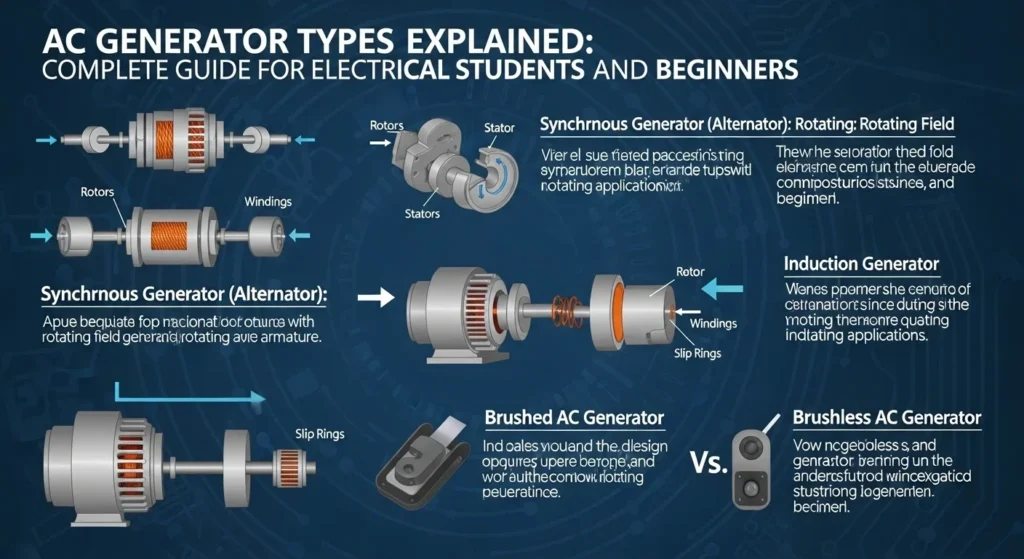
There are several AC generator types used in power systems and industrial applications.
Synchronous Generator Explained: Working, Components, Advantages, and Uses
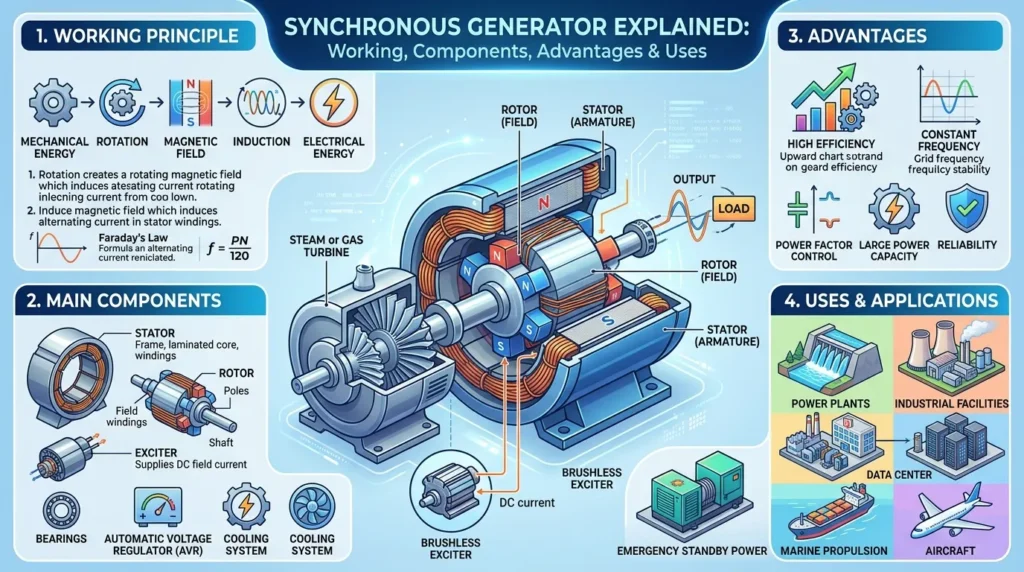
A synchronous generator is the most commonly used AC generator in power plants.
A synchronous generator, also known as an alternator, is an electrical machine that converts mechanical energy into alternating current (AC) electrical energy. It is called a synchronous generator because its rotor rotates at a speed that remains synchronized with the frequency of the electrical output. Synchronous generators are the primary source of electricity generation in power plants worldwide, including thermal, hydroelectric, nuclear, wind, and gas power stations. They play a crucial role in supplying reliable electrical power to homes, industries, commercial buildings, and electrical grids.
The operation of a synchronous generator is based on Faraday’s Law of Electromagnetic Induction, which states that a voltage is induced when a conductor cuts through a magnetic field. As the rotor’s magnetic field rotates inside the stator windings, it induces an alternating voltage in the stator coils, producing electrical power.
Main Components of a Synchronous Generator
A synchronous generator consists of several important components that work together to generate electricity efficiently.
1. Stator
The stator is the stationary part of the generator and contains the armature windings where electrical power is generated. It is constructed using laminated steel cores to minimize energy losses caused by eddy currents. The stator windings are usually arranged in a three-phase configuration to produce three-phase AC power.
Functions of the Stator
- Houses the armature windings
- Produces output electrical voltage
- Supports magnetic flux interaction
- Delivers generated power to the electrical system
2. Rotor
The rotor is the rotating component that carries the magnetic field. It is connected to a prime mover such as a steam turbine, gas turbine, water turbine, or diesel engine. When the rotor rotates, its magnetic field cuts across the stator conductors, inducing voltage.
Functions of the Rotor
- Produces a rotating magnetic field
- Converts mechanical energy into electromagnetic energy
- Maintains synchronous operation
- Controls generator output through excitation
3. Excitation System
The excitation system supplies direct current (DC) to the rotor winding to create the magnetic field required for power generation. Modern generators use automatic voltage regulators (AVRs) to maintain stable voltage levels.
Functions of the Excitation System
- Provides rotor magnetization
- Controls terminal voltage
- Improves voltage stability
- Enhances generator performance
4. Slip Rings and Brushes
In conventional synchronous generators, slip rings and carbon brushes transfer DC excitation current from the stationary source to the rotating rotor winding.
Functions
- Supply DC current to the rotor
- Maintain continuous electrical contact
- Enable magnetic field generation
5. Shaft
The shaft mechanically connects the rotor to the prime mover. It transfers rotational energy from the turbine or engine to the generator rotor.
Functions
- Transmits mechanical power
- Supports rotor rotation
- Maintains mechanical alignment
6. Cooling System
Large generators generate heat during operation. Cooling systems use air, hydrogen, or water to remove excess heat and maintain safe operating temperatures.
Functions
- Prevents overheating
- Improves efficiency
- Extends equipment life
- Ensures reliable operation
Working Principle of a Synchronous Generator
The operation of a synchronous generator follows a simple but highly effective process:
Step 1: Mechanical Input
A prime mover such as a steam turbine, hydro turbine, wind turbine, or diesel engine rotates the generator shaft.
The first step in the operation of a synchronous generator is the supply of mechanical energy from a prime mover. A prime mover is a machine that provides the rotational force required to turn the generator shaft. Common prime movers include steam turbines, gas turbines, hydro turbines, wind turbines, and diesel engines. When the prime mover operates, it rotates the generator’s shaft and rotor at a specific speed known as the synchronous speed. The amount of electrical power that the generator can produce depends largely on the mechanical power supplied by the prime mover. A steady and controlled mechanical input is essential because it helps maintain a constant rotational speed, which in turn ensures a stable output frequency and reliable electricity generation. Without this initial mechanical energy, the generator cannot create the rotating magnetic field necessary for producing electrical power.
Step 2: Rotor Magnetization
The excitation system supplies DC current to the rotor winding, creating a strong magnetic field around the rotor.
After the rotor begins rotating, the next step is rotor magnetization. In this process, the excitation system supplies direct current (DC) to the rotor winding, creating a strong magnetic field around the rotor poles. This magnetic field is essential because it acts as the source of magnetic flux required for electricity generation. The excitation current may be provided through slip rings and brushes or by a brushless excitation system in modern generators. As the strength of the excitation current increases or decreases, the magnetic field strength also changes, allowing operators to regulate the generator’s output voltage. Proper rotor magnetization ensures that a stable and powerful magnetic field is available to interact with the stator windings, which is necessary for efficient electromagnetic induction and reliable power generation. Without rotor magnetization, the generator would not be able to produce the electrical voltage needed for supplying loads or connecting to the power grid.
Step 3: Magnetic Field Rotation
As the rotor turns, the magnetic field rotates at the same speed as the rotor.
After the rotor receives mechanical energy and becomes magnetized, it starts rotating inside the stator. As the rotor turns, its magnetic field also rotates at the same speed. This rotating magnetic field continuously cuts across the stationary conductors (windings) of the stator. According to Faraday’s Law of Electromagnetic Induction, whenever a magnetic field moves across a conductor, it induces an electromotive force (EMF) or voltage in that conductor. The speed of rotation and the strength of the magnetic field directly affect the amount of voltage generated. In a synchronous generator, the rotor rotates at a constant speed that remains synchronized with the frequency of the electrical system. This controlled rotation ensures stable and efficient power generation, making synchronous generators ideal for power plants and large industrial applications where a constant frequency and reliable electrical output are required.
Step 4: Electromagnetic Induction and Voltage Generation
The rotating magnetic field cuts through the stationary stator windings. According to Faraday’s Law, this changing magnetic flux induces an alternating voltage in the stator conductors.
As the rotor’s magnetic field rotates inside the stator, it continuously passes across the stator windings. This movement of the magnetic field through the stationary conductors creates a change in magnetic flux. According to Faraday’s Law of Electromagnetic Induction, a changing magnetic flux induces an electromotive force (EMF) or voltage in a conductor. As a result, electrical energy is generated in the stator windings without any direct electrical connection between the rotor and stator. The magnitude of the induced voltage depends on factors such as the strength of the magnetic field, the speed of rotor rotation, and the number of turns in the stator windings. Since the magnetic field rotates continuously, the induced voltage alternates in direction, producing alternating current (AC). This process is the core operating principle of a synchronous generator and enables the efficient conversion of mechanical energy into electrical energy for power generation systems.
Step 5: AC Power Generation
The induced voltage appears at the stator terminals as three-phase alternating current, which can then be transmitted to electrical loads or the power grid.
Once voltage is induced in the stator windings through electromagnetic induction, the synchronous generator begins producing alternating current (AC) power. As the rotor’s magnetic poles continuously rotate past the stator conductors, the direction of the induced voltage changes periodically. This continuous change in voltage direction creates an alternating current waveform. The frequency of the generated AC power depends on the rotor speed and the number of magnetic poles in the generator. To maintain a stable frequency, the rotor must rotate at a constant synchronous speed. The generated AC electricity is then delivered from the stator terminals to transformers, transmission lines, or electrical loads for practical use. This process allows synchronous generators to supply reliable and high-quality electrical power for power plants, industrial facilities, commercial buildings, and large electrical networks. The ability to generate stable voltage and frequency makes synchronous generators one of the most important machines in modern power generation systems.
Synchronous Speed Formula
The speed of a synchronous generator depends on the supply frequency and the number of poles.
Formula
Ns = (120 × f) ÷ P
Where:
- Ns = Synchronous Speed (RPM)
- f = Frequency (Hz)
- P = Number of Poles
Example
For a generator operating at 50 Hz with 4 poles:
Ns = (120 × 50) ÷ 4
Ns = 1500 RPM
The rotor must rotate at 1500 RPM to produce a frequency of 50 Hz.
Advantages and Disadvantages of a Synchronous Generator
| Advantages | Disadvantages |
|---|---|
| High Efficiency – Provides excellent energy conversion efficiency, especially in large power plants. | Higher Initial Cost – More expensive due to its complex construction and excitation system. |
| Constant Frequency Output – Produces a stable frequency when operating at synchronous speed. | Complex Maintenance – Requires regular maintenance of brushes, slip rings, and excitation equipment. |
| Voltage Control Capability – Allows precise voltage regulation through excitation control. | Synchronization Requirements – Must be properly synchronized with the grid before connection. |
| Suitable for Large Power Ratings – Can generate power from a few kilowatts to several hundred megawatts. | Skilled Operation Needed – Requires trained operators for safe and efficient performance. |
| Improved Power Factor Control – Helps regulate reactive power and improve system stability. | Large Physical Size – High-capacity generators require considerable installation space. |
| Reliable Operation – Designed for continuous and dependable operation under heavy loads. | Longer Installation Time – Installation and commissioning can take longer because of system complexity. |
| Long Service Life – Offers durable performance with proper maintenance. | Higher Excitation System Dependency – Generator performance depends on the proper functioning of the excitation system. |
| Grid Stability Support – Contributes to voltage stability and reliable power system operation. | Not Suitable for Frequent Speed Changes – Requires constant synchronous speed for stable operation. |
Applications of Synchronous Generators
Synchronous generators are widely used in power generation, industrial facilities, and utility networks due to their high efficiency, stable voltage output, and ability to operate continuously under heavy loads.
Thermal Power Plants
In thermal power plants, synchronous generators are coupled with steam turbines driven by coal, natural gas, or oil-fired boilers. They convert the mechanical energy produced by the turbines into electrical energy and supply large amounts of power to the grid.
Hydroelectric Power Stations
Hydroelectric power plants use water turbines to rotate synchronous generators. The kinetic energy of flowing or falling water is converted into electrical energy, making these generators a key component of renewable power generation systems.
Nuclear Power Plants
Synchronous generators are used in nuclear power stations where steam turbines are powered by heat produced from nuclear reactors. These generators provide a stable and continuous supply of electricity to national power networks.
Wind Power Generation
Large wind turbines often utilize synchronous generators to convert the rotational energy of turbine blades into electrical power. They help maintain stable voltage and frequency when connected to modern power grids.
Industrial Power Systems
Many manufacturing plants, refineries, and processing industries use synchronous generators for reliable power generation. They can also assist in improving power factor and maintaining electrical system stability within industrial facilities.
Diesel Generator Sets
Synchronous generators are commonly installed with diesel engines in backup and emergency power systems. They provide uninterrupted electricity during power outages in hospitals, data centers, airports, and commercial buildings.
Utility Power Grids
Utility companies use large synchronous generators as the primary source of electricity generation. These generators operate in power stations and supply electrical energy to transmission and distribution networks serving millions of consumers.
Marine Power Systems
Ships and offshore platforms use synchronous generators to produce onboard electrical power. They support navigation systems, communication equipment, lighting, and various electrical loads required for safe operation.
Renewable Energy Projects
Besides hydro and wind applications, synchronous generators are also used in other renewable energy systems where stable and efficient power generation is required for grid integration and long-term operation.
A synchronous generator is one of the most important electrical machines used for modern power generation. By converting mechanical energy into electrical energy through electromagnetic induction, it provides stable, efficient, and reliable AC power. Its ability to maintain constant frequency, control voltage, and operate at high efficiency makes it the preferred choice for power plants, industrial facilities, and utility networks around the world. Understanding its construction, working principle, advantages, and applications is essential for electrical engineering students, technicians, and professionals involved in power system operations.
Features
• Rotor rotates at synchronous speed
• Produces constant frequency electricity
• High efficiency
Applications
• Power plants
• Hydroelectric stations
• Thermal power plants
• Nuclear power plants
Most large-scale electricity generation systems use synchronous generators.
Induction Generator
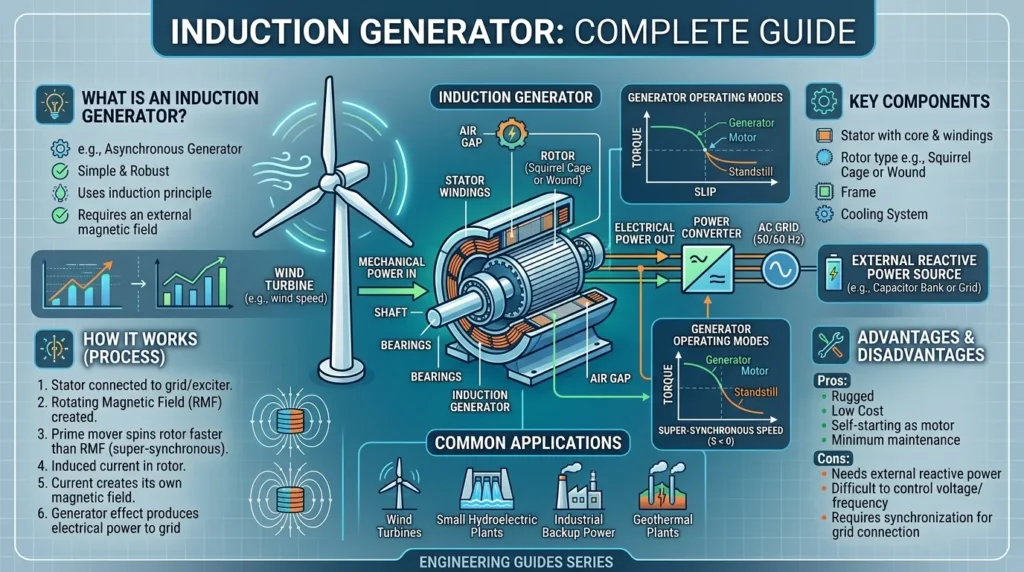
An induction generator works similarly to an induction motor but operates in reverse.
An induction generator is a type of electrical generator that works on the principle of electromagnetic induction and is widely used in modern power generation systems, especially in renewable energy applications such as wind power plants. It is essentially the same machine as an induction motor, but it operates in reverse mode. Instead of consuming electrical energy to produce mechanical motion, it converts mechanical energy into electrical energy when driven above its synchronous speed. The basic structure of an induction generator includes a stator and a rotor. The stator is connected to the electrical grid or load and contains three-phase windings, while the rotor is usually a squirrel-cage type that rotates inside the stator. When a mechanical prime mover such as a wind turbine or diesel engine drives the rotor at a speed higher than the synchronous speed of the stator’s rotating magnetic field, the relative motion between the rotor and magnetic field causes induction of current in the rotor conductors. According to Faraday’s Law, this induced current produces its own magnetic field, which interacts with the stator field and results in the generation of electrical power that is supplied to the grid.
One important feature of an induction generator is that it does not require a separate DC excitation system like a synchronous generator. Instead, it draws reactive power from the grid or from external capacitors to establish the magnetic field necessary for operation. Because of this, induction generators are simple in construction, rugged, and require less maintenance, making them highly reliable for continuous operation. However, they have some limitations, such as poor voltage regulation and dependence on the grid for excitation in grid-connected systems. They also cannot operate independently without external reactive power support.
Induction generators are widely used in wind energy systems, small hydroelectric plants, and backup power generation units. In wind turbines, they are particularly popular because they can handle variations in wind speed and provide stable operation when connected to a strong electrical grid. They are also used in industrial applications where cost-effective and low-maintenance power generation is required. Despite their limitations, induction generators play a crucial role in modern electrical power systems due to their simplicity, durability, and suitability for renewable energy integration.
Features
• Simple construction
• Lower maintenance
• Can operate with variable speeds
Applications
• Wind turbines
• Small hydro plants
• Renewable energy systems
Induction generators are popular in renewable energy applications.
Single Phase AC Generator
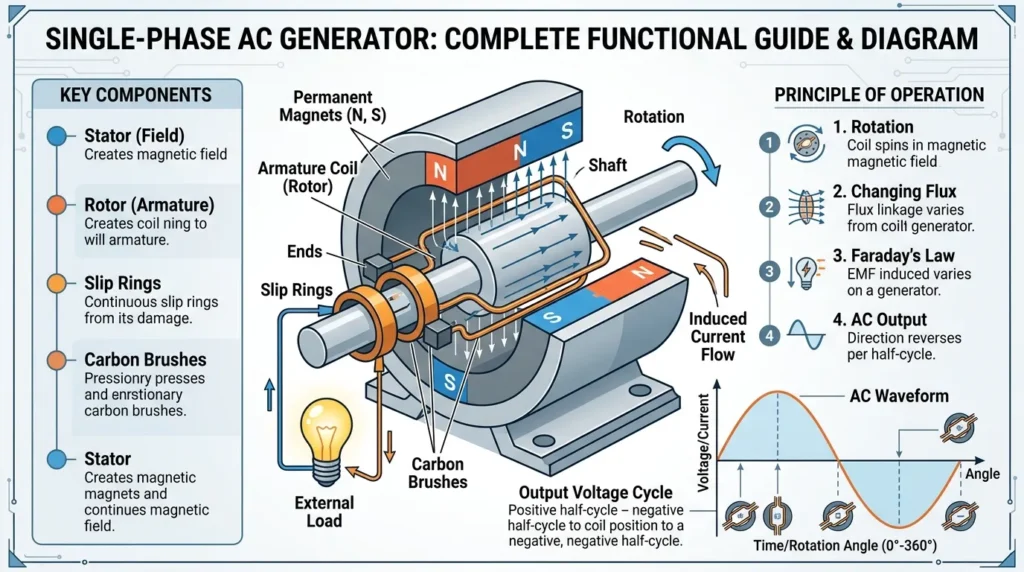
A single-phase AC generator produces single-phase alternating current.
A single-phase AC generator is an electrical machine that converts mechanical energy into single-phase alternating electrical energy using the principle of electromagnetic induction. It is one of the simplest types of generators and is widely used for small-scale power generation applications such as household appliances, small businesses, portable generators, and backup power systems. The main components of a single-phase AC generator include a stator, rotor, slip rings, brushes, and a prime mover. The stator is the stationary part of the generator and contains a single-phase winding where the electrical output is produced. The rotor is the rotating part that creates a magnetic field, either through permanent magnets or through an excitation system. The prime mover, such as a diesel engine, turbine, or gasoline engine, supplies mechanical energy to rotate the rotor inside the stator.
When the rotor rotates, its magnetic field cuts across the stator windings. According to Faraday’s Law of Electromagnetic Induction, this change in magnetic flux induces an alternating electromotive force (EMF) in the stator winding. As the rotor continues to rotate, the direction of the induced voltage changes periodically, producing an alternating current (AC) output. The output voltage of a single-phase generator follows a sinusoidal waveform, which alternates between positive and negative cycles. The frequency of the generated AC depends on the speed of rotation and the number of poles in the generator. A constant speed is required to maintain a stable frequency output, especially when used for sensitive electrical equipment.
Single-phase AC generators are simple in construction and easy to operate, making them suitable for domestic and light commercial applications. They are commonly used in home backup generators, rural electrification systems, small workshops, and portable power units. However, they have limitations compared to three-phase generators, such as lower efficiency, limited power output, and increased vibration under heavy loads. Due to these limitations, they are not suitable for large industrial or utility-scale power generation.
Despite their small size, single-phase AC generators play an important role in providing reliable electricity in areas where the power supply is unstable or unavailable. They are cost-effective, easy to maintain, and highly useful in emergency situations. Overall, the single-phase AC generator is an essential device for small-scale electrical power generation and continues to be widely used in both residential and commercial applications.
Features
• Simple design
• Lower power capacity
• Easy operation
Applications
• Small generators
• Portable power systems
• Household backup generators
Three Phase AC Generator
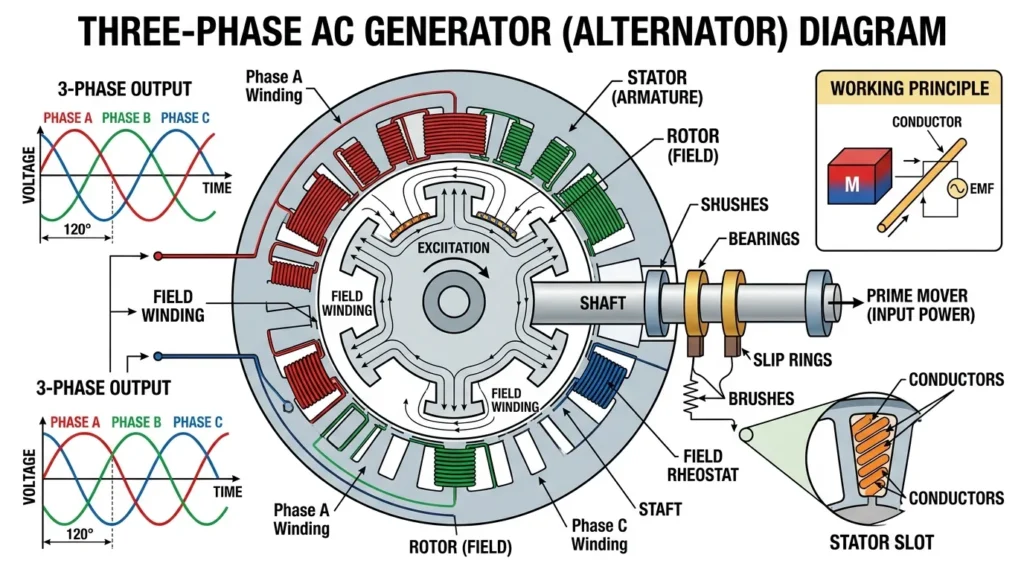
A three-phase AC generator produces three alternating voltages separated by 120 degrees.
A three-phase AC generator is an electrical machine that converts mechanical energy into three-phase alternating current (AC) electrical energy using the principle of electromagnetic induction. It is one of the most important machines in modern power systems and is widely used in power plants, industries, and utility grids due to its high efficiency, reliability, and ability to deliver large amounts of electrical power. The main components of a three-phase AC generator include the stator, rotor, slip rings or brushless excitation system, and a prime mover such as a steam turbine, water turbine, wind turbine, or diesel engine. The stator contains three separate windings spaced 120 degrees apart, which produce three separate AC voltages that are equal in magnitude but differ in phase by 120 degrees.
When the rotor is rotated by the prime mover, it creates a rotating magnetic field that cuts across the stator windings. According to Faraday’s Law of Electromagnetic Induction, this changing magnetic flux induces an alternating voltage in each of the three stator windings. Because the windings are spaced 120 degrees apart, the induced voltages are also phase-shifted by 120 degrees, resulting in a balanced three-phase AC output. This type of power generation is highly efficient and provides a continuous and smooth power flow compared to single-phase systems.
One of the major advantages of a three-phase AC generator is its ability to deliver constant power, which reduces vibrations and improves overall system stability. It also uses less conductor material for transmitting the same amount of power compared to single-phase systems, making it more economical for large-scale transmission. Additionally, three-phase generators are capable of self-starting and are suitable for heavy industrial loads such as motors, compressors, pumps, and large machinery.
Three-phase AC generators are widely used in thermal power plants, hydroelectric stations, nuclear power plants, and renewable energy systems like wind farms. They are the backbone of modern electrical grids because they provide reliable and efficient power distribution over long distances. However, they are more complex and expensive than single-phase generators and require careful synchronization when connected to the power grid.
Overall, the three-phase AC generator is an essential component of modern electrical engineering, offering high efficiency, stable operation, and the capability to meet large-scale energy demands in industrial and utility applications.
Features
• Higher power output
• Smooth power delivery
• Efficient power transmission
Applications
• Industrial power systems
• Large power plants
• Manufacturing industries
Three-phase generators are the backbone of modern electrical power systems.
Main Components of an AC Generator (Detailed Explanation)
An AC generator is made up of several essential components that work together to convert mechanical energy into electrical energy efficiently. Each part has a specific role in ensuring smooth operation, stable output, and reliable performance of the generator system.
Stator
The stator is the stationary outer part of the AC generator. It contains the armature windings where the electrical output is produced. When the magnetic field of the rotor cuts across these windings, an electromotive force (EMF) is induced, resulting in AC power generation.
Rotor
The rotor is the rotating component of the generator. It produces a magnetic field either through DC excitation or permanent magnets. As it rotates inside the stator, it continuously changes the magnetic flux linkage with the stator windings, which is essential for electricity generation.
Slip Rings
Slip rings are conductive rings attached to the rotor shaft. They are used to transfer electrical current from a stationary external circuit to the rotating rotor winding, especially in wound-rotor systems, ensuring continuous excitation supply.
Brushes
Brushes are made of carbon or graphite and maintain electrical contact with the slip rings. They allow current to flow between stationary and rotating parts while minimizing wear and friction.
Shaft
The shaft is a strong mechanical component that connects the rotor to the prime mover such as a turbine or engine. It transfers mechanical energy from the driving source to the rotor, enabling its rotation.
Bearings
Bearings support the rotating shaft and reduce friction between moving parts. They ensure smooth rotation of the rotor and help increase the efficiency and lifespan of the generator.
Cooling System
Large AC generators produce significant heat during operation. To prevent overheating and damage, cooling systems such as air cooling, hydrogen cooling, or water cooling are used. These systems maintain safe operating temperatures and improve performance reliability.
All these components work together in perfect coordination to ensure efficient, stable, and continuous generation of alternating current. Without any one of these parts, the generator cannot function properly or deliver reliable electrical power.
AC Generator Advantages and Disadvantages
| Advantages of AC Generator | Disadvantages / Limitations of AC Generator |
|---|---|
| High efficiency in power generation | Complex design compared to DC generators |
| Suitable for large power systems | Requires synchronization with the power grid |
| Easy voltage transformation using transformers | High installation cost for large generators |
| Reliable operation | Requires regular maintenance of moving parts |
| Long lifespan with proper maintenance | Sensitive to mechanical failures |
| Ideal for long-distance power transmission | More complex operation and control |
| Widely used in power plants and industries | Needs skilled technical handling for safe operation |
| Supports large-scale electricity distribution | Cannot operate efficiently without proper load balancing |
AC Generator Applications (Detailed Explanation)
AC generators are widely used in modern electrical systems because they can efficiently produce large-scale electrical power. Their applications range from small home backup systems to massive power plants that supply electricity to entire cities.
Home Applications
In residential areas, AC generators are commonly used as backup power sources during electricity outages. Small portable generators are used to run essential appliances such as lights, fans, refrigerators, and water pumps. They are also used in emergency power systems for homes and small buildings to ensure uninterrupted electricity supply during grid failures.
Industrial Applications
In industries, AC generators play a vital role in powering heavy machinery and equipment. Manufacturing plants use them to operate production lines, while mining operations rely on them for drilling machines, conveyor systems, and ventilation systems. They provide stable and continuous power, which is essential for maintaining productivity in industrial environments.
Power Generation Applications
AC generators are the backbone of large-scale electricity production. They are used in hydroelectric power plants where water turbines drive generators, thermal power plants where steam turbines are used, nuclear power stations powered by nuclear energy, and wind power systems that convert wind energy into electricity. These applications supply electricity to national grids and support millions of consumers.
Modern Technology Applications
In modern technology systems, AC generators are also used in renewable energy projects, such as solar hybrid systems and wind farms. They are important in marine power systems for ships and offshore platforms, where they supply onboard electrical power. In aviation, specialized AC generators are used in aircraft to provide reliable electrical energy for navigation, communication, and control systems.
Overall, AC generators are essential in every sector of modern society. From small household backup systems to large power stations, they ensure continuous, reliable, and efficient electricity generation, making them one of the most important machines in the field of electrical engineering.
9. Comparison: AC Generator vs DC Generator
Understanding the difference between AC generator and DC generator is important for electrical learners.
| Feature | AC Generator | DC Generator |
|---|---|---|
| Output Current | Alternating Current | Direct Current |
| Maintenance | Lower | Higher |
| Power Capacity | High | Limited |
| Efficiency | Higher for large systems | Lower |
| Applications | Power plants | Battery charging |
AC generators are preferred for large power systems, while DC generators are used in specialized applications.
10. Selection Guide: How to Choose an AC Generator (Updated & Detailed)
Selecting the right AC generator is very important for safe, efficient, and reliable electrical power generation. The choice depends on several technical and practical factors that must match the load and application requirements.
Power Requirement
The first and most important factor is the total power demand. The generator should have enough capacity (in kW or kVA) to handle the connected load. It is always recommended to choose a generator with some extra capacity to manage starting surges and future load expansion.
Phase Type
The phase type depends on the application. Single-phase generators are suitable for small domestic loads such as home appliances and light equipment, while three-phase generators are designed for industrial and commercial systems where heavy machines and motors are used.
Speed and Frequency
The generator must operate at a speed that produces the required frequency, usually 50 Hz in most countries and 60 Hz in some regions. Proper speed control is essential to maintain stable and consistent electrical output.
Efficiency
High-efficiency generators convert more mechanical energy into electrical energy with fewer losses. Choosing an efficient generator reduces fuel consumption, operating costs, and heat generation, making the system more economical in the long run.
Environment and Operating Conditions
The installation environment also plays a key role. Factors such as temperature, humidity, dust, altitude, and ventilation must be considered. Generators used in harsh environments require special protection and cooling systems.
Load Type and Characteristics
It is important to consider whether the load is resistive, inductive, or mixed. Motors and industrial machines require generators that can handle high starting currents and reactive power.
Maintenance and Reliability
A good generator should be easy to maintain and have strong reliability. Availability of spare parts, service support, and durability should also be considered before selection.
Manufacturer Specifications
Always follow the manufacturer’s guidelines, technical datasheets, and safety standards. Proper selection based on specifications ensures long-term performance and prevents system failure.
Choosing the right AC generator requires careful analysis of power needs, phase type, efficiency, and operating conditions. A well-selected generator ensures stable performance, cost-effectiveness, and long service life in any electrical system.
11. Common Problems & Solutions
Problem 1: Generator Not Producing Voltage
Possible Causes
• Loss of residual magnetism
• Faulty connections
Solution
Re-magnetize the generator or check wiring connections.
Problem 2: Overheating
Possible Causes
• Overload
• Poor cooling
Solution
Reduce load and improve cooling system.
Problem 3: Voltage Fluctuation
Possible Causes
• Speed variations
• Faulty regulator
Solution
Check turbine speed and voltage regulator.
12. Future Trends in AC Generator Technology (Updated & Detailed)
The technology of AC generators is continuously evolving to meet the increasing demand for efficient, reliable, and sustainable electricity generation. Future developments are focused on improving performance, reducing energy losses, and integrating smart technologies.
Renewable Energy Integration
In the future, AC generators will play an even more important role in renewable energy systems such as wind, hydroelectric, and hybrid power plants. Advanced generator designs will improve energy conversion efficiency from natural sources, helping reduce dependence on fossil fuels and supporting clean energy production.
Smart Grid Technology
Modern AC generators will be fully integrated with smart grid systems. These smart grids will allow real-time monitoring, automatic load adjustment, and efficient distribution of electricity. This will improve system stability, reduce power losses, and ensure better management of electricity demand and supply.
High-Efficiency Materials
New advancements in electrical and magnetic materials, such as improved silicon steel and superconducting materials, will significantly increase generator efficiency. These materials reduce energy losses due to heat and resistance, resulting in better performance and longer lifespan of generators.
Compact and Lightweight Designs
Future AC generators will be designed to be more compact and lightweight while still delivering high power output. This will make installation easier, reduce space requirements, and lower transportation and manufacturing costs, especially for portable and industrial applications.
Digital Monitoring and Automation
Advanced sensors and digital control systems will allow continuous monitoring of generator performance. Automation will help detect faults early, optimize output, and reduce maintenance needs, leading to more reliable and intelligent power systems.
Improved Cooling Systems
New cooling technologies such as advanced air, liquid, and hybrid cooling systems will enhance thermal management. This will allow generators to operate at higher efficiency levels without overheating.
Overall, the future of AC generator technology is moving toward smarter, more efficient, and environmentally friendly systems. These advancements will play a major role in improving global electricity generation and supporting sustainable energy development.
13. Conclusion
AC generators are essential machines that convert mechanical energy into electrical energy in the form of alternating current. They are widely used in power plants, industries, and modern electrical systems.
In this article, we explored AC generator types explained, AC generator working principle, AC generator applications, and AC generator advantages and disadvantages. We also discussed synchronous generators, induction generators, and single-phase and three-phase generators.
Understanding the difference between AC generator and DC generator helps electrical students and engineers choose the right machine for different applications.
As electricity demand continues to grow worldwide, AC generators will remain a critical part of power generation systems. Learning about generator technology is a valuable step for anyone studying electrical engineering or working in the electrical industry.