
Imagine walking into a shopping mall on a hot day and feeling cool air inside, even though the entrance doors are wide open. You may not notice it, but an air curtain is working silently above the doorway, preventing hot air, dust, and insects from entering. This simple yet powerful device plays a major role in maintaining indoor comfort and energy efficiency.
Air curtains are widely used in commercial buildings, industries, cold storage areas, and even modern homes. For electrical students, engineers, and technicians, understanding how air curtains work is important because they combine electrical systems, airflow dynamics, and energy-saving technology.
In this article, you will learn everything about air curtains, including their working principle, types, components, applications, advantages and disadvantages, and how to select the right one. The goal is to explain the topic in a clear and practical way so that beginners can easily understand and apply this knowledge in real-world situations.
2. What is Air Curtain?
An air curtain is an electrical device that creates a high-speed stream of air across an opening, such as a door or entrance. This air stream acts like an invisible barrier that separates two different environments without using a physical door.
Simple Explanation
Think of an air curtain like a wall made of air. It allows people and goods to pass through easily while blocking outside air, dust, insects, and pollutants.
Practical Example
In a supermarket, doors are often kept open for customers. Without an air curtain, hot air would enter, increasing cooling costs. The air curtain prevents this, maintaining indoor temperature and comfort.
3. Air Curtain Working Principle
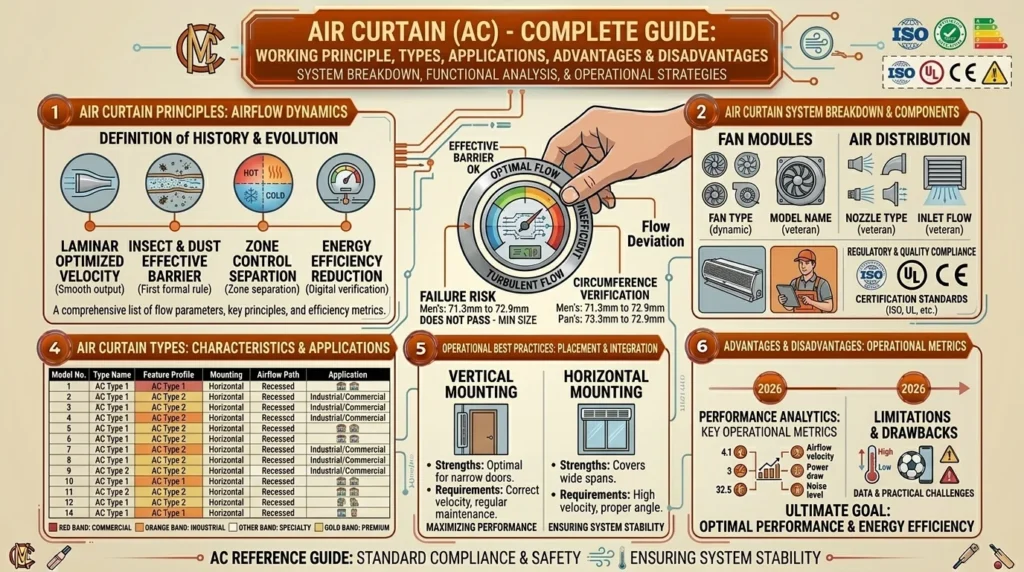
The air curtain working principle is based on creating a controlled flow of air that acts as a barrier between two areas.
Step-by-Step Working
- Air is drawn into the unit using a fan or blower
- The air passes through filters to remove dust
- The motor accelerates the air to high velocity
- The air is directed downward (or sideways) across the opening
- This high-speed airflow prevents external air from entering
Simple Analogy
It works like a waterfall. Just as water falling from a height forms a barrier, the air curtain creates a continuous air stream that blocks unwanted elements.
4. Types / Classification of Air Curtain
Air curtains are classified based on design, mounting position, and application.
4.1 Wall-Mounted Air Curtain
Installed above doors, this is the most common type used in shops and offices. It is easy to install and maintain.
4.2 Ceiling Cassette Air Curtain
Mounted inside the ceiling, it offers a clean and modern look. Suitable for malls and commercial buildings.
4.3 Industrial Air Curtain
Designed for factories and warehouses, these are powerful and can cover large openings.
4.4 Heated Air Curtain
Includes a heating element to provide warm air. Used in cold climates to maintain indoor temperature.
4.5 Low-Speed Air Curtain
Used in small spaces where high velocity is not required.
5. Main Components of Air Curtain
Understanding the components helps in maintenance and troubleshooting.
Fan or Blower
- Creates airflow
- Determines air velocity
Electric Motor
- Drives the fan
- Usually single-phase or three-phase
Air Filters
- Remove dust and particles
- Improve air quality
Heating Element (Optional)
- Provides warm air in heated models
Nozzle or Outlet
- Directs airflow in a specific direction
Control Panel
- Allows speed and temperature adjustment
6. Air Curtain Advantages
The air curtain advantages and disadvantages are important for proper understanding.
Advantages
- Saves energy by reducing air conditioning loss
- Maintains indoor temperature
- Prevents dust, insects, and pollution
- Improves hygiene in food areas
- Allows easy movement without doors
- Reduces electricity bills
- Enhances customer comfort in commercial spaces
7. Disadvantages / Limitations
Limitations
- Initial installation cost can be high
- Not fully effective in strong wind conditions
- Requires proper alignment for best performance
- Regular maintenance needed
- Noise may be produced in low-quality models
8. Air Curtain Applications
The air curtain applications are wide and growing.
Commercial Use
- Shopping malls
- Restaurants
- Supermarkets
- Hospitals
Industrial Use
- Factories
- Warehouses
- Cold storage rooms
Residential Use
- Modern homes
- Kitchens
Special Applications
- Clean rooms
- Airports
- Pharmaceutical industries
9. Comparison Section
Difference Between Air Curtain and Air Conditioner
| Feature | Air Curtain | Air Conditioner |
|---|---|---|
| Function | Creates air barrier | Cools air |
| Energy Use | Low | High |
| Installation | Above doors | Inside rooms |
| Purpose | Prevents air exchange | Temperature control |
| Cost | Moderate | Higher |
This explains the difference between air curtain and air conditioner clearly.
10. Selection Guide
Choosing the right air curtain is important for efficiency.
Tips for Beginners
- Measure door width and height
- Choose correct air velocity
- Select mounting type (wall or ceiling)
- Check noise level
- Consider energy consumption
- Choose trusted brands
11. Common Problems & Solutions
Problem: Weak Airflow
Solution: Clean filters and check motor performance
Problem: Noise Issue
Solution: Tighten components and check fan balance
Problem: Air Not Blocking Properly
Solution: Adjust angle and speed settings
Problem: Device Not Starting
Solution: Check power supply and wiring
12. Future Trends
Air curtain technology is improving with modern innovations.
- Smart air curtains with sensors
- Energy-efficient motors
- IoT-based remote control systems
- Silent operation designs
- Eco-friendly materials
These advancements will make air curtains more efficient and widely used in the future.
13. Conclusion
Air curtains are an essential solution for maintaining indoor comfort and improving energy efficiency in modern buildings. They create an invisible barrier that prevents unwanted air exchange while allowing easy access through open doors. Understanding the air curtain working principle, types, components, and applications helps engineers and technicians use them effectively.
Although they have some limitations, their benefits in reducing energy loss, improving hygiene, and enhancing comfort make them highly valuable. With continuous advancements in technology, air curtains are becoming smarter and more efficient. For beginners and professionals alike, learning about air curtains is an important step toward understanding modern electrical and HVAC systems.