
Imagine working in an industrial control room where hundreds of machines are running at the same time. Engineers need to constantly monitor voltage, current, temperature, and frequency to ensure everything is operating safely. In such environments, even a small error in measurement can lead to equipment failure or production loss. This is where Digital Panel Meters play a very important role.
Understanding Digital Panel Meters is essential for electrical students, engineers, and technicians because they are widely used in modern electrical systems for accurate real-time monitoring. Unlike analog meters, they provide precise digital readings, are easy to read, and can be integrated with automation systems.
In this article, you will learn what digital panel meters are, their working principle, types, components, advantages, disadvantages, applications, selection guide, and future trends—all explained in simple and practical language.
What is Digital Panel Meters?
A Digital Panel Meter (DPM) is an electronic device used to measure and display electrical quantities such as voltage, current, temperature, frequency, and resistance in digital form.
Simple Explanation
It converts an electrical signal into a readable digital value shown on an LED or LCD screen.
Practical Example
In a generator panel, a digital panel meter shows real-time voltage like “230V” instead of a moving needle on a scale.
Working Principle of Digital Panel Meters
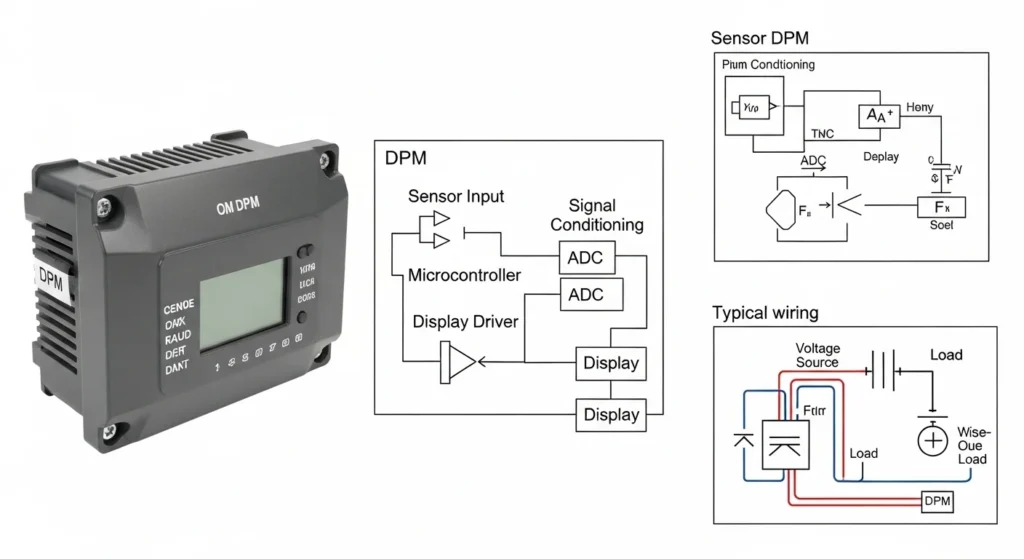
The Digital Panel Meters working principle is based on signal conversion and digital display technology.
Step-by-Step Working
- Input Signal Detection
The meter receives an analog signal (voltage, current, etc.) from the system. - Signal Conditioning
The input signal is adjusted to a suitable level using amplifiers or filters. - Analog to Digital Conversion (ADC)
The analog signal is converted into digital form using an ADC converter. - Processing Unit
A microcontroller processes the digital signal and calculates the measured value. - Display Output
The final value is shown on an LED or LCD display.
Easy Analogy
It works like translating a spoken language (analog signal) into written text (digital display) that is easy to read and understand.
Types / Classification of Digital Panel Meters
1. Voltage Digital Panel Meter
Used to measure AC/DC voltage.
- Displays real-time voltage
- Common in power distribution systems
2. Current Digital Panel Meter
Measures electrical current.
- Used in motor control panels
- Helps monitor load conditions
3. Frequency Meter
Measures frequency of AC supply.
- Important in power systems
- Ensures system stability
4. Temperature Panel Meter
Used with sensors like thermocouples.
- Industrial heating systems
- Furnace monitoring
5. Multifunction Digital Panel Meter
Advanced type that measures multiple parameters.
- Voltage, current, power, frequency
- Used in modern automation systems
Main Components of Digital Panel Meters
A digital panel meter consists of several important parts:
- Input Sensor Circuit
Detects electrical signals from the system. - Signal Conditioner
Adjusts signal level for processing. - ADC (Analog to Digital Converter)
Converts analog signal into digital data. - Microcontroller Unit (MCU)
Processes and calculates measurements. - Display Unit (LED/LCD)
Shows the final reading. - Power Supply Unit
Provides operating voltage to the meter.
Each component ensures accurate and stable performance.
Advantages of Digital Panel Meters
- High accuracy and precision
- Easy-to-read digital display
- Fast response time
- Compact and modern design
- Low maintenance requirement
- Compatible with automation systems
- Can measure multiple parameters
These advantages make them ideal for modern electrical systems.
Disadvantages / Limitations
- Requires external power supply
- More expensive than analog meters
- Sensitive to voltage spikes
- Complex internal circuitry
- May require calibration over time
Despite these limitations, their accuracy and reliability make them widely preferred.
Applications of Digital Panel Meters
Industrial Applications
- Motor control centers
- Power distribution panels
- Automation systems
Commercial Applications
- Buildings and offices
- HVAC systems
- Energy monitoring systems
Power Systems
- Generators
- Transformers
- Substations
Renewable Energy
- Solar power plants
- Wind energy systems
Digital panel meter applications are growing rapidly in smart energy systems.
Comparison: Digital vs Analog Panel Meters
| Feature | Digital Panel Meter | Analog Panel Meter |
|---|---|---|
| Display | Numeric digital display | Pointer and scale |
| Accuracy | High | Moderate |
| Reading | Easy and precise | Less accurate |
| Response | Fast | Slower |
| Maintenance | Low | Higher |
| Cost | Higher | Lower |
This clearly shows the difference between analog and digital meters.
Selection Guide for Beginners
When choosing a digital panel meter:
- Check measurement type (voltage, current, etc.)
- Select correct input range
- Ensure display type (LED/LCD)
- Look for accuracy rating
- Consider environmental conditions
- Choose multifunction if needed
Proper selection improves system efficiency and reliability.
Common Problems & Solutions
Incorrect Reading
- Cause: Wrong calibration
- Solution: Recalibrate the meter
No Display
- Cause: Power failure
- Solution: Check power supply
Fluctuating Values
- Cause: Electrical noise
- Solution: Use filters or stabilizers
Sensor Failure
- Cause: Damaged input sensor
- Solution: Replace sensor unit
Regular maintenance ensures long-term performance.
Future Trends in Digital Panel Meters
The future of digital panel meters is highly advanced:
- Smart IoT-enabled meters
- Wireless monitoring systems
- Cloud-based energy tracking
- AI-based predictive analysis
- Touchscreen digital panels
These innovations will make energy monitoring smarter and more efficient.
Conclusion
Understanding Digital Panel Meters is very important for modern electrical engineering. These devices provide accurate, fast, and reliable measurement of electrical parameters in digital form. From industrial machines to power systems and renewable energy plants, they are widely used everywhere.
We explored their working principle, types, components, advantages, disadvantages, applications, and future trends. We also compared them with analog meters and discussed selection tips for beginners.
As technology advances, digital panel meters are becoming smarter and more connected with automation systems. Learning about them helps engineers design safer, more efficient, and modern electrical systems.