
Imagine you are working in a power plant or even checking a generator at home. The voltage looks correct, the current seems stable, but something still feels wrong. The equipment is not performing efficiently. In many such cases, the problem is not voltage or current—it is frequency. This is where a frequency meter becomes extremely important.
In electrical systems, maintaining the correct frequency (usually 50 Hz or 60 Hz) is critical for proper operation of machines, motors, and electronic devices. Even a small variation can cause overheating, inefficiency, or equipment damage.
A frequency meter helps engineers, technicians, and electricians measure and monitor this frequency accurately. It ensures system stability and safe operation.
In this article, you will learn everything about the frequency meter, including its definition, working principle, types, components, applications, advantages and disadvantages, and practical selection tips. The explanation is simple and practical—just like a senior engineer guiding a junior in the field.
What Is a Frequency Meter?
A frequency meter is an electrical measuring instrument used to determine the frequency of an alternating current (AC) or alternating voltage (AC) signal. It measures how many complete electrical cycles occur in one second, with the result displayed in Hertz (Hz). Frequency meters play an important role in monitoring the performance and stability of electrical systems, generators, motors, and power distribution networks.
Simple Explanation
Frequency is the number of times an AC signal completes one full cycle in one second.
For example:
- 50 Hz means the signal completes 50 cycles every second.
- 60 Hz means the signal completes 60 cycles every second.
Practical Example
Imagine a generator supplying power to a factory. Under normal operating conditions, the generator produces electricity at 50 Hz. If the frequency suddenly drops to 45 Hz due to overloading or a mechanical fault, electric motors may run slower, production equipment can lose efficiency, and sensitive devices may malfunction. A frequency meter instantly detects this change, allowing operators to identify the problem and take corrective action before it affects the entire system.
Frequency Meter Working Principle
The working principle of a frequency meter is based on measuring the number of complete cycles an alternating current (AC) or voltage signal produces within one second. The instrument detects the incoming waveform, counts its cycles over a specific time interval, and displays the frequency in Hertz (Hz).
How Does a Frequency Meter Work?
A frequency meter follows these basic steps to measure frequency accurately:
- Receives the AC Signal – The instrument is connected to the AC power source or electrical circuit.
- Detects Waveform Cycles – Its internal electronic circuit identifies each complete cycle of the waveform.
- Calculates the Frequency – The meter counts the number of cycles occurring in one second using a precise timing circuit.
- Displays the Reading – The calculated frequency is shown on an analog scale or digital display in Hertz (Hz).
Simple Analogy
You can think of frequency like the ticking of a clock or a person’s heartbeat.
- A faster heartbeat represents a higher frequency because more beats occur each second.
- A slower heartbeat represents a lower frequency because fewer beats occur each second.
Similarly, a frequency meter counts how many electrical cycles occur every second to determine the signal’s frequency.
Key Features of the Working Principle
- Measures the number of electrical cycles per second.
- Designed primarily for alternating current (AC) and alternating voltage (AC) signals.
- Uses precise timing circuits to provide accurate frequency readings.
- Available in both analog and digital designs.
- Helps monitor the stability and performance of electrical power systems, generators, motors, and industrial equipment.
Types / Classification of Frequency Meter
Frequency meters are available in different types based on technology and usage.
1.What Is an Analog Frequency Meter?
This is a traditional type with a needle indicator.
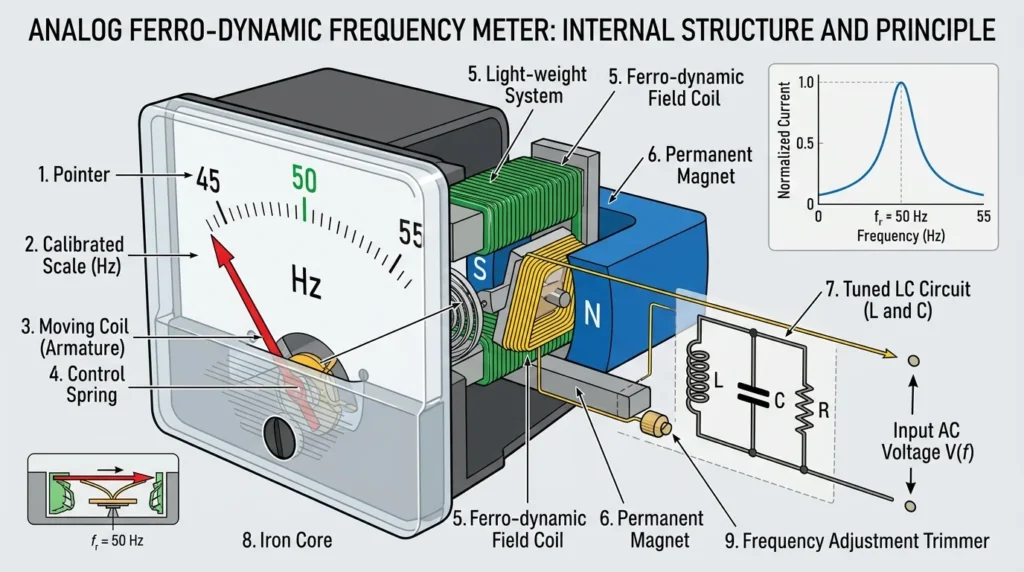
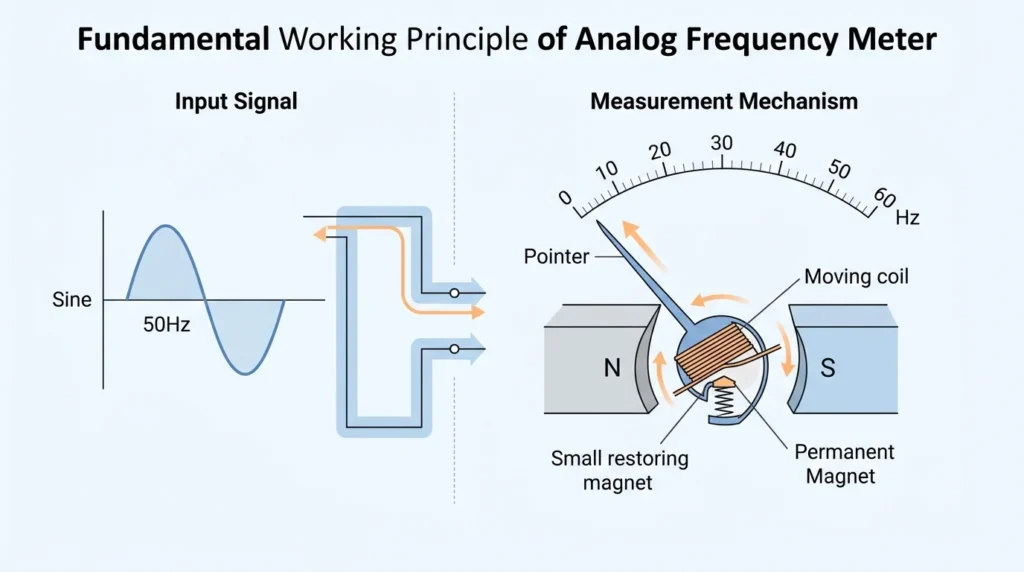
An analog frequency meter is an electrical measuring instrument used to determine the frequency of an alternating current (AC) supply. It displays the frequency value using a moving pointer and a calibrated scale instead of a digital screen. Analog frequency meters are commonly installed in electrical panels, power distribution systems, substations, generators, and industrial control equipment where continuous monitoring of AC frequency is required. The frequency of an electrical system is measured in Hertz (Hz), which represents the number of complete cycles that occur in one second. For example, the standard power frequency is 50 Hz in many countries and 60 Hz in others. Maintaining the correct frequency is essential because many electrical devices, motors, transformers, and industrial machines are designed to operate efficiently only within a specific frequency range. An analog frequency meter provides a simple and reliable way to monitor these changes in real time. Most analog frequency meters work using principles such as vibrating reed, moving iron, or electrodynamic mechanisms that respond to variations in AC frequency. As the supply frequency changes, the internal mechanism moves the pointer to indicate the corresponding value on the scale. Although digital frequency meters are now widely used because of their higher accuracy and additional features, analog frequency meters remain popular in many industrial applications due to their rugged construction, ease of use, and ability to provide a quick visual indication of frequency fluctuations without requiring complex electronics. They also require very little maintenance and can operate reliably in harsh environments where dust, vibration, or electrical noise may affect sensitive digital instruments. Engineers and technicians often use analog frequency meters during routine equipment inspections, generator synchronization, power plant operations, and electrical maintenance tasks to ensure the power system operates within safe limits. Their continuous pointer movement also makes it easier to observe gradual frequency variations compared to rapidly changing digital displays. Because of their durability, simplicity, and dependable performance, analog frequency meters continue to play an important role in electrical engineering, especially in applications where a clear visual indication of AC frequency is more valuable than highly precise numerical measurements.
Features
- Uses mechanical movement
- Simple design
- Less accurate compared to digital
Use
- Old electrical panels
- Basic monitoring systems
What Is a Digital Frequency Meter?
Modern and widely used type.
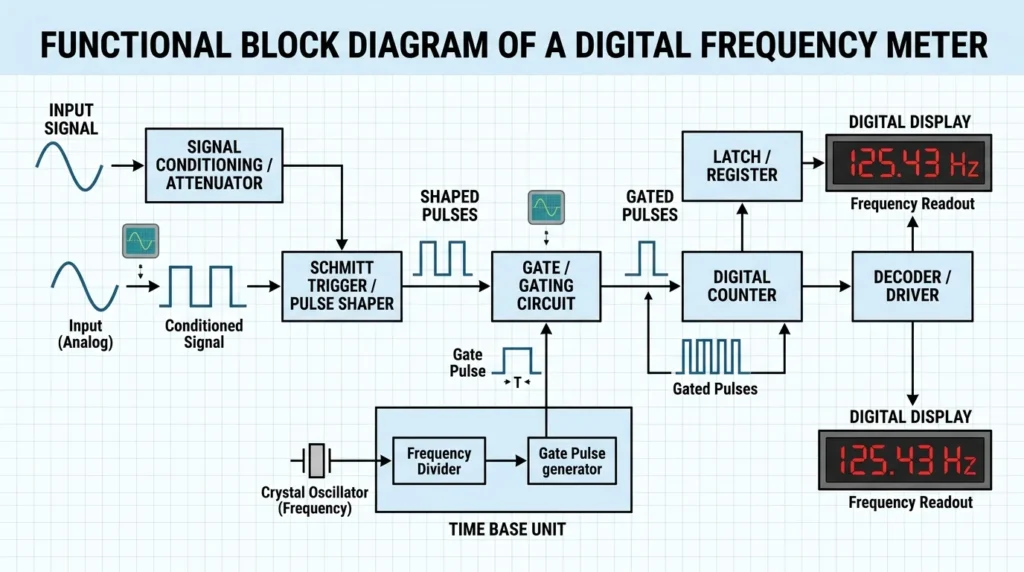
A digital frequency meter is an electronic instrument used to measure the frequency of an alternating current (AC) or electronic signal with high accuracy. Unlike an analog frequency meter, which uses a moving pointer and scale, a digital frequency meter displays the measured frequency as a numerical value on an LCD or LED screen. The frequency is expressed in Hertz (Hz), indicating the number of complete cycles an electrical signal produces in one second. Digital frequency meters are widely used in electrical engineering, power systems, telecommunications, laboratories, industrial automation, and electronic testing because they provide fast, accurate, and easy-to-read measurements. These meters operate by converting the input signal into a series of electrical pulses and counting the number of cycles that occur during a specific time interval using an internal crystal-controlled timing circuit. A built-in microprocessor then calculates the frequency and displays the result instantly. Digital frequency meters can measure a wide range of frequencies, from a few hertz to several megahertz or even gigahertz, depending on the instrument’s design and application. Many modern models also include additional functions such as period measurement, pulse counting, duty cycle measurement, and data logging, making them versatile tools for professionals. They are commonly installed in electrical control panels, power plants, substations, generator systems, and manufacturing facilities to continuously monitor the stability of AC power frequency. In electronic laboratories, digital frequency meters help engineers test oscillators, communication circuits, signal generators, and electronic equipment with exceptional precision. Their high accuracy, minimal reading errors, and ability to provide stable numerical readings make them superior to analog frequency meters in many applications. Additionally, digital frequency meters are less affected by mechanical wear, vibration, or pointer misalignment, resulting in improved long-term reliability and reduced maintenance requirements. Their compact design, quick response time, and advanced electronic circuitry have made them the preferred choice for modern electrical and electronic measurement systems. Whether used for troubleshooting, equipment maintenance, quality control, or continuous monitoring, a digital frequency meter plays a vital role in ensuring that electrical systems operate safely, efficiently, and within their specified frequency limits.
Features
- Displays readings on digital screen
- High accuracy
- Fast response
Use
- Laboratories
- Industrial systems
- Power plants
3. What Is a Vibrating Reed Frequency Meter?
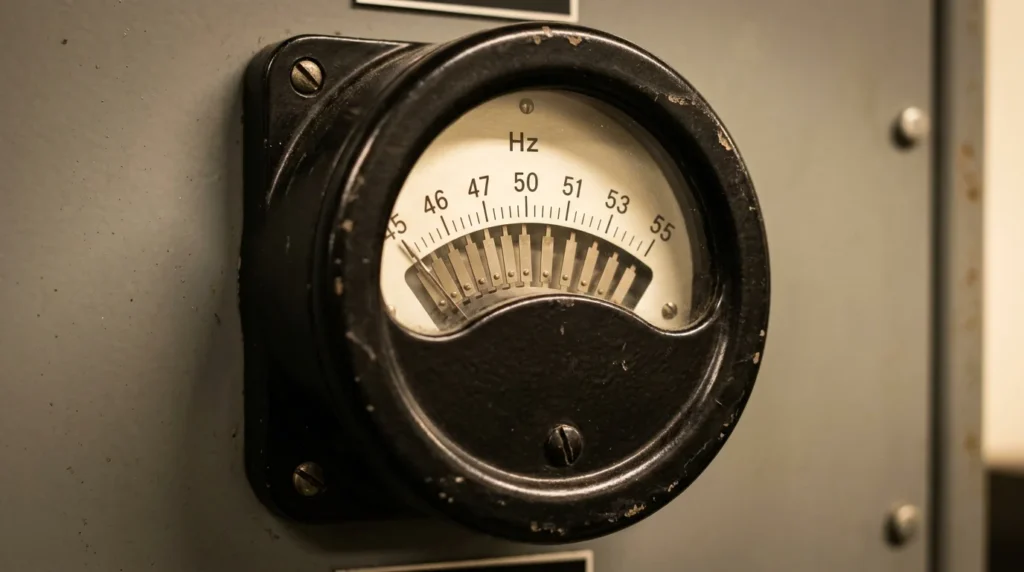
A vibrating reed frequency meter is a specialized analog instrument used to measure the frequency of an alternating current (AC) supply by using the principle of mechanical resonance. It consists of a series of thin steel reeds, each carefully tuned to vibrate at a specific frequency, such as 45 Hz, 46 Hz, 47 Hz, up to 55 Hz or higher, depending on the meter’s range. These reeds are mounted side by side near an electromagnet connected to the AC supply. When the alternating current flows through the electromagnet, it produces a magnetic field that changes direction at the same frequency as the electrical supply. As a result, the reed whose natural frequency matches the supply frequency begins to vibrate with the greatest amplitude due to resonance, while the neighboring reeds vibrate only slightly. The frequency is determined by observing which reed vibrates the most, and the corresponding value printed next to that reed represents the supply frequency. Vibrating reed frequency meters are simple, reliable, and require no complex electronic circuits, making them suitable for industrial environments where ruggedness and durability are important. They are commonly used in power stations, substations, generator panels, switchboards, and industrial electrical systems to monitor AC frequency. These meters are particularly effective for measuring frequencies within a narrow range around the standard power frequencies of 50 Hz or 60 Hz. Although they do not provide the same level of precision as modern digital frequency meters, vibrating reed frequency meters offer excellent visual indication of frequency changes and continue to operate reliably under harsh conditions such as vibration, dust, and electrical interference. They also require very little maintenance because they contain few moving parts and no delicate electronic components. Engineers and technicians often use them for continuous monitoring of generator output and power system stability, where a quick visual confirmation of frequency is sufficient. Despite the widespread use of digital measuring instruments today, vibrating reed frequency meters remain valuable in many industrial applications because of their simple operating principle, dependable performance, long service life, and ability to function without sophisticated electronic circuitry.
Uses metal reeds that vibrate at different frequencies.
Features
- Each reed corresponds to a frequency
- Only one reed vibrates strongly at a time
Use
- Power distribution panels
4. What Is a Resonance Frequency Meter?
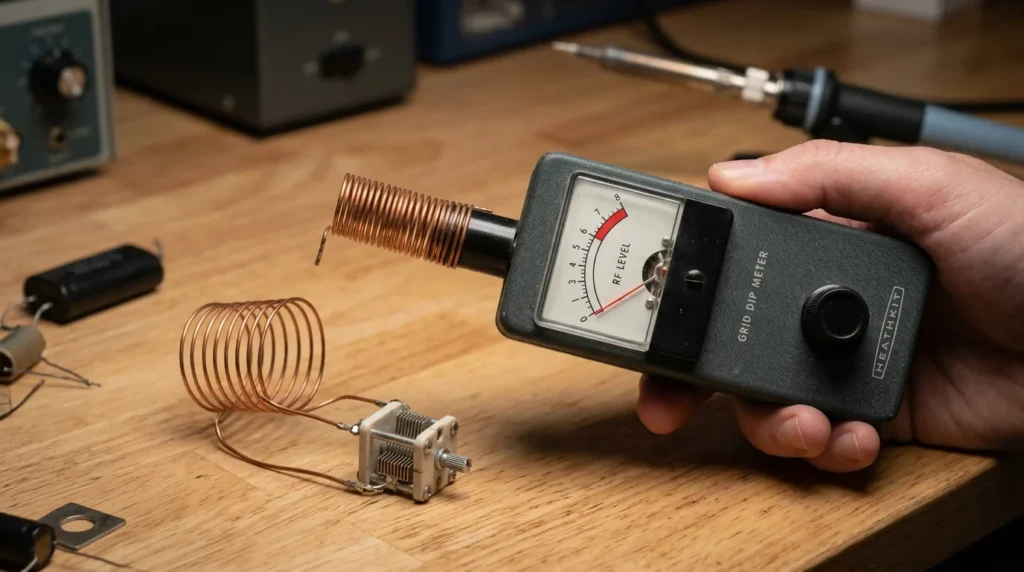
A resonance frequency meter is an electrical measuring instrument that determines the frequency of an alternating current (AC) signal by using the principle of electrical resonance. It operates with a tunable LC (inductor-capacitor) resonant circuit, where the inductance or capacitance is adjusted until the circuit reaches resonance with the incoming AC signal. At the resonant condition, the inductive reactance equals the capacitive reactance, causing the circuit to produce the maximum current or voltage. The frequency corresponding to this resonant point is then indicated on a calibrated scale, allowing the user to determine the frequency of the electrical signal accurately. Resonance frequency meters are widely used in laboratories, communication systems, radio-frequency (RF) testing, electronic research, and educational experiments where precise frequency measurement is required over a broad range. Unlike vibrating reed frequency meters, which are mainly designed for standard power frequencies such as 50 Hz or 60 Hz, resonance frequency meters can measure much higher frequencies, making them suitable for testing oscillators, transmitters, receivers, and electronic circuits. These instruments provide good accuracy because the resonance condition can be identified very precisely. However, they usually require manual tuning of the LC circuit before a reading can be obtained, making the measurement process slower than that of modern digital frequency meters. Despite this limitation, resonance frequency meters remain valuable for demonstrating resonance principles, calibrating electronic equipment, and performing frequency measurements where high sensitivity is important. They have a simple operating principle, require relatively few components, and offer reliable performance when properly calibrated. Although advanced digital frequency counters have largely replaced resonance frequency meters in many industrial and commercial applications, they are still used in laboratories, educational institutions, and specialized testing environments due to their ability to illustrate the practical application of electrical resonance. Their dependable operation, good measurement accuracy, and straightforward design make resonance frequency meters an important instrument for understanding frequency measurement techniques and the behavior of resonant electrical circuits.
Works on resonance principle.
Features
- Uses LC circuit
- Measures frequency based on resonance
Use
- Electronic circuits
5. What Is an Electronic Frequency Counter?
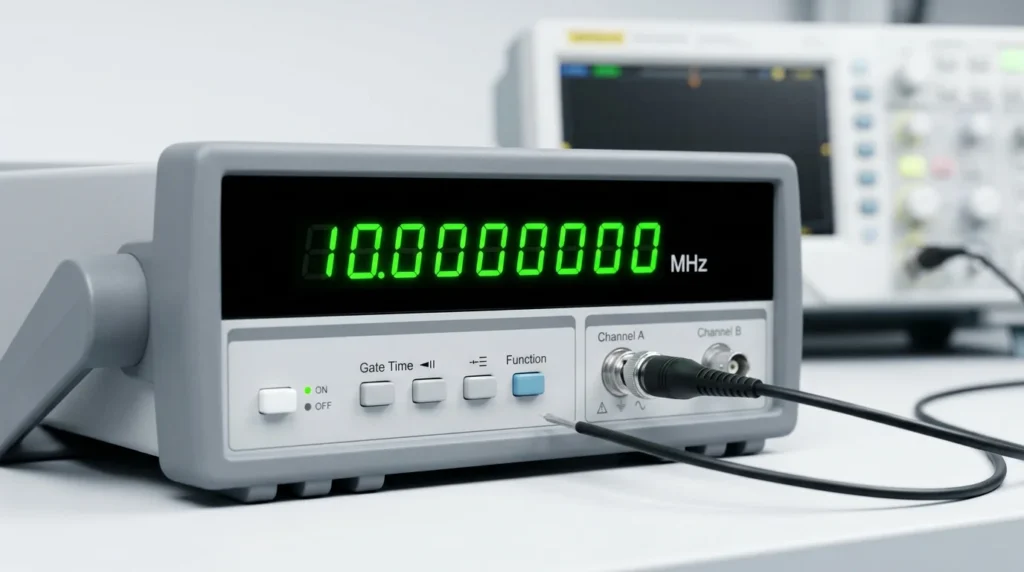
An electronic frequency counter is a precision electronic instrument used to measure the frequency of electrical, electronic, or radio-frequency (RF) signals by counting the number of signal cycles that occur within a specific time interval. Unlike analog frequency meters, which rely on mechanical movement or resonance, an electronic frequency counter uses high-speed digital circuits, a crystal-controlled time base, and a microprocessor to produce highly accurate frequency measurements. The input signal is first conditioned into a clean pulse waveform, after which the instrument counts the pulses during a precisely controlled gate time. The total number of pulses counted is then displayed as the signal frequency on a digital LCD or LED screen in units such as Hertz (Hz), kilohertz (kHz), megahertz (MHz), or gigahertz (GHz), depending on the instrument’s measurement range. Electronic frequency counters are widely used in electronics laboratories, communication systems, broadcasting stations, industrial automation, research facilities, and educational institutions because they provide fast, reliable, and highly accurate frequency measurements. These instruments are commonly used to test oscillators, signal generators, radio transmitters, receivers, digital circuits, microcontrollers, and communication equipment. Many modern electronic frequency counters include advanced functions such as period measurement, time interval measurement, pulse counting, duty cycle measurement, event counting, and automatic range selection, making them versatile diagnostic tools. Their crystal-controlled timing system ensures exceptional accuracy and long-term stability, while the digital display eliminates reading errors associated with analog instruments. Electronic frequency counters can measure frequencies ranging from a few hertz to several gigahertz, depending on the model and input circuitry. Because they have no moving mechanical parts, they require minimal maintenance and provide consistent performance even in demanding industrial environments. Their ability to measure high-frequency signals with excellent precision has made them an essential instrument for electrical engineers, electronics technicians, researchers, and communication professionals. Today, electronic frequency counters are considered one of the most accurate and reliable frequency measurement devices available, playing a vital role in equipment testing, calibration, troubleshooting, quality control, and the maintenance of modern electrical and electronic systems.
Advanced type using digital electronics.
Features
- Counts pulses in a time period
- Very high precision
Use
- Communication systems
- Signal testing
Here is an updated and more informative version of your section with improved headings, explanations, and SEO-friendly content.
Main Components of a Frequency Meter
A frequency meter consists of several essential components that work together to measure the frequency of an electrical signal accurately. Each component performs a specific function to ensure reliable readings in electrical, industrial, and laboratory applications.
1. Input Terminal
The input terminal is the point where the AC signal enters the frequency meter. It safely receives the electrical waveform from the circuit or equipment being tested and transfers it to the internal measurement circuitry.
Functions:
- Receives the input AC signal
- Connects the meter to the electrical circuit
- Ensures stable signal transmission
- Protects internal components from improper connections
2. Signal Conditioning Circuit
Before the signal is measured, it passes through the signal conditioning circuit. This section removes electrical noise, filters unwanted interference, and shapes the waveform into a form that the measurement unit can process accurately.
Functions:
- Filters unwanted electrical noise
- Improves signal quality
- Stabilizes waveform for accurate measurement
- Reduces measurement errors
3. Measurement Unit
The measurement unit is the heart of the frequency meter. It counts the number of cycles occurring within a specific time interval and calculates the signal frequency, which is expressed in Hertz (Hz).
Functions:
- Detects waveform cycles
- Calculates signal frequency
- Processes measurement data
- Ensures high accuracy and precision
4. Display Unit
The display unit presents the measured frequency to the user. Depending on the type of frequency meter, the display may be an analog pointer, LCD screen, LED display, or digital panel that provides clear and easy-to-read results.
Functions:
- Displays frequency in Hertz (Hz)
- Provides clear measurement readings
- Uses analog or digital display technology
- Allows quick monitoring of frequency changes
5. Power Supply
The power supply provides the electrical energy required to operate the internal circuits of the frequency meter. Some frequency meters use batteries, while others are powered directly from the AC mains or through an external DC supply.
Functions:
- Supplies operating power to the meter
- Supports continuous measurement
- Powers the display and processing circuits
- Maintains stable instrument performance
Why These Components Are Important
Each component of a frequency meter plays a vital role in delivering accurate and reliable frequency measurements. From receiving the input signal to processing and displaying the final reading, these parts work together to ensure the meter performs efficiently in electrical testing, power systems, industrial automation, and laboratory applications.
Advantages of Frequency Meter
Key Benefits
- Accurate frequency measurement
- Easy to use and read
- Helps maintain system stability
- Prevents equipment damage
- Useful in both small and large systems
Real-World Benefits
- Ensures motor efficiency
- Improves power quality
- Supports preventive maintenance
Disadvantages / Limitations
Practical Limitations
- Cannot measure DC signals
- Accuracy depends on signal quality
- Analog meters may have reading errors
- Sensitive to noise in some cases
Technical Challenges
- Requires proper calibration
- Digital meters need power supply
Frequency Meter Applications
Frequency meters are widely used in electrical, industrial, commercial, and research environments to measure the frequency of AC signals accurately. They help engineers and technicians monitor equipment performance, maintain power quality, and troubleshoot electrical systems.
1. Power Plants
Power plants use frequency meters to continuously monitor the frequency of the electrical grid. Maintaining the correct frequency is essential for ensuring stable power generation and preventing system disturbances.
Applications:
- Monitor grid frequency
- Maintain power system stability
- Detect frequency fluctuations
- Support reliable power distribution
2. Generators
Frequency meters are commonly installed on generators to verify that the output frequency remains within the required limits. This helps ensure generators operate efficiently and safely.
Applications:
- Check generator output frequency
- Verify proper generator operation
- Monitor engine speed indirectly
- Prevent equipment damage due to incorrect frequency
3. Industrial Machines
Many industrial machines rely on a stable power frequency for accurate operation. Frequency meters help monitor electrical supply and maintain consistent motor speed and machine performance.
Applications:
- Monitor motor operating frequency
- Maintain production efficiency
- Improve machine performance
- Detect electrical supply issues
4. Laboratories
In laboratories, frequency meters are used for testing, research, and analyzing electrical and electronic circuits. They provide precise frequency measurements required for experiments and equipment calibration.
Applications:
- Test electrical and electronic signals
- Analyze circuit performance
- Calibrate laboratory instruments
- Support research and development
5. Home and Commercial Applications
Frequency meters are also used in residential and commercial electrical systems to monitor the output of backup power equipment and renewable energy systems.
Applications:
- Monitor UPS system frequency
- Check inverter output frequency
- Test backup power systems
- Ensure stable electrical supply
Why Frequency Meter Applications Matter
Frequency meters play a crucial role in maintaining the reliability, efficiency, and safety of electrical systems. Whether used in power plants, generators, industrial facilities, laboratories, or homes, they help detect frequency variations early, improve equipment performance, and ensure electrical devices operate within their designed frequency range.
Comparison Section
Frequency Meter vs Voltmeter
| Feature | Frequency Meter | Voltmeter |
|---|---|---|
| Measures | Frequency (Hz) | Voltage (V) |
| Purpose | Signal stability | Voltage level |
| Use | AC systems | AC & DC |
| Importance | System performance | Power supply |
How to Choose the Right Frequency Meter
Selecting the right frequency meter is essential for obtaining accurate frequency measurements, improving system reliability, and ensuring safe operation. Whether you are working with electrical power systems, industrial equipment, generators, or electronic circuits, choosing the correct meter helps you achieve consistent and precise results. Consider the following factors before making your decision.
Important Factors to Consider
Measurement Accuracy
Accuracy is one of the most important considerations when selecting a frequency meter. For industrial plants, laboratories, and calibration work, choose a high-precision digital frequency meter. For basic monitoring and maintenance, standard accuracy may be sufficient.
Frequency Measurement Range
Always select a meter that covers the frequencies you plan to measure. Power systems commonly operate between 45–65 Hz, while electronic devices, communication systems, and RF applications often require meters capable of measuring frequencies ranging from kilohertz (kHz) to gigahertz (GHz).
Meter Type
Different frequency meters are designed for different applications. Choose the type that best suits your requirements.
- Analog Frequency Meter – Ideal for monitoring continuous frequency variations.
- Digital Frequency Meter – Offers precise readings with a clear digital display.
- Electronic Frequency Counter – Best for measuring high-frequency electronic signals.
- Portable Frequency Meter – Convenient for field inspections and maintenance work.
Display and Readability
A bright, easy-to-read display improves efficiency, especially in low-light industrial environments. Digital displays generally provide faster and more accurate readings than analog scales.
Intended Application
Select a frequency meter specifically designed for your working environment.
- Electrical power distribution
- Industrial automation
- Generator maintenance
- Motor testing
- Electronic circuit analysis
- Research laboratories
- Educational training
Safety and Protection
Safety should never be overlooked. Choose a meter with features such as:
- Overload protection
- High-quality insulation
- Fused input protection
- CAT safety ratings (where applicable)
- Compliance with international electrical safety standards
Build Quality and Durability
If the meter will be used in industrial or outdoor environments, select a rugged model with a durable housing that can withstand dust, vibration, moisture, and accidental drops.
Ease of Operation
A user-friendly frequency meter improves productivity. Useful features include:
- Auto-ranging capability
- Backlit display
- Simple control buttons
- Fast measurement response
- Data hold function
- Low battery indication
Calibration and Reliability
Choose a frequency meter that can be calibrated easily and maintains long-term measurement stability. Regular calibration ensures accurate and dependable readings throughout the instrument’s service life.
Budget and Value
Compare different models based on accuracy, features, durability, warranty, and after-sales support. Investing in a reliable frequency meter often provides better long-term value than choosing the lowest-priced option.
Frequency Meter Buying Tips
Buying the right frequency meter becomes easier when you focus on your actual measurement needs rather than unnecessary features.
Tips Before Purchasing
- Determine the frequency range you need to measure.
- Choose a digital frequency meter for higher accuracy.
- Select a trusted and well-reviewed manufacturer.
- Verify safety certifications before purchase.
- Consider future measurement requirements.
- Check calibration support and warranty coverage.
- Ensure compatibility with your electrical system or testing equipment.
- Compare accuracy specifications instead of price alone.
- Read customer reviews and technical specifications carefully.
- Purchase from an authorized dealer whenever possible.
Best Frequency Meter Selection Checklist
Before buying a frequency meter, make sure it offers:
- Appropriate measurement range
- High measurement accuracy
- Easy-to-read display
- Strong safety protection
- Durable construction
- Simple operation
- Reliable calibration support
- Suitable application compatibility
- Good warranty and technical support
- Excellent value for money
Choosing the right frequency meter based on these factors will improve measurement accuracy, reduce maintenance issues, and ensure dependable performance in both industrial and laboratory applications.
Common Problems and Solutions
The following issues are commonly encountered while using a frequency meter.
1. Why is the frequency reading unstable?
Possible Causes:
- Electrical noise or interference
- Loose input connections
- Fluctuating power supply
Solutions:
- Use signal filters if necessary.
- Tighten all electrical connections.
- Keep measurement cables away from high-voltage lines.
- Ensure a stable input signal.
2. Why is the meter not showing any reading?
Possible Causes:
- No input signal
- Incorrect wiring
- Power supply failure
- Damaged fuse or internal component
Solutions:
- Verify the input signal.
- Check all wiring connections.
- Confirm the power supply is working.
- Inspect and replace the fuse if required.
3. Why is the frequency reading incorrect?
Possible Causes:
- Meter calibration error
- Incorrect measurement range
- Faulty input signal
Solutions:
- Recalibrate the frequency meter.
- Select the correct measurement range.
- Test the signal source with another instrument.
4. Why is the display flickering?
Possible Causes:
- Voltage fluctuations
- Weak battery (portable models)
- Loose display connections
Solutions:
- Use a stable power source.
- Replace the battery if necessary.
- Check internal and external connections.
5. Why does the meter show inconsistent readings?
Possible Causes:
- Electromagnetic interference
- Damaged input cables
- Poor grounding
Solutions:
- Use shielded cables.
- Replace damaged leads.
- Ensure proper grounding of the equipment.
Future Trends in Frequency Meters
Advancements in digital electronics and industrial automation are making frequency meters more accurate, intelligent, and easier to integrate into modern electrical systems.
Smart Digital Frequency Meters
Modern frequency meters feature microprocessor-based technology, offering faster measurements, improved precision, and automatic diagnostics.
Wireless Monitoring
Wireless communication enables technicians to monitor frequency remotely without being physically present near the equipment.
IoT Integration
Internet of Things (IoT)-enabled frequency meters can transmit real-time data to cloud platforms for continuous monitoring, predictive maintenance, and performance analysis.
Automation System Integration
Frequency meters are increasingly integrated with PLCs, SCADA systems, and industrial automation networks, allowing automatic monitoring and control of electrical equipment.
Data Logging and Analytics
Many advanced frequency meters can store historical measurement data, helping engineers analyze trends, identify faults, and improve system reliability.
Future Industry Direction
The future of frequency measurement technology is focused on:
- Higher measurement accuracy
- Real-time monitoring and alerts
- Remote access through cloud platforms
- AI-assisted fault detection
- Smart grid compatibility
- Enhanced energy management
- Compact, portable, and multifunction digital instruments
Conclusion
A frequency meter is a simple yet powerful instrument that plays a critical role in electrical systems. It ensures that the frequency remains within safe limits, which is essential for proper operation of machines and equipment.
From power plants to home systems, its applications are wide and important. Understanding the frequency meter working principle, types, and uses helps engineers and technicians maintain system efficiency and safety.
While it has some limitations, modern digital frequency meters provide high accuracy and reliability. As technology advances, frequency measurement is becoming smarter and more integrated with automated systems.
For beginners, learning about frequency meters is a strong step toward mastering electrical measurement and system analysis.