
Imagine waking up early in the morning. You switch on the light, turn on the fan, charge your mobile phone, and make tea using an electric kettle. All these simple actions depend on one invisible power: electricity. Without electricity, modern life would stop. Homes would be dark, industries would close, and communication systems would fail.
Many beginners use electrical devices daily but do not understand how electricity works. This lack of basic knowledge can lead to unsafe practices, wrong connections, and equipment damage. For students, technicians, and engineers, learning the basics of electricity is the first step toward professional success.
This article, “What is Electricity? Basic Guide for Beginners,” will help you understand electricity in simple language. You will learn its definition, working principle, types, components, advantages, disadvantages, and applications. You will also discover practical tips, common problems, and future trends. By the end, you will have strong fundamental knowledge to build your electrical skills.
Electricity
Electricity is a form of energy that results from the movement of electric charges, mainly electrons. It is one of the most important discoveries in science and plays a vital role in modern life. Almost every activity in today’s world depends on electricity, including lighting homes, running machines, powering communication systems, and operating industries. Without electricity, modern society would not function efficiently.
Electricity is mainly produced in power stations using different energy sources such as coal, water, wind, solar energy, and nuclear power. Once generated, it is transmitted through high-voltage transmission lines and then distributed to homes, industries, and commercial areas through a network of substations and transformers. This process ensures that electricity reaches consumers safely and efficiently at usable voltage levels like 230V for homes and higher voltages for industries.
There are two main types of electricity: static electricity and current electricity. Static electricity is the buildup of electric charge on the surface of an object, while current electricity is the continuous flow of electric charge through a conductor. Current electricity is what we commonly use in our daily life.
Electricity works on basic principles such as voltage, current, and resistance. Voltage is the electrical pressure, current is the flow of electrons, and resistance is the opposition to the flow of current. These three factors are related by Ohm’s Law, which is a fundamental principle in electrical engineering.
Electricity has many advantages, including ease of use, high efficiency, and ability to transmit energy over long distances. It is clean at the point of use and can be converted into other forms of energy such as light, heat, and motion. However, electricity can also be dangerous if not handled properly, as it can cause electric shocks, fires, and equipment damage.
In modern life, electricity is used in homes, hospitals, schools, transportation systems, communication devices, and industries. It powers computers, mobile phones, air conditioners, motors, and countless other devices. Renewable energy sources are also becoming more popular for generating electricity in an environmentally friendly way.
Overall, electricity is the backbone of modern civilization. It supports technological development, improves living standards, and plays a key role in economic growth and industrial progress.
2. What is Electricity? Complete Beginner’s Guide (2026)
Definition of Electricity
Electricity is a form of energy produced by the movement of electric charges, primarily electrons, through a conductive material such as a copper or aluminum wire. It is one of the most important energy sources in the modern world, powering homes, industries, transportation systems, communication networks, and electronic devices.
In simple terms, electricity is the controlled flow of electrons from one point to another through a closed electrical circuit. This flow of electrons carries energy that can be converted into light, heat, sound, or mechanical motion, depending on the electrical device being used.
Without electricity, most of the technologies and conveniences we rely on every day would not function.
Simple Explanation of Electricity
Everything around us is made up of tiny particles called atoms. Each atom contains three main particles:
- Protons (positive charge)
- Neutrons (no charge)
- Electrons (negative charge)
Among these particles, electrons are capable of moving from one atom to another. When a voltage source, such as a battery or generator, creates an electrical pressure, these electrons begin moving in the same direction through a conductor. This movement is known as electric current, which is what we commonly call electricity.
The faster and more organized the movement of electrons, the greater the electrical energy that can be delivered to electrical equipment.
Electricity Explained with a Simple Water Flow Analogy
One of the easiest ways to understand electricity is by comparing it to water flowing through a pipe.
| Water System | Electrical System |
|---|---|
| Water | Electrons |
| Water Pipe | Electrical Wire |
| Water Pressure | Voltage |
| Water Flow | Electric Current |
| Narrow Pipe | Resistance |
| Water Tap | Electrical Switch |
| Water Pump | Power Source |
Just as water flows through a pipe because of pressure, electrons flow through a wire because of voltage. If the switch is turned off (or the pipe is blocked), the flow stops. When the circuit is closed, electricity flows and powers electrical devices.
Practical Example of Electricity
A common example of electricity can be seen when you plug a mobile phone charger into a wall socket.
The power station generates electrical energy and delivers it through transmission lines, distribution networks, and finally to your home’s electrical outlet. When you connect the charger and switch it on, electrons begin flowing through the charging cable into the charger, which converts the electrical energy into the correct voltage needed to charge your phone’s battery.
This continuous movement of electrons is a practical demonstration of electricity in everyday life.
3. Working Principle of Electricity (2026)
How Does Electricity Work?
The working principle of electricity is based on the movement of electrons through a closed electrical circuit under the influence of an electrical force called voltage.
A voltage source creates an electrical potential difference between two points. This potential difference pushes electrons through a conductor, creating an electric current. As the current passes through electrical devices such as bulbs, fans, televisions, or motors, electrical energy is converted into useful forms like light, heat, sound, or mechanical energy.
The flow of electrons continues until the circuit is opened or the power source is removed.
Step-by-Step Working Process of Electricity
Step 1: Electricity is Generated
Electricity is produced by a power source such as a generator, battery, solar panel, or wind turbine. The source creates electrical energy and provides the voltage needed to move electrons.
Step 2: Voltage Creates Electrical Pressure
Voltage acts like pressure inside the electrical circuit. It pushes electrons from the negative terminal toward the positive terminal through a conductor.
Without voltage, electrons remain stationary and no current flows.
Step 3: Electrons Flow Through the Wire
Once the circuit is closed, electrons begin moving through the conductor. This movement of electrons is called electric current.
The conductor provides a low-resistance path that allows electricity to travel efficiently.
Step 4: Electrical Devices Use the Energy
As electric current passes through appliances and electrical equipment, they convert electrical energy into useful forms of energy.
For example:
- Electric bulb → Light energy
- Heater → Heat energy
- Fan → Mechanical energy
- Speaker → Sound energy
- Mobile charger → Battery charging
Step 5: The Circuit is Completed
After passing through the electrical device, the current returns to the power source, completing the circuit.
A continuous, closed circuit is essential for electricity to flow safely and efficiently.
Easy Analogy to Understand Electricity
Imagine a water tank connected to a pipe with a tap.
| Water System | Electrical System |
|---|---|
| Water Tank | Power Source |
| Water Pressure | Voltage |
| Water Flow | Electric Current |
| Pipe | Electrical Wire |
| Tap | Switch |
| Water Wheel | Electrical Load |
When the tap is opened, water flows through the pipe and turns the water wheel. Similarly, when an electrical switch is turned on, current flows through the wire and powers the connected electrical device.
Key Points About the Working Principle of Electricity
- Electricity flows only through a closed electrical circuit.
- Voltage provides the force that moves electrons.
- Current is the movement of electrons through a conductor.
- Resistance limits and controls the flow of current.
- Electrical devices convert electrical energy into useful forms of energy.
- Conductors allow electricity to flow easily, while insulators prevent current flow.
- A complete circuit is necessary for electrical equipment to operate correctly.
The working principle of electricity is simple: a power source creates voltage, voltage pushes electrons through a conductor, and the moving electrons (electric current) deliver energy to electrical devices. As long as the circuit remains closed, electricity continues to flow, allowing electrical equipment to perform useful work efficiently and safely. This basic principle forms the foundation of every electrical and electronic system used today.
4. Types / Classification of Electricity (2026)
Electricity is broadly classified into two main types based on the way electric charges behave:
- Static Electricity
- Current Electricity
Each type has different characteristics, methods of generation, and practical applications. Understanding these two forms of electricity is essential for learning the basics of electrical engineering and power systems.
What is Static Electricity? Complete Guide (2026)
Static electricity is a type of electrical energy in which electric charges accumulate and remain at rest on the surface of an object. It is produced when electrons are transferred from one material to another through friction, contact, or induction.
Unlike current electricity, static electricity does not flow continuously through a conductor. Instead, the charges remain stored on the object’s surface until they are suddenly discharged.
How Does Static Electricity Work?
When two different materials are rubbed together, electrons move from one material to the other.
As a result:
- One object loses electrons and becomes positively charged.
- The other object gains electrons and becomes negatively charged.
The electric charges remain on the surfaces because there is no complete path for continuous current flow. When the charged object comes close to another object with a different electrical potential, the stored charge is released suddenly as an electric discharge.
Characteristics of Static Electricity
- Electricity remains at rest on an object’s surface.
- Produced by friction, contact, or induction.
- Charges do not flow continuously.
- Usually generated on insulating materials.
- Released suddenly as an electric spark or discharge.
- More common in dry weather due to low humidity.
- Can attract lightweight objects because of electrostatic force.
Common Examples of Static Electricity
Static electricity is commonly experienced in daily life.
Examples include:
- Rubbing a balloon on your hair and watching it stick to a wall.
- Feeling a small electric shock after walking on a carpet and touching a metal door handle.
- Clothes sticking together after coming out of a clothes dryer.
- Plastic comb attracting small pieces of paper.
- Lightning during thunderstorms.
Applications of Static Electricity
Although static electricity is often associated with small shocks, it has many useful industrial and commercial applications.
Some important applications include:
- Photocopiers
- Laser printers
- Electrostatic spray painting
- Air purification systems
- Electrostatic precipitators in power plants
- Powder coating
- Inkjet printing technology
- Dust removal systems
Advantages of Static Electricity
- Useful in modern printing technology.
- Improves paint coating efficiency.
- Helps remove dust and smoke particles from industrial exhaust gases.
- Used in pollution control equipment.
- Supports various manufacturing processes.
Disadvantages of Static Electricity
- Can cause unwanted electric shocks.
- May damage sensitive electronic components.
- Creates fire and explosion hazards near flammable gases or liquids.
- Can interfere with electronic equipment.
- Requires grounding and safety measures in industrial environments.
Natural Example of Static Electricity
The most powerful natural example of static electricity is lightning.
Inside thunderclouds, positive and negative electric charges build up due to the movement of water droplets and ice particles. When the voltage difference becomes extremely high, the accumulated charge is released suddenly as a massive electrical discharge between clouds or between a cloud and the ground.
Lightning demonstrates the enormous amount of energy that can be produced by static electricity.
Static electricity is electricity at rest, produced by the accumulation of electric charges on the surface of an object. It is generated through friction, contact, or induction and remains stored until discharged. Although it can cause shocks and industrial hazards, static electricity has many valuable applications in printing, manufacturing, pollution control, and other modern technologies. Understanding static electricity provides a strong foundation for learning the broader concepts of electricity and electrical engineering.
Current Electricity: Complete Guide (2026)
What is Current Electricity?
Current electricity is the continuous flow of electric charges (mainly electrons) through a conductor such as a copper or aluminum wire. It is produced when a voltage (electric potential difference) pushes electrons through a closed electrical circuit. Unlike static electricity, where electric charges remain stationary, current electricity involves the constant movement of electrons from one point to another.
Current electricity is the most commonly used form of electricity and powers nearly every electrical and electronic device used today, including lighting systems, household appliances, industrial machinery, computers, communication equipment, and transportation systems.
How Does Current Electricity Work?
The working principle of current electricity is based on the movement of electrons through a complete electrical circuit.
The process works as follows:
- A power source such as a battery or generator creates a voltage.
- The voltage produces an electrical pressure that pushes electrons.
- Electrons begin moving through the conductor.
- The electric current passes through the connected electrical device (load).
- The device converts electrical energy into light, heat, sound, or mechanical energy.
- The current returns to the power source, completing the circuit.
Without a closed circuit, current cannot flow.
Current Electricity Formula (Ohm’s Law)
The relationship between current, voltage, and resistance is explained by Ohm’s Law.
[
I = \frac{V}{R}
]
Where:
- I = Electric Current (Ampere, A)
- V = Voltage (Volt, V)
- R = Resistance (Ohm, Ω)
This equation shows that current increases when voltage increases and decreases when resistance increases.
Unit of Current Electricity
Electric current is measured in Amperes (A).
Common measuring instruments include:
- Ammeter
- Clamp Meter
- Digital Multimeter
Types of Current Electricity
Current electricity is mainly divided into two types.
1. Direct Current (DC)
Direct Current (DC) flows in only one direction from the negative terminal to the positive terminal of the power source.
Examples:
- Batteries
- Solar panels
- Mobile phone batteries
- Power banks
- Electronic circuits
Applications:
- Portable electronic devices
- LED lighting
- Electric vehicles
- Communication equipment
- Computer systems
2. Alternating Current (AC)
Alternating Current (AC) changes its direction continuously at regular intervals. Most countries use AC because it can be transmitted efficiently over long distances using transformers.
Examples:
- Household electricity supply
- Industrial power systems
- Electrical substations
- Commercial buildings
Applications:
- Home appliances
- Air conditioners
- Water pumps
- Industrial motors
- Lighting systems
- Power distribution networks
Characteristics of Current Electricity
Current electricity has several important characteristics.
- Electric charges move continuously through a conductor.
- Requires a complete or closed electrical circuit.
- Flows because of applied voltage.
- Can be AC or DC.
- Easily controlled using electrical devices.
- Converts electrical energy into useful forms of energy.
- Can travel long distances through transmission and distribution systems.
Examples of Current Electricity
Current electricity is used in almost every aspect of modern life.
Common examples include:
- Electric bulbs
- Ceiling fans
- Refrigerators
- Air conditioners
- Mobile phone chargers
- Computers and laptops
- Televisions
- Washing machines
- Electric motors
- Water pumps
- Elevators
- Industrial machinery
For example, when you turn on a light switch, the electrical circuit is completed, allowing current to flow through the bulb. The bulb then converts electrical energy into light, illuminating the room.
Applications of Current Electricity
Current electricity is essential in numerous sectors.
Major applications include:
- Residential electrical systems
- Commercial buildings
- Industrial manufacturing
- Power transmission and distribution
- Hospitals and medical equipment
- Telecommunications
- Railway and metro systems
- Electric vehicles
- Renewable energy systems
- Automation and control systems
Advantages of Current Electricity
Current electricity offers many benefits.
- Provides continuous electrical power.
- Operates electrical and electronic equipment efficiently.
- Easy to generate and distribute.
- Supports modern communication systems.
- Powers industries and manufacturing plants.
- Essential for transportation and automation.
- Reliable for domestic, commercial, and industrial applications.
Disadvantages of Current Electricity
Despite its advantages, current electricity also has some limitations.
- Can cause electric shock if handled improperly.
- High current may lead to overheating.
- Short circuits can damage electrical equipment.
- Electrical faults may result in fires.
- Requires protective devices and proper insulation.
- Regular maintenance is necessary for safe operation.
Safety Measures for Current Electricity
To use current electricity safely, follow these precautions:
- Never touch bare electrical wires.
- Use properly insulated cables and equipment.
- Install circuit breakers and fuses.
- Ensure proper earthing (grounding).
- Switch off the power before maintenance.
- Avoid overloading electrical circuits.
- Keep electrical equipment away from water.
- Use appropriate personal protective equipment (PPE) when working on electrical systems.
Current electricity is the continuous movement of electric charges through a conductor under the influence of voltage. It forms the foundation of modern electrical and electronic systems, supplying energy to homes, industries, commercial buildings, and transportation networks. Available as Direct Current (DC) and Alternating Current (AC), current electricity powers nearly every device used in daily life. With proper safety measures and protection systems, it provides a reliable, efficient, and indispensable source of energy for today’s world.
AC Electricity (Alternating Current): Complete Guide (2026)
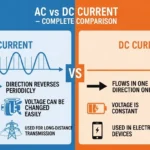
Alternating Current (AC) is a type of electric current in which the direction and magnitude of the current change continuously with time. Unlike Direct Current (DC), which flows in only one direction, AC reverses its direction periodically, making it highly suitable for electrical power generation, transmission, and distribution.
Today, AC electricity is the most widely used form of electrical power worldwide. It supplies electricity to homes, offices, factories, hospitals, schools, shopping malls, and commercial buildings. One of its greatest advantages is that its voltage can be easily increased or decreased using transformers, allowing efficient transmission over long distances with minimal energy loss.
How Does AC Electricity Work?
The working principle of AC electricity is based on electromagnetic induction.
When a conductor rotates inside a magnetic field (or a magnetic field rotates around a conductor), the direction of the induced voltage changes continuously. As a result, the electric current also changes direction at regular intervals, producing alternating current.
The complete process is as follows:
- An AC generator rotates inside a magnetic field.
- Electromagnetic induction produces alternating voltage.
- The current changes direction periodically.
- Transformers increase the voltage for long-distance transmission.
- Electricity travels through high-voltage transmission lines.
- Distribution transformers reduce the voltage before supplying consumers.
- AC electricity powers electrical appliances safely and efficiently.
AC Voltage Equation
The instantaneous value of AC voltage is represented by the sinusoidal equation:
[
V = V_m \sin(\omega t)
]
Where:
- V = Instantaneous voltage
- Vm = Maximum (peak) voltage
- ω = Angular frequency (rad/s)
- t = Time (seconds)
This sinusoidal waveform is the most common form of AC electricity used in electrical power systems.
Frequency of AC Electricity
The frequency of AC indicates how many times the current completes one full cycle every second.
- 50 Hz – Used in most countries, including Europe, Asia, Australia, and many other regions.
- 60 Hz – Used in countries such as the United States, Canada, and parts of South America.
For example, a 50 Hz power supply changes its direction 50 times per second, while a 60 Hz supply changes direction 60 times per second.
Types of AC Electricity
AC electricity is generally divided into two main types.
1. Single-Phase AC
Single-phase AC consists of one alternating voltage waveform and is mainly used for residential and light commercial applications.
Applications:
- Homes
- Apartments
- Small offices
- Lighting systems
- Fans
- Televisions
- Refrigerators
- Air conditioners
- Washing machines
2. Three-Phase AC
Three-phase AC consists of three alternating voltages separated by 120° from each other.
It provides smoother power delivery and higher efficiency, making it ideal for industrial applications.
Applications:
- Factories
- Industrial motors
- Water pumps
- Compressors
- Manufacturing plants
- Large HVAC systems
- Heavy electrical machinery
Characteristics of AC Electricity
AC electricity has several important characteristics.
- Current changes direction continuously.
- Voltage varies in a sinusoidal waveform.
- Easy to step up and step down using transformers.
- Suitable for long-distance power transmission.
- Efficient for supplying large electrical loads.
- Available as single-phase and three-phase systems.
- Widely used throughout modern electrical power networks.
Applications of AC Electricity
Alternating Current is used in almost every sector of modern life.
Major applications include:
- Residential power supply
- Commercial buildings
- Industrial manufacturing
- Electrical transmission networks
- Power distribution systems
- Hospitals
- Educational institutions
- Shopping malls
- Airports
- Railway electrification
- Water treatment plants
- Agricultural irrigation systems
Advantages of AC Electricity
AC electricity offers numerous benefits.
- Highly efficient for long-distance transmission.
- Voltage can be easily increased or decreased using transformers.
- Lower transmission losses at high voltages.
- Supports three-phase power systems.
- Economical for large-scale power distribution.
- Powers both domestic and industrial equipment.
- Reliable and cost-effective electrical supply.
Disadvantages of AC Electricity
Despite its advantages, AC electricity has certain limitations.
- Reactive power reduces overall system efficiency.
- Power factor correction is often required.
- More complex than DC for some electronic circuits.
- Can produce electromagnetic interference (EMI).
- Requires synchronization in interconnected power systems.
- High-voltage AC systems require advanced protection equipment.
Examples of AC Electricity
Common examples of AC electricity include:
- Electricity supplied from wall sockets
- Ceiling fans
- Refrigerators
- Air conditioners
- Washing machines
- Electric ovens
- Water pumps
- Industrial motors
- Street lighting
- Commercial buildings
Whenever you plug an appliance into a household electrical outlet, it operates using Alternating Current (AC) supplied by the electrical distribution network.
Safety Measures for AC Electricity
Because AC electricity can be hazardous, proper safety practices are essential.
Important precautions include:
- Never touch exposed live wires.
- Use properly insulated cables and equipment.
- Install circuit breakers and residual current devices (RCDs).
- Ensure proper earthing (grounding).
- Avoid operating electrical equipment with wet hands.
- Disconnect the power supply before maintenance.
- Use personal protective equipment (PPE) when working on electrical installations.
Alternating Current (AC) is the most widely used type of electricity in modern power systems. It continuously changes its direction and follows a sinusoidal waveform, making it ideal for efficient power generation, long-distance transmission, and large-scale distribution. Its ability to work with transformers and three-phase systems allows electricity to be delivered safely and economically to homes, businesses, and industries worldwide. For these reasons, AC electricity remains the backbone of today’s electrical power infrastructure.
DC Electricity (Direct Current): Complete Guide (2026)
What is DC Electricity (Direct Current)?
Direct Current (DC) is a type of electric current that flows in only one direction through an electrical circuit. Unlike Alternating Current (AC), which continuously changes its direction, DC provides a steady and constant flow of electrons from the negative terminal to the positive terminal of a power source.
Because of its stable voltage and current, DC electricity is widely used in electronic devices, battery-powered equipment, renewable energy systems, communication networks, and electric vehicles. Most portable electronic devices operate using DC power due to its reliability and ease of control.
How Does DC Electricity Work?
The working principle of DC electricity is based on the continuous movement of electrons in a single direction through a closed electrical circuit.
The process works as follows:
- A DC power source, such as a battery or solar panel, produces a constant voltage.
- The voltage creates an electrical pressure that pushes electrons through the conductor.
- Electrons flow continuously in one direction.
- The electrical device (load) converts electrical energy into useful energy such as light, heat, or mechanical motion.
- The current returns to the power source, completing the circuit.
Since the direction of current never changes, DC provides a stable and reliable source of electrical energy.
DC Power Formula
The electrical power in a DC circuit is calculated using the following equation:
[
P = V \times I
]
Where:
- P = Electrical Power (Watts, W)
- V = Voltage (Volts, V)
- I = Current (Amperes, A)
This formula shows that electrical power is equal to the product of voltage and current.
Sources of DC Electricity
Direct Current is produced by several electrical sources.
Common sources include:
- Batteries
- Solar panels (photovoltaic cells)
- Fuel cells
- DC generators
- Power banks
- USB power supplies
- DC power supplies
- Rectifiers (AC to DC converters)
Characteristics of DC Electricity
Direct Current has several unique characteristics.
- Flows in only one direction.
- Provides constant voltage and current.
- Does not change frequency.
- Ideal for electronic circuits.
- Easy to store in batteries.
- Suitable for low-voltage applications.
- Provides stable electrical output.
Applications of DC Electricity
DC electricity is widely used in modern electrical and electronic systems.
Major applications include:
- Mobile phones
- Laptops
- Tablets
- LED lighting
- Power banks
- Calculators
- Radios
- Computer systems
- Communication equipment
- CCTV systems
- Electric vehicles (EVs)
- Solar photovoltaic systems
- Battery charging systems
- Industrial control circuits
- Medical electronic equipment
Advantages of DC Electricity
Direct Current offers several important benefits.
- Stable and constant voltage output.
- Ideal for sensitive electronic devices.
- Easy to store in rechargeable batteries.
- Highly efficient for low-voltage applications.
- Better compatibility with solar energy systems.
- Easier electronic speed and power control.
- Reliable for communication and automation systems.
Disadvantages of DC Electricity
Despite its advantages, DC electricity has some limitations.
- Less economical for conventional long-distance transmission.
- Voltage cannot be changed using ordinary transformers.
- Requires electronic converters (DC-DC converters) for voltage conversion.
- Battery systems require regular charging and maintenance.
- High-current DC circuits may require larger conductors.
High Voltage Direct Current (HVDC)
Modern electrical power systems also use High Voltage Direct Current (HVDC) technology for transmitting electricity over very long distances.
HVDC offers several advantages, including:
- Lower transmission losses over long distances.
- Efficient transmission through underground and submarine cables.
- Better interconnection between different AC power grids.
- Improved stability for large electrical networks.
- Reduced reactive power losses.
Because of these benefits, HVDC technology is increasingly used in renewable energy projects and international power transmission systems.
Examples of DC Electricity
Direct Current is used in many everyday devices.
Common examples include:
- Mobile phone batteries
- Laptop batteries
- Power banks
- Solar panels
- Flashlights
- Electric toys
- CCTV cameras
- USB chargers
- Electric vehicles
- Portable medical equipment
For example, when you use a smartphone powered by its battery, the device operates using Direct Current (DC). Similarly, electricity generated by solar panels is DC before it is converted to AC by an inverter for household use.
Safety Measures for DC Electricity
Although DC voltage is generally lower in many applications, it can still be dangerous if handled improperly.
Important safety precautions include:
- Avoid touching exposed live conductors.
- Use insulated wires and connectors.
- Install appropriate fuses and circuit breakers.
- Disconnect the power source before maintenance.
- Ensure correct battery polarity during installation.
- Use properly rated chargers and power supplies.
- Wear suitable personal protective equipment (PPE) when working on high-voltage DC systems.
Direct Current (DC) is a type of electricity that flows continuously in one direction, providing a stable and reliable source of electrical power. It is produced by batteries, solar panels, fuel cells, and DC generators, making it essential for electronic devices, renewable energy systems, communication equipment, and electric vehicles. Although conventional DC systems are less suitable for standard long-distance transmission, modern HVDC technology has made Direct Current an important solution for efficient, long-distance power transfer. Its stable output and compatibility with electronic systems make DC electricity a fundamental part of today’s technology and future energy systems.
5. Main Components of an Electrical System (2026 Guide)
An electrical system consists of several essential components that work together to generate, transmit, control, protect, and use electrical energy safely and efficiently. Each component has a specific function, and the failure of any one part can affect the overall performance of the system.
Understanding these components is fundamental for electrical students, technicians, engineers, and anyone learning the basics of electricity.
1. Power Source
What is a Power Source?
A power source is the component that generates or supplies electrical energy to the entire electrical system. It creates the voltage (electrical pressure) required to move electrons through a conductor and operate electrical devices.
Without a power source, no electric current can flow.
Common Examples of Power Sources
- Power stations
- Electrical generators
- Batteries
- Solar panels
- Wind turbines
- Fuel cells
- UPS (Uninterruptible Power Supply)
Main Functions
- Generates electrical energy.
- Provides voltage to the circuit.
- Supplies continuous electrical power.
- Starts the flow of electric current.
2. Conductors
What are Conductors?
Conductors are materials that allow electric current to flow easily because they contain a large number of free electrons. They provide a low-resistance path for electricity to travel from the power source to electrical loads.
Copper and aluminum are the most commonly used conductors due to their excellent electrical conductivity and durability.
Common Examples of Conductors
- Copper wire
- Aluminum wire
- Copper busbars
- Aluminum busbars
- Transmission cables
- Distribution cables
Main Functions
- Carry electric current.
- Connect electrical components.
- Reduce energy losses.
- Ensure efficient power transmission and distribution.
3. Insulators
What are Insulators?
Insulators are materials that resist the flow of electric current. They are used to protect people and equipment by preventing electricity from flowing where it is not intended.
Insulators are commonly used to cover electrical wires, support overhead transmission lines, and separate energized parts from grounded structures.
Common Examples of Insulators
- Plastic
- Rubber
- Glass
- Porcelain
- Ceramic
- PVC
- Fiberglass
Main Functions
- Prevent electric leakage.
- Protect users from electric shock.
- Support conductors safely.
- Improve electrical system safety.
- Reduce the risk of short circuits.
4. Load (Electrical Device)
What is an Electrical Load?
An electrical load is any device or equipment that consumes electrical energy and converts it into another useful form of energy, such as light, heat, sound, or mechanical motion.
Loads are the final consumers of electricity in an electrical system.
Common Examples of Electrical Loads
- LED bulbs
- Ceiling fans
- Electric motors
- Air conditioners
- Refrigerators
- Washing machines
- Water heaters
- Computers
- Mobile phone chargers
- Televisions
Main Functions
- Consume electrical energy.
- Convert electricity into useful energy.
- Perform useful electrical work.
- Complete the purpose of the electrical system.
5. Switch
What is a Switch?
A switch is an electrical control device used to open or close an electrical circuit. It allows users to start or stop the flow of electric current safely.
Switches are available in many forms, including manual switches, push buttons, selector switches, and smart switches.
Common Examples of Switches
- Wall switch
- Push-button switch
- Toggle switch
- Rotary switch
- Selector switch
- Smart switch
Main Functions
- Turn electrical devices ON and OFF.
- Control the flow of electricity.
- Improve user safety.
- Isolate equipment during maintenance.
6. Protection Devices
What are Protection Devices?
Protection devices are safety components that protect electrical systems, equipment, and users from faults such as overloads, short circuits, earth leakage, and electrical fires.
These devices automatically disconnect the power supply whenever abnormal electrical conditions occur.
Common Examples of Protection Devices
- Fuse
- Miniature Circuit Breaker (MCB)
- Molded Case Circuit Breaker (MCCB)
- Residual Current Circuit Breaker (RCCB)
- Earth Leakage Circuit Breaker (ELCB)
- Residual Current Device (RCD)
- Surge Protection Device (SPD)
- Protective Relays
Main Functions
- Protect against overloads.
- Prevent short circuits.
- Detect earth leakage faults.
- Protect electrical equipment.
- Reduce fire hazards.
- Improve system reliability and safety.
How These Components Work Together
All electrical system components work together to deliver electricity safely and efficiently.
The process is as follows:
- The power source generates electrical energy.
- Conductors carry the electricity through the circuit.
- The switch controls the flow of current.
- Protection devices monitor the system and disconnect power during faults.
- The load uses electrical energy to perform useful work.
- Insulators prevent unwanted current flow and ensure safe operation.
This coordinated operation ensures that electricity is generated, transmitted, controlled, protected, and utilized safely in homes, commercial buildings, and industrial facilities.
The main components of an electrical system include the power source, conductors, insulators, electrical loads, switches, and protection devices. Each component performs a unique function, from generating and carrying electricity to controlling, protecting, and using electrical energy. Together, these components form a safe, reliable, and efficient electrical system that powers modern homes, industries, businesses, and infrastructure around the world.
6. Advantages of Electricity
Electricity has many benefits in daily life.
Key Advantages (Bullet Points)
- Easy to use and control
- Clean energy at user end
- Fast transmission
- High efficiency
- Supports modern technology
- Improves living standards
- Saves time and labor
- Enables automation
Real-World Benefits
- Hospitals use electricity for life-saving machines.
- Industries use it for production.
- Homes use it for comfort.
These points show electricity advantages and disadvantages clearly.
7. Disadvantages / Limitations of Electricity
Although useful, electricity has some limitations.
Main Disadvantages
- Electric shock risk
- Fire hazards
- Power failure problems
- Expensive setup
- Needs skilled handling
- Environmental impact (generation)
Practical Concerns
Improper wiring can cause accidents. Poor maintenance can damage equipment. That is why safety is very important.
8. Applications of Electricity
Electricity applications cover almost every field.
Home Applications
- Lighting
- Fans
- Refrigerators
- Washing machines
- TVs
- Charging devices
Industrial Applications
- Motors
- Welding machines
- CNC machines
- Automation systems
- Compressors
Commercial Uses
- Offices
- Banks
- Shopping malls
- Data centers
Modern Technology Uses
- Smartphones
- Computers
- Internet systems
- Electric vehicles
- Robotics
These examples show wide electricity applications.
9. Comparison Section: AC vs DC Electricity
Understanding the difference between AC and DC is important.
Comparison Table
| Feature | AC (Alternating Current) | DC (Direct Current) |
| Direction | Changes repeatedly | One direction |
| Source | Power stations | Batteries |
| Distance | Long distance | Short distance |
| Usage | Homes, industries | Electronics |
| Cost | Low transmission cost | Higher cost |
Explanation
AC is better for power distribution. DC is better for electronic devices. This explains the difference between AC and DC.
10. Selection Guide for Beginners
Choosing the right electrical system is important.
How to Choose
For Home Use:
- Use AC supply
- Install safety devices
- Use standard wiring
For Electronics:
- Use DC supply
- Use regulated adapters
- Check voltage rating
For Solar Systems:
- Use hybrid systems
- Install inverter
- Use quality batteries
Beginner Tips
- Always check voltage.
- Use certified equipment.
- Follow safety rules.
- Avoid overloading.
- Consult experts.
11. Common Electrical Problems and Their Solutions (2026 FAQ Guide)
Electrical systems may occasionally develop faults due to overloading, poor wiring, damaged equipment, or improper maintenance. Identifying these problems early and applying the correct solution helps improve safety, reduce downtime, and extend the life of electrical equipment.
Below are some of the most common electrical problems along with their causes and recommended solutions.
Q1. Why Does My Fuse Blow Frequently?
Possible Causes:
- Circuit overload
- Short circuit
- Faulty electrical appliance
- Damaged wiring
- Incorrect fuse rating
Solution:
- Disconnect unnecessary electrical appliances.
- Check for overloaded circuits.
- Inspect wiring for damage or loose connections.
- Replace the fuse with the correct rating.
- If the problem continues, consult a qualified electrician.
Q2. Why Do My Lights Flicker?
Possible Causes:
- Loose wire connections
- Voltage fluctuations
- Faulty light switch
- Defective bulb
- Overloaded electrical circuit
Solution:
- Tighten loose electrical connections.
- Replace damaged bulbs or switches.
- Check the electrical panel for loose terminals.
- Avoid overloading the circuit.
- Contact the electricity supplier if voltage fluctuations are frequent.
Q3. Why Is My Electrical Device Overheating?
Possible Causes:
- Overloading
- Poor ventilation
- Dust accumulation
- Faulty internal components
- Loose electrical connections
Solution:
- Reduce the electrical load.
- Ensure adequate ventilation around the device.
- Clean cooling vents regularly.
- Inspect power cords and connections.
- Replace damaged components if necessary.
Q4. Why Is There No Power in My Home or Office?
Possible Causes:
- Tripped MCB or RCCB
- Blown fuse
- Power outage
- Loose electrical connection
- Faulty main switch
Solution:
- Check the main electrical panel.
- Reset the MCB or RCCB if it has tripped.
- Replace a blown fuse with the correct rating.
- Confirm whether there is a utility power outage.
- Contact a qualified electrician if the problem persists.
Q5. Why Do I Receive an Electric Shock?
Possible Causes:
- Poor earthing (grounding)
- Damaged insulation
- Exposed live wires
- Faulty electrical appliances
- Moisture near electrical equipment
Solution:
- Install a proper earthing system.
- Replace damaged cables and insulation.
- Never touch exposed conductors.
- Install RCCBs or RCDs for shock protection.
- Keep electrical equipment dry and well maintained.
Q6. Why Does My Circuit Breaker Trip Repeatedly?
Possible Causes:
- Circuit overload
- Short circuit
- Earth leakage fault
- Defective electrical appliance
Solution:
- Disconnect unnecessary appliances.
- Locate and repair the faulty circuit.
- Test appliances individually.
- Replace damaged wiring if required.
Q7. Why Are My Electricity Bills So High?
Possible Causes:
- High-power appliances
- Old, inefficient equipment
- Standby power consumption
- Poor energy management
Solution:
- Use energy-efficient appliances.
- Switch off devices when not in use.
- Replace old lighting with LED bulbs.
- Monitor electricity consumption regularly.
Q8. Why Is My MCB Tripping Frequently?
Possible Causes:
- Overloaded circuit
- Short circuit
- Faulty electrical equipment
- Incorrect MCB rating
Solution:
- Reduce the connected load.
- Check for faulty appliances.
- Inspect wiring for faults.
- Replace the MCB with the correct rating if necessary.
12. Future Trends in Electricity (2026 and Beyond)
The electrical industry is rapidly evolving as new technologies improve the way electricity is generated, transmitted, distributed, stored, and consumed. Future power systems will focus on higher efficiency, sustainability, digital automation, and smarter energy management to meet growing global energy demands.
Emerging Technologies in Electricity
Several innovative technologies are shaping the future of electrical power systems.
- Smart grids
- Renewable energy systems
- Solar photovoltaic (PV) technology
- Wind power generation
- Hydroelectric power systems
- Battery Energy Storage Systems (BESS)
- Electric vehicles (EVs)
- Wireless charging technology
- Smart homes and smart buildings
- Internet of Things (IoT) for energy monitoring
- Artificial Intelligence (AI)-based power management
- High Voltage Direct Current (HVDC) transmission
- Microgrids
- Distributed energy resources (DERs)
- Advanced electrical protection systems
Future Direction of Electrical Power Systems
The next generation of electrical systems will become:
- More energy-efficient
- Environmentally friendly
- Digitally controlled
- Highly automated
- More reliable and resilient
- Cost-effective to operate
- Better integrated with renewable energy
- Smarter through AI and IoT technologies
- More secure against power disturbances
- Capable of real-time monitoring and predictive maintenance
Role of Renewable Energy
Renewable energy sources are expected to become the primary contributors to future electricity generation.
Key technologies include:
- Solar power plants
- Wind farms
- Hydroelectric stations
- Geothermal energy
- Biomass power generation
- Green hydrogen energy systems
These clean energy sources help reduce carbon emissions, improve energy security, and support sustainable development worldwide.
Growth of Energy Storage Systems
Modern battery technologies are transforming the electrical industry by storing excess electricity for later use.
Major benefits include:
- Improved grid stability
- Better renewable energy integration
- Backup power during outages
- Reduced peak electricity demand
- Enhanced power quality
Lithium-ion batteries, solid-state batteries, and other advanced storage technologies are expected to play an increasingly important role in future power systems.
Artificial Intelligence in Electrical Systems
Artificial Intelligence (AI) is making electrical networks more intelligent and efficient by enabling:
- Predictive maintenance
- Automatic fault detection
- Load forecasting
- Energy optimization
- Smart grid management
- Real-time monitoring and control
AI-powered systems help utilities reduce operational costs while improving reliability and service quality.
The future of electricity is centered on smart, sustainable, and digitally connected power systems. Advances in renewable energy, energy storage, AI, smart grids, electric vehicles, and automation are transforming how electricity is generated and delivered. As these technologies continue to evolve, future electrical networks will become more efficient, reliable, environmentally friendly, and capable of meeting the world’s growing energy demands.
13. Conclusion
Electricity is the backbone of modern life. From simple lighting to advanced machines, everything depends on it. In this basic guide, we explained what electricity is, its working principle, types, components, advantages, disadvantages, and applications. We also discussed AC vs DC, common problems, and future trends.
For beginners, understanding these fundamentals is very important. It helps you work safely, choose the right equipment, and grow professionally. As a student, technician, or engineer, strong basic knowledge will make you confident and skilled.
Keep learning, practicing, and following safety rules. With proper understanding, electricity can become your strongest professional tool and a path to long-term success.