
Imagine installing electrical wiring in a modern building where multiple circuits must run from the main distribution board to different rooms. Instead of using several individual wires separately, electricians often use a single cable that contains multiple insulated conductors inside one protective jacket. This type of cable is known as a Multi Core Cable.
In electrical installations, safety, organization, and efficiency are very important. Multi core cables help simplify complex wiring systems by combining several conductors in a single cable structure. They are widely used in homes, industries, control panels, machines, and power distribution systems.
For electrical students, engineers, and technicians, understanding multi core cables is essential because they are used in almost every electrical project. These cables reduce installation time, improve safety, and protect wires from mechanical damage.
In this article, you will learn everything about Multi Core Cable, including its definition, multi core cable working principle, types, components, advantages, disadvantages, applications, and selection tips. By the end, you will have a clear understanding of how these cables work and where they are used in modern electrical systems.
2. What is Multi Core Cable?
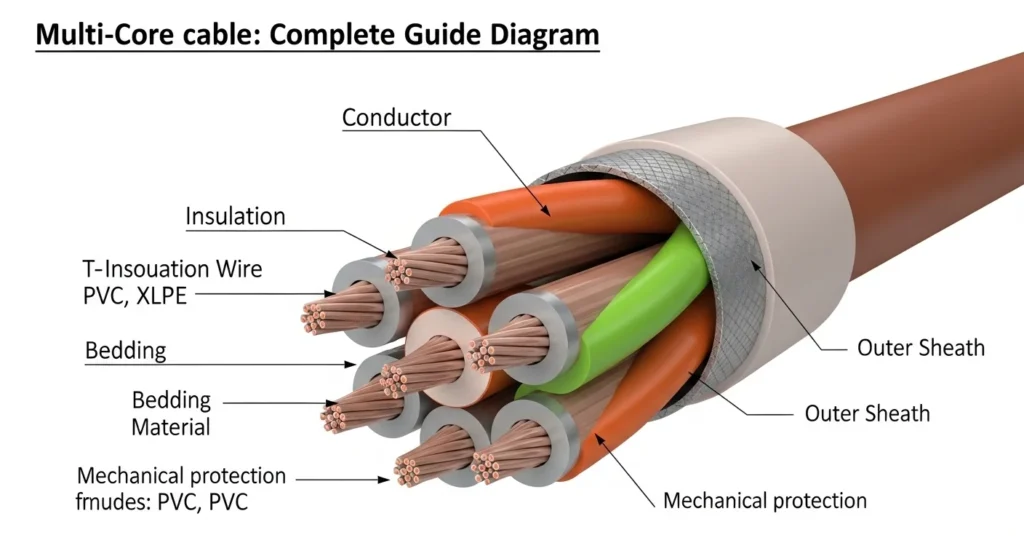
A Multi Core Cable is an electrical cable that contains two or more insulated conductors (cores) inside a single outer protective sheath.
Each core carries electrical current independently, but all the conductors are protected within the same cable jacket.
In simple words, a multi core cable is a bundle of multiple wires enclosed inside one cable covering.
Simple Explanation
Instead of running several single wires separately, engineers combine them into one cable to make installation easier and safer.
Practical Example
In a three-phase power system, a cable may contain:
- One core for Phase R
- One core for Phase Y
- One core for Phase B
- One core for Neutral
- One core for Earth
This type of cable is commonly used in industrial power distribution and motor connections.
3. Multi Core Cable Working Principle
A multi core cable is an electrical cable that contains more than one insulated conductor (core) inside a single protective outer sheath. The working principle of a multi core cable is based on the safe and efficient transmission of electrical power or signals through multiple separate conductors, without interference between them. Each core inside the cable acts as an independent pathway for electric current, allowing the cable to carry different circuits simultaneously.
When electrical power is supplied to a multi core cable, the current enters through the conductor terminals and flows into the individual cores. Each core is made of a highly conductive material such as copper or aluminum, which allows electrons to move easily and efficiently. These cores are individually insulated using materials like PVC, rubber, or XLPE, which prevent direct contact between them. This insulation is very important because it avoids short circuits, leakage of current, and unwanted electrical interaction between different conductors.
The main working principle of a multi core cable is electrical separation with combined protection. While all cores are enclosed in a single cable structure, each conductor operates independently, carrying its own current or signal. This allows one cable to perform multiple functions at the same time, such as supplying power, transmitting control signals, or connecting different devices in a system.
The outer sheath of the cable provides additional protection by covering all internal cores. It protects the cable from external factors such as moisture, heat, dust, chemicals, and mechanical damage. This ensures that the internal conductors remain safe and functional even in harsh environments.
In practical applications, multi core cables are widely used in control panels, industrial machinery, electrical distribution systems, and communication systems. Their working principle ensures efficient space utilization, reduced wiring complexity, and improved safety. By combining multiple insulated conductors in one protective structure, multi core cables provide a reliable and organized solution for modern electrical installations.
Step-by-Step Working of Electrical Cable
1. Power Supply Entry
The working of an electrical cable begins when electrical power is supplied from the main source. The current enters the cable through the conductor terminals or connection points. These terminals act as the entry point for electricity, allowing safe transfer of energy into the internal conductors of the cable.
2. Transmission Through Conductors
Inside the cable, there are one or more metallic conductors, usually made of copper or aluminum. These conductors are responsible for carrying electric current from one point to another. Each conductor provides a separate path for electricity, allowing multiple circuits or loads to be powered simultaneously without mixing.
3. Flow of Electric Current
Once the power enters the conductors, electric current starts flowing through them due to the potential difference. This flow of electrons continues along the length of the cable, transferring electrical energy efficiently toward the connected electrical devices or systems.
4. Insulation Protection
Each conductor is surrounded by a layer of insulating material such as PVC or rubber. This insulation is very important because it prevents direct contact between the conductors. It also ensures that electricity does not leak out or create short circuits, making the cable safe for use.
5. Separation of Individual Cores
In multi-core cables, each insulated conductor is known as a core. These cores are kept separate from each other due to insulation. This separation allows different electrical signals or power loads to pass through the same cable without interference, ensuring smooth and reliable operation.
6. Outer Sheath Protection
All the internal components of the cable are covered by an outer protective layer called the sheath. This sheath protects the cable from external factors such as moisture, heat, dust, chemicals, and mechanical stress. It increases the durability and lifespan of the cable.
7. Mechanical Strength and Safety
The outer structure of the cable also provides mechanical strength, preventing damage during installation or usage. It protects the inner conductors from bending, cutting, or crushing, ensuring safe and long-term performance in different environments.
8. Safe Electrical Power Distribution
Finally, the electrical energy is delivered safely to the connected devices or systems. Because of proper insulation, separation of cores, and protective layers, the cable ensures efficient power transmission without leakage, interference, or loss of safety.
An electrical cable works by safely transferring electrical energy through insulated conductors while being protected by strong internal and external layers. This ensures reliable, efficient, and safe power distribution in residential, commercial, and industrial applications.
Easy Analogy
Think of a multi core cable like a bundle of water pipes inside a large protective pipe.
- Each small pipe carries water separately.
- The large outer pipe protects all of them together.
Similarly, each conductor inside the cable carries electricity independently while the outer sheath provides protection.
4. Types / Classification of Multi Core Cables
Multi core cables are classified based on the number of conductors and their applications.
Two Core Cable: Working Principle, Structure, and Applications
Two core cables contain two insulated conductors.
Typical use:
- Single-phase electrical circuits
- Small appliances
- Lighting circuits
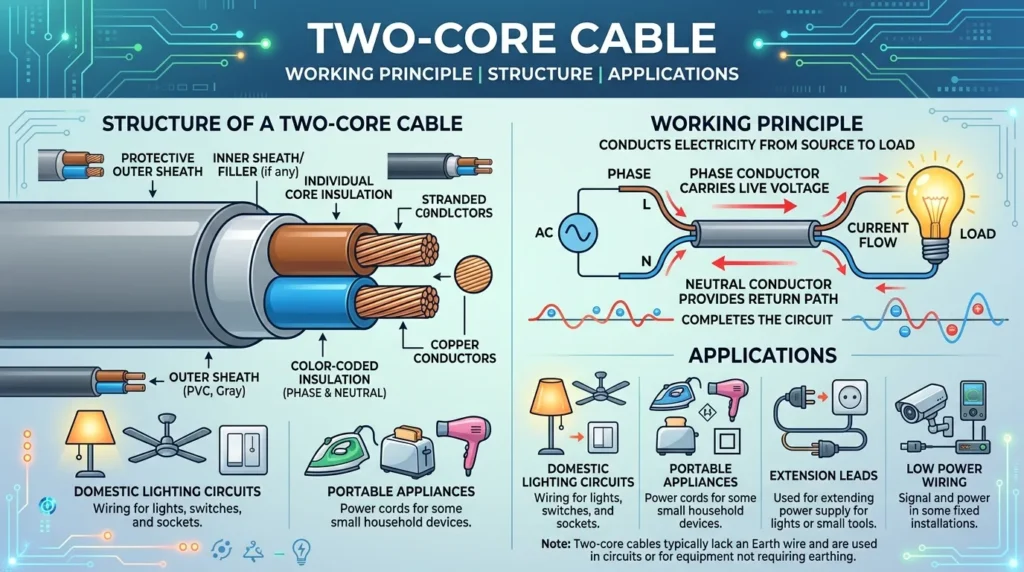
A Two Core Cable is a type of electrical cable that contains two separate insulated conductors inside a single protective outer sheath. It is one of the most commonly used cables in electrical wiring systems, especially for simple single-phase power supply applications. The two cores are usually made of copper or aluminum, which are highly conductive materials that allow electric current to flow efficiently with minimal resistance.
The working principle of a two core cable is based on the safe transmission of electrical power through two separate pathways: one for the live (phase) conductor and the other for the neutral conductor. When electrical supply is provided, current flows through the live wire towards the load or electrical device. After completing its work, the current returns through the neutral wire, forming a complete electrical circuit. This continuous loop allows devices to operate smoothly and safely.
Each core inside the cable is individually insulated using materials such as PVC or rubber. This insulation prevents direct contact between the two conductors and ensures that electricity does not leak or create short circuits. The insulation also protects the cable from environmental factors like heat, moisture, and chemical exposure. Both insulated cores are then enclosed in an outer sheath, which provides additional mechanical protection and improves durability.
The main advantage of a two core cable is its simple design and easy installation. Because it contains only two conductors, it is lightweight, flexible, and suitable for basic electrical connections. It is widely used in household wiring for lighting circuits, fans, small appliances, and other low-power devices.
Two core cables are also commonly used in extension cords and portable electrical equipment. Their simple structure makes them cost-effective and easy to maintain. However, they are not suitable for complex systems that require multiple connections or control circuits.
In terms of safety, the insulation and outer sheath play an important role in protecting users from electric shock and preventing damage to the internal conductors. Proper installation and handling are necessary to ensure long-term performance and reliability.
In conclusion, a two core cable works by providing a safe and efficient path for electrical current through two insulated conductors. Its simple structure, reliable performance, and wide range of applications make it an essential component in basic electrical wiring systems used in homes, offices, and small-scale electrical installations.
Three Core Cable: Working Principle, Structure, and Applications
Three core cables contain three conductors.
Common applications:
- Single-phase power with earth
- Small motors
- Household electrical wiring
Example:
- Phase
- Neutral
- Earth
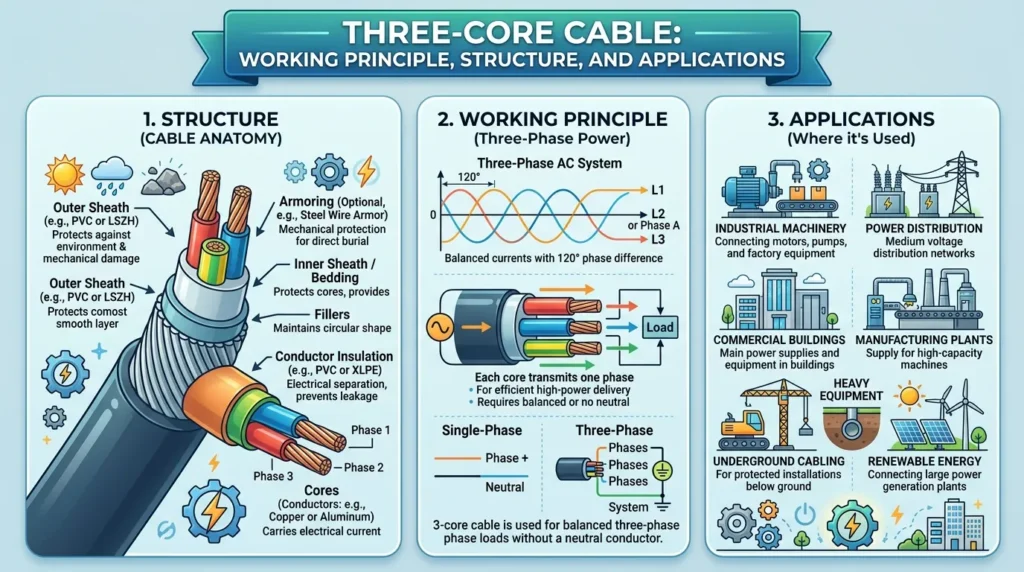
A Three Core Cable is an electrical cable that contains three separate insulated conductors inside a single outer sheath. It is widely used in electrical installations where a safe and stable power supply is required, especially for single-phase and some control applications. The three cores are typically made of copper or aluminum, which provide excellent electrical conductivity and ensure efficient transmission of current with minimal power loss.
The working principle of a three core cable is based on the transmission of electrical energy through three distinct pathways. In most common applications, the three cores are used as live (phase), neutral, and earth (ground) conductors. The live wire carries current from the power source to the electrical load, the neutral wire completes the circuit by returning current back to the source, and the earth wire provides safety by directing leakage current safely into the ground.
When electrical power is supplied, current flows through the live conductor to operate the device. After performing its function, the current returns through the neutral conductor, completing the electrical circuit. Meanwhile, the earth conductor remains inactive during normal operation but becomes active during fault conditions, such as insulation failure or short circuit. It protects users by preventing electric shock and ensuring safety.
Each conductor inside the cable is individually insulated using materials like PVC, XLPE, or rubber. This insulation prevents unwanted contact between the cores and eliminates the risk of short circuits. The insulated cores are then enclosed in a strong outer sheath, which protects the cable from external damage such as heat, moisture, dust, and mechanical stress.
Three core cables are commonly used in domestic wiring, industrial machines, pumps, air conditioners, and other electrical systems that require grounding for safety. They are more reliable and safer compared to two core cables because of the additional earth connection.
In conclusion, a three core cable works by safely transmitting electrical power through live, neutral, and earth conductors within a single insulated structure. Its strong safety features, efficient design, and wide range of applications make it an essential component in modern electrical systems.
Four Core Cable: Working Principle, Structure, and Applications
Four core cables are commonly used in three-phase electrical systems.
Typical conductors include:
- Three phases
- One neutral conductor
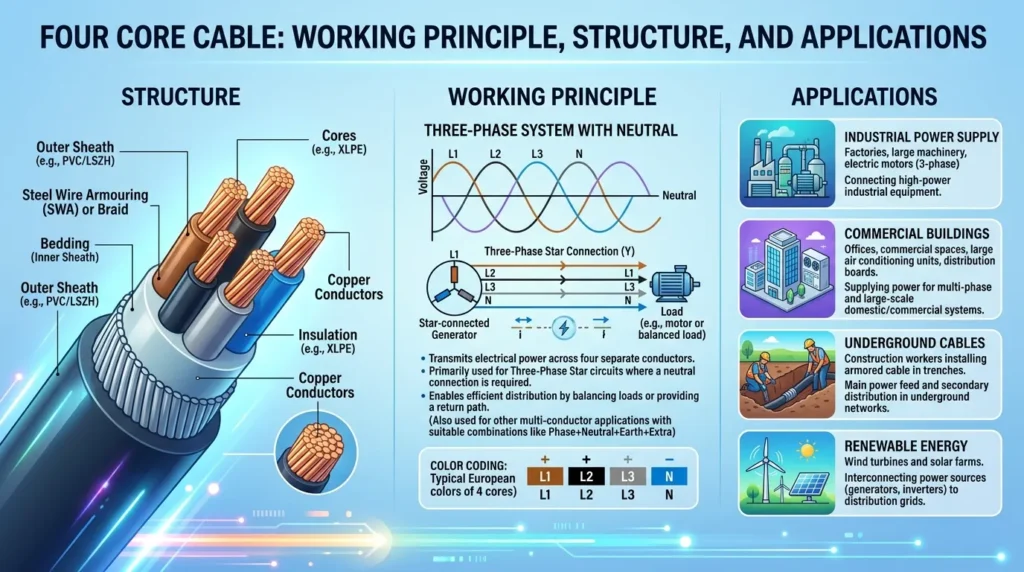
A Four Core Cable is an electrical cable that contains four individually insulated conductors inside a single outer protective sheath. It is commonly used in electrical power distribution systems, industrial machinery, and control applications where multiple electrical connections are required in one compact cable. The conductors are usually made of copper or aluminum, which ensure good conductivity and efficient transmission of electrical power with low energy loss.
The working principle of a four core cable is based on the safe and simultaneous transmission of electrical energy through four separate conductors without interference. Each core carries current independently, depending on the type of electrical system in which it is used. In most power systems, the four cores are used as three-phase lines (R, Y, B) and a neutral conductor, which together provide stable and balanced power supply for heavy electrical loads. In some control systems, the cores may also be used for signaling, grounding, or different circuit functions.
When electrical power is supplied, current flows through the phase conductors to operate electrical equipment such as motors, pumps, and industrial machines. The neutral conductor completes the electrical circuit by providing a return path for current. In three-phase systems, the three-phase supply ensures smooth operation, higher efficiency, and reduced power fluctuations, making it suitable for large-scale electrical applications.
Each conductor inside the cable is individually insulated using materials like PVC, XLPE, or rubber. This insulation prevents direct contact between cores, eliminating the risk of short circuits and electrical faults. All four insulated conductors are then enclosed within a strong outer sheath, which protects the cable from external damage such as moisture, heat, dust, chemicals, and mechanical stress.
Four core cables are widely used in industrial plants, commercial buildings, construction sites, and power distribution networks. They are especially important for applications requiring high power transmission and multiple circuit connections in a single cable system.
In conclusion, a four core cable works by efficiently carrying electrical current or signals through four insulated conductors within one protective structure. Its reliability, safety, and ability to handle complex electrical systems make it an essential component in modern electrical engineering and industrial installations.
Five Core Cable: Working Principle, Structure, and Applications
Five core cables include:
- Three phases
- One neutral
- One earth conductor
These cables are commonly used in industrial machines and control systems.
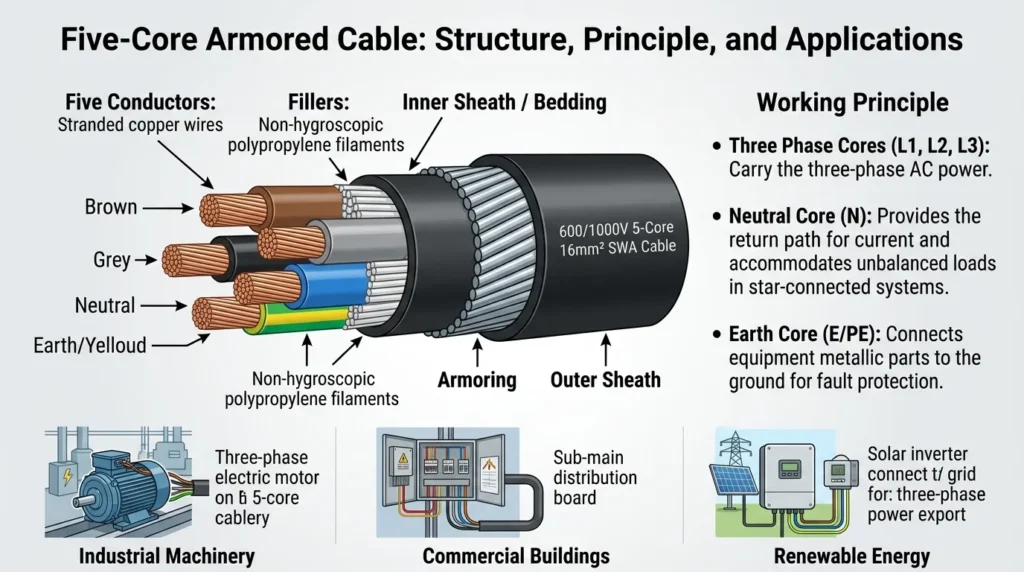
A Five Core Cable is an electrical cable that contains five individually insulated conductors within a single outer protective sheath. It is mainly used in complex electrical systems where multiple connections are required, especially in three-phase power distribution, control circuits, and industrial installations. The conductors are typically made of copper or aluminum, which provide excellent conductivity and ensure efficient and reliable transmission of electrical power.
The working principle of a five core cable is based on the simultaneous and safe transmission of electrical current or signals through five separate pathways without interference. Each core is designed to carry a specific function depending on the system requirement. In many power applications, the five cores are used as three-phase lines (R, Y, B), one neutral wire, and one earth (ground) wire. This arrangement provides both efficient power delivery and enhanced safety.
When electrical power is supplied, current flows through the three phase conductors to operate heavy electrical loads such as motors, machines, and industrial equipment. The neutral wire completes the electrical circuit by providing a return path for current. The earth wire acts as a safety conductor, carrying leakage current to the ground in case of insulation failure or electrical faults. This helps protect both equipment and users from electric shock and damage.
Each conductor inside the cable is individually insulated using materials like PVC, XLPE, or rubber. This insulation ensures that the conductors remain electrically separated, preventing short circuits and electrical leakage. All five insulated cores are then enclosed in a strong outer sheath, which protects the cable from external factors such as heat, moisture, dust, chemicals, and mechanical stress.
Five core cables are widely used in industrial plants, commercial buildings, power distribution systems, heavy machinery, and control panels. They are especially useful in environments where safety, efficiency, and multi-function wiring are required in a single compact cable.
In conclusion, a five core cable works by transmitting electrical power and safety signals through five insulated conductors within one protective structure. Its strong safety features, high efficiency, and ability to handle complex electrical systems make it an essential component in modern electrical engineering and industrial applications.
Armored Multi Core Cable: Working Principle, Structure, and Applications
Armored cables include a metal protective layer (steel wire armor) around the cable.
Advantages:
- Mechanical protection
- Suitable for underground installation
- Resistant to external damage
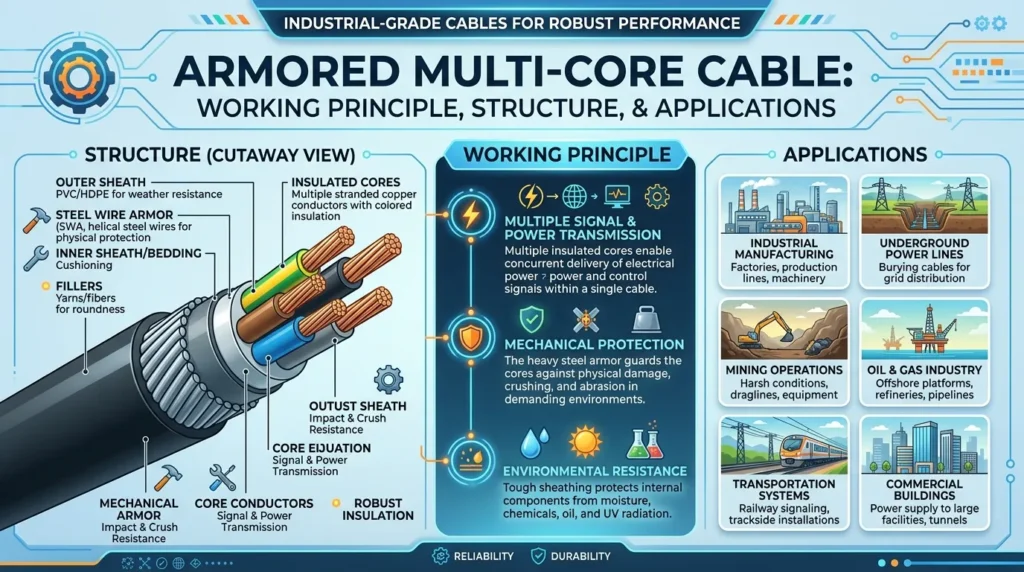
An Armored Multi Core Cable is a heavy-duty electrical cable that contains multiple insulated conductors inside a protective outer layer of metallic armor. It is designed for safe and reliable power transmission in harsh environments where cables are exposed to mechanical stress, moisture, chemicals, or underground installation conditions. This type of cable is widely used in industrial plants, power stations, construction sites, and underground electrical distribution systems.
The working principle of an armored multi core cable is based on the efficient and safe transmission of electrical power or signals through multiple insulated conductors while being protected from external damage. Each core inside the cable carries electrical current independently, depending on the circuit design. These cores are typically made of copper or aluminum, which offer high conductivity and ensure minimal power loss during transmission.
Each conductor is individually insulated using materials such as PVC, XLPE, or rubber. This insulation prevents direct contact between the cores, avoiding short circuits and electrical leakage. All insulated cores are then grouped together and covered with a bedding layer for additional protection. Over this, a layer of metallic armor is applied, usually made of steel wire armor (SWA) or steel tape armor (STA). This armored layer provides strong mechanical protection against crushing, impact, rodents, and external damage.
The outermost layer of the cable is called the sheath, which protects the internal structure from moisture, dust, heat, and chemical exposure. This multi-layer construction ensures long-lasting durability and safe operation even in extreme environmental conditions.
Armored multi core cables are commonly used in underground wiring, outdoor installations, industrial machinery, heavy equipment, and power distribution networks. They are especially important in areas where cables are exposed to physical damage or require additional safety protection.
In conclusion, an armored multi core cable works by transmitting electrical energy through multiple insulated conductors while being shielded by a strong metallic armor layer. Its high durability, safety, and resistance to external damage make it an essential solution for demanding electrical and industrial applications.
5. Main Components of Multi Core Cable
Multi core cables consist of several important parts that ensure safe and reliable electrical transmission.
Conductor
The conductor carries electrical current.
Common materials:
- Copper (high conductivity)
- Aluminum (lightweight and economical)
Insulation
Insulation surrounds each conductor and prevents electrical leakage or short circuits.
Common insulation materials include:
- PVC (Polyvinyl Chloride)
- XLPE (Cross-linked Polyethylene)
- Rubber insulation
Inner Sheath
The inner sheath holds all insulated conductors together and provides additional protection.
Armoring (Optional)
Some cables include steel wire or aluminum armor for mechanical protection.
Armored cables are used in underground or industrial installations.
Outer Sheath
The outer sheath protects the cable from:
- Moisture
- Chemicals
- Mechanical damage
- Environmental conditions
It is usually made of PVC or polyethylene.
6. Multi Core Cable Advantages and Disadvantages (Table Format)
Advantages of Multi Core Cable
| Advantage | Explanation |
|---|---|
| Simplified Wiring Installation | Multiple conductors are combined in a single cable, reducing wiring complexity. |
| Improved Safety | Proper insulation between cores reduces the risk of short circuits and electrical faults. |
| Space Saving | One multi core cable replaces several separate wires, saving installation space. |
| Better Mechanical Protection | Outer sheath provides strong protection against heat, moisture, and physical damage. |
| Neat Electrical Layout | Wiring becomes more organized, clean, and easier to manage in panels and systems. |
| Reduced Installation Time | Fewer individual wires mean faster and easier installation work. |
| Versatility | Can be used for power, control, and signal transmission in various applications. |
Disadvantages / Limitations of Multi Core Cable
| Limitation | Explanation |
|---|---|
| Higher Initial Cost | More expensive compared to single-core cables due to complex construction. |
| Heat Dissipation Issues | Multiple conductors in one sheath may cause heat buildup under heavy load. |
| Difficult Repairs | If one core is damaged, repairing inside the cable is complicated. |
| Less Flexibility | Thick multi core cables are harder to bend and install in tight spaces. |
Multi core cables are still widely used because their advantages in safety, organization, and efficiency usually outweigh their limitations in modern electrical systems.
8. Multi Core Cable Applications
Multi core cables are widely used in residential, commercial, and industrial systems.
Residential Applications
- House wiring systems
- Air conditioner connections
- Water pump motors
- Lighting circuits
Industrial Applications
- Power distribution systems
- Electric motors
- Machine control wiring
- Manufacturing equipment
Control Systems
Multi core cables are used in:
- Control panels
- Automation systems
- PLC wiring
Communication Systems
Special multi core cables transmit:
- Signals
- Data
- Control commands
Underground Power Distribution
Armored multi core cables are commonly used for underground electrical networks.
These multi core cable applications make them essential in modern electrical engineering.
9. Comparison Section
Difference Between Single Core Cable and Multi Core Cable
| Feature | Single Core Cable | Multi Core Cable |
|---|---|---|
| Number of Conductors | One | Two or more |
| Installation | Requires multiple cables | Single cable installation |
| Space Requirement | More space | Compact wiring |
| Flexibility | Higher flexibility | Slightly less flexible |
| Applications | Simple circuits | Complex power and control circuits |
Understanding the difference between single core cable and multi core cable helps engineers select the correct cable for electrical projects.
10. Multi Core Cable Selection Guide (Detailed Version)
Choosing the correct multi core cable is very important for safe, efficient, and long-lasting electrical performance. Improper selection can lead to overheating, voltage drop, insulation failure, or even system damage. Therefore, several technical and environmental factors must be carefully considered before selecting a cable.
1. Current Rating (Ampacity)
The current carrying capacity of the cable is one of the most important factors.
- The cable must safely carry the maximum load current without overheating
- Undersized cables can cause insulation damage and power loss
- Oversized cables increase cost unnecessarily
- Always consider continuous load, starting current, and peak load conditions
Proper current rating ensures safe and stable operation of the electrical system.
2. Voltage Rating
Each multi core cable is designed for a specific voltage level.
- Low voltage cables: used in homes and small industries
- Medium voltage cables: used in industrial and distribution systems
- High voltage cables: used in power transmission networks
Selecting the correct voltage rating ensures insulation safety and prevents breakdown under high electrical stress.
3. Number of Cores
The number of cores depends on the type of electrical system and application.
- 2 Core Cable: Used for simple single-phase supply
- 3 Core Cable: Used for phase, neutral, and earth connection
- 4 Core Cable: Used in three-phase systems (without separate earth in some cases)
- 5 Core Cable: Used in three-phase systems with neutral and earth
Correct core selection ensures proper circuit functionality and system balance.
4. Insulation Type
Insulation material plays a major role in cable performance and durability.
- PVC (Polyvinyl Chloride): Common, cost-effective, suitable for normal conditions
- XLPE (Cross-Linked Polyethylene): High temperature resistance, used in heavy-duty systems
- Rubber Insulation: Flexible and suitable for portable equipment
The insulation type should match the operating temperature and environment.
5. Environmental Conditions
The installation environment strongly affects cable performance.
- Moisture and Water Exposure: Requires water-resistant insulation and sealing
- High Temperature Areas: Need heat-resistant cables like XLPE
- Chemical Exposure: Requires chemical-resistant outer sheath
- Mechanical Stress: Requires armored cables for extra protection
Environmental selection increases cable lifespan and safety.
6. Installation Method
Different installation methods require different cable types and protection levels.
- Underground Installation: Requires armored and moisture-resistant cables
- Cable Trays: Used in industrial plants for organized routing
- Conduits or Pipes: Provide extra mechanical protection in buildings
- Open Wiring: Requires strong insulation and proper support
Proper installation method ensures mechanical safety and easy maintenance.
7. Flexibility and Application Requirements
Cable flexibility and application type must also be considered.
- Flexible cables are suitable for moving equipment
- Rigid cables are used for fixed installations
- Control systems may require shielded multi core cables for signal protection
Selecting the right multi core cable involves understanding electrical load, voltage level, core requirement, insulation type, and environmental conditions. A properly selected cable ensures safe operation, long service life, reduced maintenance, and efficient power distribution in all types of electrical systems.
11. Common Problems & Solutions
Why does a multi core cable overheat?
Possible reasons include:
- Overloading
- Poor ventilation
- Incorrect cable size
Solution: Use proper cable sizing and ensure adequate cooling.
What causes insulation damage?
Common causes include:
- Mechanical stress
- High temperature
- Chemical exposure
Solution: Use armored cables or protective conduits.
Why does voltage drop occur?
Voltage drop may occur due to:
- Long cable distance
- Small conductor size
Solution: Use thicker cables with higher current capacity.
Can one damaged core affect the entire cable?
Yes. If one conductor fails, the entire cable may need replacement.
Regular inspection helps prevent failures.
12. Future Trends in Multi Core Cable Technology (Detailed Version)
Electrical cable technology is continuously improving to meet the growing demand for safer, smarter, and more efficient power distribution systems. Modern industries, smart buildings, and large-scale power networks require cables that can handle higher loads, provide better safety, and offer real-time monitoring. Because of this, multi core cable technology is rapidly evolving with new materials and advanced engineering designs.
1. High-Efficiency Insulation Materials
One of the major developments in cable technology is the use of improved insulation materials.
- New insulation compounds offer better heat resistance
- They reduce energy loss during transmission
- They improve overall electrical efficiency
- They increase cable lifespan under heavy load conditions
Materials like advanced XLPE and polymer blends are being widely used to enhance performance in high-temperature and high-voltage environments.
2. Smart Monitoring Cables
Future cables are becoming more intelligent with built-in monitoring systems.
- Embedded sensors can track temperature changes inside the cable
- Real-time monitoring of current load and voltage levels
- Early detection of overheating or insulation failure
- Alerts can be sent to control systems for preventive maintenance
These smart cables help reduce the risk of electrical faults, system downtime, and fire hazards, especially in industrial and critical infrastructure applications.
3. Fire-Resistant and Fire-Performance Cables
Safety is a top priority in modern electrical systems, leading to the development of fire-resistant cables.
- Can continue operating during fire conditions for a limited time
- Prevents the spread of flames along cable routes
- Produces low smoke and low toxic gas emissions
- Essential for hospitals, airports, and high-rise buildings
These cables improve emergency safety and allow critical systems like alarms and lighting to function during disasters.
4. Environmentally Friendly and Sustainable Materials
Environmental concerns are driving the development of eco-friendly cable solutions.
- Use of recyclable and non-toxic materials
- Reduction of harmful chemical compounds like lead and halogens
- Lower carbon footprint during manufacturing
- Safer disposal and recycling after end-of-life use
These innovations support global sustainability goals and green building standards.
5. Compact High-Power Cable Designs
Modern engineering is focusing on making cables smaller but more powerful.
- Higher current carrying capacity in reduced sizes
- Improved conductor design for better conductivity
- Enhanced thermal management to prevent overheating
- Space-saving solutions for dense electrical installations
These compact designs are especially useful in urban infrastructure and industrial automation systems.
The future of multi core cables is focused on intelligence, safety, efficiency, and sustainability. With innovations like smart monitoring systems, fire-resistant technology, advanced insulation, and eco-friendly materials, electrical cables are becoming more reliable and advanced. These improvements will play a key role in supporting modern power systems, smart cities, and industrial automation in the coming years.
13. Conclusion
Multi core cables play a vital role in modern electrical systems because they allow multiple conductors to operate safely within a single cable structure. This design simplifies electrical installations and improves protection for conductors.
Understanding the multi core cable working principle, types, components, and applications is essential for electrical students, engineers, and technicians. These cables are widely used in homes, industries, control panels, and power distribution systems.
Although multi core cables may have some limitations, such as higher initial cost and heat management challenges, their benefits greatly outweigh the disadvantages. Proper cable selection, installation, and maintenance ensure safe and efficient operation.
As electrical technology continues to evolve, advanced multi core cables with better insulation, monitoring systems, and improved safety features will become even more important in modern power networks.