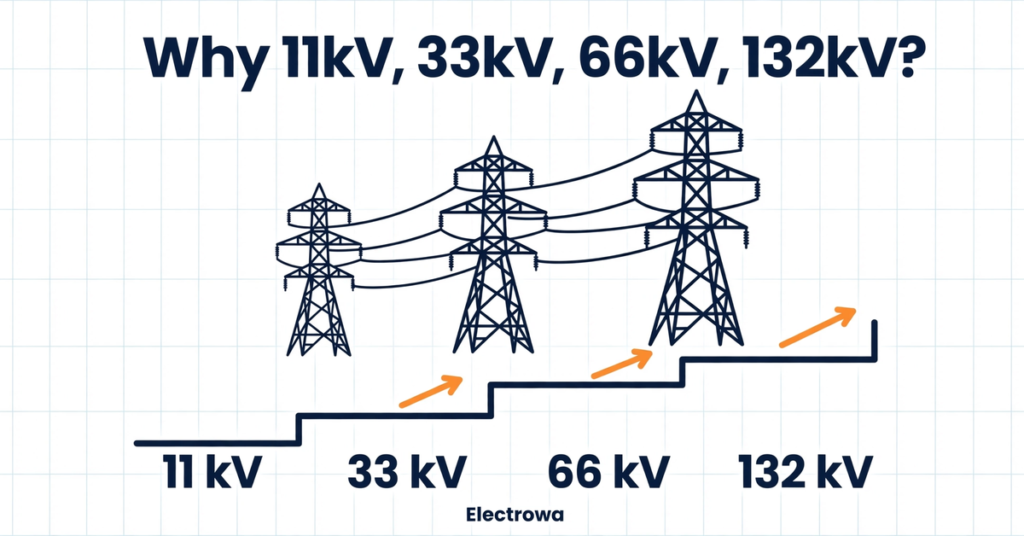

Look at any power system and the voltage levels follow a strange pattern: 11 kV, 33 kV, 66 kV, 132 kV. Why not round numbers like 10, 30, 60, or 120 kV? The answer is history, still built into every grid: they are all multiples of 11, from a rule used when the first transmission lines were designed.
The rule: generate the voltage 10% higher than the voltage you want to deliver. Power is always lost along a line, so the voltage at the receiving end is lower than at the sending end. Early engineers allowed about a 10% drop: 11 kV for 10 kV, 33 kV for 30 kV, 66 kV for 60 kV, 132 kV for 120 kV. The receiving-end numbers are round; the sending-end numbers are multiples of 11.
In this guide, you will learn where the 10% rule came from, what each voltage level is used for, and — with a worked example — why 132 kV instead of 11 kV cuts power loss to a tiny fraction. The same physics explains why voltage rises with distance and load.
The 10% Rule: Why 11, Not 10
Every conductor has resistance, so some voltage is always lost as current flows. Early engineers assumed a drop of about 10% between the generating station and the consumer, so the generating voltage was set 10% higher than the required voltage.
The math is simple: 10 kV + 10% = 11 kV; 30 + 3 = 33 kV; 60 + 6 = 66 kV; 120 + 12 = 132 kV. Each is a multiple of 11, because 10% extra on a round number always gives 11, 33, 66, or 132. Modern grids regulate voltage tightly, so the 10% drop no longer happens — but the names stayed.
Voltage Levels and Where They Are Used
| Voltage level | Delivers | Typical use |
|---|---|---|
| 11 kV | 10 kV | Primary distribution — towns and industry |
| 33 kV | 30 kV | Sub-transmission — large towns |
| 66 kV | 60 kV | Sub-transmission — cities and industry |
| 132 kV | 120 kV | Transmission — bulk transfer |
| 220 kV and 400 kV | — | Extra-high-voltage, very long distances |
The pattern is a ladder: power is generated at 11 kV, stepped up to 132 kV or higher for long distances, then stepped down through 66 kV and 33 kV to transformers delivering 400 V to homes. Each step exists because higher voltage means lower current — and lower current means far lower losses.
Worked Example: 10 MW at 11 kV vs 132 kV
Line loss is I²R — current squared times resistance — so cutting current is the most powerful way to cut losses. Take a 10 MW load on a three-phase line at 0.8 power factor. Three-phase power is P = √3 × V × I × pf, so I = P ÷ (√3 × V × pf).
At 11 kV: I = 10,000,000 ÷ (1.732 × 11,000 × 0.8) = 10,000,000 ÷ 15,242 ≈ 656 A. At 132 kV: I = 10,000,000 ÷ (1.732 × 132,000 × 0.8) = 10,000,000 ÷ 182,899 ≈ 55 A. Voltage is 12 times higher (132 ÷ 11 = 12), so current is 12 times lower. Since loss depends on current squared, loss at 132 kV is 12² = 144 times lower than at 11 kV. That is why bulk power is never sent at 11 kV over long distances.
Why Not Use Higher Voltage Everywhere?
If higher voltage always means lower loss, why not transmit everything at 400 kV? Because higher voltage costs more: taller towers, bigger insulators, wider clearances, and pricier switchgear and transformers. A short 11 kV line is cheap with small losses, so raising its voltage would cost more than it saves. Engineers choose the lowest voltage that keeps losses acceptable — 11 kV locally, 33 kV and 66 kV regionally, 132 kV+ only where distance and load justify it.
Frequently Asked Questions
1. Why are transmission voltages multiples of 11?
Because of the old 10% rule: generation voltage was set 10% above the delivered voltage. 10 + 10% = 11 kV, 30 + 10% = 33 kV, 60 + 10% = 66 kV, 120 + 10% = 132 kV.
2. What voltage is used for distribution to homes?
Local distribution runs at 11 kV to transformers, which step it down to 400 V three-phase (230 V single-phase) for homes.
3. Why is power transmitted at high voltage?
For the same power, higher voltage means lower current, and loss is I²R. Doubling voltage cuts loss to a quarter; raising it 12 times cuts loss 144 times.
4. Is 33 kV a transmission or distribution voltage?
Sub-transmission: it carries power from grid substations to 33/11 kV substations feeding towns and large consumers — between transmission (132 kV+) and distribution (11 kV).
5. Does the 10% voltage drop still happen today?
No. Modern grids use tap changers, capacitors, and regulators to hold voltage steady. The multiples of 11 are a historical standard, never renamed.
6. Why is 220 kV or 400 kV not a multiple of 11?
Those levels came later, after the 10% rule was dropped. They follow international standards for very-long-distance transmission, not the old 11 kV pattern.
Conclusion
Transmission voltages are multiples of 11 because of a simple idea from the early grid: add 10% to the voltage you want to deliver, so the line drop leaves the customer with the right voltage. That gave us 11, 33, 66, and 132 kV — names that stuck after the 10% drop disappeared. The worked example shows why the ladder matters: the same 10 MW needs 656 A at 11 kV but only 55 A at 132 kV — losses roughly 144 times lower. Higher voltage is not about round numbers — it is about moving power with the least waste.
Also read: Difference Between 11kV, 33kV, 66kV and 132kV · Power Loss Formula · Voltage Drop Formula · Voltage Drop Calculator · Watt Calculator