
An induction motor never quite runs at the speed stamped on its nameplate as “synchronous speed” — it always runs a little slower. That small speed difference has a name: slip. Slip is not a defect or a sign of a worn-out motor. It is the very thing that makes an induction motor work. Without slip, the rotor would produce no torque at all and the motor would not turn. In this guide, you will learn what slip is, how to calculate it with a simple formula, what typical slip values look like, and how to use slip as a quick health check for any induction motor.
Whether you are sizing a motor, reading a nameplate, or troubleshooting a motor that runs hot, slip is one of the most useful numbers you can calculate. It needs only two measurements — the synchronous speed and the actual rotor speed — and a pocket calculator.
What Is Slip in an Induction Motor?
When a three-phase supply feeds the stator windings of an induction motor, it creates a magnetic field that rotates around the stator. This rotating magnetic field turns at a fixed speed called the synchronous speed (Ns), which depends only on the supply frequency and the number of poles in the motor. Our guide to the three-phase induction motor explains how this rotating field is produced.
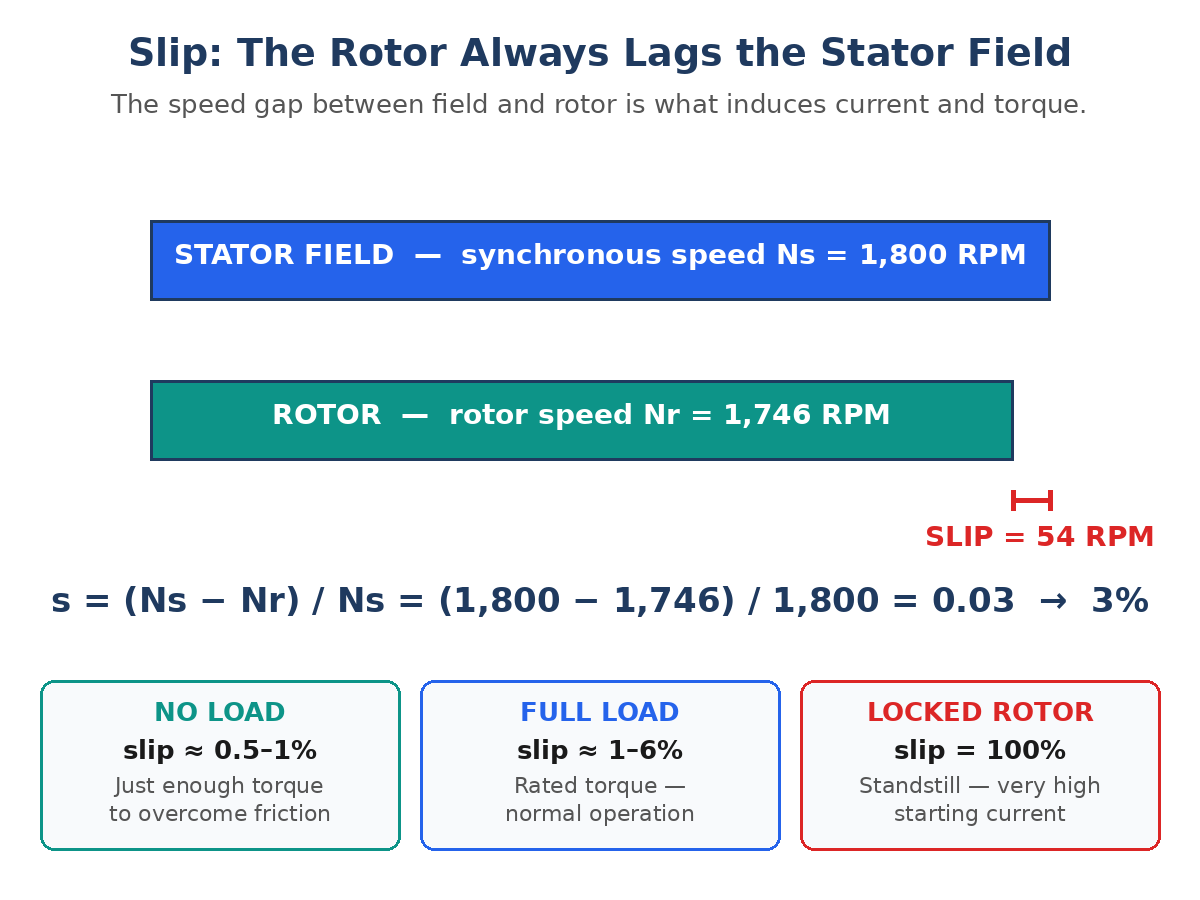
The rotor, however, does not spin at synchronous speed. It always turns a little slower, at the rotor speed (Nr). The difference between the two speeds, expressed as a fraction or percentage of the synchronous speed, is the slip. Slip is what allows the rotating field to cut across the rotor conductors and induce current in them — and that induced current is what produces torque. If the rotor ever did catch up with the field, there would be no relative motion, no induced current, and no torque. The motor would simply coast down until slip returned.
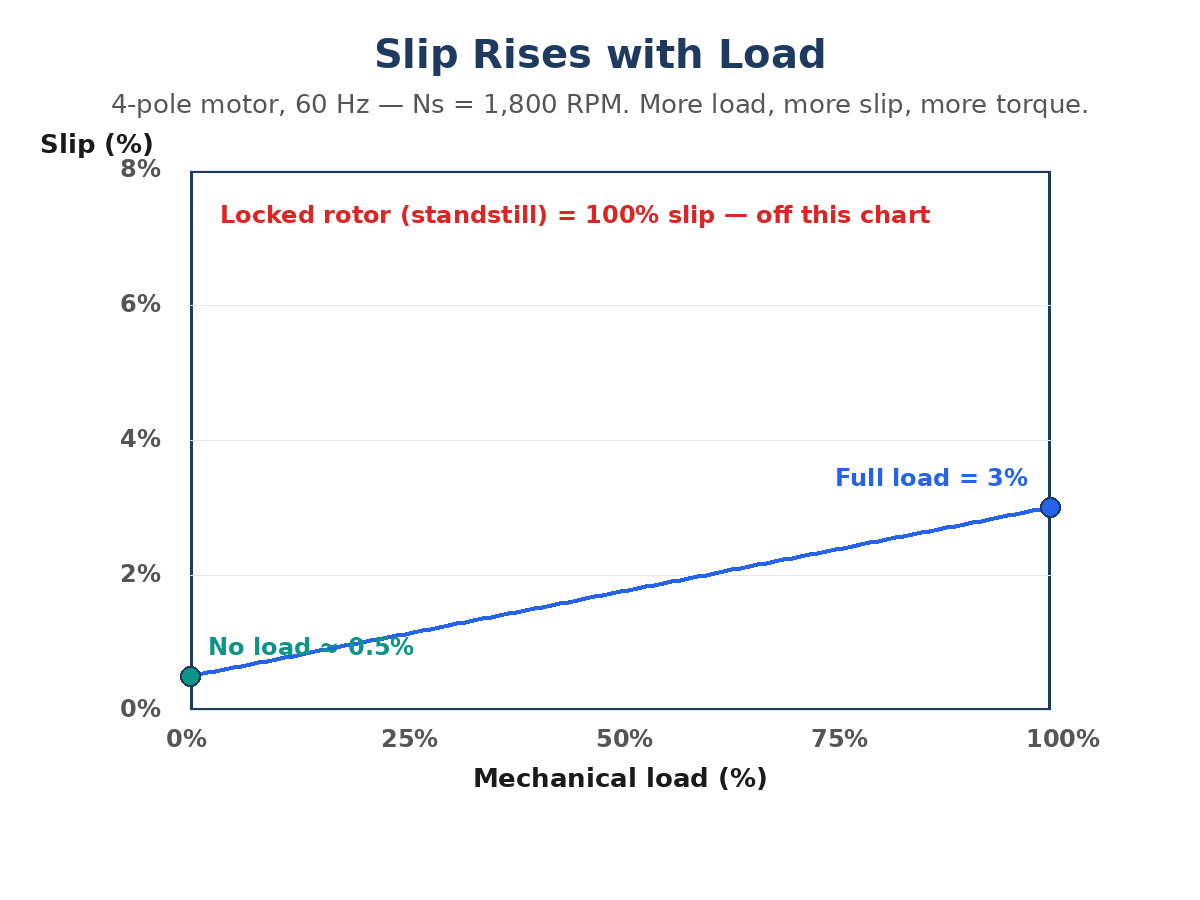
Slip is usually written as a decimal (for example, 0.03) or as a percentage (3%). At no load, slip is very small — often under 1% — because the motor only needs enough torque to overcome friction and windage. As the mechanical load increases, the rotor slows down, slip increases, more current is induced in the rotor, and torque rises to meet the load. In other words, slip is the motor’s automatic way of matching its torque to the load.
The Slip Formula
Slip is calculated from two speeds. First, the synchronous speed comes from the supply frequency and the pole count:
Ns = (120 × f) / P
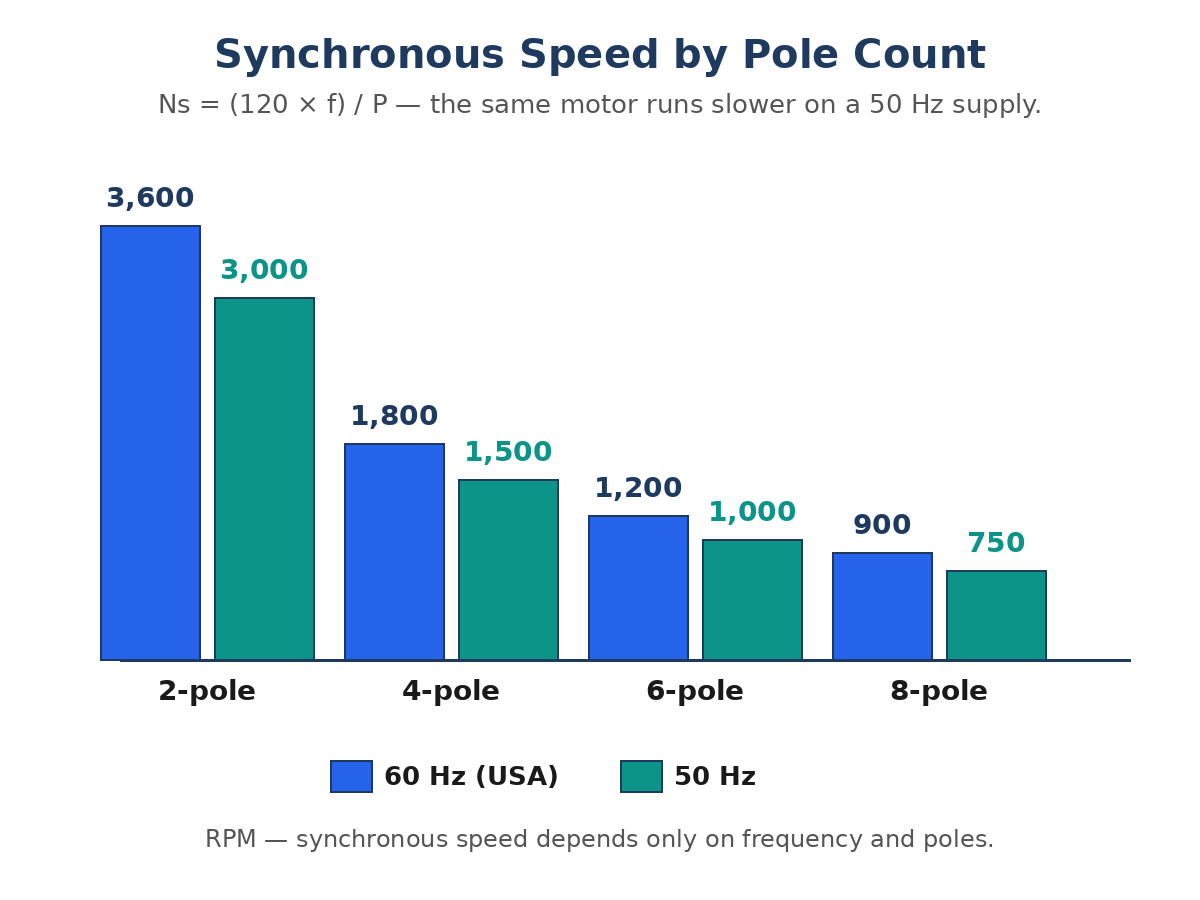
Here f is the supply frequency in hertz and P is the number of poles. On a 60 Hz supply in the United States, a 4-pole motor has a synchronous speed of (120 × 60) / 4 = 1,800 RPM. On a 50 Hz supply, the same motor runs at 1,500 RPM. The most common synchronous speeds are 3,600, 1,800, 1,200 and 900 RPM at 60 Hz, and 3,000, 1,500, 1,000 and 750 RPM at 50 Hz.
Once you know the synchronous speed Ns and the measured rotor speed Nr, slip is:
s = (Ns − Nr) / Ns
Multiply by 100 to express slip as a percentage: slip (%) = ((Ns − Nr) / Ns) × 100. You can also rearrange the formula to find the rotor speed from a known slip: Nr = Ns × (1 − s). And the rotor frequency — the frequency of the current induced in the rotor — is simply fr = s × f. At 3% slip on a 60 Hz supply, the rotor current oscillates at only 1.8 Hz.
Worked Examples
Three worked examples show how the formula is used in practice.
Example 1 — A 4-pole motor on 60 Hz. A 4-pole induction motor runs on a 60 Hz supply, so Ns = (120 × 60) / 4 = 1,800 RPM. Under full load, a tachometer reads a rotor speed of 1,746 RPM. Slip = (1,800 − 1,746) / 1,800 = 54 / 1,800 = 0.03, or 3%. This is a typical full-load slip for a standard industrial motor.
Example 2 — A 2-pole motor on 50 Hz. A 2-pole motor on a 50 Hz supply has Ns = (120 × 50) / 2 = 3,000 RPM. Lightly loaded, it runs at 2,970 RPM. Slip = (3,000 − 2,970) / 3,000 = 30 / 3,000 = 0.01, or 1%. A 1% slip tells you the motor is carrying only a light load.
Example 3 — Finding rotor speed from rated slip. A 6-pole motor on 60 Hz has Ns = (120 × 60) / 6 = 1,200 RPM, and its nameplate lists a rated slip of 4%. The expected full-load rotor speed is Nr = Ns × (1 − s) = 1,200 × (1 − 0.04) = 1,200 × 0.96 = 1,152 RPM. If you measure a much lower speed than this at full load, the motor is probably overloaded or undervolted. Our guide on how to read a motor nameplate shows where to find the rated speed and other data you need for these checks.
Typical Slip Values at Full Load
Full-load slip for a standard induction motor usually falls between 1% and 6%. Large, high-efficiency motors sit at the low end of that range, while small fractional-horsepower motors sit at the high end. Motors built for high starting torque, such as those used on crushers and conveyors, are deliberately designed for 8% to 15% slip.
| Motor Type | Typical Full-Load Slip | Typical Rotor Speed (4-Pole, 60 Hz) |
|---|---|---|
| Large high-efficiency motor (over 100 HP) | 1–3% | 1,746–1,782 RPM |
| Standard industrial motor (1–100 HP) | 2–5% | 1,710–1,764 RPM |
| Small / fractional HP motor | 5–8% | 1,656–1,710 RPM |
| High-slip motor (crushers, conveyors) | 8–15% | 1,530–1,656 RPM |
| No load (any motor) | 0.5–1% | 1,782–1,791 RPM |
| Locked rotor (standstill) | 100% | 0 RPM |
The locked-rotor row shows why a stalled motor is dangerous: at 100% slip, the rotor frequency equals the supply frequency and the motor draws several times its rated current. If the overload protection does not trip quickly, the windings overheat. This is also why slip matters for starting: at the moment of switch-on, slip is 100% and starting current is typically 5 to 7 times the full-load current.
Slip Calculator: Worked Table
You do not need a special tool to calculate slip — the formula takes seconds. The table below works like a calculator: find your synchronous speed, read across to your measured rotor speed, and the slip is already worked out. All values are for a 60 Hz supply, the standard in the United States.
| Poles | Synchronous Speed Ns (RPM) | Measured Rotor Speed Nr (RPM) | Slip s | Slip (%) | What It Means |
|---|---|---|---|---|---|
| 2 | 3,600 | 3,528 | 0.02 | 2% | Light to normal load |
| 2 | 3,600 | 3,420 | 0.05 | 5% | Heavy load |
| 4 | 1,800 | 1,782 | 0.01 | 1% | Very light load |
| 4 | 1,800 | 1,746 | 0.03 | 3% | Typical full load |
| 4 | 1,800 | 1,710 | 0.05 | 5% | Heavy load — check it |
| 6 | 1,200 | 1,176 | 0.02 | 2% | Normal load |
| 6 | 1,200 | 1,152 | 0.04 | 4% | Typical full load |
| 8 | 900 | 873 | 0.03 | 3% | Typical full load |
To use the table as a calculator for any motor, follow these steps:
- Find Ns: use Ns = (120 × f) / P, or read the synchronous speed from the motor nameplate’s pole count.
- Measure Nr: use a tachometer on the shaft, or read the speed from a drive display if the motor runs on a VFD.
- Subtract: Ns − Nr gives the slip speed in RPM.
- Divide and multiply by 100: ((Ns − Nr) / Ns) × 100 gives slip as a percentage.
- Compare: check the result against the typical full-load range of 1% to 6%. A value far outside that range deserves investigation.
What Slip Tells You About a Motor
Because slip rises with load, a single slip measurement is a quick diagnostic. A motor running at its rated slip is carrying its rated load. A motor running well above its rated slip is overloaded, undervolted, or suffering from a mechanical problem such as a worn bearing or a binding load. Slip above 8% on a standard motor usually means trouble — overload, low supply voltage, or excessive mechanical drag — and the motor will run hot because rotor copper losses rise with slip.
Slip is also the reason speed control of an induction motor is not as simple as turning a knob. Changing the supply voltage changes the torque, and the motor settles at a new slip — but the speed range is narrow and efficiency falls. That is why modern speed control uses a variable frequency drive (VFD), which changes the frequency and therefore the synchronous speed itself. The squirrel-cage induction motor — the most common type in industry — is almost always paired with a VFD when variable speed is needed.
Slip, Rotor Frequency and Torque
Slip connects three quantities that matter in motor design. The rotor frequency is fr = s × f, so at 3% slip on a 60 Hz supply the rotor sees only 1.8 Hz. The induced rotor voltage is also proportional to slip, which is why it is highest at start-up (s = 1) and nearly zero at no load. Torque follows a curve: it rises from zero at synchronous speed, reaches a maximum at a slip of roughly 15% to 25% (the breakdown torque), and then falls. Normal operation stays on the stable, low-slip part of that curve, between no load and full load, where more slip always means more torque.
This is also why an induction motor is sometimes called an asynchronous motor: its rotor speed is never synchronized with the supply. A synchronous motor, by contrast, locks its rotor to the field and runs at exactly Ns with zero slip. Our comparison of the two designs is covered in our article on the synchronous motor, and the differences are worth knowing before you choose a motor for a constant-speed application.
Applications Where Slip Matters
- Motor selection: the rated slip on the nameplate tells you the full-load speed you will actually get, not the synchronous speed.
- Load estimation: measuring slip lets you estimate how heavily a motor is loaded without a power meter.
- Troubleshooting: abnormally high slip points to overload, low voltage, or mechanical binding; abnormally low slip with high current can indicate a rotor fault.
- Energy audits: high-slip motors waste more energy as rotor heat, so slip helps identify candidates for replacement with high-efficiency motors.
- VFD setup: drives use slip compensation to hold speed steady as the load changes.
Frequently Asked Questions
What is the slip formula for an induction motor?
Slip s = (Ns − Nr) / Ns, where Ns is the synchronous speed and Nr is the actual rotor speed. As a percentage, slip (%) = ((Ns − Nr) / Ns) × 100. Synchronous speed is Ns = (120 × f) / P, with f the supply frequency in hertz and P the number of poles.
What is normal slip for an induction motor?
At full load, a standard induction motor typically slips 1% to 6%. Large high-efficiency motors run at 1% to 3%, standard industrial motors at 2% to 5%, and small motors at 5% to 8%. At no load, slip drops to about 0.5% to 1%.
Can slip be zero in an induction motor?
No. If slip were zero, the rotor would turn at exactly synchronous speed, there would be no relative motion between the field and the rotor, no current would be induced, and the motor would produce no torque. Slip is essential to induction motor operation.
What happens if slip is too high?
High slip means the motor is overloaded, undervolted, or mechanically dragging. Rotor losses rise with slip, so the motor runs hot, efficiency drops, and the windings can overheat. Slip above about 8% on a standard motor should be investigated.
How do you calculate rotor speed from slip?
Use Nr = Ns × (1 − s), where s is slip as a decimal. For example, a 4-pole motor on 60 Hz has Ns = 1,800 RPM; at 3% slip (s = 0.03), Nr = 1,800 × 0.97 = 1,746 RPM.
Conclusion
Slip is the small speed gap that makes the induction motor possible. The formula s = (Ns − Nr) / Ns turns two easy measurements into a number that tells you the load, the health, and the efficiency of a motor. A normal full-load slip of 1% to 6% means the motor is doing its job; a slip far outside that range is a warning worth investigating. Keep the formula and the worked table above handy — the next time a motor runs hot or slow, slip is the first number to check. For more worked examples and an online calculator, see the Motor Slip Calculator on kwcalc.com.