
Introduction
Imagine your car battery dies on a cold morning. A friend gives you a jump start, and the engine roars back to life. But as you drive, the battery never drains again. Something under the hood is making fresh electricity while the engine runs. That something is the alternator.
The alternator is one of the most common electrical machines in the world. Every time you turn on your headlights, radio, or air conditioner while driving, the alternator supplies the power — not the battery. The battery only starts the engine; the alternator keeps everything running after that.
In this guide, we will explain the alternator working principle in simple steps, look at the main types, explore alternator applications in daily life, and cover alternator advantages and disadvantages honestly. We will also explain the difference between alternator and generator, and show you how to choose the right alternator for your needs.
What Is an Alternator?
An alternator is an electrical machine that converts mechanical energy into alternating current (AC) electrical energy. “Mechanical energy” simply means spinning motion — like an engine shaft or a turbine turning. The alternator takes that spinning and turns it into usable electricity.
Think of a bicycle dynamo light: as the wheel spins, the small dynamo touching the tire produces electricity for the lamp. An alternator works on the same idea but is bigger, stronger, and far more efficient, producing AC power that changes direction many times per second.
Most alternators generate three-phase AC — three alternating currents working together. This is the same type of power that large power plants produce. A car alternator follows the same rule but adds a rectifier to convert the AC into DC for charging the battery.
Working Principle
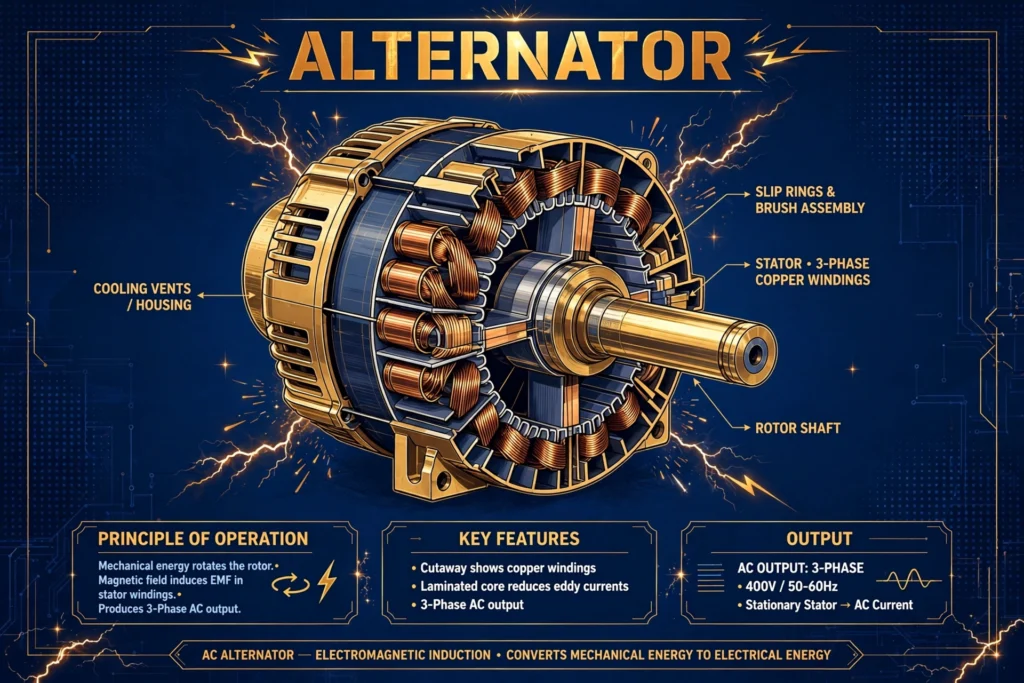
The alternator works on electromagnetic induction — the law discovered by Michael Faraday: when a magnetic field moves past a conductor, a voltage is created in the conductor. Here is how it happens inside an alternator:
- Rotation starts: A prime mover — a car engine, water turbine, or diesel engine — spins the rotor. The rotor carries an electromagnet that produces a magnetic field.
- Field sweeps the coils: As the rotor turns, its magnetic field sweeps past the stationary copper coils (stator windings). Picture waving a magnet quickly past a coil of wire.
- Voltage is induced: The moving field cuts through the stator coils, inducing an alternating voltage. Because the rotor keeps spinning, the voltage rises and falls in a wave shape called a sine wave.
- Speed sets the frequency: Faster rotation means faster alternation. Alternators are typically designed for 50 Hz (50 direction changes per second), or 60 Hz in countries like the USA.
- Power is delivered: When a load is connected to the stator terminals, the induced voltage drives alternating current through the circuit. Mechanical work becomes electrical power.
A simple analogy: an alternator is like a water pump turned by a windmill. The blades are the rotor, the turning motion is mechanical energy, and the flowing water is electricity. As long as the windmill spins, power keeps flowing.
Types of Alternator
Rotating Armature Alternator
Here the copper coils rotate while the magnetic field stays fixed, and output is collected through slip rings and brushes that wear over time. Used only in very small, low-voltage machines because rotating high-voltage connections are unsafe.
Rotating Field Alternator
The most common design worldwide: the magnetic field rotates on the rotor while the armature coils stay still. Only a small DC excitation current passes through the slip rings, so output comes from fixed terminals — safer and more reliable. Nearly all power-station alternators use this type.
Car Alternator
A small rotating-field alternator driven by a belt from the engine. It generates three-phase AC internally, and a built-in rectifier converts it to DC to charge the 12-volt battery. A voltage regulator keeps output steady as engine speed changes.
Diesel Generator Alternator
Paired with a diesel engine to form a generator set (genset), it delivers stable voltage during load changes. Common in hospitals, offices, and factories as backup power. Many are brushless for lower maintenance.
Hydro and Steam Turbine Alternators
The giants — massive machines driven by water turbines in dams or steam turbines in thermal plants, producing thousands of volts at megawatt scale. Large hydro units often use a vertical shaft with a salient-pole rotor built for slow rotation.
Brushless Alternator
Uses a small exciter generator on the same shaft instead of slip rings and brushes, removing the fastest-wearing parts. The result is less maintenance and higher reliability — the standard for modern standby and prime-power alternators.
Main Components
- Stator: The fixed outer part with armature windings — copper coils in a laminated iron core. This is where output voltage is produced.
- Rotor: The rotating part carrying the magnetic field. Salient-pole rotors (projecting poles) suit low speeds; smooth cylindrical rotors suit high-speed steam turbines.
- Field winding: The rotor coil that creates the magnetic field when DC flows through it. Small alternators may use permanent magnets instead.
- Exciter: The DC source feeding the field winding — a small DC generator, battery system, or brushless exciter on the same shaft.
- Slip rings and brushes: Carry DC excitation current to the spinning field winding. Not needed in brushless designs.
- Voltage regulator: Keeps output voltage stable by adjusting field current when load or speed changes.
- Rectifier: Diodes that convert AC to DC in car and portable alternators for battery charging.
- Frame and bearings: The housing holding everything together and the bearings letting the rotor spin smoothly.
Advantages
- High efficiency: Typically 85–95%, better than most DC generators of similar size.
- Low maintenance: Brushless designs have no brushes to replace; even car alternators need little beyond belt and bearing checks.
- Compact and light: More power per kilogram than a DC generator of the same rating — why cars switched to alternators decades ago.
- Works at variable speed: Charges the battery at engine idle or full speed, thanks to the voltage regulator.
- Safer output: In rotating-field designs, high-voltage output comes from stationary terminals with no sliding contacts in the power path.
- Easy to parallel: Large units can be synchronized to share load — the basis of entire power grids.
- Long service life: Simple construction and few wearing parts let industrial alternators run for decades with routine checks.
Disadvantages and Limitations
- Needs a prime mover: It cannot generate alone — an engine or turbine must spin it. No rotation means no output.
- Speed-sensitive frequency: Output frequency follows rotational speed, so drifting speed can harm sensitive equipment.
- Requires excitation: Most types need a DC source for the field winding; if excitation fails, output collapses.
- AC output only: DC loads like batteries need an added rectifier, which adds cost and small losses.
- Needs voltage regulation: Without a regulator, output swings with load changes.
- Noise and vibration: Engine-driven sets, especially diesel gensets, need proper mounting and sometimes sound enclosures.
- Grid synchronization is skilled work: Connecting a large alternator to the grid requires matching voltage, frequency, and phase exactly.
Applications
Vehicles: Every car, truck, and bus has one. It charges the battery and powers headlights, ignition, air conditioning, and safety systems while the engine runs. Motorcycles and some aircraft use them too.
Power generation: Almost all grid electricity starts in an alternator — hydroelectric dams, coal, gas, and nuclear plants all spin large alternators with turbines.
Backup power: Diesel and gas gensets keep hospitals, data centers, banks, and factories running during blackouts. Portable petrol units serve construction sites, farms, and outdoor events.
Industry and transport: Factories use alternators in captive power plants; ships use shaft-driven and auxiliary units; diesel-electric locomotives use them to feed traction motors.
Renewables and modern uses: Wind turbines drive alternators to feed the grid, hybrid vehicles use starter-generators, and village micro-hydro systems use small alternators to light homes.
Alternator Comparison
A frequent question is the difference between alternator and generator. Strictly, an alternator IS an AC generator — but in everyday language, “generator” usually means a DC generator. Here is how they compare:
| Feature | Alternator (AC) | DC Generator |
|---|---|---|
| Output type | Alternating current (AC) | Direct current (DC) |
| Current collection | Slip rings (or brushless) | Commutator and brushes |
| Efficiency | Higher (85–95%) | Lower (75–85%) |
| Size for same power | Smaller and lighter | Bigger and heavier |
| Maintenance | Low, especially brushless | Higher — commutator wears |
| Output at low speed | Charges even at idle (with regulator) | Poor at low speed |
| Typical use | Cars, power stations, gensets | Old vehicles, welding sets |
The takeaway: the alternator won for most uses because it is more efficient, more compact, and easier to maintain than the classic DC generator.
How to Choose the Right Alternator
- Size the power: Add up the wattage of everything running at once, then add 20–25% for starting surges. A 5 kW load needs roughly a 6–7 kVA alternator.
- Match voltage and frequency: Choose to fit your country’s standard (e.g., 230 V / 50 Hz) and your equipment.
- Check the speed rating: The rated RPM must match your engine or turbine (common: 1500 or 3000 RPM for 50 Hz).
- Single-phase or three-phase: Homes and small shops need single-phase; factories and large loads need three-phase.
- Go brushless for long hours: Brushless designs save time and service cost in continuous duty.
- Insist on AVR: An automatic voltage regulator keeps output steady when loads switch — essential for electronics.
- Consider the environment: Dusty, hot, or outdoor sites need proper enclosure (IP rating) and cooling.
- Buy serviceable brands: Spare parts and local service matter more than a slightly lower price.
Common Problems and Solutions
Q: Why is my car battery warning light on?
A: The alternator is likely not charging. Check the drive belt first — if loose or broken, the alternator cannot spin. If the belt is fine, the regulator, brushes, or diodes may have failed and need workshop testing.
Q: The output voltage is too low. What causes this?
A: Usual suspects: a slipping belt, weak field excitation, a faulty regulator, or overload. Reduce the load, check belt tension, and test the excitation circuit and regulator.
Q: Why does the alternator whine or grind?
A: Worn bearings or a misaligned belt. A whine that changes with engine speed often means bearing failure — replace them early, before a seizure damages the stator.
Q: Can an alternator overcharge the battery?
A: Yes, if the voltage regulator fails. Overcharging boils battery fluid and damages electronics — replace the faulty regulator immediately and check the battery.
Q: Why does the genset shut down under load?
A: The engine may be undersized for the load, fuel flow restricted, or cooling air blocked causing overheating. Verify the load against the rating, inspect filters, and clean cooling paths.
Q: How often should an alternator be serviced?
A: On cars, inspect the belt and connections at every service. On industrial units, check bearings, insulation resistance, and brushes (if fitted) yearly or per the manufacturer’s schedule.
Future Trends
The alternator is an old invention that keeps evolving. Better magnetic materials and smarter electronic regulators are pushing efficiency higher while wasting less energy as heat. In cars, the belt-driven alternator is gradually giving way to 48-volt mild-hybrid systems, where a starter-generator also recovers braking energy.
In power generation, digital monitoring is the big shift: sensors track temperature, vibration, and insulation health, and software predicts failures before they happen. This cuts downtime in plants and data centers. Permanent-magnet alternators are also growing in wind turbines and small hydro plants because they need no excitation system.
As grids absorb more solar and wind, fast-response excitation helps alternators keep the system stable when clouds pass or wind drops. The machine stays the same; the controls around it keep getting smarter.
Conclusion
The alternator is a simple idea with huge impact: spin a magnet inside coils of wire, and useful electricity flows out. From the small unit under your car’s hood to the giants inside power stations, the alternator working principle has endured for over a century because it is efficient, reliable, and easy to scale.
Knowing the difference between alternator and generator, the main types, and the alternator advantages and disadvantages helps you choose, use, and maintain the right machine — for a car, a home backup set, or an industrial plant. As vehicles electrify and grids grow smarter, the alternator will keep doing what it does best: turning motion into power, quietly and reliably.