
Imagine sitting in a small apartment during a hot summer evening. The room feels warm, and there is very little air circulation. A traditional ceiling fan may not provide enough airflow, and installing an air conditioner may not be practical or affordable. In such situations, many people choose a tower fan because it is compact, energy-efficient, and capable of circulating air effectively within a room.
Tower fans have become very popular in modern homes, offices, and small workspaces. Their slim vertical design allows them to fit easily in corners or narrow spaces while still providing strong airflow. Unlike traditional fans with visible blades, tower fans often use internal blade systems and oscillation mechanisms to distribute air evenly.
For electrical students, engineers, and technicians, understanding tower fans is useful because they combine electric motors, airflow systems, electronic controls, and mechanical design. These fans demonstrate how simple electrical devices can improve comfort and energy efficiency in everyday environments.
In this article, we will explain the tower fans working principle, types, main components, advantages, disadvantages, and tower fans applications. We will also discuss the difference between tower fan and pedestal fan, helping beginners understand how different fan designs operate and when to use each one.
What are Tower Fans?
Tower fans are vertical, slim-designed electric fans that circulate air through a tall cylindrical or rectangular housing. They are designed to provide consistent airflow while occupying minimal floor space.
Unlike traditional fans with large external blades, tower fans use internal rotating blades or airflow systems to move air through vents along the height of the fan.
Simple Explanation
A tower fan pulls air into the base or rear of the unit and pushes it upward through internal blades. The air then exits through narrow vents across the front of the fan, creating a smooth and continuous airflow.
Practical Example
For example, in a small bedroom or office space, a tower fan can be placed in the corner. When it operates, it circulates air throughout the room and improves comfort without occupying much space.
Because of their modern design and quiet operation, tower fans are widely used in homes and apartments.
How Does a Tower Fan Work?
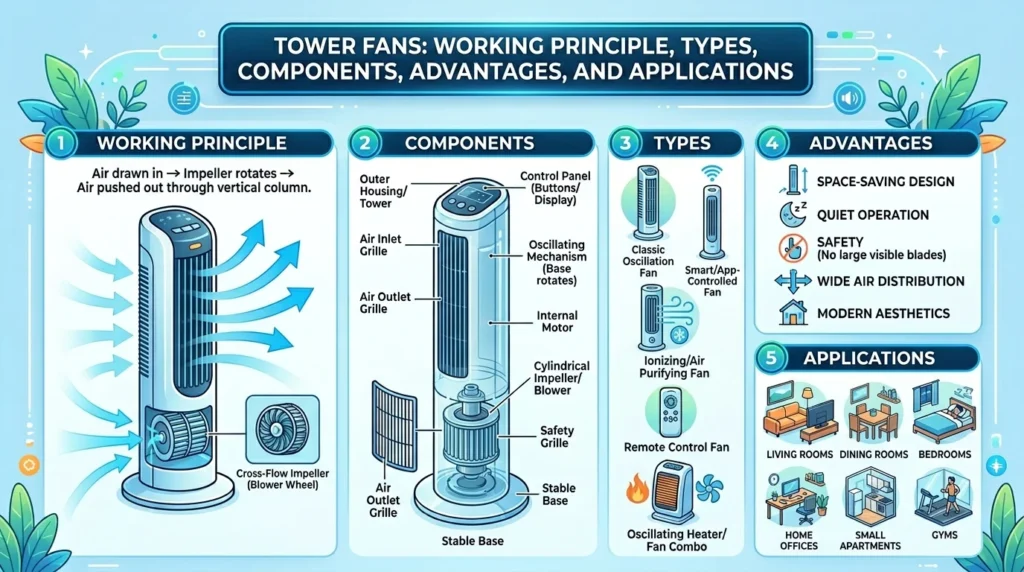
A tower fan works by using an electric motor, internal impeller, airflow channels, and outlet vents to circulate air throughout a room. When the fan is switched on, electrical energy powers the motor, which rotates the internal impeller. The rotating impeller draws surrounding air through the intake vents and pushes it through the fan’s internal airflow path.
The moving air is then directed toward the vertical outlet vents on the front of the fan. These vents distribute the airflow across a larger vertical area, creating a steady breeze. When the oscillation function is enabled, the fan moves from side to side, allowing the airflow to reach a wider portion of the room.
Unlike an air conditioner, a tower fan normally does not remove heat from the room or lower the actual room temperature. Instead, it increases air movement across the skin, which can make people feel cooler and more comfortable.
Step-by-Step Working Process
- Electrical power is supplied to the tower fan.
- The electric motor starts rotating.
- The motor drives the internal impeller or fan assembly.
- The rotating impeller draws room air through the intake vents.
- The impeller accelerates and directs the air through internal channels.
- Air exits through the vertical outlet vents.
- The oscillation mechanism moves the fan from side to side when activated.
- The resulting airflow improves air circulation and personal comfort.
Simple Working Flow
Electrical Power → Motor Rotation → Impeller Rotation → Air Intake → Air Acceleration → Air Outlet → Room Air Circulation
This simple process allows a tower fan to provide continuous airflow while maintaining a compact and space-saving design.
Tower Fans Working Principle (Detailed Explanation)
The working principle of a tower fan is based on electric motor-driven airflow generation, where air is drawn in from the surroundings, accelerated inside a vertical housing, and then released evenly through narrow vents to cool the room efficiently. Unlike traditional ceiling or pedestal fans, tower fans use a compact cylindrical impeller system, making them safer, quieter, and space-saving.
1. Electric Motor Activation
When the tower fan is switched on, electrical energy is supplied to the internal electric motor. This motor is the main driving force of the fan.
Electric motor activation is the first and most important step in the working of a tower fan. It is the process in which electrical energy is converted into mechanical motion to start the airflow system inside the fan. Without the activation of the electric motor, the fan cannot perform any cooling function.
When a tower fan is switched on, the electrical supply from the power source reaches the internal circuit of the fan. This circuit is designed to safely control and distribute electricity to different components, especially the electric motor. In most tower fans, the motor is located either at the base or in the middle section of the unit to ensure better balance and stability during operation. Once the power is received, the motor begins to activate by creating a rotating magnetic field inside it.
This rotating magnetic field interacts with the rotor of the motor, causing it to spin. As a result, the mechanical shaft connected to the motor also starts rotating. This rotation is the foundation of the entire airflow system in the tower fan. The speed of the motor can usually be controlled through different settings such as low, medium, or high. These settings regulate the amount of electrical current supplied to the motor, which directly affects the rotation speed and airflow strength.
During activation, the motor operates quietly and efficiently in modern tower fans due to improved design and advanced engineering. The smooth starting mechanism helps prevent sudden jerks or overload, ensuring long-term durability of the device. In some advanced models, the motor is also supported by thermal protection systems that prevent overheating during continuous use.
Overall, electric motor activation is the core process that enables a tower fan to function. It transforms electrical energy into controlled rotational movement, which ultimately drives the internal fan system to produce a steady and comfortable airflow. Without this step, no air circulation or cooling effect would be possible in the tower fan.
What happens here:
- The motor converts electrical energy into mechanical rotation
- It starts spinning the internal fan assembly
- Speed settings control how fast the motor rotates
The motor is usually located at the base or middle section of the fan for stability.
2. Rotation of Internal Impeller (Fan Assembly)
Inside the tower fan, there is a long cylindrical impeller or drum-shaped blade system instead of large external blades.
The rotation of the internal impeller is one of the most important stages in the working principle of a tower fan. Unlike traditional fans that use large external blades, tower fans contain a long cylindrical impeller hidden inside the vertical housing. This impeller is responsible for generating and maintaining the airflow that provides cooling throughout the room. Its enclosed design not only improves safety but also contributes to the sleek appearance and efficient performance of the fan.
Once the electric motor is activated, it transfers mechanical energy to the impeller through a connected shaft. The impeller, which consists of multiple small curved blades arranged around a cylindrical structure, begins rotating at high speed. As these blades spin, they create a pressure difference inside the fan. This pressure difference pulls air into the tower through the intake vents located at the back or bottom of the unit.
As the impeller continues to rotate, it captures the incoming air and forces it upward through the internal airflow channels. The curved shape and arrangement of the blades are carefully designed to accelerate the air smoothly and efficiently. Instead of producing short bursts of air, the rotating impeller creates a steady and continuous stream of airflow. This results in a more comfortable cooling effect that feels gentle and evenly distributed.
The speed of the impeller can usually be adjusted through the fan’s control settings. Lower speeds provide a soft breeze suitable for sleeping or relaxation, while higher speeds generate stronger airflow for hotter conditions. Because the impeller is enclosed within the tower structure, it operates more quietly than many conventional fans and reduces the risk of accidental contact with moving parts.
Overall, the rotation of the internal impeller is the heart of the tower fan’s airflow system. It converts the motor’s rotational energy into controlled air movement, ensuring efficient cooling, improved safety, quieter operation, and consistent performance for everyday indoor use.
Working process:
- The motor rotates this cylindrical fan at high speed
- Small curved blades on the cylinder push air forward
- Continuous rotation ensures steady airflow
This enclosed design makes tower fans safer and more efficient.
3. Air Intake from Surroundings
The fan body has air intake vents located at the rear or lower side of the unit.
Air intake from the surroundings is a crucial stage in the working principle of a tower fan. Before cool airflow can be delivered into the room, the fan must first draw in the air present around it. This process ensures a continuous supply of air for circulation and cooling. Most tower fans are designed with intake vents located at the back, sides, or lower section of the unit. These vents allow surrounding air to enter the fan efficiently without obstruction.
When the internal impeller begins rotating, it creates a slight pressure difference inside the fan housing. This pressure difference generates a suction effect that pulls warm room air through the intake vents. The incoming air then moves into the internal airflow channels, where it is directed toward the rotating impeller for further processing. In some advanced tower fan models, built-in filters are included near the intake area to trap dust, lint, and other airborne particles before the air continues through the system. This helps improve air quality while maintaining efficient operation.
The effectiveness of the air intake process directly influences the fan’s overall performance. A steady and unrestricted flow of incoming air enables the fan to produce smooth and consistent airflow. Therefore, keeping the intake vents clean and free from dust buildup is important for maintaining maximum cooling efficiency. In simple terms, the air intake stage acts as the starting point of the airflow cycle, allowing the tower fan to continuously circulate room air and provide a refreshing and comfortable cooling experience.
How air enters:
- Surrounding warm air is pulled inside due to suction created by rotating blades
- Air flows smoothly through internal channels
- Some models include filters to remove dust particles
This step is essential for maintaining continuous airflow circulation.
4. Air Acceleration Inside the Tower
Once air enters the fan, it passes through the rotating impeller system.
Air acceleration inside the tower is an essential stage in the operation of a tower fan. After the surrounding air enters through the intake vents, it moves toward the internal impeller, where its speed and pressure are increased before being released back into the room. This process is responsible for transforming ordinary room air into a steady and refreshing stream of airflow that provides effective cooling.
As the cylindrical impeller rotates at high speed, its specially designed curved blades capture the incoming air and push it through the narrow internal channels of the tower. During this movement, the air gains velocity and becomes more concentrated. The rotating blades create pressure that accelerates the airflow upward through the fan’s vertical body. This increase in air speed ensures that the fan can distribute air efficiently across the room without the need for large exposed blades.
The design of the tower fan plays an important role in this stage. The enclosed structure guides the accelerated air smoothly toward the outlet vents, reducing turbulence and maintaining a consistent flow. As a result, users experience a continuous and comfortable breeze rather than uneven bursts of air.
In simple terms, air acceleration inside the tower converts slow-moving intake air into a stronger and more focused airflow. This process improves the cooling performance of the fan, enhances energy efficiency, and contributes to the quiet operation that makes tower fans a popular choice for homes and offices.
Key process:
- The rotating blades increase air velocity
- Air pressure is built inside the cylindrical chamber
- The airflow becomes stronger and more focused
This stage is responsible for creating a steady cooling breeze.
5. Air Discharge Through Vertical Vents
After acceleration, the air is pushed outward through narrow vertical outlet grills on the front side of the tower fan.
Air discharge through vertical vents is the final stage of the airflow process inside a tower fan. After the incoming air has been drawn into the fan and accelerated by the rotating internal impeller, it is directed toward the front outlet vents and released back into the room. This stage is responsible for delivering the cooling effect that users feel during operation.
Tower fans are designed with long, narrow vertical vents positioned along the front of the unit. These vents allow the accelerated air to exit in a controlled and uniform manner. Instead of producing a strong and concentrated blast of air like some traditional fans, the vertical vent system spreads the airflow evenly across a wider height range. This creates a smooth and comfortable breeze that feels natural and less harsh on the body.
The shape and arrangement of these vents also help reduce turbulence and noise, contributing to the quiet operation for which tower fans are known. Because the airflow is distributed through multiple openings, the cooling effect becomes more balanced and consistent throughout the room. This design is especially beneficial in bedrooms, living rooms, and offices where prolonged comfort is important.
In simple terms, the air discharge process through vertical vents transforms the accelerated airflow inside the tower into a steady stream of cool air. It enhances user comfort, improves air distribution, and ensures efficient cooling performance while maintaining the sleek and space-saving design of the tower fan.
Important points:
- Air exits in a smooth, continuous stream
- The vertical design spreads air evenly across height
- It creates a soft cooling effect instead of strong direct wind
This makes tower fans comfortable for long use.
6. Oscillation Mechanism for Wider Air Distribution
Most tower fans include an oscillation feature to improve air circulation in the room.
The oscillation mechanism in a tower fan is a special feature designed to distribute airflow evenly across a larger area instead of blowing air in only one fixed direction. This function improves comfort and ensures that multiple people in a room can feel the cooling effect at the same time
The oscillation mechanism is an important feature in many tower fans that helps distribute airflow evenly throughout a room. Instead of directing air in only one fixed direction, the oscillation function allows the fan to move from side to side, increasing the area covered by the airflow. This results in more effective cooling and improved comfort for everyone in the room.
When the oscillation mode is activated, a small internal motor works together with a gear system located inside the fan. This mechanism gently rotates the body of the tower fan from left to right and then back again in a continuous motion. Most standard tower fans provide an oscillation angle ranging from approximately 60 to 120 degrees, enabling air to reach different parts of the room efficiently.
The main advantage of oscillation is that it prevents airflow from being concentrated in a single spot. Instead, cool air is spread more uniformly, reducing hot areas and improving overall air circulation. This feature is especially useful in living rooms, bedrooms, offices, and other shared spaces where multiple people may benefit from the cooling effect at the same time.
In addition to enhancing comfort, the oscillation mechanism also improves the fan’s efficiency by maximizing airflow coverage without increasing energy consumption. Users can enjoy better cooling performance while maintaining low operating costs. Overall, the oscillation mechanism plays a vital role in making tower fans practical and effective, ensuring that fresh, moving air is distributed evenly across the room for a more pleasant indoor environment.
How the Oscillation Mechanism Works
Inside the tower fan, there is a small oscillation motor and gear system connected to the main body of the fan
The oscillation mechanism in a tower fan is designed to move the fan from side to side so that airflow can be distributed across a wider area. This feature improves cooling efficiency by ensuring that air reaches different parts of the room instead of being directed toward a single location. The mechanism operates through a combination of a small electric motor, gears, and connecting components that work together to produce smooth and controlled movement.
When the oscillation function is activated, a dedicated oscillation motor inside the fan begins to operate. This motor drives a series of gears that convert the motor’s continuous rotational motion into a slow side-to-side movement. The gear system is carefully designed to rotate the tower fan body through a specific angle and then reverse the direction automatically. As a result, the fan gently swings from left to right and back again in a repeated cycle.
Most tower fans provide an oscillation range of approximately 60 to 120 degrees, allowing the airflow to cover a larger section of the room. The movement is smooth and quiet, ensuring that users are not disturbed during sleep, work, or relaxation. Some advanced models also allow users to adjust the oscillation angle according to their cooling preferences.
This mechanism not only enhances comfort but also improves air circulation by reducing areas of stagnant air. By spreading the airflow evenly throughout the space, the oscillation system helps maintain a more consistent room temperature. Overall, the oscillation mechanism is a simple yet highly effective feature that significantly increases the performance and practicality of tower fans in everyday use.
Working process:
- When oscillation mode is turned on, the small motor activates
- This motor drives a gear mechanism at the base or head of the fan
- The gear system slowly rotates the fan body left and right
- This movement continues in a smooth, controlled motion
This side-to-side movement helps spread air throughout the room.
Range of Movement
Most tower fans can oscillate within a specific angle range, usually:
- Around 60° to 120° rotation angle
- Some advanced models offer wider coverage
This allows air to reach different corners of the room instead of staying in one direction.
Benefits of Oscillation
The oscillation system improves the overall performance of the fan in several ways:
- Provides uniform cooling across the room
- Reduces hot spots by circulating air evenly
- Improves comfort for multiple people at once
- Enhances air circulation in closed spaces
- Makes cooling more efficient without increasing power usage
Importance in Daily Use
Oscillation is especially useful in:
- Living rooms where people sit in different positions
- Bedrooms for full-area cooling during sleep
- Offices where multiple workstations are present
It ensures that the cooling effect is not limited to a single person or direction.
The oscillation mechanism is an important feature of tower fans that improves airflow distribution by rotating the fan body side to side using a motor-driven gear system. This simple but effective technology makes tower fans more practical, comfortable, and efficient for everyday indoor cooling.
How it works:
- The fan body rotates left and right automatically
- A small internal gear system controls movement
- Air is spread across a wider area instead of one direction
This helps cool multiple people in a room at the same time.
The working principle of a tower fan is based on a simple but efficient system: an electric motor rotates an internal cylindrical impeller, air is drawn in through vents, accelerated inside the body, and then released through vertical grills with oscillation for wider distribution. This design makes tower fans safe, quiet, energy-efficient, and ideal for modern indoor cooling needs.
Simple Analogy
Think of a tower fan like a vertical wind tunnel. Air enters from one side, moves upward through spinning blades, and exits evenly along the tower.
How Much Electricity Does a Tower Fan Use?
A tower fan generally uses less electricity than an air conditioner, but its actual power consumption depends on the motor, fan speed, operating mode, and model. Most tower fans are designed for relatively low electrical power consumption, making them suitable for extended daily use.
The power rating of a tower fan is usually listed in watts (W) on the product label or specifications. A higher wattage means the fan can use more electrical energy when operating for the same amount of time.
Tower Fan Electricity Consumption Formula
You can calculate the electrical energy consumed by a tower fan using this simple formula:
Energy Consumption (kWh) = Power (W) × Operating Time (hours) ÷ 1000
For example, if a tower fan has a power rating of 50 watts and operates for 8 hours:
50 × 8 ÷ 1000 = 0.4 kWh
Therefore, the fan uses approximately 0.4 kilowatt-hours (kWh) during 8 hours of operation at its rated power.
Example of Tower Fan Power Consumption
Consider a tower fan rated at 60 watts that runs for 10 hours per day.
60 × 10 ÷ 1000 = 0.6 kWh per day
If the fan operates for 30 days:
0.6 × 30 = 18 kWh per month
This means the tower fan would consume approximately 18 kWh of electricity per month under these operating conditions.
The actual consumption may be lower because many tower fans do not continuously operate at their maximum rated power. Lower speed settings, timers, sleep modes, and automatic controls can affect energy use.
Factors That Affect Tower Fan Electricity Consumption
Several factors can influence how much electricity a tower fan uses:
- Motor type: Different motor designs have different efficiency levels.
- Fan speed: Higher speeds generally require more power.
- Operating time: Running the fan for more hours increases total energy consumption.
- Operating mode: Sleep, eco, or automatic modes may reduce power use on some models.
- Oscillation: Oscillation can slightly affect energy use depending on the motor and mechanism.
- Fan size and design: Larger or more powerful models may have higher wattage ratings.
How to Reduce Tower Fan Energy Consumption
You can reduce electricity use by selecting an appropriate speed instead of continuously using the highest setting. Using the timer or sleep mode can also prevent the fan from running unnecessarily.
Regular maintenance is helpful as well. Dust buildup around the intake vents, outlet vents, or internal components can restrict airflow and may reduce performance.
For the most accurate calculation, check the wattage rating on your specific tower fan and multiply it by the number of hours you use the fan.
A tower fan is primarily an air-movement device. Unlike an air conditioner, it normally does not remove heat from the room. Instead, it increases air circulation and can make people feel cooler through increased airflow.
Types of Tower Fans (Detailed Guide)
Tower fans are modern cooling devices designed to provide efficient airflow in homes, offices, and commercial spaces. They come in different types based on technology, features, and user convenience. Each type is designed to meet specific cooling needs and lifestyle preferences. Below is a detailed explanation of the main types of tower fans.
Standard Tower Fans: Features, Working Principle, Advantages, and Common Uses
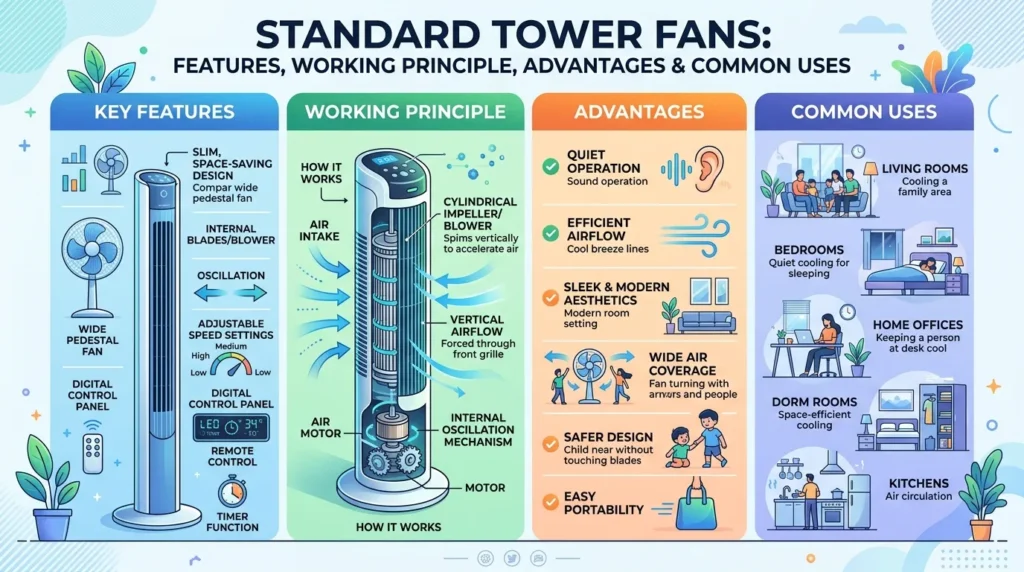
Standard tower fans are the most common and widely used type of tower fan. They are designed for basic cooling purposes and are suitable for everyday home use.
Standard tower fans are the most basic and commonly used type of tower fan designed for simple, effective, and affordable cooling. They are widely used in homes, offices, and small commercial spaces where advanced features are not required.
These fans focus on providing steady airflow, easy operation, and energy efficiency, making them ideal for everyday use.
Standard tower fans are among the most popular cooling appliances used in homes and offices because they offer an effective combination of simplicity, affordability, and energy efficiency. Designed with a tall and slim vertical structure, these fans occupy very little floor space, making them an excellent choice for apartments, bedrooms, study rooms, and other areas where space is limited. Unlike traditional pedestal fans with large exposed blades, standard tower fans contain an internal cylindrical impeller hidden within the housing. This enclosed design not only enhances safety but also provides a sleek and modern appearance that blends well with different interior styles.
The working principle of a standard tower fan is relatively simple. When the fan is switched on, an electric motor powers the internal impeller, causing it to rotate at high speed. The rotating impeller draws surrounding air into the unit through intake vents, accelerates it through the internal channels, and releases it through narrow vertical vents at the front of the fan. Many standard models also include an oscillation feature that moves the fan from side to side, allowing the airflow to cover a wider area and improving overall room circulation.
One of the biggest advantages of standard tower fans is their ease of use. They typically include straightforward controls, multiple speed settings, and low power consumption, making them suitable for everyday operation. In addition, they require minimal maintenance and are generally more affordable than advanced smart or bladeless models. Standard tower fans are commonly used in bedrooms, living rooms, home offices, and small commercial spaces where quiet and efficient cooling is needed. Their reliable performance, compact design, and cost-effectiveness make them a practical choice for users seeking a comfortable indoor environment without investing in expensive cooling equipment.
Design and Structure
Standard tower fans have a tall, slim vertical design that helps save space while providing good air circulation.
Key design features:
- Vertical cylindrical body for compact placement
- Internal rotating fan system (hidden blades)
- Front air outlet vents for smooth airflow
- Stable base to prevent tipping
This simple structure allows the fan to fit easily in corners or small rooms.
Working System
Standard tower fans operate using a basic electric motor-driven impeller system.
How it works:
- The electric motor starts when the fan is switched on
- Internal blades rotate to pull air inside
- Air is pushed through narrow vertical vents
- The fan releases continuous airflow into the room
This process creates a soft and steady breeze suitable for personal cooling.
Main Features
Standard tower fans usually come with essential functions only.
Common features include:
- Multiple speed settings (low, medium, high)
- Basic manual or button control panel
- Oscillation function for wider air distribution
- Lightweight and portable design
- Low power consumption
These features make them easy to use for all age groups.
Advantages of Standard Tower Fans
Standard tower fans offer several practical benefits:
- ✔ Affordable price compared to advanced models
- ✔ Easy to operate without complex settings
- ✔ Energy-efficient for daily use
- ✔ Space-saving design suitable for small rooms
- ✔ Low maintenance requirements
They are a cost-effective cooling solution for regular use.
Limitations
Although useful, standard tower fans also have some limitations:
- No smart or remote control features
- Limited airflow power compared to premium models
- Basic design without advanced technology
- Fewer customization options
These limitations make them less suitable for high-tech or large-area cooling needs.
Common Applications
Standard tower fans are widely used in:
- Bedrooms for personal cooling
- Small living rooms
- Study rooms and home offices
- Shops and small workplaces
They are best suited for individual or small-space cooling needs.
Standard tower fans are simple, reliable, and budget-friendly cooling devices. With basic speed control, oscillation, and compact design, they provide effective airflow for everyday comfort. Although they lack advanced features, their efficiency and affordability make them one of the most popular choices for home and office cooling.
Key Features:
- Simple and easy-to-use control panel (manual buttons or knobs)
- Multiple speed settings for adjusting airflow intensity
- Oscillation function to distribute air across a wider area
- Compact and space-saving vertical design
Benefits:
Standard tower fans are affordable and energy-efficient. They are ideal for small to medium-sized rooms such as bedrooms, living rooms, and study areas. These fans are perfect for users who need basic cooling without advanced features.
2. Bladeless Tower Fans: Working Principle, Key Features, Advantages, and Common Uses
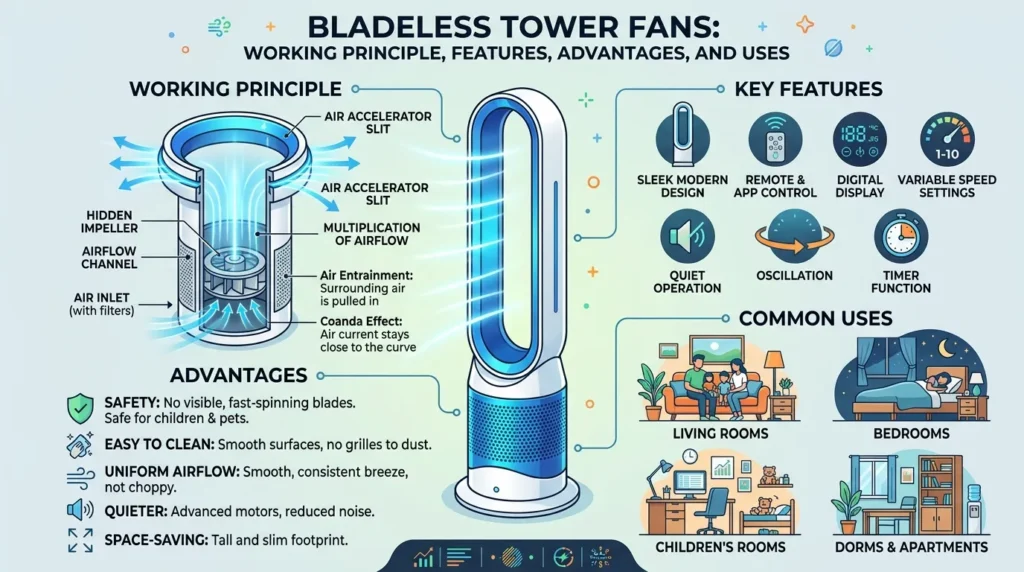
Bladeless tower fans are modern cooling devices that use air multiplication technology instead of traditional rotating blades. They create a smooth and continuous airflow through an internal mechanism.
Bladeless tower fans are modern cooling appliances that use advanced airflow technology to provide smooth and efficient air circulation without exposed rotating blades. Unlike conventional fans, these models contain a hidden motor and internal impeller that draw air into the unit through intake vents. The air is then accelerated and directed through a specially designed air channel, creating a powerful and continuous stream of airflow. This innovative working principle allows bladeless tower fans to deliver a comfortable cooling effect while maintaining a sleek and minimalist appearance.
One of the key features of bladeless tower fans is their safe design. Since there are no visible blades, they are an excellent choice for homes with children and pets. They also produce smoother airflow with less turbulence, resulting in quieter operation compared to many traditional fans. In addition, their streamlined construction makes cleaning easier because there are fewer components exposed to dust and dirt. Many models include useful functions such as multiple speed settings, oscillation for wider air distribution, remote control, timers, and sleep modes for added convenience.
Bladeless tower fans offer several advantages, including enhanced safety, energy efficiency, low maintenance requirements, and a modern aesthetic that complements contemporary interiors. They are commonly used in bedrooms, living rooms, offices, and other indoor spaces where quiet performance and stylish design are valued. Although they are generally more expensive than standard tower fans, their advanced technology, convenience, and improved user experience make them a popular choice for people seeking a sophisticated and effective cooling solution.
Key Features:
- No visible blades for enhanced safety
- Smooth and consistent airflow without sudden bursts
- Stylish and modern design suitable for contemporary interiors
- Easy to clean compared to traditional fans
Benefits:
Bladeless tower fans are safer for children and pets due to the absence of external blades. They also operate more quietly and provide a more comfortable cooling experience. These fans are commonly used in modern homes, offices, and luxury environments.
3.Remote-Control Tower Fans: Working Principle, Key Features, Advantages, and Common Uses
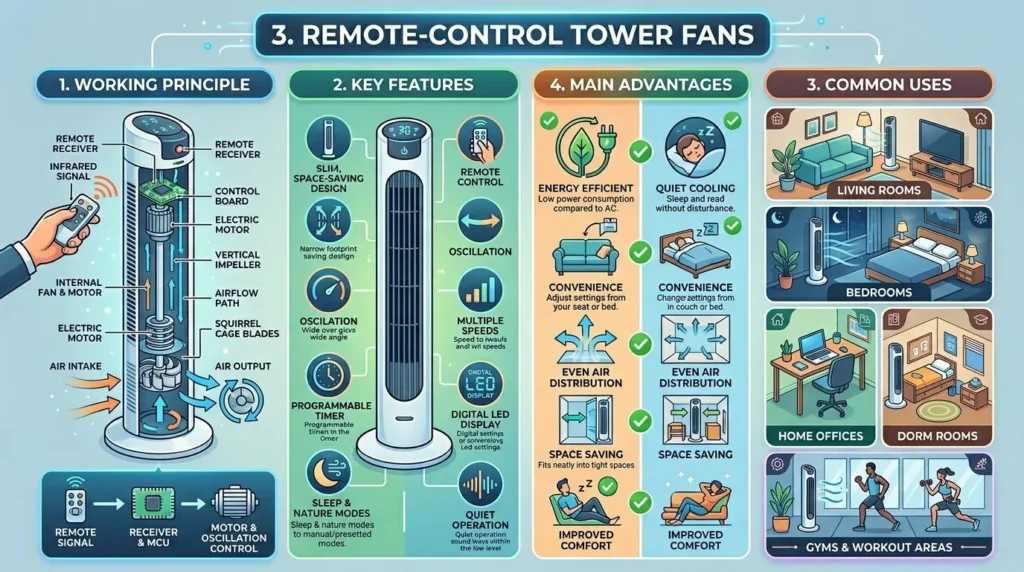
Remote-control tower fans come with a wireless remote that allows users to operate the fan from a distance. This feature adds convenience and improves user experience.
Remote-control tower fans are modern cooling devices designed to provide convenience, comfort, and efficient airflow management. These fans operate on the same basic principle as standard tower fans, where an electric motor drives an internal impeller to draw in surrounding air, accelerate it, and release it through vertical vents. The key difference is the addition of a remote control system that allows users to operate the fan from a distance without needing to manually adjust the settings on the unit.
The working principle involves both mechanical and electronic components. While the motor handles airflow generation, the remote control communicates with the fan using infrared signals. When a button is pressed on the remote, the signal is received by the fan’s sensor, which then adjusts settings such as speed, oscillation, timer, or power on/off function. This makes operation simple and user-friendly, especially in bedrooms and living spaces.
Key features of remote-control tower fans include multiple speed settings, oscillation control, timer functions, and easy-to-use wireless remotes. Some advanced models also offer sleep modes for quiet operation during nighttime use.
The main advantages of these fans are convenience, energy efficiency, and improved comfort. Users can adjust settings without getting up, making them ideal for relaxation and sleep. Common uses include bedrooms, living rooms, offices, and small commercial spaces where easy control and effective cooling are needed.
Key Features:
- Wireless remote control for easy operation
- Adjustable speed settings without touching the unit
- Built-in timer function for automatic shut-off
- Oscillation control from remote
Benefits:
These fans are ideal for bedrooms, offices, and living rooms where convenience is important. Users can easily adjust settings without getting up, making them especially useful during sleep or relaxation.
4. Smart Tower Fans: Working Principle, Key Features, Advantages, and Common Uses
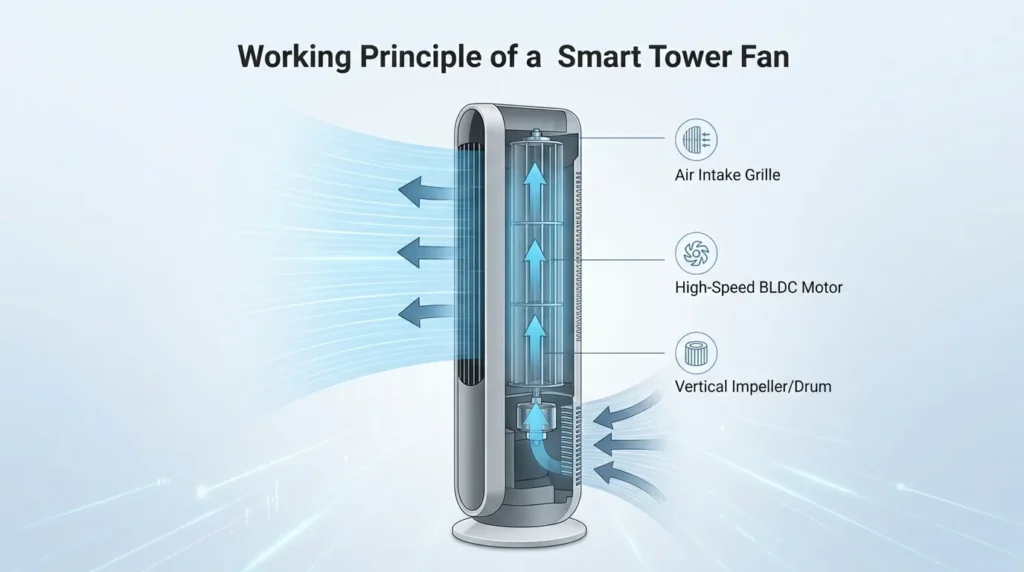
Smart tower fans are advanced cooling devices that integrate modern technology for enhanced control and efficiency. They are designed for smart homes and tech-savvy users.
Smart tower fans are advanced cooling devices designed for modern homes that combine traditional airflow technology with digital connectivity and automation features. These fans operate using the same basic mechanical principle as standard tower fans, where an electric motor powers an internal impeller to draw in surrounding air, accelerate it, and release it through vertical vents. However, what makes smart tower fans different is their ability to be controlled through mobile apps, Wi-Fi connectivity, and voice assistants, offering a highly convenient and intelligent cooling experience.
The working principle involves both mechanical and smart electronic systems. The motor generates airflow by rotating the internal impeller, while built-in sensors and control modules manage fan operations based on user commands. Through a mobile application or smart home system, users can adjust speed settings, activate oscillation, set timers, and even schedule automatic on/off functions. Many smart tower fans are also compatible with voice assistants such as Alexa or Google Assistant, allowing hands-free control.
Key features of smart tower fans include Wi-Fi connectivity, remote app control, multiple speed levels, oscillation control, sleep modes, and programmable timers. Some advanced models also include temperature sensors that automatically adjust fan speed according to room conditions. These features make them highly efficient and user-friendly.
The advantages of smart tower fans include convenience, energy efficiency, automation, and improved comfort. Users can control the fan from anywhere, even when they are not at home, which enhances flexibility and energy savings. They are commonly used in bedrooms, living rooms, offices, and smart homes where technology integration is preferred. Overall, smart tower fans represent the future of cooling systems by combining performance, intelligence, and modern lifestyle needs.
Key Features:
- Wi-Fi connectivity for remote access
- Mobile app control from smartphones or tablets
- Voice assistant compatibility (such as Alexa or Google Assistant)
- Customizable cooling modes and schedules
Benefits:
Smart tower fans offer maximum convenience and energy efficiency. Users can control them from anywhere, even outside the home. They are ideal for modern smart homes where automation and connectivity are important.
Tower fans come in different types, each designed to meet specific needs. Standard fans are best for basic cooling, bladeless fans offer safety and modern design, remote-control fans provide convenience, and smart fans deliver advanced automation and control. Choosing the right type depends on your budget, lifestyle, and cooling requirements.
Tower Fan Maintenance Tips
Regular maintenance helps a tower fan maintain good airflow, operate efficiently, and last longer. Because tower fans draw room air through intake vents, dust and debris can gradually accumulate around the vents and other accessible parts. Cleaning the fan regularly can help prevent restricted airflow and unnecessary strain on the motor.
1. Clean the Air Intake Vents
Dust can collect on the rear or side intake vents and reduce the amount of air entering the fan. Turn off and unplug the tower fan before cleaning it.
Use a soft brush, microfiber cloth, or vacuum cleaner with a suitable attachment to remove visible dust from the intake vents.
2. Clean the Air Outlet Vents
The vertical outlet vents can also collect dust over time. Gently clean these areas with a dry microfiber cloth or soft brush.
Avoid pushing dust deeper into the fan because it can accumulate around internal components.
3. Remove Dust From the Exterior
Wipe the fan housing regularly to prevent dust buildup. A slightly damp cloth can be used on the exterior, but make sure water does not enter the electrical components, control panel, motor area, or other openings.
Always disconnect the fan from the power supply before cleaning.
4. Check for Unusual Noise
Pay attention to new or unusual sounds such as rattling, grinding, buzzing, or excessive vibration. These sounds can indicate loose parts, dust buildup, an obstruction, or a mechanical problem.
If the noise continues after basic cleaning and inspection, stop using the fan and follow the manufacturer’s service instructions.
5. Keep the Fan on a Stable Surface
Place the tower fan on a level and stable surface. An uneven surface can increase vibration and may affect the fan’s operation.
Keep the fan away from areas where it can easily be knocked over.
6. Keep Airflow Open
Do not place furniture, curtains, boxes, or other objects directly against the fan’s intake or outlet vents. Restricted airflow can reduce the fan’s performance.
Leave sufficient space around the fan so that air can enter and exit freely.
7. Inspect the Power Cord and Plug
Check the power cord and plug periodically for visible damage, cuts, exposed wires, melting, or unusual discoloration.
Do not operate the fan if the power cord or plug is damaged. Replace damaged electrical components through an appropriate service provider or according to the manufacturer’s instructions.
8. Clean the Fan Regularly
The required cleaning frequency depends on the environment and how often the fan is used. A fan operating in a dusty environment may require more frequent cleaning than one used in a relatively clean room.
Regular inspection and cleaning can help maintain airflow and reduce dust accumulation.
9. Store the Fan Properly
If the tower fan will not be used for an extended period, clean it before storage and disconnect it from the power supply. Store it in a dry location and protect it from excessive dust and moisture.
Important Safety Precaution
Never immerse a tower fan in water or pour liquid into the fan housing. Always unplug the unit before cleaning or inspecting it.
For internal repairs, motor servicing, or electrical faults, follow the manufacturer’s instructions and use a qualified technician when necessary.
Proper maintenance is a simple way to keep a tower fan operating reliably while maintaining effective airflow and reducing avoidable problems.
Tower Fan vs Air Conditioner
Tower fans and air conditioners are both used to improve comfort during hot weather, but they work in very different ways. A tower fan mainly moves air around a room, while an air conditioner removes heat from indoor air and transfers it outside.
Understanding the difference can help users choose the right cooling solution for their needs, energy budget, and room conditions.
How a Tower Fan Works
A tower fan uses an electric motor to rotate an internal fan or impeller. The rotating assembly draws room air through intake vents and pushes it through internal air channels before releasing it through vertical outlet vents.
The moving air increases air circulation and can make people feel cooler. However, a standard tower fan normally does not remove heat from the room.
How an Air Conditioner Works
An air conditioner uses a refrigeration cycle to remove heat from indoor air. The system absorbs heat through the indoor evaporator coil and transfers that heat to the outside through the condenser.
As a result, an air conditioner can actually lower the temperature of an enclosed room when properly sized and operated.
Tower Fan vs Air Conditioner: Key Differences
| Feature | Tower Fan | Air Conditioner |
|---|---|---|
| Main function | Moves and circulates air | Removes heat from indoor air |
| Cooling method | Increased airflow and perceived cooling | Refrigeration-based cooling |
| Electricity use | Generally lower | Generally higher |
| Installation | Usually minimal or none | May require installation depending on type |
| Portability | Easy to move | Varies by type |
| Room temperature reduction | Normally does not directly lower room temperature | Designed to lower room temperature |
| Maintenance | Relatively simple | Requires more maintenance |
| Best use | Personal cooling and air circulation | Cooling an entire enclosed space |
Which Is More Energy Efficient?
A tower fan generally consumes less electricity than an air conditioner because it mainly powers a motor and fan assembly. An air conditioner requires additional electrical power for components such as the compressor, fans, and control systems.
However, electricity consumption varies by model, operating conditions, and usage time. A high-efficiency air conditioner may use energy more effectively for actual room cooling than simply comparing wattage alone.
When Should You Use a Tower Fan?
A tower fan can be a practical choice when:
- You need personal airflow.
- The room is already reasonably comfortable.
- You want to improve air circulation.
- You want a portable cooling device.
- You want to use less electricity than a typical air-conditioning system.
- You need airflow while sleeping or working.
When Should You Use an Air Conditioner?
An air conditioner is more appropriate when:
- The indoor temperature is very high.
- You need to reduce the actual room temperature.
- You want both cooling and humidity control, depending on the system.
- You need consistent cooling for an enclosed room.
- Outdoor conditions are too hot for airflow alone to provide sufficient comfort.
Can You Use a Tower Fan With an Air Conditioner?
Yes. Using a tower fan together with an air conditioner can help distribute conditioned air around a room. The fan can improve air circulation and help move cool air toward occupied areas.
This combination may allow users to feel comfortable while setting the air conditioner to a less aggressive cooling level, although the actual energy savings depend on the specific equipment and operating conditions.
Tower Fan or Air Conditioner: Which Is Better?
There is no single answer because the two appliances serve different purposes. A tower fan is better for air movement, personal comfort, and lower-power operation, while an air conditioner is better when the goal is to reduce the actual temperature of an enclosed room.
For simple airflow and circulation, a tower fan may be sufficient. For significant heat removal and temperature control, an air conditioner is the more suitable option.
Main Components of Tower Fans
Tower fans consist of several electrical and mechanical components that work together to generate airflow.
Electric Motor (Detailed Explanation)
The electric motor is the most important component in a tower fan because it is responsible for converting electrical energy into mechanical motion. This mechanical motion is what drives the internal impeller and ultimately produces airflow for cooling. Without the electric motor, a tower fan cannot operate at all.
When the fan is connected to a power source and switched on, electrical current flows into the motor. Inside the motor, this current creates a rotating magnetic field. This magnetic field interacts with the rotor, causing it to spin. As the rotor turns, it transfers mechanical energy to the connected shaft, which is attached to the fan’s internal impeller system. This continuous rotation is what generates airflow inside the tower fan.
Electric motors used in tower fans are designed to be compact, efficient, and quiet. Most modern fans use single-phase induction motors or similar low-power motors that consume less electricity while still providing stable performance. These motors are also designed to operate safely for long hours without overheating, making them suitable for continuous use in homes and offices.
Speed control is another important function of the electric motor. By adjusting the electrical input, the fan can operate at different speeds such as low, medium, or high. This allows users to control the airflow according to their comfort level and room temperature.
Overall, the electric motor acts as the driving force of the tower fan system. It ensures smooth rotation, efficient energy conversion, and reliable airflow generation, making it a key component in modern cooling technology.
The electric motor is the main power source of the fan.
It rotates the internal blade assembly and drives airflow.
Cylindrical Fan Blade Assembly
This long rotating structure moves air vertically inside the tower.
It replaces the traditional large fan blades.
The cylindrical fan blade assembly is a key internal component of a tower fan that plays a major role in generating and directing airflow. Unlike traditional fans that use large visible blades, tower fans use a hidden cylindrical impeller system designed in a drum-like structure. This assembly is responsible for drawing air into the fan, accelerating it, and pushing it smoothly through the outlet vents for cooling purposes.
The cylindrical assembly consists of multiple small, curved blades arranged around a rotating cylinder. These blades are carefully engineered to move air efficiently as the cylinder spins at high speed. When the electric motor activates the system, it transfers mechanical energy to the cylindrical blade assembly, causing it to rotate continuously. As it spins, the curved blades capture surrounding air and force it forward through the internal airflow channel.
One of the main advantages of the cylindrical design is its ability to produce a steady and uniform airflow. Instead of creating strong, uneven bursts of air, the rotating cylinder ensures that air is distributed evenly across the fan’s vertical structure. This results in a smoother and more comfortable cooling experience for users.
The enclosed design of the cylindrical blade assembly also improves safety by keeping moving parts hidden inside the fan body. It reduces noise levels, enhances energy efficiency, and makes the fan more compact compared to traditional blade systems.
Overall, the cylindrical fan blade assembly is a vital part of a tower fan’s working system. It efficiently converts rotational energy into controlled airflow, ensuring consistent cooling performance, quiet operation, and improved safety for everyday indoor use.
Air Intake Vents
These vents allow air to enter the fan system.
They are usually located at the back or bottom of the fan.
Air intake vents are an important part of a tower fan that allow surrounding air to enter the internal cooling system. These vents are usually located at the rear, sides, or lower section of the fan body and are designed with narrow openings to ensure smooth and controlled airflow into the unit. They act as the starting point of the entire air circulation process inside the fan.
When the tower fan is switched on, the internal impeller begins to rotate, creating a low-pressure area inside the fan housing. Due to this pressure difference, air from the room is naturally drawn into the fan through the air intake vents. This process ensures a continuous supply of fresh air for the fan to process and convert into cooling airflow.
The design of air intake vents is carefully engineered to improve efficiency. The size, shape, and positioning of the vents help control the amount of air entering the system while also reducing dust and large particles from entering the internal components. In some advanced tower fans, filters are placed near the intake vents to further improve air quality by trapping dust and allergens before the air moves deeper into the fan.
Keeping air intake vents clean is essential for maintaining proper fan performance. If these vents become blocked with dust or dirt, airflow can be reduced, leading to lower cooling efficiency and increased strain on the motor.
Overall, air intake vents play a crucial role in ensuring smooth airflow entry, efficient cooling performance, and proper functioning of the tower fan system.
Air Outlet Vents
Air exits through narrow vertical vents along the front of the fan.
These vents help distribute airflow evenly.
Air outlet vents are the final passage through which cooled air is released from a tower fan into the surrounding environment. These vents are usually located at the front of the fan in a tall, narrow vertical design. Their main function is to guide and distribute the accelerated airflow coming from inside the fan in a smooth and controlled manner.
After air is drawn in through the intake vents and accelerated by the internal impeller, it moves toward the outlet section. At this stage, the air has gained speed and pressure. The air outlet vents then direct this airflow outward into the room. Because of their vertical structure, these vents help spread air evenly across a wider area, providing consistent cooling from top to bottom.
The design of air outlet vents is important for both performance and comfort. The narrow slits help reduce turbulence, which results in a smoother and quieter airflow. Instead of producing harsh or concentrated wind, the air is released in a soft and continuous stream, making tower fans comfortable for long-term use in bedrooms, offices, and living spaces.
In many tower fans, the outlet vents work together with the oscillation function to distribute air more effectively. As the fan moves side to side, the air coming out of the vents covers a larger portion of the room, improving overall air circulation.
Overall, air outlet vents are essential for delivering the final cooling effect. They control the direction, spread, and smoothness of airflow, ensuring that the tower fan provides efficient, quiet, and comfortable cooling performance.
Oscillation Mechanism
This mechanism allows the fan to rotate from side to side.
Oscillation helps spread airflow across a wider area.
The oscillation mechanism is an important feature in tower fans that helps distribute airflow across a wider area of a room. Instead of blowing air in only one fixed direction, this system allows the fan to move side to side, ensuring better air circulation and more uniform cooling.
When the oscillation function is turned on, a small dedicated motor inside the fan becomes active. This motor is connected to a gear and shaft system that controls the movement of the fan body or the upper section of the unit. As the motor rotates, the gear mechanism converts this rotational motion into a slow and controlled left-to-right swinging movement. This continuous motion allows the fan to cover a larger space compared to a stationary fan.
Most tower fans offer an oscillation angle ranging from around 60 degrees to 120 degrees. This adjustable range helps users customize airflow according to room size and cooling needs. The movement is designed to be smooth and quiet so that it does not disturb users during sleep, study, or work.
The oscillation mechanism improves overall cooling efficiency by preventing air from being concentrated in one area. Instead, it spreads cool air evenly throughout the room, reducing hot spots and improving comfort for multiple people at the same time. It also enhances air circulation, which helps maintain a more balanced indoor temperature.
Overall, the oscillation mechanism plays a key role in making tower fans more effective and practical. By combining controlled movement with steady airflow, it ensures a comfortable and refreshing cooling experience in homes, offices, and other indoor spaces.
Control Panel
The control panel allows users to adjust settings such as:
- Fan speed
- Oscillation
- Timer function
Some models include digital displays.
The control panel is an important interface of a tower fan that allows users to operate and adjust all fan functions easily. It is usually located on the top or front section of the fan and contains buttons, touch controls, or digital displays depending on the model. The control panel acts as the main communication point between the user and the internal system of the fan.
When a user presses a button or selects an option, the control panel sends an electronic signal to the fan’s internal circuit board. This circuit then activates the required function, such as changing fan speed, turning oscillation on or off, or adjusting the timer settings. In modern tower fans, the control panel is often supported by LED indicators or digital screens that display the selected settings clearly.
Most standard tower fans include simple control panels with basic buttons for power, speed control, and oscillation. However, advanced models may feature touch-sensitive panels that provide a more modern and user-friendly experience. These panels are designed to be easy to use, even for beginners, ensuring quick access to all essential functions.
The control panel also plays a key role in safety and convenience. It allows users to control the fan without needing to open or interact with internal components, reducing the risk of damage or misuse. In some advanced tower fans, the control panel is integrated with remote control or smart connectivity systems, allowing users to operate the fan through mobile apps or voice commands.
Overall, the control panel is a vital part of a tower fan that ensures simple operation, better control, and improved user experience. It makes the fan more practical and efficient for everyday use in homes and offices.
Base and Housing
The base provides stability, while the housing protects internal components.
The tall vertical design is what gives tower fans their name.
The base and housing are essential structural parts of a tower fan that provide stability, protection, and support to all internal components. Together, they form the outer body of the fan and ensure that the internal motor, impeller, and electrical system operate safely and efficiently. The design of the base and housing is also important for the overall appearance and durability of the fan.
The base is the bottom part of the tower fan and is responsible for keeping the unit stable on the floor. It is usually wide and heavy enough to prevent the fan from tipping over during operation or oscillation. In many designs, the base also contains important components such as the power cord, control circuit, and sometimes even the oscillation motor. A strong base ensures that the fan remains balanced even when running at high speeds.
The housing refers to the outer vertical body of the tower fan. It is designed to cover and protect the internal parts, including the cylindrical impeller, motor, and airflow channels. The housing is built with durable plastic or similar lightweight materials that are strong enough to withstand daily use while remaining easy to move. It also contains air intake and outlet vents that allow smooth airflow circulation.
In addition to functionality, the base and housing also contribute to the fan’s modern and stylish appearance. Their slim, vertical design makes tower fans suitable for small spaces, as they occupy very little floor area. The enclosed structure also improves safety by keeping moving parts hidden inside.
Overall, the base and housing are crucial for stability, protection, airflow direction, and design efficiency, making them fundamental components of a tower fan system.
Advantages of Tower Fans
Understanding the advantages and disadvantages of tower fans helps homeowners, office users, and facility managers determine whether a tower fan is the right cooling solution for their space. Tower fans are popular because of their slim design, quiet operation, energy efficiency, and modern appearance, making them suitable for both residential and commercial environments.
Unlike traditional fans with exposed blades, tower fans use a vertical airflow design that distributes air more evenly while occupying very little floor space.
Key Advantages
1. Space-Saving Design
Tower fans have a tall, slim profile that fits easily into small rooms, apartments, offices, and tight corners without occupying much floor space.
2. Quiet Operation
Most tower fans operate more quietly than conventional pedestal or box fans, making them ideal for bedrooms, study rooms, offices, and libraries where low noise levels are important.
3. Modern and Attractive Appearance
Tower fans feature a sleek and contemporary design that blends well with modern home and office interiors.
4. Energy Efficient
Tower fans generally consume less electricity than air conditioners while providing effective air circulation, helping reduce energy costs during warm weather.
5. Wide and Even Air Distribution
Many tower fans include oscillation functions that distribute airflow across a wider area, improving room ventilation and comfort.
6. Safe for Homes with Children and Pets
Unlike conventional fans, tower fans have enclosed or hidden blades, reducing the risk of accidental contact and improving safety.
7. Multiple Speed and Operating Modes
Most modern tower fans offer adjustable fan speeds and operating modes such as:
- Normal Mode
- Natural Breeze Mode
- Sleep Mode
- Eco Mode
These features allow users to customize airflow according to their comfort.
8. Remote Control and Smart Features
Many advanced tower fans include convenient features such as:
- Remote control
- Digital display
- Timer function
- Wi-Fi connectivity
- Smart home integration
- Voice control compatibility
9. Easy Portability
Most tower fans are lightweight and equipped with built-in carrying handles, allowing them to be moved easily between rooms.
10. Low Maintenance Requirements
With regular dust cleaning and occasional filter or grille maintenance (where applicable), tower fans generally require minimal servicing.
Real-World Benefits of Tower Fans
Tower fans are widely used because they provide efficient air circulation while maintaining a compact footprint.
Common Benefits
- Saves valuable floor space
- Improves indoor comfort
- Reduces electricity consumption
- Operates quietly during sleep or work
- Enhances room aesthetics
- Improves air circulation when used with air conditioners
- Suitable for homes, apartments, offices, hotels, and study areas
Disadvantages and Limitations of Tower Fans
Although tower fans provide many advantages, they also have certain limitations that should be considered before purchasing one.
1. Lower Airflow Than Large Pedestal Fans
Tower fans generally produce lower airflow compared to high-powered pedestal or industrial fans, making them less suitable for cooling very large spaces.
2. Limited Cooling Capability
Tower fans circulate existing air but do not lower the air temperature like an air conditioner. They improve comfort by increasing air movement rather than providing refrigeration.
3. More Difficult to Clean
The narrow internal airflow channels and enclosed design can make cleaning dust from the internal blades and motor more challenging than with conventional fans.
4. Higher Initial Cost
Tower fans are typically more expensive than basic table or pedestal fans because of their advanced features, oscillation mechanisms, and modern design.
5. Performance Depends on Room Size
Tower fans perform best in small to medium-sized rooms. Their cooling effectiveness decreases in large open areas.
6. Electronic Components May Require Maintenance
Models equipped with digital displays, remote controls, sensors, or Wi-Fi features may require occasional servicing if electronic components fail.
7. Lower Air Throw Distance
Compared to some pedestal fans, tower fans often have a shorter air throw, making them less effective at delivering strong airflow over long distances.
8. Can Become Noisy Over Time
Dust buildup, worn bearings, or motor wear may increase operating noise if the fan is not cleaned and maintained regularly.
Key Takeaway
Tower fans are an excellent choice for small and medium-sized rooms where quiet operation, energy efficiency, safety, and space-saving design are priorities. Their modern features, wide airflow distribution, and low power consumption make them ideal for bedrooms, offices, apartments, and living rooms. However, they are not intended to replace air conditioners or provide the high airflow required for very large spaces. Choosing the right tower fan depends on room size, airflow requirements, desired features, and regular maintenance.
Tower Fans Applications
The tower fans applications extend across residential and commercial environments.
Home Applications
Tower fans are widely used in:
- Bedrooms
- Living rooms
- Apartments
- Study rooms
They improve air circulation and comfort.
Office Applications
Many offices use tower fans because they are:
- Quiet
- Compact
- Energy efficient
They help maintain comfortable working conditions.
Commercial Spaces
Tower fans can also be used in:
- Small retail stores
- Reception areas
- Waiting rooms
They provide air circulation without occupying much space.
Personal Cooling
Some people place tower fans near desks or beds to provide direct airflow.
Personal cooling refers to the use of cooling devices to provide direct comfort to an individual rather than cooling an entire room or building. Tower fans are commonly used for personal cooling because they deliver a focused and refreshing stream of air while consuming relatively little electricity. People often place these fans near their beds, desks, or seating areas to maintain a comfortable temperature during hot weather. Personal cooling helps reduce discomfort, improve concentration, and support better sleep by creating a pleasant indoor environment. It is also an energy-efficient solution, as users can stay cool without relying heavily on air conditioning systems.
Difference Between Tower Fan and Pedestal Fan
Understanding the difference between a tower fan and a pedestal fan helps users choose the right cooling solution based on their needs, room size, and budget.
| Feature | Tower Fan | Pedestal Fan |
|---|---|---|
| Design | Slim, vertical, modern tower design | Traditional fan mounted on an adjustable stand |
| Blade Visibility | Hidden internal blades | Visible rotating blades |
| Airflow Strength | Moderate and evenly distributed airflow | Strong and focused airflow |
| Oscillation | Wide oscillation for uniform air circulation | Wide oscillation with directional airflow |
| Noise Level | Generally quieter during operation | Can be louder, especially at higher speeds |
| Space Requirement | Compact design with a small footprint | Requires more floor space |
| Height Adjustment | Fixed height | Adjustable height in most models |
| Safety | Safer due to enclosed blades | Exposed blades require extra caution |
| Energy Consumption | Usually more energy-efficient | Slightly higher depending on motor size |
| Cleaning & Maintenance | Slightly more difficult because blades are enclosed | Easier to clean due to exposed blades |
| Appearance | Stylish and modern | Traditional and functional |
| Best For | Bedrooms, offices, apartments, and small to medium-sized rooms | Large rooms, workshops, garages, and open spaces |
| Price | Usually more expensive | Generally more affordable |
Tower fans are best for compact spaces, quiet operation, and modern interiors, while pedestal fans provide stronger airflow and are ideal for larger rooms where maximum air circulation is required.
Do Tower Fans Actually Cool a Room?
A tower fan can make a room feel cooler, but it normally does not lower the actual room temperature like an air conditioner. Instead, a tower fan improves air movement and increases the evaporation of moisture from the skin, which can make people feel more comfortable in warm conditions.
Understanding this difference is important because the terms airflow and cooling do not mean the same thing.
How Does a Tower Fan Make You Feel Cooler?
A tower fan draws air from the room and pushes it back into the space through its outlet vents. When this moving air passes over your skin, it helps remove heat from the body and increases the rate at which sweat evaporates.
As a result, you may feel cooler even though the temperature measured by a room thermometer remains nearly the same.
Does a Tower Fan Lower Room Temperature?
A standard tower fan does not actively remove heat from a room. It does not use a refrigeration cycle or compressor to transfer heat outdoors.
The electric motor and other components also produce a small amount of heat while operating. Therefore, a conventional tower fan should be considered an air-circulation and personal-comfort device, rather than a room-temperature cooling system.
When Is a Tower Fan Effective?
A tower fan can be particularly useful when the main goal is to improve airflow and personal comfort. It can help circulate air in bedrooms, offices, living rooms, and other indoor spaces.
Its effectiveness depends on factors such as:
- Indoor temperature
- Humidity level
- Air movement
- Fan speed
- Room ventilation
- Distance between the fan and the user
In a moderately warm room, the airflow can provide noticeable comfort. In extremely hot conditions, however, a tower fan may not provide enough cooling by itself.
Tower Fan vs Air Conditioner for Cooling
The main difference is the way each appliance handles heat.
A tower fan moves air, while an air conditioner removes heat from indoor air.
For example, if a room is 30°C, running a tower fan does not normally change the room temperature to 25°C. It simply creates stronger airflow that may make a person feel cooler.
An air conditioner, on the other hand, is specifically designed to reduce indoor temperature by removing heat from the room.
Can a Tower Fan Cool a Room With Windows Open?
A tower fan can help improve ventilation when windows or doors are open, depending on outdoor conditions and the position of the fan. If outdoor air is cooler than indoor air, moving air through the room can help improve comfort.
However, if the outdoor air is hotter than the indoor air, opening windows may increase the heat entering the room.
For this reason, the effectiveness of ventilation depends heavily on the indoor and outdoor temperature.
Can a Tower Fan Make a Room Cooler at Night?
A tower fan can make nighttime conditions feel more comfortable by providing continuous airflow. If the surrounding air is relatively cool, it can also help distribute that cooler air throughout the room.
Using a timer or sleep mode can be useful if the fan does not need to operate continuously throughout the night.
Do Tower Fans Cool Better Than Regular Fans?
Tower fans and traditional fans both primarily move air, so neither should normally be considered a substitute for an air conditioner.
A tower fan may offer advantages such as a slim vertical design, oscillation, multiple speed settings, timers, remote controls, and different airflow modes. A traditional pedestal or floor fan may produce stronger airflow in some models.
The best choice depends on the required airflow, available space, noise level, features, and intended use.
Final Answer: Do Tower Fans Really Cool?
Yes, tower fans can make you feel cooler, but they normally do not reduce the actual temperature of a room. They work by increasing air movement around the body and improving air circulation.
If you need personal cooling and airflow, a tower fan can be an effective option. If you need to significantly reduce the temperature of an enclosed room, an air conditioner is generally more appropriate.
Selection Guide for Choosing the Right Tower Fan (2026)
Choosing the right tower fan ensures better cooling performance, lower energy consumption, quieter operation, and long-term reliability. Before purchasing a tower fan, consider the following factors to select the model that best suits your needs and room size.
Room Size
Choose a tower fan based on the size of the room where it will be used. Small rooms generally require standard airflow, while medium and large rooms need fans with higher airflow capacity and wider air coverage.
Tip: Always check the manufacturer’s recommended room size before purchasing.
Airflow Capacity
Airflow determines how effectively a tower fan can circulate air throughout the room. Models with higher airflow provide faster and more efficient cooling, especially during hot weather.
Choose a fan with sufficient airflow if you plan to use it in living rooms, offices, or larger spaces.
Oscillation Range
A wider oscillation angle distributes cool air more evenly across the room instead of directing airflow to a single location.
Look for tower fans with wide-angle oscillation if multiple people will be using the fan or if you need better whole-room air circulation.
Noise Level
If you intend to use the fan while sleeping, studying, or working, select a model that operates quietly. Many modern tower fans include Sleep Mode or Quiet Mode, which reduce noise without compromising comfort.
Quiet operation is especially important for:
- Bedrooms
- Offices
- Study rooms
- Nurseries
Speed Settings and Cooling Modes
A good tower fan should offer multiple speed levels and operating modes to suit different weather conditions and personal preferences.
Useful features include:
- Multiple fan speeds
- Normal mode
- Sleep mode
- Eco mode
- Natural breeze mode
These options provide greater flexibility and improve overall comfort.
Control Features
Modern tower fans include convenient control options that make daily operation easier.
Look for features such as:
- Remote control
- LED display
- Digital touch controls
- Timer function
- Wi-Fi connectivity
- Smartphone app control
- Voice assistant compatibility (Alexa or Google Assistant)
These features improve convenience and enhance the overall user experience.
Energy Efficiency
Choose an energy-efficient tower fan to reduce electricity consumption and operating costs. Models equipped with Brushless DC (BLDC) motors or energy-saving modes consume less power while delivering excellent cooling performance.
Energy-efficient fans are ideal for users who operate their fans for long hours each day.
Safety Features
Safety should always be a priority, especially in homes with children or pets.
Look for safety features such as:
- Overheat protection
- Child lock
- Tip-over protection (where available)
- Enclosed fan blades
- Automatic shutoff timer
These features improve user safety and protect the appliance from damage.
Build Quality and Warranty
Choose a tower fan made from high-quality materials with a durable motor and reliable construction. Purchasing from a reputable brand with a good warranty and customer support can provide added peace of mind and ensure long-term performance.
Final Buying Tip
Before making your purchase, compare the fan’s airflow capacity, room coverage, noise level, energy efficiency, control features, safety functions, build quality, and warranty. Selecting a model that matches your specific cooling needs will provide better comfort, improved reliability, and greater value for your investment.
Common Problems and Solutions of Tower Fans (2026)
Tower fans are designed to provide reliable and energy-efficient cooling with minimal maintenance. However, like any electrical appliance, they may develop issues over time due to continuous use, dust accumulation, electrical faults, or worn-out components. Understanding the most common tower fan problems and their practical solutions can help users troubleshoot minor issues, restore optimal performance, and extend the lifespan of the appliance.
Below are some of the most frequently encountered tower fan problems along with their possible causes and effective solutions.
Why Is My Tower Fan Not Turning On?
If your tower fan does not power on, the problem may be related to the power supply, electrical connections, or internal components. In many cases, the issue can be resolved with a few basic checks before seeking professional repair.
Possible Causes
- Loose or unplugged power cord
- Faulty electrical outlet
- Tripped circuit breaker
- Damaged power cable
- Defective power switch
- Blown internal fuse
- Faulty control board or PCB
- Motor failure
Solutions
- Verify that the fan is securely plugged into a working outlet.
- Test the outlet using another electrical appliance.
- Inspect the power cord for cuts, burns, or other visible damage.
- Reset the circuit breaker if it has tripped.
- Check whether the power button or control panel is functioning correctly.
- If the fan still does not operate, have the internal fuse, circuit board, or motor inspected by a qualified technician.
Regular electrical inspections help prevent unexpected breakdowns and improve operational safety.
Why Is the Airflow Weak?
Weak airflow is one of the most common complaints among tower fan users. In most situations, the problem is caused by dust buildup that restricts air circulation or by reduced motor performance over time.
Possible Causes
- Dust-clogged air intake vents
- Blocked air outlet openings
- Dirty fan blades or impeller
- Low fan speed setting
- Worn or aging motor
- Restricted internal airflow
Solutions
- Clean the intake and outlet vents regularly.
- Remove accumulated dust using a soft brush or vacuum cleaner.
- Follow the manufacturer’s instructions for cleaning internal components.
- Select a higher fan speed if additional airflow is required.
- Replace or repair the motor if performance has significantly declined.
Routine cleaning ensures consistent airflow and improves overall cooling efficiency.
Why Is My Tower Fan Making Unusual Noise?
Tower fans are generally designed for quiet operation. Grinding, rattling, buzzing, or clicking sounds usually indicate that maintenance or repairs are required.
Possible Causes
- Loose screws or fasteners
- Dust accumulation around moving parts
- Worn motor bearings
- Misaligned fan blades or impeller
- Foreign objects inside the housing
- Motor vibration
Solutions
- Turn off the fan and disconnect it from the power supply before inspection.
- Tighten any loose screws or external fittings.
- Clean dust and debris from the internal components.
- Remove any foreign objects trapped inside the fan housing.
- Replace worn bearings or damaged components if necessary.
- Contact a qualified technician if the noise continues after cleaning.
Regular maintenance helps maintain quiet operation and prevents further mechanical damage.
Why Is the Oscillation Function Not Working?
The oscillation feature allows tower fans to distribute airflow across a wider area. If this function stops working, the fan may only blow air in one fixed direction.
Possible Causes:
- Faulty oscillation motor
- Damaged gear mechanism
- Broken linkage components
- Electrical connection failure
- Excessive wear due to prolonged use
Solutions:
- Verify that the oscillation mode has been activated correctly.
- Inspect the oscillation controls and settings.
- Check for damaged gears or disconnected linkages.
- Replace defective oscillation motors if necessary.
- Consult a technician for internal repairs.
Timely repairs can restore efficient air distribution throughout the room.
Future Trends in Tower Fan Technology (2026): Smart Innovations, Energy Efficiency, and the Future of Home Cooling
Tower fan technology is evolving rapidly as consumers demand smarter, quieter, healthier, and more energy-efficient cooling solutions. Modern tower fans are no longer simple air circulation devices—they are becoming intelligent appliances equipped with smart connectivity, advanced airflow engineering, energy-saving motors, and air purification systems.
Manufacturers are investing heavily in innovative technologies to improve user comfort while reducing electricity consumption and environmental impact. As smart homes become more common, the next generation of tower fans will integrate seamlessly with home automation systems, offering greater convenience, personalized cooling, and improved indoor air quality.
Smart Tower Fans with AI and Home Automation
One of the biggest trends in 2026 is the rise of smart tower fans that can automatically adjust their performance based on room conditions and user preferences.
Emerging Smart Features
- Wi-Fi connectivity for remote operation
- Smartphone app control
- Voice control through Amazon Alexa, Google Assistant, and Apple Siri
- AI-powered temperature adjustment
- Automatic climate sensing
- Custom cooling schedules
- Sleep and Eco modes
- Remote diagnostics and firmware updates
These intelligent features allow users to control their tower fans from anywhere, improve comfort, and reduce unnecessary energy consumption.
High-Efficiency Brushless DC (BLDC) Motors
Future tower fans are increasingly using Brushless DC (BLDC) motors, which are significantly more efficient than traditional AC motors.
Benefits of BLDC Motors
- Up to 60% lower energy consumption
- Quiet operation with minimal vibration
- Longer motor lifespan
- Better speed control
- Lower maintenance requirements
- Reduced heat generation
- Eco-friendly performance
BLDC technology is becoming the preferred choice for premium tower fans due to its excellent efficiency and reliability.
Advanced Airflow Engineering for Maximum Cooling
Manufacturers continue to improve airflow performance using computational fluid dynamics (CFD) and aerodynamic engineering.
Future Airflow Innovations
- Optimized impeller blade designs
- Larger air circulation coverage
- Multi-directional airflow
- 3D oscillation technology
- Reduced air turbulence
- Improved room-wide cooling
- Higher airflow with lower noise levels
These improvements provide faster cooling while maintaining a comfortable and consistent airflow throughout the room.
Integrated Air Purification and Indoor Air Quality Improvement
Modern tower fans are increasingly combining cooling and air purification into a single appliance.
Advanced Air Quality Features
- HEPA air filters
- Activated carbon filters
- Dust and pollen removal
- Pet hair filtration
- Smoke and odor reduction
- Allergen removal
- PM2.5 particle filtration
These hybrid systems not only cool the room but also help create a healthier indoor environment, making them ideal for homes, offices, and people with allergies or respiratory sensitivities.
Ultra-Quiet Operation with Noise Reduction Technology
Noise reduction is a major focus for manufacturers developing next-generation tower fans.
New Noise Control Technologies
- Brushless motor technology
- Improved bearing systems
- Aerodynamic fan blades
- Sound-dampening materials
- Balanced rotating components
Future tower fans will operate at extremely low noise levels, making them perfect for bedrooms, offices, nurseries, libraries, and study rooms.
Energy-Saving Eco Modes and Intelligent Power Management
As electricity costs continue to rise, manufacturers are introducing advanced energy management features.
Future Energy-Saving Features
- Automatic power optimization
- Occupancy detection sensors
- Adaptive cooling modes
- Intelligent standby operation
- Variable speed control
- Energy consumption monitoring
These technologies maximize cooling performance while minimizing electricity usage.
Internet of Things (IoT) Connectivity
The Internet of Things (IoT) is transforming household appliances, including tower fans.
IoT Features Include
- Remote monitoring
- Cloud connectivity
- Smart home integration
- Usage reports
- Maintenance reminders
- Automatic software updates
IoT-enabled tower fans provide greater convenience and allow users to monitor performance from anywhere.
Sustainable and Eco-Friendly Manufacturing
Environmental sustainability is becoming increasingly important in appliance design.
Future tower fans will feature:
- Recyclable materials
- Eco-friendly plastics
- Low-carbon manufacturing processes
- Energy-efficient components
- Reduced packaging waste
- Longer product lifespan
These improvements help reduce environmental impact while promoting sustainable living.
Personalized Cooling with AI Technology
Artificial Intelligence (AI) is expected to play a major role in future tower fans.
AI-Powered Features
- Learning user preferences
- Automatic airflow adjustment
- Weather-based cooling optimization
- Occupancy detection
- Personalized comfort settings
- Predictive maintenance alerts
AI allows tower fans to automatically create the most comfortable indoor environment without constant manual adjustments.
Enhanced Safety Features
Future tower fans will include even more advanced safety systems.
Expected Safety Improvements
- Overheat protection
- Child lock functions
- Tip-over detection
- Automatic shutoff
- Motor overload protection
- Smart fault detection
These features improve user safety while protecting the appliance from damage.
The Future of Tower Fan Technology
The future of tower fan technology is centered on smart automation, energy efficiency, healthier indoor air, quieter operation, and intelligent cooling performance. As technologies such as Artificial Intelligence (AI), the Internet of Things (IoT), BLDC motors, advanced air purification systems, and smart home integration continue to evolve, tower fans will become more efficient, user-friendly, and environmentally sustainable than ever before.
Consumers can expect future tower fans to deliver powerful cooling, lower electricity consumption, cleaner indoor air, ultra-quiet performance, and seamless integration with modern smart homes. These innovations will transform tower fans from simple cooling appliances into intelligent climate-control systems, making them an essential part of comfortable, energy-efficient, and connected living spaces in 2026 and beyond.
Conclusion
Tower fans are modern air circulation devices designed to provide efficient airflow while saving space. Their slim design, quiet operation, and energy efficiency make them a popular choice for homes, offices, and small commercial spaces.
In this article, we discussed the tower fans working principle, types, components, advantages, disadvantages, and tower fans applications. We also explained the difference between tower fan and pedestal fan, helping beginners understand how different fan designs work.
For electrical students, engineers, and technicians, studying tower fans provides insight into airflow mechanics, electric motors, and modern cooling devices.
As technology advances, tower fans will continue to improve with smart features, better efficiency, and advanced airflow systems, making them even more useful in modern environments.