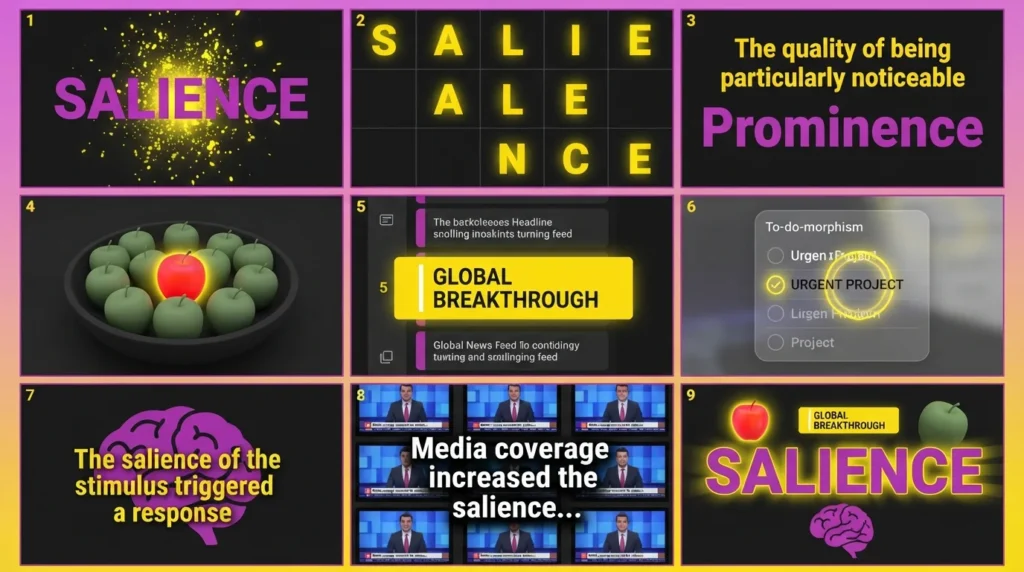

Why do some things immediately catch our attention while other details seem easy to ignore? The answer is often salience. This word describes the quality that makes something stand out, seem important, or attract attention.
People search for salience meaning, salience definition, what is salience, and examples of salience because the word can sound more complicated than it really is. It is common in psychology, communication, business, marketing, education, and everyday discussions about attention. Learners may also confuse salience with words such as importance, relevance, and prominence.
Understanding salience can make it easier to read academic articles, business reports, research papers, and professional writing. For example, a bright warning sign has high visual salience because it quickly attracts attention. A major fact in a news story may also have high salience because it stands out as especially important.
In this guide, you will learn the salience definition, meaning, origin, spelling, common mistakes, everyday examples, related forms, and practical usage. The guide uses simple American English for readers in the United States and other English-speaking audiences.
Salience – Quick Answer
Salience is the quality of being noticeable, prominent, or important enough to attract attention.
In simple words:
Salience = how much something stands out or attracts attention.
For example:
The bright red sign had high salience.
The color makes the sign easy to notice.
Another example:
The issue gained salience during the election campaign.
Here, salience means that the issue became more noticeable or important to people.
Simple Salience Definition
You can remember it this way:
Salience is the quality that makes something stand out and attract attention.
The meaning can change slightly depending on the context.
Salience Examples
The bright warning label has high visual salience.
The topic has growing salience in public discussions.
The researcher studied the salience of different images.
The company’s safety policy has become more salient after the incident.
The Origin of Salience
The word salience comes from the Latin word salire, meaning “to leap” or “to jump.”
The idea behind the word is that something salient seems to “jump out” from its surroundings and attract attention.
The related English word salient developed from this same Latin root.
Over time, salient came to describe something that stands out or is especially noticeable. The noun salience developed to describe the quality or degree of standing out.
For example:
Salient:
The warning sign is salient.
Salience:
The warning sign has high salience.
The word is now widely used in fields such as psychology, linguistics, marketing, communication, and social science.
Why Does Salience Mean “Standing Out”?
The original idea of something “leaping” or “jumping” provides a useful way to remember the modern meaning.
Imagine a group of ordinary signs with one large, bright warning sign.
The warning sign jumps out visually.
Therefore, it has high salience.
This connection between the historical meaning and modern usage makes the word easier to remember.
British English vs American English Spelling
The word salience is spelled the same way in American English and British English.
| Feature | American English | British English |
|---|---|---|
| Word | salience | salience |
| Spelling | salience | salience |
| Adjective | salient | salient |
| Plural noun | saliences | saliences |
| Related noun | salience | salience |
There is no standard American-British spelling difference in the word salience.
The correct spelling is:
S-A-L-I-E-N-C-E
American English Example
The salience of the issue increased after the announcement.
British English Example
The salience of the issue increased after the announcement.
The spelling remains unchanged.
Which Spelling Should You Use?
The standard spelling is salience in American English, British English, and other major varieties of English.
For US Audiences
Use:
salience
For example:
The study examines the salience of social media images.
This spelling is appropriate for American academic, professional, and general writing.
For UK and Commonwealth Audiences
Use:
salience
There is no need to change the spelling for British English.
For Global Audiences
Use salience consistently.
Because there is no major US-UK spelling difference, the main issue is not spelling. It is making sure readers understand the meaning from context.
For a general audience, importance, visibility, prominence, or relevance may sometimes be easier words.
Common Mistakes With Salience
Because salience is a formal word, learners can sometimes use it incorrectly.
Mistake 1: Confusing Salience With Salient
❌ The salience issue needs attention.
✅ The salient issue needs attention.
Salient is an adjective.
Salience is a noun.
Compare:
The issue is salient.
The issue has high salience.
Mistake 2: Using Salience as a Verb
❌ The event salienced the problem.
✅ The event highlighted the problem.
Salience is a noun and should not normally be used as a verb.
Mistake 3: Assuming Salience Always Means Importance
Salience and importance can overlap, but they are not exactly the same.
Something can be noticeable without being important.
For example:
The bright yellow shirt had high visual salience.
The shirt may attract attention, but that does not mean it is important.
Mistake 4: Confusing Salience With Relevance
Relevance describes how closely something relates to a topic or situation.
Salience describes how strongly something stands out or attracts attention.
For example:
A small detail may be highly relevant but not very salient.
Mistake 5: Using Salience in Very Casual Writing
The word is correct, but it can sound formal.
Instead of:
The salience of your message is high.
A casual speaker might say:
Your message really stands out.
Both can express a similar idea, but the second sounds more natural in everyday conversation.
Salience in Everyday Examples
The word salience is more common in professional, academic, and technical writing than in casual conversation.
Salience in Emails
The report should explain the salience of these findings.
Please highlight the points with the greatest salience.
The presentation focuses on the salience of customer feedback.
These examples are suitable for professional communication.
Salience in News Writing
The issue gained salience after the new report was released.
The story increased the salience of the problem among readers.
The topic has gained political salience in recent months.
In news writing, salience often refers to how noticeable or important an issue becomes in public discussion.
Salience on Social Media
The word is less common in casual social media posts, but it may appear in academic, marketing, or professional discussions.
For example:
The visual salience of the post helped it attract attention.
The campaign increased the salience of the brand.
For everyday posts, people are more likely to say attention, visibility, or what stands out.
Salience in Formal Writing
The study examines the salience of visual information.
Researchers measured the salience of different features.
The report discusses the growing salience of climate-related risks.
The word works well when writing about attention, perception, communication, or social issues.
Salience in Psychology
In psychology, salience often refers to how noticeable or attention-grabbing something is.
A bright light, loud sound, unusual object, or emotionally strong event may have high salience.
For example:
The sudden loud noise had high auditory salience.
The noise quickly attracted attention because it was different from the surrounding sounds.
Salience can influence what people notice first, although attention is affected by many factors, including expectations, goals, emotions, and context.
Salience in Marketing
Marketers often care about whether a brand, product, advertisement, or message stands out.
For example:
The new packaging increased the visual salience of the product.
This means the packaging made the product more noticeable.
Brand salience can also refer to how easily a brand comes to a person’s mind in a particular buying situation.
Salience in Communication
In communication, salience can describe how strongly an idea, message, topic, or detail attracts attention.
For example:
The speaker increased the salience of the main argument by repeating the key point.
A detail may become more salient because it is repeated, emphasized, visually highlighted, or presented in an unusual way.
Salience vs Importance vs Relevance
These words are related, but they are not identical.
| Word | Basic Meaning | Example |
|---|---|---|
| Salience | Degree to which something stands out | The headline has high salience. |
| Importance | Degree of value or significance | Safety is important. |
| Relevance | Connection to a topic or situation | The information is relevant. |
| Prominence | State of being noticeable or well-known | The company gained prominence. |
| Visibility | Degree to which something can be seen or noticed | The sign has high visibility. |
This comparison can help you choose the right word.
Salience and Related Word Forms
| Word | Part of Speech | Meaning | Example |
|---|---|---|---|
| salient | adjective | noticeable or important | A salient feature |
| salience | noun | quality of standing out | High salience |
| saliently | adverb | in a salient way | The issue was saliently presented. |
The most common forms are salient and salience.
Salience – Google Trends and Usage Data
The search term salience has a more specialized search intent than basic words such as important or attention.
People may search for:
- salience meaning
- salience definition
- what is salience
- salience examples
- salient meaning
- salience in psychology
- visual salience
- salience in marketing
- brand salience
- salience in communication
The word appears across several academic and professional fields, including psychology, marketing, linguistics, communication, education, and social science.
Search interest can vary by country and context. Academic terms may receive more searches from students, researchers, professionals, and people studying specialized subjects.
For a website targeting the United States, keyword research should focus specifically on Google searches from the US. Search volume can change over time, so current US keyword data should be checked for the relevant date range.
Who Searches for Salience?
The word may be useful for:
- College students
- English learners
- Psychology students
- Marketing professionals
- Researchers
- Teachers
- Writers
- Communication professionals
- Business students
- Social science students
People searching for the word often want a simple definition before learning its specialized meaning.
Salience – Keyword Variations Comparison
| Keyword Variation | Main Search Intent | Simple Explanation |
|---|---|---|
| salience | General meaning | Quality of standing out |
| salience meaning | Definition | What salience means |
| salience definition | Definition | Formal meaning |
| what is salience | Beginner explanation | Simple explanation |
| salience examples | Learning | Examples in sentences |
| salient meaning | Related word | Meaning of salient |
| visual salience | Psychology/visual | What attracts visual attention |
| salience in psychology | Academic | Attention and perception |
| brand salience | Marketing | How strongly a brand comes to mind |
| salience in communication | Communication | How strongly a message stands out |
FAQs About Salience
1. What does salience mean?
Salience means the quality of being noticeable, prominent, or important enough to attract attention.
Example:
The bright warning sign has high salience.
2. What is the simple definition of salience?
A simple definition is:
Salience is how much something stands out and attracts attention.
3. Is salience a noun?
Yes. Salience is a noun.
Example:
The salience of the issue increased.
The related adjective is salient.
4. What is the difference between salient and salience?
Salient is an adjective that means noticeable or important.
Salience is a noun that describes the quality or degree of being noticeable or prominent.
Examples:
This is a salient point.
The point has high salience.
5. Is salience the same as importance?
Not always.
Salience describes how strongly something stands out or attracts attention, while importance describes its value or significance.
Something can be highly noticeable without being very important.
6. What is visual salience?
Visual salience refers to how strongly something stands out visually and attracts attention.
A bright red object among gray objects may have high visual salience.
7. What does salience mean in psychology?
In psychology, salience generally refers to the degree to which something stands out and attracts attention.
An unusual sound, bright object, or emotionally strong event may have high salience.
Conclusion
Salience is a useful English noun that describes the quality or degree of standing out, attracting attention, or appearing especially noticeable. In simple terms, something with high salience is more likely to catch your attention.
The word is common in psychology, marketing, communication, education, business, and academic writing. Its meaning can change slightly with context. Visual salience, for example, focuses on what attracts attention visually, while brand salience can refer to how easily a brand comes to mind. In general writing, salience can describe how noticeable or prominent an issue, idea, or detail is.
For American English readers, the spelling is simple: salience. There is no standard spelling difference between American and British English.
Remember the difference between salient and salience: salient is an adjective, while salience is a noun. If your audience is unfamiliar with the word, simpler terms such as importance, visibility, prominence, or attention may communicate the idea more clearly.