
Imagine a house powered entirely by sunlight during the day and wind energy at night. The lights stay on, appliances run smoothly, and no fuel is burned. This is not a futuristic dream—it is the practical use of renewable energy sources.
Traditional energy sources such as coal, oil, and natural gas have powered industries for decades. However, these resources are limited and produce pollution that harms the environment. Rising energy demand and climate concerns have pushed engineers and scientists to develop cleaner alternatives.
Renewable energy sources provide electricity using naturally replenishing resources such as sunlight, wind, water, and biomass. These sources are sustainable, environmentally friendly, and increasingly cost-effective.
For electrical students, engineers, and technicians, understanding renewable energy systems is becoming essential. Modern power systems now integrate solar panels, wind turbines, and hydroelectric plants alongside traditional generation.
In this article, you will learn the renewable energy sources working principle, their types, components, advantages, disadvantages, and real-world applications. You will also understand how to select the right renewable system and the future direction of this rapidly growing technology.
2. What is Renewable Energy Sources?
Renewable energy sources are natural resources that can generate energy continuously without being depleted. These resources naturally replenish over time through environmental processes.
In simple terms, renewable energy comes from nature and does not run out when used properly.
Common renewable energy sources include:
- Sunlight (solar energy)
- Wind
- Flowing water
- Biomass materials
- Earth’s internal heat (geothermal)
Unlike fossil fuels, renewable energy does not rely on burning fuel. Instead, it converts natural energy into electricity or heat.
Simple Practical Example
Consider a solar panel installed on a rooftop. When sunlight strikes the panel, it generates electricity that powers lights, fans, and appliances in the home.
The sun will continue shining tomorrow, next year, and for billions of years. That is why solar energy is called renewable.
In engineering terms, renewable energy systems convert natural energy into electrical power using mechanical, thermal, or photovoltaic processes.
3. Renewable Energy Sources Working Principle
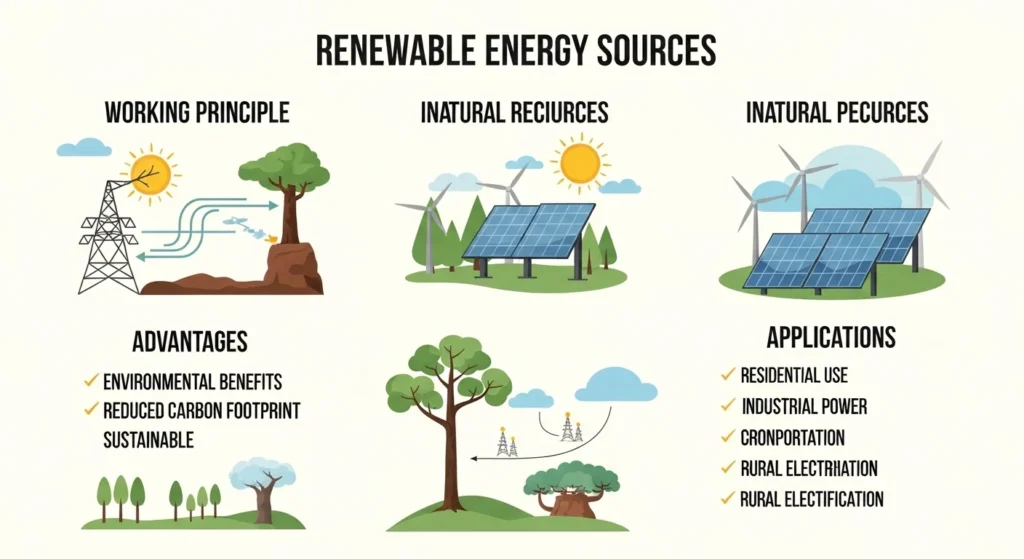
The renewable energy sources working principle is based on converting natural energy into usable electricity.
Each renewable source uses a different conversion method, but the general process follows these steps:
Step-by-Step Energy Conversion Process
- Energy Collection
- Natural resources like sunlight, wind, or water are captured.
- Energy Conversion
- Devices such as solar cells or turbines convert natural energy into mechanical or electrical energy.
- Electricity Generation
- Generators convert mechanical energy into electrical power.
- Power Conditioning
- Inverters and controllers convert power into usable AC electricity.
- Distribution
- Electricity is used locally or supplied to the power grid.
Simple Analogy
Think of renewable energy systems like a water wheel in a river:
- Flowing water spins the wheel.
- The spinning wheel drives a generator.
- The generator produces electricity.
The same principle applies to wind turbines and hydroelectric plants.
4. Types / Classification of Renewable Energy Sources
Renewable energy can be classified based on the natural resource used.
Solar Energy
Solar energy converts sunlight directly into electricity using photovoltaic cells.
Solar panels absorb sunlight and produce DC electricity. An inverter converts it into AC power for homes and industries.
Solar power systems are widely used for:
- Rooftop power systems
- Solar water heaters
- Solar street lighting
- Utility-scale solar farms
Wind Energy
Wind energy uses moving air to rotate large turbines connected to generators.
When wind spins the turbine blades, mechanical energy is converted into electrical energy.
Wind farms are commonly installed in:
- Coastal regions
- Open plains
- Offshore locations
Hydropower
Hydropower generates electricity using flowing water.
Water stored in a dam flows through turbines. The rotating turbine drives a generator to produce electricity.
Hydropower is one of the oldest renewable energy technologies.
Biomass Energy
Biomass energy uses organic materials such as:
- Wood
- Agricultural waste
- Animal manure
- Crop residues
These materials are burned or processed to produce heat and electricity.
Geothermal Energy
Geothermal energy uses heat stored inside the Earth.
Hot water or steam from underground reservoirs drives turbines connected to generators.
Geothermal plants are usually located in areas with volcanic or geothermal activity.
5. Main Components of Renewable Energy Systems
Renewable energy systems contain several key components that ensure efficient power generation.
Energy Collector
This component captures natural energy.
Examples include:
- Solar panels
- Wind turbine blades
- Water turbines
Energy Converter
This part converts natural energy into mechanical or electrical energy.
Examples include:
- Photovoltaic cells
- Turbines
- Heat exchangers
Generator
The generator converts mechanical energy into electrical energy using electromagnetic induction.
Power Electronics
Devices such as inverters and controllers regulate and convert electricity into usable form.
Energy Storage System
Batteries store excess electricity for use when energy production is low.
This is common in solar and wind systems.
6. Renewable Energy Sources Advantages and Disadvantages
Understanding renewable energy sources advantages and disadvantages helps engineers design practical power systems.
Advantages
- Environmentally friendly with minimal pollution
- Unlimited energy supply from natural sources
- Reduces dependence on fossil fuels
- Low operating cost after installation
- Suitable for remote and rural areas
- Improves energy security
Disadvantages / Limitations
- High initial installation cost
- Weather dependency (solar and wind)
- Energy storage requirements
- Large land area for some installations
- Power output can fluctuate
- Some technologies require specific geographical locations
7. Renewable Energy Sources Applications
Renewable energy technologies are widely used in modern power systems.
Residential Applications
- Rooftop solar power systems
- Solar water heaters
- Solar lighting systems
- Small wind turbines
Industrial Applications
- Power generation for factories
- Biomass power plants
- Industrial heating systems
- Hybrid renewable power systems
Utility-Scale Power Generation
Large renewable plants supply electricity to national grids.
Examples include:
- Solar farms
- Wind farms
- Hydroelectric dams
Modern Technology Applications
Renewable energy also powers advanced technologies such as:
- Electric vehicle charging stations
- Smart grids
- Microgrids
- Remote communication systems
These systems represent the expanding role of renewable energy sources applications in modern engineering.
8. Comparison Section
Difference Between Renewable and Non-Renewable Energy
| Feature | Renewable Energy | Non-Renewable Energy |
|---|---|---|
| Energy Source | Natural and replenishable | Limited fossil fuels |
| Environmental Impact | Low emissions | High pollution |
| Availability | Unlimited with proper use | Finite supply |
| Cost Over Time | Low operating cost | Increasing fuel cost |
| Sustainability | Long-term energy solution | Short-term resource |
Understanding the difference between renewable and non-renewable energy is essential for designing future power systems.
9. Selection Guide
Choosing the right renewable energy system depends on several technical factors.
Resource Availability
Check whether your location has strong sunlight, wind, or water flow.
Energy Demand
Calculate the electrical load requirements before selecting the system size.
Installation Space
Solar farms and wind turbines require adequate land area.
Budget
Initial investment can vary depending on the technology.
Maintenance Requirements
Some systems require regular maintenance and monitoring.
For beginners, solar energy systems are often the simplest and most practical option.
10. Common Problems & Solutions
Why is my solar system producing less power?
Possible causes:
- Dust on solar panels
- Shading from buildings or trees
- Faulty inverter
Solution: Clean panels regularly and inspect electrical connections.
Why do wind turbines stop during low wind speeds?
Wind turbines require minimum wind speed to rotate.
Solution: Install turbines in high-wind locations.
Why is renewable energy output unstable?
Weather conditions can change energy production.
Solution: Use energy storage systems like batteries.
Why is system efficiency decreasing?
Component aging or poor maintenance can reduce performance.
Solution: Perform periodic system inspection.
11. Future Trends
Renewable energy technology continues to evolve rapidly.
Advanced Solar Panels
New materials are improving solar panel efficiency and reducing cost.
Floating Solar Plants
Solar panels installed on water reservoirs save land space and improve cooling.
Offshore Wind Farms
Wind turbines installed in oceans capture stronger winds and produce more electricity.
Smart Grids
Smart grid technology helps integrate renewable energy into existing power networks.
Energy Storage Innovations
New battery technologies are improving energy storage capacity and reliability.
These innovations will make renewable energy the backbone of future power systems.
12. Conclusion
Renewable energy sources are transforming the global energy landscape. Unlike fossil fuels, these energy sources come from natural processes that continuously replenish themselves.
In this article, we explored the renewable energy sources working principle, types such as solar, wind, hydro, biomass, and geothermal energy, and their main system components. We also discussed the renewable energy sources advantages and disadvantages, applications in homes and industries, and the difference between renewable and conventional energy systems.
For electrical engineers and students, renewable energy knowledge is no longer optional—it is a core skill for future power system design. Modern electrical grids increasingly rely on clean and sustainable energy technologies.
By understanding renewable systems today, engineers can design efficient, environmentally responsible power solutions for tomorrow’s world.
Continuous learning and practical experience in renewable energy technologies will help build a sustainable and reliable energy future.