
Imagine an automatic garage door that stops exactly when it is fully open or a conveyor belt in a factory that automatically shuts off when a package reaches the end. These everyday actions are made possible by a small but essential device called a limit switch. Although it may seem simple, a limit switch plays a vital role in ensuring machines operate safely, accurately, and efficiently.
Understanding a limit switch is important for electrical students, engineers, technicians, and beginners because it is one of the most widely used control devices in industrial automation and electrical systems. It detects the movement or position of an object and sends an electrical signal to start, stop, or control machinery. From elevators and CNC machines to packaging equipment and home automation systems, limit switches help prevent equipment damage and improve operational safety.
In this guide, you will learn what a limit switch is, the limit switch working principle, different types, components, advantages, disadvantages, applications, selection tips, troubleshooting methods, and future developments. By the end of this article, you will have a clear understanding of how limit switches work and why they are indispensable in modern electrical and industrial systems.
What is a Limit Switch?
A limit switch is an electromechanical switching device that detects the presence, position, or movement of an object by physical contact. When a moving object touches the actuator of the switch, the internal electrical contacts change their state, either opening or closing the electrical circuit.
A limit switch is commonly used to control machines automatically, stop moving parts at a specific position, and improve equipment safety.
Unlike proximity sensors that detect objects without touching them, a limit switch requires direct mechanical contact with the object being monitored.
Simple Explanation
In simple words, a limit switch acts like an automatic ON/OFF button that is pressed by a moving object. When the object reaches a certain position, it activates the switch, which then sends a signal to control the electrical circuit.
It works like pressing a doorbell button. When you press the button, the circuit changes state. Similarly, when a machine part presses a limit switch, it activates or deactivates the connected equipment.
Practical Example
You can commonly find limit switches in:
- Elevators
- Automatic gates
- Conveyor belts
- Industrial machines
- CNC machines
- Robotic systems
- Packaging equipment
- Garage doors
For example, when an elevator reaches the top floor, a limit switch signals the motor to stop, preventing the elevator from moving beyond its safe limit.
Limit Switch Working Principle
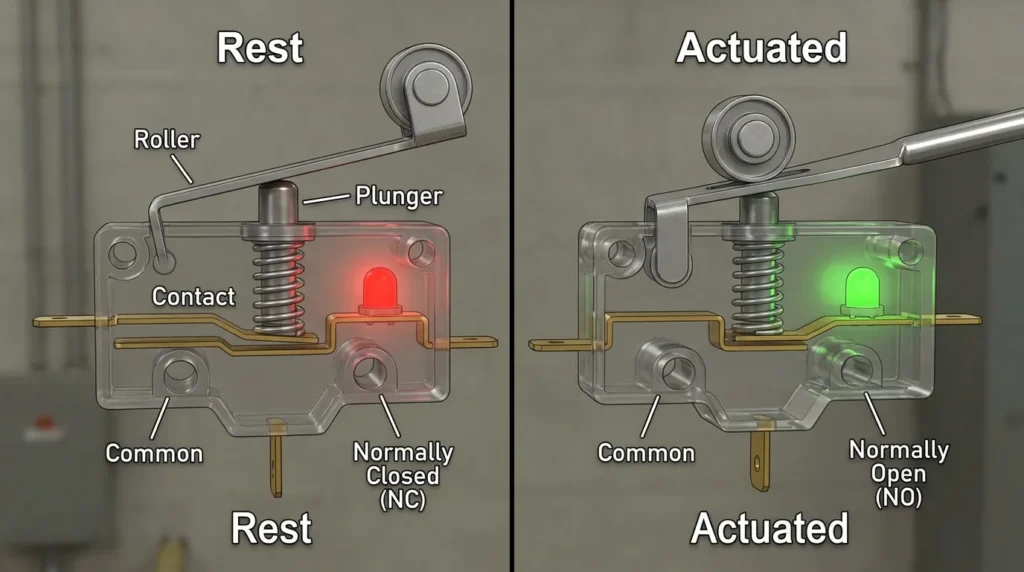
The limit switch working principle is based on mechanical movement and electrical contact switching. When a moving object physically touches the actuator of the switch, it changes the position of the internal contacts, allowing or interrupting the flow of electricity.
This simple mechanism enables automatic control of electrical equipment without continuous human intervention.
Step-by-Step Working Process
Step 1: Object Approaches the Switch
A moving machine part or object travels toward the installed limit switch.
The switch remains in its normal position until the object reaches it.
Step 2: Actuator is Pressed
As the object reaches the switch, it pushes the actuator.
Depending on the design, the actuator may be:
- Roller lever
- Plunger
- Lever arm
- Spring rod
- Rotary arm
The actuator converts mechanical movement into electrical switching.
Step 3: Internal Contacts Change Position
Pressing the actuator causes the internal electrical contacts to move.
The contacts may:
- Close the circuit (Normally Open)
- Open the circuit (Normally Closed)
- Change from one state to another (Changeover)
This switching action generates the required electrical control signal.
Step 4: Electrical Signal is Sent
Once the contacts change position, the limit switch sends an electrical signal to the control system.
This signal may:
- Start a motor
- Stop a motor
- Reverse motor direction
- Activate an alarm
- Operate a relay
- Control a PLC input
Step 5: Machine Performs the Required Action
The control system receives the signal and performs the programmed operation.
Examples include:
- Stopping conveyor movement
- Opening a safety gate
- Reversing an electric motor
- Shutting down equipment
- Starting another machine
Step 6: Actuator Returns to Its Original Position
After the moving object leaves the switch, the internal spring returns the actuator to its normal position.
The electrical contacts also return to their original state, preparing the switch for the next operation.
Simple Analogy
Imagine a refrigerator door.
When the door closes, a small switch is pressed, turning the interior light OFF.
When the door opens, the switch is released, turning the light ON.
A limit switch works in exactly the same way, except it controls industrial machines instead of a light.
Key Principles
The operation of a limit switch depends on several basic principles:
- Detects object movement through physical contact.
- Converts mechanical motion into an electrical signal.
- Uses Normally Open (NO) and Normally Closed (NC) contacts.
- Controls electrical equipment automatically.
- Improves machine safety and operational accuracy.
- Provides reliable position detection.
- Suitable for repeated switching operations.
Because of its simple construction, high reliability, and long service life, the limit switch remains one of the most widely used control devices in industrial automation, manufacturing, material handling, and electrical control systems.
Types of Limit Switches
Limit switches are available in various designs to suit different industrial applications, machine movements, and environmental conditions. Each type is designed to detect a specific kind of mechanical movement and provide accurate position control. Understanding the different types of limit switches helps engineers and technicians choose the most suitable switch for safe and efficient machine operation.
1. Roller Lever Limit Switch
A roller lever limit switch is one of the most widely used types in industrial automation. It features a roller mounted on the end of a lever arm. When a moving object contacts the roller, the lever rotates and activates the internal electrical contacts.
The roller minimizes friction between the switch and the moving object, making it ideal for continuous and repetitive operations.
Features
- Roller reduces mechanical wear
- Smooth operation
- Long service life
- Suitable for high-speed machinery
- High switching reliability
Applications
- Conveyor belts
- Packaging machines
- Material handling systems
- Industrial automation
- Assembly lines
2. Plunger Limit Switch
A plunger limit switch uses a spring-loaded push button (plunger) as its actuator. When an object presses the plunger, the internal contacts change position, producing the required electrical signal.
Its compact design makes it suitable for applications where space is limited.
Features
- Compact construction
- High positioning accuracy
- Fast switching action
- Easy installation
- Reliable operation
Applications
- CNC machines
- Hydraulic systems
- Press machines
- Industrial equipment
- Automatic doors
3. Rotary Lever Limit Switch
A rotary lever limit switch uses a rotating lever arm to detect movement from different directions. The lever rotates when contacted by a moving machine part, causing the internal contacts to operate.
Its adjustable lever makes it suitable for complex machine movements.
Features
- Multi-directional operation
- Adjustable lever length
- High flexibility
- Smooth switching
- Durable construction
Applications
- Robotic systems
- Automated production lines
- Packaging equipment
- Industrial conveyors
- Material transfer systems
4. Whisker (Spring Rod) Limit Switch
A whisker limit switch, also called a spring rod limit switch, uses a flexible spring wire as its actuator. Even a light touch can activate the switch, making it suitable for delicate objects.
The flexible rod bends when contacted and returns to its original position after the object passes.
Features
- Sensitive operation
- Flexible actuator
- Detects light objects
- Low operating force
- Suitable for irregular surfaces
Applications
- Bottle filling machines
- Packaging industries
- Textile machinery
- Food processing equipment
- Electronic assembly lines
5. Heavy-Duty Limit Switch
A heavy-duty limit switch is designed for harsh industrial environments where equipment is exposed to dust, vibration, moisture, oil, chemicals, and heavy mechanical loads.
These switches are built with rugged metal housings and reinforced actuators for long-lasting performance.
Features
- Heavy-duty metal enclosure
- High mechanical strength
- Water and dust resistance
- Long operating life
- Excellent reliability
Applications
- Mining equipment
- Steel plants
- Cement factories
- Power plants
- Construction machinery
- Heavy industrial automation
6. Precision Limit Switch
A precision limit switch is specially designed for applications requiring extremely accurate position detection and repeatable switching.
These switches have low operating tolerance and provide highly consistent performance.
Features
- High positioning accuracy
- Fast response
- Excellent repeatability
- Stable operation
- Long mechanical life
Applications
- CNC machines
- Robotics
- Semiconductor manufacturing
- Laboratory equipment
- Precision automation systems
7. Miniature Limit Switch
A miniature limit switch is a small, lightweight switch designed for compact electrical and electronic equipment where installation space is limited.
Despite its small size, it provides reliable switching performance.
Features
- Compact design
- Lightweight construction
- Quick response
- Easy installation
- Cost-effective
Applications
- Home appliances
- Printers
- Vending machines
- Medical equipment
- Consumer electronics
Main Components of a Limit Switch
A limit switch consists of several important components that work together to detect movement and control electrical circuits. Each component performs a specific function to ensure reliable operation, long service life, and accurate switching.
1. Actuator
The actuator is the external mechanical part of the limit switch that comes into direct contact with the moving object. It receives the mechanical force and transfers it to the internal switching mechanism.
Different actuator designs include:
- Roller lever
- Plunger
- Rotary lever
- Spring rod (whisker)
- Adjustable arm
Functions
- Detects object movement
- Transfers mechanical force
- Initiates switching action
- Determines operating position
2. Operating Head
The operating head holds the actuator and converts its movement into internal mechanical action. In many limit switches, the operating head can be rotated to allow different mounting positions.
Functions
- Supports the actuator
- Transfers movement
- Allows flexible installation
- Improves switching accuracy
3. Internal Contact Block
The contact block contains the electrical contacts that open or close the circuit when the actuator is operated.
Most limit switches include:
- Normally Open (NO) contacts
- Normally Closed (NC) contacts
- Changeover contacts
Functions
- Opens electrical circuits
- Closes electrical circuits
- Sends control signals
- Operates relays and contactors
4. Spring Mechanism
The spring mechanism returns the actuator and contacts to their original position after the external force is removed.
Functions
- Restores normal position
- Provides quick switching
- Improves repeatability
- Ensures reliable operation
5. Terminal Block
The terminal block provides secure electrical connections between the limit switch and the external control circuit.
Functions
- Connects control wires
- Provides secure wiring
- Ensures reliable electrical contact
- Simplifies installation
6. Protective Housing
The housing protects all internal components from dust, moisture, oil, vibration, and accidental mechanical damage.
Depending on the application, housings may be made from:
- High-strength plastic
- Aluminum
- Zinc alloy
- Stainless steel
Functions
- Protects internal parts
- Increases durability
- Improves safety
- Extends service life
7. Sealing Gasket
Many industrial limit switches include sealing gaskets to prevent contaminants from entering the enclosure.
Functions
- Prevents dust entry
- Stops water penetration
- Protects electrical contacts
- Maintains IP protection rating
8. Mounting Base
The mounting base allows the switch to be securely attached to machines, control panels, or supporting structures.
Functions
- Provides stable installation
- Reduces vibration
- Ensures accurate positioning
- Supports long-term operation
9. Cover and Fastening Screws
The cover encloses the internal mechanism, while fastening screws hold the housing securely together.
Functions
- Protects internal components
- Allows easy maintenance
- Keeps parts securely assembled
- Prevents accidental contact
Every component of a limit switch works together to provide accurate position detection, reliable switching, and safe machine control. Proper understanding of these components helps electrical students, engineers, and technicians install, maintain, and troubleshoot limit switches effectively in residential, commercial, and industrial automation systems.
Advantages of Limit Switch
Understanding the limit switch advantages and disadvantages helps users determine whether this device is suitable for their automation and control applications. Limit switches are valued for their simple design, dependable operation, and ability to provide accurate position detection in a wide range of electrical and industrial systems.
1. High Reliability
Limit switches are designed to operate consistently under repeated mechanical movement. Their simple construction ensures dependable performance even in demanding environments.
Benefits
- Reliable operation
- Consistent switching
- Long service life
- Minimal operational errors
2. Accurate Position Detection
A limit switch detects the exact position of a moving object, allowing machinery to stop, start, or reverse at the correct point.
Benefits
- Precise machine control
- Improved operational accuracy
- Reduced positioning errors
- Better automation performance
3. Simple Installation
Most limit switches are easy to install and connect to electrical control circuits using standard wiring methods.
Benefits
- Quick installation
- Easy wiring
- Reduced setup time
- Lower installation cost
4. Improves Machine Safety
Limit switches automatically stop equipment when moving parts reach their travel limit, reducing the risk of accidents and equipment damage.
Benefits
- Prevents over-travel
- Protects machinery
- Enhances operator safety
- Reduces maintenance costs
5. Durable Construction
Industrial limit switches are built with strong materials that resist dust, vibration, moisture, and mechanical impact.
Benefits
- Long operating life
- Suitable for harsh environments
- Reduced replacement frequency
- Reliable industrial performance
6. Low Maintenance
Limit switches require very little maintenance when installed correctly.
Benefits
- Low operating cost
- Minimal servicing
- Reliable long-term operation
- Easy inspection
7. Wide Operating Range
Limit switches are available in various sizes, actuator styles, and electrical ratings, making them suitable for different machines and applications.
Benefits
- Flexible installation
- Suitable for multiple industries
- Compatible with various control systems
- Supports different voltage ratings
8. Cost-Effective Solution
Compared to many electronic sensing devices, limit switches provide an economical solution for mechanical position detection.
Benefits
- Affordable purchase price
- Long service life
- Excellent value for money
- Reduced operating costs
Disadvantages / Limitations of Limit Switch
Although limit switches are highly reliable, they also have certain limitations that should be considered before selecting them for an application.
1. Requires Physical Contact
Unlike proximity sensors, a limit switch must be physically touched by the moving object.
Limitations
- Mechanical contact required
- Not suitable for non-contact detection
- Can experience mechanical wear
2. Mechanical Wear
Continuous operation causes gradual wear of the actuator and internal components.
Limitations
- Reduced lifespan under heavy use
- Periodic replacement may be required
- Increased maintenance in high-cycle applications
3. Limited Switching Speed
Mechanical operation makes limit switches slower than electronic sensors.
Limitations
- Not suitable for extremely high-speed automation
- Slower response than photoelectric or proximity sensors
4. Sensitive to Improper Alignment
Incorrect installation may prevent proper operation.
Limitations
- Requires accurate positioning
- Improper alignment causes unreliable switching
- Regular inspection may be needed
5. Environmental Damage
Without proper protection, dust, moisture, oil, or chemicals may affect performance.
Limitations
- Outdoor applications require weatherproof models
- Harsh environments need sealed enclosures
6. Contact Bounce
Mechanical contacts may briefly open and close several times before settling.
Limitations
- May generate unwanted signals
- Additional control circuitry may be required
7. Limited Detection Distance
A limit switch only detects objects that physically touch its actuator.
Limitations
- No long-distance sensing
- Unsuitable for remote object detection
Limit Switch Applications
There are numerous limit switch applications in residential, commercial, industrial, and modern automation systems. They provide reliable position sensing, safety control, and automatic machine operation.
Home Applications
Limit switches are used in many household electrical devices.
Common Home Applications
- Automatic garage doors
- Electric gates
- Home elevators
- Washing machines
- Microwave ovens
- Smart home automation
- Motorized curtains
These applications improve convenience, safety, and automation.
Commercial Applications
Commercial facilities use limit switches for equipment control and building automation.
Applications
- Automatic doors
- Escalators
- Elevators
- Parking barriers
- Security systems
- HVAC equipment
- Warehouse automation
Industrial Applications
Industrial automation is the largest application area for limit switches.
Common Industrial Applications
- Conveyor systems
- Packaging machines
- CNC machines
- Hydraulic presses
- Robotic arms
- Material handling equipment
- Machine tools
- Assembly lines
- Industrial automation systems
Limit switches improve productivity while protecting expensive machinery.
Power and Electrical Applications
Electrical engineers use limit switches in power control systems.
Applications
- Motor control circuits
- Control panels
- Circuit breaker mechanisms
- Transformer tap changers
- Generator control
- Electrical testing equipment
Modern Technology Applications
Limit switches are widely used in advanced automation systems.
Applications
- Industrial robots
- Smart factories
- Automated warehouses
- Electric vehicle production
- Renewable energy systems
- Automated guided vehicles (AGVs)
- Smart manufacturing
Difference Between Limit Switch and Proximity Sensor
| Feature | Limit Switch | Proximity Sensor |
|---|---|---|
| Detection Method | Mechanical contact | Non-contact sensing |
| Physical Contact | Required | Not required |
| Accuracy | High | Very High |
| Response Speed | Moderate | Fast |
| Mechanical Wear | Yes | No |
| Cost | Lower | Higher |
| Maintenance | Low | Very Low |
| Suitable for Harsh Environments | Yes | Yes (depending on type) |
| Typical Applications | Machine position control | Object detection and automation |
This table clearly explains the difference between limit switch and proximity sensor, helping users select the appropriate device based on their automation requirements.
Selection Guide: How to Choose the Right Limit Switch
Choosing the right limit switch ensures reliable operation, accurate position detection, and long service life.
1. Identify the Application
Choose a switch according to the machine and movement type.
Examples:
- Conveyor systems
- Elevators
- Robotic arms
- Packaging machines
- CNC equipment
2. Select the Correct Actuator
Different applications require different actuator styles.
Options include:
- Roller lever
- Plunger
- Rotary lever
- Spring rod
- Adjustable lever
3. Check Electrical Ratings
Verify:
- Operating voltage
- Current rating
- Switching capacity
- AC or DC compatibility
Always select a switch with ratings suitable for the electrical system.
4. Consider Environmental Conditions
For dusty, wet, or outdoor environments, choose a sealed limit switch with an appropriate IP protection rating.
5. Evaluate Mechanical Durability
Industrial applications require switches designed for millions of operating cycles.
Look for:
- Heavy-duty housing
- Durable actuator
- High mechanical life
- Corrosion resistance
Tips for Beginners
- Choose the correct actuator type.
- Follow the manufacturer’s wiring diagram.
- Mount the switch securely.
- Avoid excessive operating force.
- Inspect periodically for wear.
- Replace damaged actuators immediately.
Common Problems & Solutions
Q1: Why is the limit switch not operating?
Possible Causes
- Incorrect wiring
- Damaged actuator
- Loose mounting
- Internal contact failure
Solution
- Check wiring connections.
- Inspect the actuator.
- Tighten the mounting hardware.
- Replace the switch if necessary.
Q2: Why does the switch operate intermittently?
Possible Causes
- Loose electrical terminals
- Dirt inside the switch
- Worn contacts
Solution
- Tighten terminals.
- Clean the switch.
- Replace worn components.
Q3: Why does the actuator stick?
Possible Causes
- Dust accumulation
- Mechanical damage
- Weak return spring
Solution
- Clean the actuator.
- Lubricate moving parts if recommended.
- Replace damaged components.
Q4: Why is the machine not stopping?
Possible Causes
- Incorrect switch position
- Broken actuator
- Faulty control circuit
Solution
- Reposition the switch.
- Inspect the control wiring.
- Test the electrical contacts.
Q5: How often should a limit switch be inspected?
For normal industrial use, inspect limit switches every 3–6 months or according to the equipment maintenance schedule.
Future Trends in Limit Switch Technology
Limit switch technology continues to evolve alongside industrial automation and smart manufacturing.
Smart Limit Switches
Modern switches now include:
- Self-diagnostic features
- LED status indicators
- Electronic monitoring
- Improved switching accuracy
IoT Integration
Future limit switches will communicate directly with industrial control networks.
Benefits
- Remote monitoring
- Predictive maintenance
- Real-time fault detection
- Improved equipment management
Wireless Monitoring
Advanced industrial systems now support wireless status monitoring, reducing wiring complexity and simplifying maintenance.
Improved Materials
Manufacturers are developing switches with:
- Better corrosion resistance
- Higher impact strength
- Longer mechanical life
- Improved environmental protection
Industry Direction
As Industry 4.0 continues to expand, limit switches will become more intelligent, reliable, and integrated with smart factories, robotics, renewable energy systems, and automated production lines.
Conclusion
A limit switch is one of the most reliable and widely used electromechanical devices for detecting object position and controlling machine movement. By understanding the limit switch working principle, types, components, limit switch applications, and limit switch advantages and disadvantages, electrical students, engineers, and technicians can confidently select and use the right switch for various automation systems. Although limit switches require physical contact, their durability, simplicity, and cost-effectiveness make them an excellent choice for many industrial and commercial applications. As automation technology continues to advance, modern limit switches will offer smarter features, improved reliability, and seamless integration with Industry 4.0 and IoT-based control systems, ensuring safe and efficient machine operation.