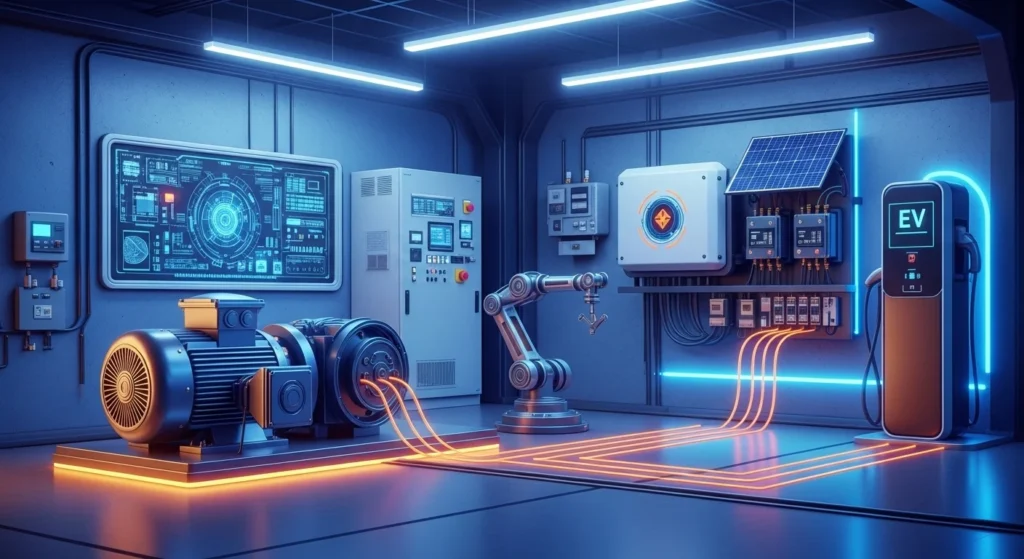

Imagine you enter an industrial plant for the first time. Large motors are running conveyor belts, transformers are stepping down voltage, generators are supplying backup power, and control panels are managing everything automatically. At first, it may look complicated. But when you understand machines and devices step by step, everything becomes logical and clear.
For electrical students, engineers, technicians, and beginners, learning machines and devices topics is not optional. It is the foundation of electrical engineering. Without understanding how machines convert energy and how devices control and protect systems, you cannot design, install, or maintain electrical systems safely.
In this complete guide, we will explain what Machines & Devices Topics mean, their working principles, types, components, applications, advantages and disadvantages, and future trends. You will also learn the difference between electrical machines and electrical devices, and how to choose the right equipment for your work.
Let’s begin with the basics and build your knowledge like a strong electrical system.
2. What is Machines & Devices Topics?
Machines & Devices Topics refer to the study of electrical machines and electrical devices used to generate, convert, control, and utilize electrical energy.
Clear Definition
Electrical machines are equipment that convert energy from one form to another, such as:
- Electrical to mechanical (motor)
- Mechanical to electrical (generator)
Electrical devices are components that control, protect, measure, or regulate electrical systems.
Simple Explanation
- A motor rotates a fan.
- A generator produces electricity.
- A circuit breaker protects from overload.
- A transformer changes voltage level.
All these are part of machines and devices topics in electrical engineering.
Practical Example
In a water pumping system:
- Motor → Runs the pump
- Contactor → Controls motor
- Overload relay → Protects motor
- Transformer → Adjusts voltage
Each machine and device has a clear role.
3. Machines & Devices Working Principle
The machines & devices working principle depends on energy conversion and electromagnetic laws.
Step-by-Step Basic Working
- Electrical energy flows in a conductor.
- A magnetic field is created.
- Interaction between magnetic field and current produces motion.
- Motion or rotation converts energy.
Easy Analogy
Think of a bicycle dynamo:
- You rotate the wheel (mechanical energy).
- The dynamo converts it into electrical energy.
- The light glows.
Similarly:
- Motor → Electricity makes rotation.
- Generator → Rotation makes electricity.
Most electrical machines follow basic electromagnetic principles:
- Magnetic field
- Current flow
- Mechanical motion
Electrical devices, on the other hand, work by:
- Detecting current or voltage
- Interrupting or controlling flow
- Protecting circuits
4. Types / Classification
Machines and devices can be classified into two main groups.
Electrical Machines
These convert energy.
1. DC Machines
- DC Motor
- DC Generator
Used in battery systems and variable speed control.
2. AC Machines
- Induction Motor
- Synchronous Motor
- Alternator
Common in industries and power plants.
3. Transformers
- Step-up Transformer
- Step-down Transformer
Used to increase or decrease voltage.
Electrical Devices
These control or protect systems.
1. Switching Devices
- Switch
- Contactor
- Relay
Control current flow.
2. Protection Devices
- Circuit Breaker
- Fuse
- Overload Relay
Protect against faults.
3. Measuring Devices
- Voltmeter
- Ammeter
- Multimeter
Measure electrical values.
5. Main Components
Although different machines have different designs, most share common components.
For Electrical Machines
1. Stator
- Stationary part
- Produces magnetic field
2. Rotor
- Rotating part
- Produces motion
3. Windings
- Copper coils
- Carry electric current
4. Shaft
- Transfers mechanical power
For Electrical Devices
1. Contacts
- Open or close circuit
2. Coil (in relays/contactors)
- Creates magnetic field
3. Insulation
- Prevents short circuit
4. Housing
- Protects internal parts
Each component has a specific function in overall performance.
6. Machines & Devices Advantages and Disadvantages
Advantages
- Efficient energy conversion
- Reliable operation
- Long service life
- Easy control with modern systems
- Suitable for small to large applications
Real-World Benefits
- Motors run factories
- Transformers power cities
- Protection devices prevent fires
- Generators provide backup during outages
Disadvantages / Limitations
- Initial cost can be high
- Requires maintenance
- Energy losses occur (heat loss)
- Overloading can cause damage
- Complex systems need trained technicians
Understanding machines & devices advantages and disadvantages helps in proper planning.
7. Machines & Devices Applications
Machines & devices applications are everywhere.
Home Applications
- Ceiling fan (motor)
- Refrigerator (compressor motor)
- Voltage stabilizer
- Circuit breaker
Industrial Applications
- Conveyor systems
- CNC machines
- Industrial motors
- Transformers
- Protection relays
Modern Technology Applications
- Solar inverters
- Electric vehicles
- Smart grids
- Automation systems
- Robotics
Electrical machines and devices are the backbone of modern civilization.
8. Comparison Section
Difference Between Electrical Machines and Electrical Devices
| Feature | Electrical Machines | Electrical Devices |
| Function | Convert energy | Control or protect |
| Example | Motor, Generator | Relay, Breaker |
| Moving Parts | Usually yes | Usually no |
| Power Handling | High | Low to medium |
| Complexity | More complex | Less complex |
The difference between electrical machines and electrical devices mainly lies in energy conversion versus control function.
9. Selection Guide
Choosing the correct machine or device is important.
1. Identify Application
- Motor for pump
- Transformer for voltage change
- Breaker for protection
2. Check Power Rating
- Voltage rating
- Current rating
- Frequency
3. Consider Environment
- Indoor or outdoor
- Dusty or clean area
- High temperature or normal
4. For Beginners
- Start with small systems
- Learn nameplate details
- Follow safety standards
Never select equipment without checking rating specifications.
10. Common Problems & Solutions
Q1: Why does a motor overheat?
Reason:
- Overload
- Poor ventilation
- Low voltage
Solution:
- Reduce load
- Improve cooling
- Check supply voltage
Q2: Why does a circuit breaker trip frequently?
Reason:
- Short circuit
- Overcurrent
- Faulty device
Solution:
- Inspect wiring
- Measure load current
- Replace damaged equipment
Q3: What is the difference between motor and generator?
Motor converts electrical to mechanical.
Generator converts mechanical to electrical.
Q4: Why does transformer hum?
Reason:
- Magnetic vibration
Solution:
- Ensure proper mounting
- Check core tightness
11. Future Trends
The electrical industry is evolving quickly.
1. Smart Machines
- IoT-enabled motors
- Remote monitoring
2. Energy Efficient Devices
- High-efficiency motors
- Low-loss transformers
3. Automation & AI Integration
- Smart relays
- Programmable controllers
4. Renewable Energy Systems
- Solar generators
- Wind turbines
- Battery storage systems
The future focuses on efficiency, automation, and sustainability.
12. Conclusion
Machines & Devices Topics form the core of electrical engineering. From motors and generators to relays and breakers, each component plays an important role in energy conversion, control, and protection. Understanding the machines & devices working principle, machines & devices applications, and machines & devices advantages and disadvantages builds a strong technical foundation.
As a student or technician, always focus on practical learning. Study ratings, understand functions, and follow safety rules. Electrical machines power the world, and electrical devices keep it safe and controlled.
Master these topics step by step, and you will grow confidently in your electrical career.