
Imagine turning on your smartphone to make a call, watching television at home, or connecting to Wi-Fi. All of these everyday technologies work because of electromagnetic waves. Although we cannot see them with our eyes, they constantly travel around us and carry information, energy, and signals across long distances.
For electrical students, engineers, and technicians, understanding electromagnetic waves is essential. These waves form the foundation of modern communication systems such as radio broadcasting, satellite communication, wireless networks, radar systems, and even medical imaging equipment.
From a technical point of view, electromagnetic waves explain how energy can travel through empty space without needing a physical medium like wires or cables. This concept is one of the most important discoveries in electrical engineering and physics.
In this article, we will explore the Electromagnetic wave working principle, understand how these waves are generated, examine their types, and discuss their real-world applications. We will also look at the Electromagnetic wave advantages and disadvantages, common problems, and future technological developments. By the end, you will clearly understand how electromagnetic waves power many of the technologies used in modern electrical and communication systems.
2. What is Electromagnetic Wave?
An electromagnetic wave is a type of energy wave that travels through space due to the interaction of electric and magnetic fields. These two fields move together in a repeating pattern and propagate through space at the speed of light.
In simple terms, an electromagnetic wave is created when an electric field and a magnetic field oscillate together and move forward through space.
Simple Explanation
When an electric charge moves or vibrates, it creates both electric and magnetic fields. If these fields keep changing continuously, they produce a wave that travels outward. This wave is called an electromagnetic wave.
One unique property of electromagnetic waves is that they do not require a physical medium to travel. Unlike sound waves that require air or water, electromagnetic waves can move through empty space.
Practical Example
A common example is radio communication. When a radio transmitter sends signals, it generates electromagnetic waves. These waves travel through the air and are received by radios, televisions, or mobile phones.
3. Electromagnetic Wave Working Principle
The Electromagnetic wave working principle is based on the interaction between electric fields and magnetic fields.
When a charged particle accelerates or vibrates, it produces a changing electric field. This changing electric field creates a magnetic field. Similarly, a changing magnetic field generates an electric field. This continuous interaction allows the wave to propagate forward.
Step-by-Step Explanation
- An electric charge starts vibrating or accelerating.
- The motion of the charge produces a changing electric field.
- This changing electric field generates a magnetic field.
- The magnetic field also changes and produces another electric field.
- The cycle continues and forms a wave moving through space.
Key Characteristics
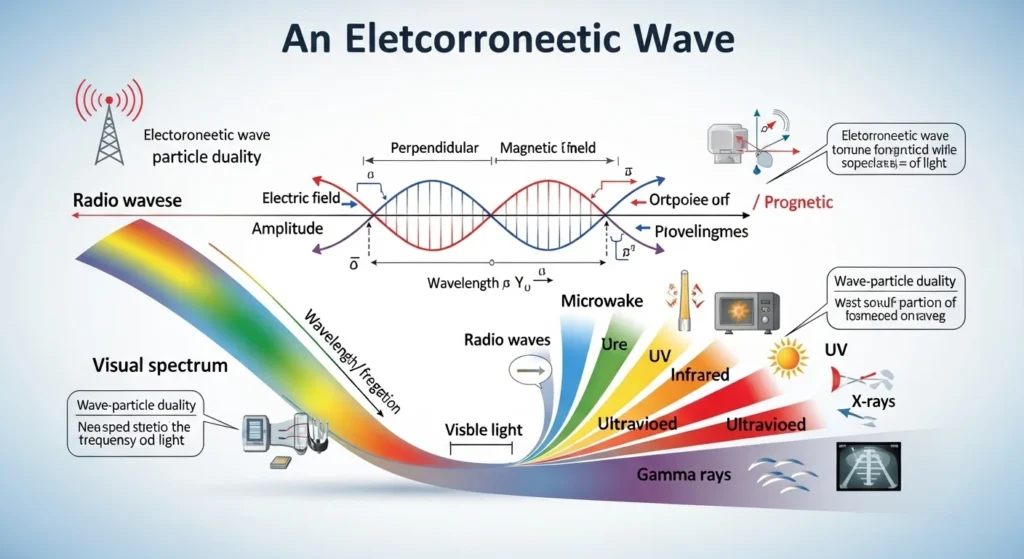
- Electric and magnetic fields are perpendicular to each other.
- The wave travels at the speed of light (approximately 3 × 10⁸ m/s).
- Energy is transferred through oscillating fields.
Easy Analogy
Think of dropping a stone in a pond. The disturbance creates ripples that move outward. Similarly, a vibrating electric charge creates disturbances in electric and magnetic fields that travel through space as electromagnetic waves.
4. Types / Classification of Electromagnetic Waves
Electromagnetic waves are classified based on their frequency and wavelength. The entire range of these waves is called the electromagnetic spectrum.
Radio Waves: Definition, Properties, Working Principle, and Applications
A Radio Waves are a type of electromagnetic wave used to transmit information through air or space without using wires. They are widely used in communication systems such as radio broadcasting, television signals, mobile networks, satellite communication, and wireless devices. Radio waves are an essential part of modern life because they allow long-distance communication quickly, safely, and efficiently.
Radio waves are part of the electromagnetic spectrum and have the longest wavelength and lowest frequency among all electromagnetic waves. They travel at the speed of light and can move through vacuum, air, and some solid materials depending on their frequency. These waves are generated by oscillating electric currents in antennas and are received by other antennas that convert them back into electrical signals.
Working Principle of Radio Waves
The radio waves working principle is based on electromagnetic induction and wave propagation. When an alternating current passes through a transmitter antenna, it creates oscillating electric and magnetic fields. These fields combine to form radio waves that travel through space.
At the receiving end, another antenna captures these waves and converts them back into electrical signals, which are then processed into sound, images, or data.
Simple Steps:
- Electrical signal is generated in transmitter
- Antenna converts it into radio waves
- Waves travel through air or space
- Receiver antenna captures the waves
- Signal is converted back into usable information
Properties of Radio Waves
Radio waves have several important properties:
- Long wavelength (from millimeters to kilometers)
- Low frequency compared to other electromagnetic waves
- Travel at the speed of light
- Can travel long distances
- Can penetrate through walls and buildings (depending on frequency)
- Do not require a medium for transmission
Types of Radio Waves
Radio waves are a major part of the electromagnetic spectrum and are widely used in communication systems, broadcasting, navigation, and wireless technologies. They are classified into different types based on their frequency and wavelength. Each type of radio wave has its own properties and specific applications in electrical and communication engineering. Understanding the types of radio waves is important for students, engineers, and technicians because it helps in selecting the right frequency range for different systems.
Very Low Frequency (VLF) radio waves have the longest wavelength and lowest frequency. They are mainly used in submarine communication and long-distance navigation systems because they can penetrate deep into water and travel very far distances with low data speed. Low Frequency (LF) radio waves are used in AM radio broadcasting, aircraft beacons, and long-range communication systems. These waves are more stable and can travel long distances by reflecting from the ionosphere.
Medium Frequency (MF) radio waves are commonly used for AM radio broadcasting and maritime communication. They are suitable for medium-distance communication and are widely used in commercial radio services. High Frequency (HF) radio waves are also known as shortwave radio waves. They are very important for international communication because they can reflect from the ionosphere and travel across continents.
Very High Frequency (VHF) radio waves are used in FM radio broadcasting, television signals, aviation communication, and two-way radio systems. They provide better sound quality and less noise compared to lower frequency waves but have a shorter range. Ultra High Frequency (UHF) radio waves are widely used in mobile phones, GPS systems, Wi-Fi networks, satellite communication, and modern wireless devices. These waves support high-speed data transmission and are essential for modern digital communication.
Each type of radio wave plays an important role in different technologies. Lower frequency waves are used for long-distance communication, while higher frequency waves are used for high-speed data transfer and short-range communication systems.
Radio waves are classified based on frequency:
Very Low Frequency (VLF)
Very Low Frequency (VLF) is a part of the radio wave spectrum used in long-distance and special communication systems. A Very Low Frequency refers to radio waves that operate in the frequency range of 3 kHz to 30 kHz. These waves have very long wavelengths, which allow them to travel over extremely long distances with very low signal loss. Because of this unique property, VLF waves are mainly used in communication systems where reliability and long-range coverage are more important than high data speed.
VLF waves are commonly used in submarine communication systems. Since these waves can penetrate seawater to some depth, they are useful for sending signals to submarines while they remain underwater. They are also used in navigation systems, time signal transmission, and some military communication applications. Another important feature of VLF waves is that they can follow the curvature of the Earth, which allows them to travel beyond the horizon without needing satellites or repeaters.
The working principle of VLF communication is based on the transmission of low-frequency electromagnetic waves from large antenna systems. These antennas are usually very tall and require high power because VLF waves need large structures for efficient transmission. The receiving system captures these waves and converts them into usable signals for communication or navigation purposes.
One major advantage of VLF is its excellent long-distance coverage and ability to penetrate through water and obstacles. However, it also has limitations such as very low data transmission speed and large antenna requirements. This makes it unsuitable for modern high-speed communication systems like internet or mobile networks.
In conclusion, VLF plays an important role in specialized communication systems, especially in defense, submarine communication, and navigation technologies where reliability and long-range signal transmission are critical.
Used in submarine communication and navigation systems.
Low Frequency (LF)
Low Frequency (LF) is an important part of the radio frequency spectrum used in long-range communication and navigation systems. A Low Frequency refers to radio waves that operate in the frequency range of 30 kHz to 300 kHz. These waves have longer wavelengths, which allow them to travel long distances with relatively stable signal strength. LF waves are widely used in communication systems where reliability and wide coverage are more important than high-speed data transfer.
LF radio waves are mainly used in navigation systems such as aircraft beacons and marine navigation signals. They are also used in some AM radio broadcasting services and time signal transmission systems. One key advantage of LF waves is their ability to follow the curvature of the Earth through ground wave propagation, which helps them cover large geographic areas without requiring satellites or complex infrastructure.
The working principle of LF communication is based on transmitting low-frequency electromagnetic signals through large antenna systems. These antennas generate continuous waves that travel through the atmosphere and along the Earth’s surface. The receiving antenna captures these signals and converts them into audio, navigation data, or other useful information.
LF waves are highly stable and less affected by weather conditions compared to higher frequency waves. This makes them suitable for critical communication systems such as aviation and maritime operations. However, LF waves have some limitations. They require large antenna structures for transmission and offer low data transmission rates, which makes them unsuitable for modern high-speed communication applications like internet or mobile networks.
Despite these limitations, LF radio waves remain very important in specialized fields where accuracy, stability, and long-distance coverage are required. They continue to play a key role in navigation, broadcasting, and emergency communication systems around the world.
Used in AM radio broadcasting and long-distance communication.
Medium Frequency (MF)
Medium Frequency (MF) is an important part of the radio spectrum used widely in broadcasting and communication systems. A Medium Frequency refers to radio waves that operate in the frequency range of 300 kHz to 3 MHz. These waves have moderate wavelength and are mainly used for medium-range communication where stable and reliable signal transmission is required.
MF radio waves are commonly used in AM radio broadcasting, marine communication, and aviation communication systems. They are also used in emergency communication and navigation systems. One of the most important features of MF waves is their ability to travel long distances using ground wave propagation during the day and sky wave reflection at night. This makes them very useful for broadcasting signals over large regions.
The working principle of MF communication is based on transmitting audio or data signals through an antenna using amplitude modulation (AM). The transmitter converts electrical signals into radio waves, which travel through the atmosphere and reach the receiving antenna. The receiver then converts these waves back into sound or usable information.
MF waves provide good coverage and are less complex to transmit compared to higher frequency systems. However, they have limitations such as susceptibility to noise and interference from electrical equipment, storms, and industrial machines. The bandwidth is also limited, which restricts high-quality audio and data transmission.
Despite these limitations, MF radio waves are still widely used because of their cost-effectiveness and ability to cover large distances without requiring advanced infrastructure. They are especially important in rural broadcasting, maritime communication, and basic emergency systems.
In conclusion, Medium Frequency plays a vital role in traditional communication systems, offering reliable medium to long-range transmission with simple and effective technology.
Used in AM radio transmission.
High Frequency (HF)
High Frequency (HF) refers to the range of radio waves with frequencies between 3 MHz and 30 MHz, which are widely used in long-distance communication systems. HF signals have the unique ability to travel over very long distances by reflecting off the ionosphere, a layer of Earth’s atmosphere that helps bounce radio waves back to the ground. This special property makes HF very useful for communication where direct line-of-sight is not possible, such as in maritime communication, aviation, military operations, and amateur radio (ham radio). Because HF waves can follow the curvature of the Earth through ionospheric reflection, they are often used for global broadcasting and international communication without relying heavily on satellites or cables.
One of the major advantages of High Frequency communication is its wide coverage area. A single HF transmitter can reach thousands of kilometers under the right atmospheric conditions. However, HF signals are also affected by environmental factors like solar activity, weather changes, and time of day, which can influence signal strength and quality. For example, during daytime, some HF frequencies may become weaker due to ionospheric absorption, while at night, communication may improve over longer distances.
HF is also commonly used in radio broadcasting, emergency communication systems, and remote area communication where modern internet or mobile networks are not available. In addition, HF communication equipment is generally more affordable and easier to deploy compared to satellite systems, making it a reliable backup option in critical situations.
In modern technology, although digital and satellite communication systems are becoming more popular, HF still plays an important role due to its simplicity, reliability, and ability to function in remote and disaster-affected areas. Overall, High Frequency (HF) remains a powerful and essential part of global communication systems, especially where long-distance and dependable communication is required.
Used in shortwave radio and international communication.
Very High Frequency (VHF)
Very High Frequency (VHF) refers to the radio frequency range between 30 MHz and 300 MHz, which is widely used for short to medium-range communication. VHF waves travel mainly in a straight line (line-of-sight propagation), meaning they do not bend around the Earth like lower-frequency waves. Because of this, VHF communication is best suited for open areas where obstacles such as tall buildings, hills, or mountains do not block the signal. It is commonly used in aviation communication, marine communication, FM radio broadcasting, walkie-talkies, police communication, and emergency services.
One of the key advantages of Very High Frequency is its clear and high-quality signal transmission. VHF provides less noise and interference compared to lower frequency bands, making it ideal for voice communication where clarity is important. For example, aircraft pilots use VHF radio to communicate with air traffic control because it ensures stable and reliable communication within a defined range. Similarly, FM radio stations operate in the VHF band, providing better sound quality compared to AM radio.
However, VHF has a limitation in terms of range. Since it depends on line-of-sight transmission, its communication distance is usually limited to about 100 to 300 kilometers, depending on terrain and antenna height. To overcome this limitation, repeaters and relay stations are often used to extend coverage. Despite this, VHF remains highly effective for local and regional communication systems.
VHF is also widely used in marine communication between ships and coastal stations, ensuring safe navigation and coordination at sea. In emergency situations, VHF radios are extremely important because they can operate independently of mobile networks and provide reliable communication when other systems fail.
Overall, Very High Frequency (VHF) plays a vital role in modern communication systems due to its clarity, reliability, and suitability for short-range communication in aviation, marine, and public safety services.
Used in FM radio, television broadcasting, and aviation communication.
Ultra High Frequency (UHF)
Ultra High Frequency (UHF) refers to the radio frequency range between 300 MHz and 3 GHz, which is widely used in modern wireless communication systems. UHF signals have shorter wavelengths compared to HF and VHF, which allows them to carry large amounts of data and provide strong, stable communication over short to medium distances. Because of their high frequency, UHF waves mainly travel in a straight line (line-of-sight), but they have a better ability to penetrate buildings, walls, and urban obstacles compared to VHF signals. This makes UHF highly suitable for communication in cities and densely populated areas.
One of the most common applications of Ultra High Frequency is television broadcasting, mobile phones, Wi-Fi networks, Bluetooth devices, and satellite communication systems. Many modern communication technologies depend on UHF because it supports high data transmission rates and better signal quality. For example, UHF is used in digital TV broadcasting to deliver clear picture and sound quality over a wide range of channels.
UHF is also widely used in public safety and professional communication systems such as police radios, fire departments, security services, and military communication. Walkie-talkies used in urban environments often operate on UHF because they perform better around buildings and obstacles. In addition, UHF is important in GPS systems and radar technology, which are essential for navigation, tracking, and weather monitoring.
However, UHF has some limitations. Its range is shorter compared to lower frequency bands like HF and VHF, and it requires more power or repeaters to extend coverage. Despite this, its ability to support high-capacity data transmission makes it extremely valuable in modern wireless systems.
Overall, Ultra High Frequency (UHF) is a crucial part of today’s communication world, enabling fast, reliable, and high-quality wireless connections in everyday devices and critical communication networks.
Used in mobile phones, Wi-Fi, GPS, and satellite communication.
Applications of Radio Waves
Radio waves applications are very wide in modern technology:
Communication Systems
- Radio broadcasting
- Mobile networks
- Satellite communication
Navigation Systems
- GPS systems
- Aircraft communication
- Marine navigation
Industrial Applications
- Remote control systems
- Wireless automation
- Signal monitoring
Medical Applications
- MRI imaging systems
- Medical telemetry devices
Home Applications
- Wi-Fi networks
- Television signals
- Wireless devices
Advantages of Radio Waves
- Enable wireless communication
- Travel long distances easily
- No physical cables required
- Fast transmission of information
- Can penetrate obstacles
- Low cost communication method
Disadvantages of Radio Waves
- Can face signal interference
- Affected by weather conditions (in some frequencies)
- Limited bandwidth for some applications
- Security risks in open transmission
- Signal weakening over long distances
Difference Between Radio Waves and Other Electromagnetic Waves
| Feature | Radio Waves | Light Waves |
|---|---|---|
| Wavelength | Very long | Short |
| Frequency | Low | High |
| Use | Communication | Vision, imaging |
| Energy | Low | High |
| Penetration | High | Limited |
Future Trends of Radio Wave Technology
Radio wave technology is continuously improving with modern innovations:
- 5G and 6G wireless communication systems
- Smart IoT (Internet of Things) devices
- Satellite internet expansion
- Faster wireless data transmission
- Improved signal processing techniques
Radio waves are one of the most important discoveries in electrical and communication engineering. They allow wireless transmission of data across long distances and are the backbone of modern communication systems. From radio and television to mobile phones and satellite systems, radio waves are everywhere in daily life. Understanding their working principle, properties, and applications helps students and engineers design better communication systems and improve wireless technology. As technology continues to grow, radio waves will remain a key part of future communication systems.
Radio waves have the longest wavelength and lowest frequency. They are widely used in communication systems.
Applications
- Radio broadcasting
- Television signals
- Wireless communication
Microwaves
Microwaves are a type of electromagnetic wave with frequencies ranging from about 300 MHz to 300 GHz. They have very short wavelengths compared to radio waves, which allows them to carry large amounts of data and transmit signals with high precision. Because of their properties, microwaves are widely used in modern communication, radar systems, navigation, and even household appliances like microwave ovens. They travel mostly in a straight line (line-of-sight), which means they are ideal for point-to-point communication over short to medium distances.
One of the most important uses of microwaves is in satellite communication. Satellites use microwave signals to transmit television broadcasts, internet data, and telephone signals across long distances around the world. Microwaves are also essential in mobile communication networks, especially in linking cell towers and handling high-speed data transfer. In addition, Wi-Fi networks and Bluetooth technology also operate in the microwave frequency range, enabling wireless connectivity in homes, offices, and public places.
In the field of radar technology, microwaves play a very important role. Radar systems use microwave signals to detect and track objects such as aircraft, ships, weather systems, and missiles. This makes them extremely useful in aviation, defense, and weather forecasting. Microwaves are also used in GPS systems, helping with accurate navigation and positioning.
Another common application of microwaves is in household microwave ovens. These ovens use microwave radiation to heat food by causing water molecules in the food to vibrate rapidly, producing heat. This makes cooking fast and efficient compared to traditional heating methods.
However, microwaves have some limitations, such as being affected by obstacles like buildings and weather conditions such as heavy rain. They also require precise alignment for communication systems.
Overall, microwaves are a vital part of modern technology, enabling fast communication, accurate detection systems, and convenient everyday applications that make life easier and more connected.
Microwaves have shorter wavelengths compared to radio waves.
Applications
- Microwave ovens
- Radar systems
- Satellite communication
- Wi-Fi networks
Infrared Waves
Infrared waves are a type of electromagnetic radiation with wavelengths longer than visible light but shorter than microwaves, typically ranging from about 700 nanometers to 1 millimeter. These waves are not visible to the human eye, but we can feel them as heat. Infrared radiation is naturally emitted by all objects that have heat, including the Sun, human bodies, animals, and even everyday objects. Because of this property, infrared waves are commonly called “heat waves.”
One of the most important applications of infrared waves is in thermal imaging. Infrared cameras can detect heat signatures and create images based on temperature differences. This technology is widely used in night vision devices, military surveillance, firefighting operations, and rescue missions where visibility is low. It helps detect living beings or hot objects even in complete darkness or through smoke.
Infrared waves are also used in remote controls for televisions, air conditioners, and other electronic devices. These devices send coded infrared signals to communicate with the appliance. In addition, infrared technology is used in wireless communication over short distances, such as in some data transfer systems and sensors.
In industry and science, infrared radiation is used for temperature measurement, spectroscopy, and quality control. Infrared sensors are also found in automatic doors, motion detectors, and security systems, making them very important for modern automation technology. In the medical field, infrared therapy is sometimes used for pain relief and improving blood circulation.
Another major source of infrared waves is the Sun, which provides heat and energy to Earth. This infrared radiation plays a key role in maintaining Earth’s temperature and supporting life. However, excessive infrared exposure can cause heating effects, which is why protective measures are needed in certain industrial environments.
Overall, infrared waves are extremely useful in communication, security, industry, and daily life. Their ability to detect heat and transmit simple signals makes them an important part of modern technology and natural processes.
Infrared waves are commonly associated with heat radiation.
Applications
- Remote controls
- Thermal imaging
- Night vision cameras
Visible Light
Visible light is the portion of the electromagnetic spectrum that can be detected by the human eye. It has wavelengths ranging from about 400 nanometers (violet) to 700 nanometers (red). This narrow band of electromagnetic radiation is responsible for everything we see in the world around us. Visible light is produced by natural sources such as the Sun and artificial sources like bulbs, LEDs, and screens. It travels in straight lines and behaves both like a wave and a particle, which makes it an important concept in physics and optics.
One of the most important characteristics of visible light is that it consists of different colors, which together form white light. When white light passes through a prism, it splits into a spectrum of colors: violet, indigo, blue, green, yellow, orange, and red. Each color has a different wavelength and energy level. Violet light has the shortest wavelength and highest energy, while red light has the longest wavelength and lowest energy.
Visible light plays a vital role in human life. It allows us to see objects, read, work, and perform daily activities. In nature, plants use visible light for photosynthesis, a process in which they convert sunlight into food and release oxygen. Without visible light, life on Earth would not be possible.
It is also widely used in technology. Cameras, optical fibers, lasers, microscopes, and telescopes all depend on visible light for imaging, communication, and scientific research. Optical fiber communication uses light signals to transmit data at very high speed over long distances, making modern internet systems possible.
However, excessive exposure to intense visible light, especially blue light from screens, can cause eye strain and fatigue. Proper lighting and protection are important for eye health.
Overall, visible light is a small but essential part of the electromagnetic spectrum that makes vision possible and supports life, science, and modern technology in many important ways.
Visible light is the only part of the electromagnetic spectrum that human eyes can see.
Applications
- Lighting systems
- Optical devices
- Cameras
Ultraviolet Waves
Ultraviolet (UV) waves are a type of electromagnetic radiation with wavelengths shorter than visible light but longer than X-rays, typically ranging from about 10 nanometers to 400 nanometers. These waves are not visible to the human eye, but they carry higher energy than visible light. The main natural source of ultraviolet radiation is the Sun, although artificial sources such as UV lamps and tanning beds also produce it.
Ultraviolet waves have many useful applications in daily life and industry. One of the most important uses is sterilization, where UV radiation is used to kill or inactivate harmful microorganisms like bacteria and viruses. This makes it very useful in hospitals, laboratories, and water purification systems. UV light is also used in forensic science for detecting fingerprints and analyzing crime scenes, as it can reveal substances that are invisible under normal light.
In addition, UV radiation is used in security printing, such as on currency notes and official documents, to prevent counterfeiting. It is also used in curing processes for inks, adhesives, and coatings in industrial manufacturing.
However, ultraviolet waves can also be harmful to living organisms. Overexposure to UV radiation from the Sun can cause skin burns, premature aging, and increase the risk of skin cancer. It can also damage the eyes, leading to conditions like cataracts. The Earth’s ozone layer plays an important role in absorbing most harmful UV rays and protecting life on the planet.
Overall, ultraviolet waves are both useful and potentially dangerous. When properly controlled, they are valuable in medical, industrial, and scientific applications, but protection from excessive exposure is necessary for human health and safety.
Ultraviolet radiation has higher energy and shorter wavelength.
Applications
- Sterilization equipment
- Medical treatments
- Forensic analysis
X-Rays
X-rays are a form of electromagnetic radiation with very high energy and very short wavelengths, typically ranging from about 0.01 to 10 nanometers. They lie between ultraviolet rays and gamma rays in the electromagnetic spectrum. Because of their high energy, X-rays have the ability to pass through soft tissues of the human body but are absorbed by denser materials like bones and metals. This unique property makes them extremely useful in medical imaging and industrial applications.
One of the most important uses of X-rays is in the medical field. Doctors use X-ray imaging to view bones and internal organs without performing surgery. It helps in detecting fractures, infections, dental problems, and chest diseases such as pneumonia. X-ray machines produce images called radiographs, which provide quick and accurate diagnostic information.
X-rays are also widely used in security systems, such as airport scanners, to inspect luggage and detect hidden objects. In industry, they are used to check cracks or defects in metal structures, pipelines, and machinery without damaging them. This process is known as non-destructive testing and is very important for safety in engineering projects.
In scientific research, X-rays are used in crystallography to study the structure of crystals and molecules. This has helped scientists understand the arrangement of atoms in materials and biological compounds. X-ray astronomy is another important field where space telescopes use X-rays to study stars, black holes, and other high-energy objects in the universe.
However, X-rays can be harmful to living tissues because of their high energy. Excessive exposure can damage cells and increase the risk of cancer. Therefore, protective measures like lead shields and controlled exposure are used in medical and industrial environments.
Overall, X-rays are powerful and highly useful in medicine, security, industry, and science, but they must be used carefully due to their potential health risks.
X-rays have very high energy and can penetrate many materials.
Applications
- Medical imaging
- Airport security scanners
- Industrial inspection
Gamma Rays
Gamma rays are the most energetic form of electromagnetic radiation, with extremely short wavelengths (less than 0.01 nanometers) and very high frequency. They are produced by radioactive decay of atomic nuclei, nuclear reactions, supernova explosions, and other high-energy processes in the universe. Because of their extremely high energy, gamma rays can penetrate most materials, including human tissue, which makes them both very useful and potentially dangerous.
One of the most important applications of gamma rays is in the medical field. They are used in cancer treatment through a process called radiotherapy, where controlled doses of gamma radiation are directed at cancer cells to destroy them or stop their growth. Gamma rays are also used to sterilize medical equipment, such as surgical instruments and syringes, because they can kill bacteria, viruses, and other microorganisms effectively.
In industry, gamma rays are used for non-destructive testing to check the strength and integrity of metal parts, pipelines, and welds. This helps detect internal defects without damaging the materials. They are also used to preserve food by killing harmful bacteria and increasing shelf life.
In scientific research, gamma rays help scientists study nuclear reactions and the structure of atoms. In astronomy, gamma-ray telescopes detect high-energy events in space such as black holes, neutron stars, and supernova explosions, helping us understand the most extreme environments in the universe.
However, gamma rays are extremely dangerous to living cells because they can damage DNA and cause radiation sickness or cancer if exposure is uncontrolled. Therefore, heavy shielding materials like lead and concrete are used to protect against them.
Overall, gamma rays are powerful and highly valuable in medicine, industry, and scientific research, but they must be handled with extreme care due to their strong penetrating power and harmful effects.
Gamma rays are the most powerful electromagnetic waves.
Applications
- Cancer treatment
- Nuclear research
- Sterilization of medical equipment
5. Main Components of Electromagnetic Waves
Although electromagnetic waves are not physical objects, they consist of important elements that define their behavior.
Electric Field
The electric field is created by charged particles. It represents the force exerted on other charges in the surrounding space.
Magnetic Field
The magnetic field is generated by moving electric charges. It interacts with the electric field to form the electromagnetic wave.
Wavelength
Wavelength is the distance between two consecutive peaks of the wave.
Frequency
Frequency is the number of wave cycles passing a point in one second.
Propagation Direction
The direction in which the wave travels is perpendicular to both the electric and magnetic fields.
6. Advantages of Electromagnetic Waves
There are many Electromagnetic wave advantages and disadvantages, and understanding them helps engineers design better systems.
Advantages
- Electromagnetic waves can travel through empty space.
- They enable wireless communication.
- They can carry large amounts of data.
- They support modern technologies such as Wi-Fi, satellite communication, and mobile networks.
- They can travel long distances with minimal loss.
- They enable medical technologies like X-ray imaging.
These benefits make electromagnetic waves extremely important in modern electrical and communication engineering.
7. Disadvantages / Limitations
Despite their advantages, electromagnetic waves also have some limitations.
- High-frequency waves can be harmful to human health.
- Signal interference can affect communication systems.
- Some waves require expensive equipment to generate and detect.
- Environmental conditions can reduce signal strength.
- Certain frequencies require government regulation.
Understanding these limitations helps engineers design safer and more reliable systems.
8. Electromagnetic Wave Applications
The Electromagnetic wave applications are vast and impact almost every modern industry.
Communication Systems
- Radio broadcasting
- Television transmission
- Satellite communication
- Mobile networks
- Wireless internet
Medical Field
- X-ray imaging
- MRI systems
- Cancer radiation therapy
- Sterilization equipment
Industrial Applications
- Radar detection
- Remote sensing
- Quality inspection systems
- Wireless sensors
Home and Consumer Electronics
- Microwave ovens
- Remote controls
- Bluetooth devices
- Smart home technology
These applications show how electromagnetic waves play a critical role in modern technology.
9. Comparison Section
Difference Between Electromagnetic Waves and Mechanical Waves
| Feature | Electromagnetic Waves | Mechanical Waves |
|---|---|---|
| Medium Required | No medium required | Requires medium |
| Speed | Speed of light | Slower than light |
| Examples | Radio waves, X-rays | Sound waves |
| Energy Transfer | Electric and magnetic fields | Particle vibration |
Understanding the difference between electromagnetic wave and mechanical wave helps beginners clearly distinguish these two fundamental wave types.
10. Selection Guide
When designing systems that use electromagnetic waves, engineers must choose the appropriate frequency and wavelength.
Tips for Beginners
- Use radio waves for long-distance communication.
- Use microwaves for wireless networks and radar systems.
- Use infrared for short-range devices such as remote controls.
- Use X-rays for imaging applications.
Factors to consider include:
- Transmission distance
- Signal strength
- Environmental interference
- Safety requirements
- Equipment cost
Selecting the correct wave type ensures efficient system performance.
11. Common Problems & Solutions
Why does signal interference occur?
Electromagnetic signals can overlap with other signals operating at similar frequencies.
Solution:
Use proper frequency allocation and shielding.
Why do wireless signals weaken over distance?
Signal strength decreases as the wave spreads over a larger area.
Solution:
Use signal amplifiers or repeaters.
Why do some devices lose connection indoors?
Walls and obstacles absorb or reflect electromagnetic waves.
Solution:
Place antennas in open areas or use stronger transmitters.
12. Future Trends
Electromagnetic wave technology continues to evolve rapidly with advancements in electrical and communication engineering.
Emerging Developments
- 5G and future 6G networks
- Terahertz communication systems
- Advanced satellite communication
- Smart wireless sensors
- High-resolution radar systems
These innovations will significantly improve communication speed, data capacity, and global connectivity.
For engineers and students, understanding electromagnetic wave technology will remain essential as wireless technologies continue to grow.
13. Conclusion
Electromagnetic waves are one of the most important concepts in electrical engineering and modern technology. They allow energy and information to travel through space without the need for physical wires or cables.
In this article, we explored the Electromagnetic wave working principle, different types of electromagnetic waves, and their main components. We also discussed the Electromagnetic wave advantages and disadvantages, practical applications, and comparisons with mechanical waves.
From radio broadcasting and Wi-Fi networks to medical imaging and satellite communication, electromagnetic waves play a vital role in our daily lives. As technology continues to advance, their importance will only increase.
For electrical students, engineers, and technicians, mastering this topic provides a strong foundation for understanding communication systems, electronics, and modern electrical infrastructure.
Learning about electromagnetic waves not only improves theoretical knowledge but also helps engineers design better and more efficient technologies for the future.