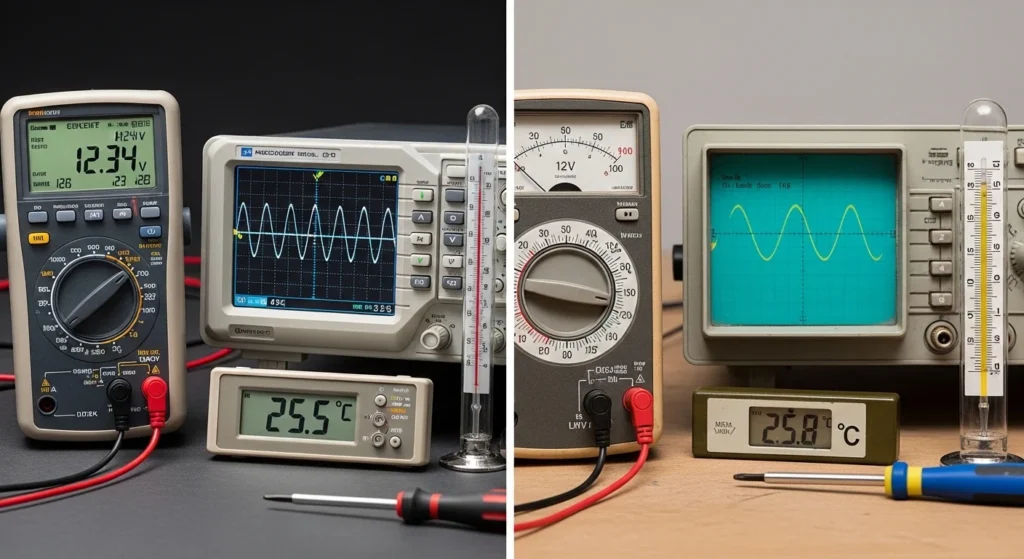

Imagine an electrician checking the voltage of a household power supply. One technician uses a traditional meter with a moving needle that points to a scale, while another uses a modern digital device that shows the voltage as numbers on a screen. Both tools measure the same electrical quantity, but they work in very different ways. These tools represent two major categories of measuring instruments: digital instruments and analog instruments.
Understanding Digital vs Analog Instruments is important for electrical students, engineers, technicians, and beginners who work with measurement devices. Measuring electrical quantities accurately is essential for troubleshooting circuits, maintaining equipment, and designing electrical systems.
Both types of instruments have been widely used in electrical engineering. Analog instruments were the standard tools for many decades, while digital instruments have become more common in modern systems due to their higher accuracy and ease of use.
In this article, you will learn about the difference between digital and analog instruments, their working principles, types, components, advantages and disadvantages, and their applications in modern electrical systems. This guide will help you understand when to use each type of instrument and how they contribute to accurate electrical measurement.
2. What is Digital vs Analog Instruments?
Digital vs Analog Instruments refers to two different methods used to measure and display electrical quantities such as voltage, current, resistance, frequency, and power.
Analog Instruments
Analog instruments display measurement values using a moving pointer or needle that moves over a calibrated scale.
Digital Instruments
Digital instruments display measurement values in numeric form on a digital screen.
Simple Explanation
- Analog instruments show values using a moving pointer and scale.
- Digital instruments show values using numbers on a display.
Practical Example
An analog voltmeter uses a needle to indicate voltage on a scale, while a digital voltmeter displays the exact voltage value like 230.5 V on a screen.
Understanding the difference between digital and analog instruments helps engineers choose the right tool for accurate measurement.
3. Working Principle
The digital vs analog instruments working principle differs based on how they process and display signals.
Analog Instrument Working Principle
Analog instruments work by converting electrical signals into mechanical movement.
Step-by-Step Process
- Electrical current flows into the instrument.
- The current creates a magnetic field.
- This magnetic field moves a coil or pointer.
- The pointer moves across a calibrated scale.
- The position of the pointer shows the measurement value.
Simple Analogy
Think of an analog instrument like a speedometer in older cars where the needle moves as speed changes.
Digital Instrument Working Principle
Digital instruments convert electrical signals into digital data.
Step-by-Step Process
- Electrical signal enters the instrument.
- The signal is converted into digital form using an analog-to-digital converter (ADC).
- The microprocessor processes the data.
- The result is displayed as numbers on the screen.
Simple Analogy
Digital instruments are like a calculator that processes numbers and shows exact values instantly.
4. Types / Classification
Understanding the types of digital and analog instruments helps in selecting the correct measuring device.
Analog Measuring Instruments
Analog instruments use mechanical movement to display readings.
Examples
- Analog Voltmeter
- Analog Ammeter
- Analog Wattmeter
- Analog Frequency Meter
These instruments are widely used in educational labs and older electrical systems.
Digital Measuring Instruments
Digital instruments display values using electronic circuits and digital displays.
Examples
- Digital Multimeter
- Digital Voltmeter
- Digital Ammeter
- Digital Clamp Meter
These instruments are widely used in modern electrical testing.
Hybrid Instruments
Some modern instruments combine analog and digital features.
They provide both graphical displays and digital readings.
5. Main Components
The components of digital and analog instruments differ based on their operating methods.
Components of Analog Instruments
Moving Coil
The moving coil generates motion when current flows through it.
Pointer
The pointer moves across the scale to indicate the measurement value.
Scale
The scale contains markings that represent measurement values.
Permanent Magnet
The magnet creates a magnetic field required for coil movement.
Components of Digital Instruments
Analog to Digital Converter (ADC)
The ADC converts electrical signals into digital form.
Microprocessor
The microprocessor processes measurement data.
Digital Display
The display shows measurement values in numeric form.
Input Circuit
The input circuit receives electrical signals from the measured system.
6. Advantages
Understanding digital vs analog instruments advantages and disadvantages helps determine their usefulness in different situations.
Advantages of Analog Instruments
- Simple construction
- Easy to understand operation
- Good for observing trends and variations
- Lower cost in some cases
Advantages of Digital Instruments
- High measurement accuracy
- Easy-to-read digital display
- Minimal reading errors
- Advanced measurement features
- Compact and portable design
These benefits explain why digital instruments dominate modern electrical testing.
7. Disadvantages / Limitations
Despite their benefits, both instrument types have limitations.
Disadvantages of Analog Instruments
- Lower measurement accuracy
- Parallax error when reading scale
- Mechanical wear and tear
- Limited measurement features
Disadvantages of Digital Instruments
- Higher cost for advanced models
- Requires power supply or battery
- More complex electronic circuits
- Sensitive to electromagnetic interference
Understanding these limitations helps users select the right tool for specific measurement tasks.
8. Applications
The digital vs analog instruments applications cover a wide range of electrical and electronic systems.
Educational Laboratories
Analog instruments are often used to teach measurement principles.
Electrical Maintenance
Digital multimeters and clamp meters are used to test circuits and equipment.
Industrial Systems
Digital instruments monitor voltage, current, and power in industrial machinery.
Power Systems
Engineers use advanced digital instruments to monitor large electrical networks.
Research and Development
Precise digital instruments are used in electronics testing and development.
9. Comparison Section
The difference between digital and analog instruments can be summarized in the following table.
| Feature | Analog Instruments | Digital Instruments |
|---|---|---|
| Display | Pointer and scale | Numeric display |
| Accuracy | Moderate | High |
| Reading Error | Possible parallax error | Minimal error |
| Complexity | Simple design | More complex electronics |
| Power Requirement | Often not required | Requires power |
| Cost | Generally lower | Higher depending on model |
This comparison helps users understand the strengths and limitations of both instrument types.
10. Selection Guide
Choosing between digital and analog instruments depends on several factors.
Important Factors
- Required measurement accuracy
- Type of electrical parameter
- Working environment
- Budget
- User experience level
Tips for Beginners
- Use digital instruments for precise measurements.
- Use analog instruments to observe trends or fluctuations.
- Choose instruments with proper safety ratings.
- Ensure the device covers the required measurement range.
Proper instrument selection improves measurement reliability and safety.
11. Common Problems & Solutions
Q1: Why do analog instruments show incorrect readings?
This may occur due to mechanical wear or calibration errors.
Solution: Calibrate the instrument regularly.
Q2: Why do digital instruments display unstable readings?
Unstable readings may be caused by electrical noise.
Solution: Use proper shielding and grounding.
Q3: Why does the digital display become blank?
This often happens due to low battery.
Solution: Replace the battery.
Q4: Why does the analog pointer not move?
The internal coil or mechanical parts may be damaged.
Solution: Repair or replace the instrument.
12. Future Trends
Electrical measurement technology is evolving rapidly.
Smart Digital Instruments
Modern instruments now include wireless connectivity and data logging features.
Integrated Monitoring Systems
Digital instruments can connect to industrial monitoring systems for real-time data analysis.
Improved Sensor Technology
New sensors provide higher accuracy and faster response times.
These innovations will improve electrical measurement efficiency and reliability.
13. Conclusion
Understanding Digital vs Analog Instruments is essential for anyone working with electrical measurement systems. Both types of instruments play important roles in electrical engineering and testing applications.
Analog instruments provide a simple and visual way to observe electrical variations, while digital instruments offer higher accuracy and convenient numerical displays. Modern electrical systems rely heavily on digital instruments because they provide precise readings and advanced measurement capabilities.
However, analog instruments still remain useful in certain applications where observing signal trends is important. By understanding the difference between digital and analog instruments, engineers and technicians can choose the most appropriate tool for each measurement task.
Learning about measurement instruments helps electrical students build strong diagnostic and troubleshooting skills that are essential for successful careers in electrical engineering.