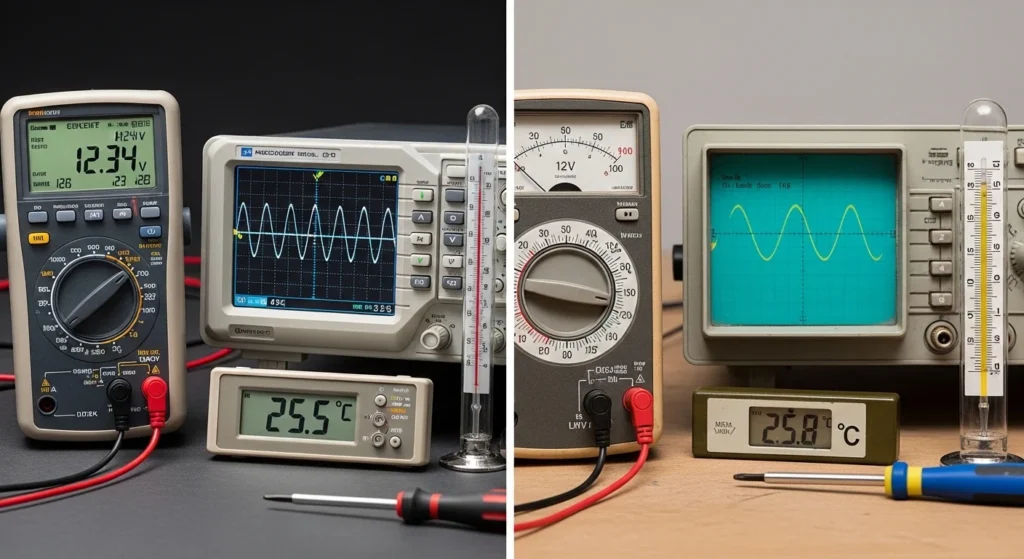

Imagine an electrician checking the voltage of a household power supply. One technician uses a traditional meter with a moving needle that points to a scale, while another uses a modern digital device that shows the voltage as numbers on a screen. Both tools measure the same electrical quantity, but they work in very different ways. These tools represent two major categories of measuring instruments: digital instruments and analog instruments.
Understanding Digital vs Analog Instruments is important for electrical students, engineers, technicians, and beginners who work with measurement devices. Measuring electrical quantities accurately is essential for troubleshooting circuits, maintaining equipment, and designing electrical systems.
Both types of instruments have been widely used in electrical engineering. Analog instruments were the standard tools for many decades, while digital instruments have become more common in modern systems due to their higher accuracy and ease of use.
In this article, you will learn about the difference between digital and analog instruments, their working principles, types, components, advantages and disadvantages, and their applications in modern electrical systems. This guide will help you understand when to use each type of instrument and how they contribute to accurate electrical measurement.
2. What are Digital and Analog Instruments?
Digital and analog instruments are measuring devices used to measure electrical quantities such as voltage, current, resistance, frequency, power, capacitance, and other electrical parameters. Although both types perform the same basic function of measurement, they differ in how they detect, process, and display the measured values. Analog instruments use a mechanical pointer to indicate readings, whereas digital instruments display precise numerical values on an electronic screen.
What are Analog Instruments?
Analog instruments display measured values using a moving pointer (needle) that travels across a calibrated scale. The pointer moves because of a mechanical or electromechanical mechanism, and its position represents the magnitude of the measured electrical quantity. These instruments provide continuous readings, making them useful for observing gradual changes and fluctuations in electrical signals.
What are Digital Instruments?
Digital instruments display measured values as numerical digits on an LCD, LED, or other digital display. They use electronic circuits and an Analog-to-Digital Converter (ADC) to convert analog electrical signals into digital data. This process provides highly accurate, easy-to-read measurements with minimal reading errors.
Simple Explanation
- Analog instruments display measurements using a moving pointer and calibrated scale.
- Digital instruments display measurements as exact numerical values on a digital screen.
Practical Example
Suppose you want to measure the voltage of a household power outlet. An analog voltmeter indicates the voltage by moving a pointer across a graduated scale, requiring the user to estimate the reading. In contrast, a digital voltmeter displays the exact voltage, such as 230.5 V, directly on the screen, making the reading faster, clearer, and more accurate.
Why is Understanding the Difference Important?
Understanding the difference between digital and analog instruments helps electricians, technicians, engineers, and students choose the right measuring device for a particular application. Analog instruments are useful for monitoring continuous variations in electrical signals, while digital instruments are preferred for applications requiring high accuracy, precision, and easy readability.
3. Working Principle of Digital and Analog Instruments
The working principle of digital and analog instruments differs mainly in the way they measure, process, and display electrical signals. Both instruments measure electrical quantities such as voltage, current, resistance, frequency, and power, but they use different technologies to present the results. Analog instruments rely on mechanical movement to indicate measurements, whereas digital instruments use electronic circuits to convert electrical signals into numerical values.
Working Principle of Analog Instruments
Analog instruments operate by converting an electrical signal into mechanical movement. When the measured current or voltage flows through the instrument, it creates a magnetic field that interacts with a permanent magnet or moving coil. This interaction produces a mechanical force that moves the pointer across a calibrated scale. The amount of pointer deflection is directly proportional to the magnitude of the measured electrical quantity.
Step-by-Step Working Process
- The electrical quantity enters the instrument.
- The current produces a magnetic field inside the measuring mechanism.
- The magnetic field creates a force on the moving coil or moving iron element.
- The pointer rotates across the calibrated scale.
- The pointer position indicates the measured value.
Simple Analogy
An analog instrument works like the speedometer in older vehicles, where a needle continuously moves across a dial to indicate changes in speed.
Working Principle of Digital Instruments
Digital instruments measure electrical quantities using electronic circuits. The incoming analog signal is first converted into digital data by an Analog-to-Digital Converter (ADC). A microprocessor processes the digital signal, performs the necessary calculations, and sends the result to an LCD or LED display, where the measurement is shown as numerical digits.
Step-by-Step Working Process
- The electrical signal enters the input circuit.
- The signal is conditioned and converted into digital data by the Analog-to-Digital Converter (ADC).
- The microprocessor processes and calculates the measurement value.
- The processed data is sent to the display unit.
- The exact measurement appears as numerical digits on the screen.
Simple Analogy
A digital instrument works like a calculator, which receives data, processes it electronically, and instantly displays the exact result in numerical form.
Key Difference in Working Principle
The primary difference is that analog instruments convert electrical energy into mechanical pointer movement, while digital instruments convert electrical signals into digital data using electronic circuits and display precise numerical readings. This makes digital instruments more accurate and easier to read, whereas analog instruments are better suited for observing continuous fluctuations and trends in electrical measurements.
4. Types and Classification of Digital and Analog Instruments
Digital and analog instruments can be classified according to the method they use to measure and display electrical quantities. Each type is designed for specific measurement tasks and applications. Understanding these classifications helps electricians, engineers, technicians, and students select the most appropriate instrument for accurate and reliable electrical measurements.
Analog Measuring Instruments
Analog instruments display measurement values using a moving pointer (needle) that travels across a calibrated scale. They operate through mechanical or electromechanical mechanisms and are particularly useful for observing continuous changes and fluctuations in electrical signals.
Common Types of Analog Instruments
- Analog Voltmeter – Measures AC or DC voltage.
- Analog Ammeter – Measures electrical current.
- Analog Ohmmeter – Measures electrical resistance.
- Analog Wattmeter – Measures electrical power.
- Analog Frequency Meter – Measures AC frequency.
- Analog Power Factor Meter – Measures the power factor of electrical systems.
- Analog Energy Meter – Measures electrical energy consumption.
These instruments are commonly used in educational laboratories, older electrical installations, industrial control panels, and applications where observing gradual variations in readings is important.
Digital Measuring Instruments
Digital instruments use electronic circuits and Analog-to-Digital Converters (ADC) to convert electrical signals into digital data, displaying the results as numerical values on an LCD or LED screen. They provide higher accuracy, faster response, and easier readability than analog instruments.
Common Types of Digital Instruments
- Digital Multimeter (DMM) – Measures voltage, current, resistance, continuity, and other electrical parameters.
- Digital Voltmeter – Measures AC and DC voltage accurately.
- Digital Ammeter – Measures electrical current.
- Digital Clamp Meter – Measures current without disconnecting the circuit.
- Digital Ohmmeter – Measures electrical resistance.
- Digital Frequency Meter – Measures signal frequency.
- Digital Power Meter – Measures electrical power and energy.
- Digital Insulation Tester – Measures insulation resistance in electrical equipment.
These instruments are widely used in electrical maintenance, industrial automation, electronics repair, laboratories, power systems, and modern troubleshooting applications.
Hybrid Instruments
Hybrid instruments combine the advantages of analog and digital technologies. They provide both a digital numerical display and an analog-style graphical indicator or bar graph, allowing users to monitor precise values while also observing real-time changes and trends.
Examples of Hybrid Instruments
- Digital multimeters with an analog bar graph
- Digital oscilloscopes
- Smart power analyzers
- Digital panel meters with graphical displays
Hybrid instruments are commonly used in industrial automation, power quality analysis, research laboratories, and advanced electrical testing where both high accuracy and trend monitoring are required.
5. Main Components of Digital and Analog Instruments
The construction of digital and analog instruments differs because they use different methods to measure and display electrical quantities. Analog instruments primarily consist of mechanical and electromagnetic components that move a pointer across a calibrated scale, whereas digital instruments use electronic circuits, sensors, microprocessors, and display units to process and present measurements as numerical values.
Main Components of Analog Instruments
Analog instruments convert electrical energy into mechanical movement using electromechanical components.
Moving Coil
The moving coil is the primary sensing element in many analog instruments. When electric current flows through the coil, it interacts with the magnetic field produced by the permanent magnet, generating a force that moves the pointer.
Pointer (Needle)
The pointer is attached to the moving mechanism and travels across the calibrated scale to indicate the measured electrical quantity.
Calibrated Scale
The calibrated scale contains numerical markings that enable the user to read the measurement according to the pointer’s position.
Permanent Magnet
The permanent magnet creates the magnetic field required for the moving coil to operate smoothly and accurately.
Control Spring
The control spring provides the restoring force that returns the pointer to its zero position and ensures proportional movement during measurement.
Damping Mechanism
The damping mechanism minimizes pointer oscillations and allows the pointer to settle quickly for stable and accurate readings.
Terminals
Input terminals provide the electrical connection between the instrument and the circuit being measured.
Main Components of Digital Instruments
Digital instruments use electronic circuits to measure, process, and display electrical quantities with high accuracy and precision.
Input Circuit
The input circuit receives the electrical signal from the circuit under test and conditions the signal before further processing.
Analog-to-Digital Converter (ADC)
The ADC converts the incoming analog electrical signal into digital data that can be processed by the instrument’s electronic system.
Microprocessor
The microprocessor performs calculations, processes measurement data, controls instrument functions, and manages communication between different electronic components.
Digital Display
The LCD or LED display presents measurement values as clear numerical digits, eliminating reading errors associated with analog scales.
Power Supply
Digital instruments require an internal battery or external power source to operate the electronic circuits and display system.
Memory and Communication Module
Advanced digital instruments may include internal memory along with USB, Bluetooth, or Wi-Fi connectivity for storing measurement data and transferring it to computers, smartphones, or cloud-based monitoring systems.
Function Selector and Control Buttons
These controls allow users to select measurement modes, ranges, and additional functions such as auto-ranging, data hold, minimum/maximum recording, and calibration options.
6. Advantages of Digital and Analog Instruments
Both digital and analog instruments offer unique benefits depending on the measurement application. Understanding their advantages helps users choose the most suitable instrument for electrical testing, monitoring, and troubleshooting.
Advantages of Analog Instruments
- Simple construction and operating principle.
- Easy to understand for learning basic measurement concepts.
- Excellent for observing continuous changes and signal fluctuations.
- Does not always require an external power supply.
- Generally lower cost than advanced digital instruments.
- Suitable for monitoring slowly changing electrical quantities.
Advantages of Digital Instruments
- High measurement accuracy and precision.
- Easy-to-read numerical display with no parallax error.
- Fast measurement response and stable readings.
- Capable of measuring multiple electrical parameters using a single instrument.
- Advanced features such as auto-ranging, data logging, peak hold, and automatic calculations.
- Compact, lightweight, and portable design.
- Better reliability and reduced human reading errors.
- Many models support computer connectivity and wireless communication.
Overall Benefit
Digital instruments have become the preferred choice for most electrical and electronic applications because they provide greater accuracy, faster measurements, and advanced diagnostic capabilities, while analog instruments remain valuable for monitoring gradual variations in electrical signals.
7. Disadvantages and Limitations of Digital and Analog Instruments
Although both types of instruments are widely used, each has certain limitations that should be considered before selecting a measuring device.
Disadvantages of Analog Instruments
- Lower measurement accuracy compared to digital instruments.
- Readings may be affected by parallax error.
- Mechanical parts are subject to wear and tear over time.
- Pointer movement can be influenced by vibration and external magnetic fields.
- Limited measurement functions.
- Reading small scale divisions can be difficult.
- Requires periodic calibration to maintain accuracy.
Disadvantages of Digital Instruments
- Generally more expensive than analog instruments.
- Requires batteries or an external power supply.
- Electronic circuits can be damaged by excessive voltage or improper use.
- Sensitive to electromagnetic interference (EMI) in some environments.
- Rapidly changing values may be difficult to observe compared to analog pointer movement.
- Advanced models may require user training to operate all features.
Overall Limitation
Neither instrument is universally better for every application. The best choice depends on the required accuracy, operating conditions, measurement purpose, and available budget.
8. Applications of Digital and Analog Instruments
Digital and analog instruments are used across a wide range of electrical, electronic, industrial, and scientific applications for measuring, monitoring, and troubleshooting electrical parameters. While analog instruments are useful for observing continuous variations, digital instruments are preferred where high accuracy and precise numerical readings are required.
Educational Laboratories
Schools, colleges, and technical institutes use analog instruments to teach the fundamentals of electrical measurement because students can easily observe pointer movement. Digital instruments are also used to perform accurate laboratory experiments and verify results.
Electrical Maintenance and Troubleshooting
Electricians and maintenance technicians use digital multimeters, clamp meters, insulation testers, and analog meters to test electrical circuits, identify faults, verify voltage and current levels, and ensure the safe operation of electrical equipment.
Industrial Automation
Manufacturing plants and industrial facilities use digital instruments to monitor motors, generators, transformers, control panels, and automated production systems. Continuous monitoring improves efficiency, reduces downtime, and supports preventive maintenance.
Power Generation and Distribution
Power plants, substations, and electrical distribution systems rely on advanced digital measuring instruments to monitor voltage, current, frequency, power, energy consumption, and power quality for reliable system operation.
Electronics Testing and Repair
Electronic technicians use digital instruments to test printed circuit boards (PCBs), semiconductors, communication equipment, and consumer electronics because of their high accuracy and fast response.
Research and Development
Research laboratories and engineering organizations use high-precision digital instruments to develop new electrical and electronic technologies, perform experimental measurements, and validate product performance.
Renewable Energy Systems
Digital instruments play a vital role in monitoring solar power systems, wind turbines, battery storage systems, and electric vehicle charging stations by measuring electrical output and system efficiency.
Building Energy Management
Commercial buildings, hospitals, shopping malls, and data centers use digital monitoring instruments to measure energy consumption, improve efficiency, and detect electrical faults before they affect system performance.
9. Comparison Section
The difference between digital and analog instruments can be summarized in the following table.
| Feature | Analog Instruments | Digital Instruments |
|---|---|---|
| Display | Pointer and scale | Numeric display |
| Accuracy | Moderate | High |
| Reading Error | Possible parallax error | Minimal error |
| Complexity | Simple design | More complex electronics |
| Power Requirement | Often not required | Requires power |
| Cost | Generally lower | Higher depending on model |
This comparison helps users understand the strengths and limitations of both instrument types.
10. Selection Guide for Digital and Analog Instruments
Selecting the right measuring instrument is essential for obtaining accurate, reliable, and safe electrical measurements. The choice between a digital and an analog instrument depends on the required level of accuracy, the application, the working environment, and the user’s experience. Digital instruments are generally preferred for precise measurements and troubleshooting, while analog instruments are useful for observing continuous changes and trends in electrical signals.
Important Factors to Consider
Before selecting a digital or analog instrument, consider the following factors:
- Measurement Accuracy – Choose digital instruments when high accuracy and precision are required.
- Type of Electrical Parameter – Ensure the instrument is designed to measure the required parameter, such as voltage, current, resistance, frequency, power, or capacitance.
- Measurement Range – Select an instrument with a measurement range suitable for the expected values.
- Working Environment – Consider temperature, humidity, dust, vibration, and electromagnetic interference in the operating environment.
- Safety Rating – Choose instruments with the appropriate CAT (Category) safety rating for residential, commercial, or industrial electrical systems.
- Resolution and Display – Digital displays provide clear numerical readings, while analog scales are useful for monitoring gradual variations.
- Portability and Power Source – Decide whether a portable battery-powered instrument or a fixed panel instrument is more suitable.
- Budget – Balance the required features and accuracy with the available budget.
- User Experience – Beginners generally find digital instruments easier to read and operate, while experienced technicians may use both depending on the application.
Tips for Beginners
- Use digital instruments for accurate and easy-to-read measurements.
- Use analog instruments when monitoring gradual changes or signal fluctuations.
- Always select an instrument with the correct measurement range.
- Choose instruments with appropriate electrical safety ratings (CAT II, CAT III, or CAT IV) for the intended application.
- Verify that the instrument has been properly calibrated before taking critical measurements.
- Read the user manual and follow the manufacturer’s operating instructions.
- Inspect test leads, probes, and batteries before use to ensure safe operation.
Selection Summary
If your priority is accuracy, precision, and ease of reading, a digital instrument is usually the best choice. If you need to observe continuous variations, trends, or fluctuations in electrical signals, an analog instrument can be more suitable. Selecting the appropriate instrument based on the application improves measurement accuracy, enhances workplace safety, and increases the overall efficiency of electrical testing and troubleshooting.
11. Common Problems and Solutions of Digital and Analog Instruments
Like all measuring devices, digital and analog instruments can experience problems due to aging components, improper handling, environmental conditions, or lack of maintenance. Understanding these common issues and their solutions helps ensure accurate measurements, reliable performance, and longer instrument life.
Q1: Why do analog instruments show incorrect readings?
Analog instruments may provide inaccurate readings due to mechanical wear, calibration errors, pointer friction, magnetic interference, or damaged internal components. These factors can affect the movement of the pointer and reduce measurement accuracy.
Solution:
- Calibrate the instrument regularly.
- Keep the instrument away from strong magnetic fields.
- Inspect the moving pointer and internal mechanism for damage.
- Replace worn or faulty parts when necessary.
Q2: Why do digital instruments display unstable or fluctuating readings?
Digital instruments may show unstable readings because of electrical noise, electromagnetic interference (EMI), loose test leads, poor grounding, or unstable input signals. Faulty sensors or damaged electronic circuits can also cause fluctuations.
Solution:
- Use proper grounding and shielding.
- Ensure all test leads are securely connected.
- Keep the instrument away from high-frequency interference sources.
- Replace damaged probes or cables if required.
Q3: Why does the digital display become blank or fail to turn on?
A blank display is commonly caused by a low battery, blown fuse, faulty power supply, damaged display module, or internal electronic failure.
Solution:
- Replace the battery with a new one.
- Check and replace any blown fuse.
- Verify the power supply connections.
- If the problem continues, have the instrument inspected by a qualified technician.
Q4: Why does the analog pointer not move?
The pointer may fail to move because of a damaged moving coil, broken spring, mechanical obstruction, open circuit, or excessive overload.
Solution:
- Check for any mechanical blockage.
- Inspect the moving coil and pointer mechanism.
- Test the internal circuit for continuity.
- Repair or replace damaged components.
- Avoid using the instrument beyond its rated measurement range.
Q5: Why do digital and analog instruments show different readings?
Small differences in readings can occur because analog instruments have lower resolution and are affected by parallax error, while digital instruments provide higher accuracy and direct numerical readings.
Solution:
- Calibrate both instruments periodically.
- Read analog scales from the correct viewing angle.
- Use digital instruments when precise measurements are required.
- Select the appropriate instrument based on the application.
12. Future Trends in Digital and Analog Instruments
Electrical measurement technology continues to evolve with advancements in electronics, communication, automation, and sensor technology. Modern instruments are becoming smarter, more accurate, and better integrated with digital monitoring systems, making electrical testing faster, safer, and more efficient.
Smart Digital Instruments
Modern digital instruments now include Bluetooth, Wi-Fi, USB connectivity, cloud storage, and data logging capabilities. These features allow technicians and engineers to monitor measurements remotely, store test results, and generate reports with greater efficiency.
IoT-Based Monitoring Systems
The integration of the Internet of Things (IoT) enables digital instruments to communicate with industrial monitoring platforms, providing real-time data collection, remote diagnostics, predictive maintenance, and continuous equipment monitoring.
Artificial Intelligence (AI) Integration
AI-powered measuring instruments can analyze measurement data, detect abnormal operating conditions, identify potential equipment failures, and recommend maintenance before breakdowns occur, reducing downtime and maintenance costs.
Advanced Sensor Technology
New-generation sensors offer higher accuracy, improved sensitivity, faster response times, and better resistance to temperature changes and electromagnetic interference, resulting in more reliable measurements even in demanding industrial environments.
Wireless and Portable Test Equipment
Manufacturers are developing compact, lightweight, battery-powered, and wireless measuring instruments that improve portability, enhance user safety, and allow testing in difficult-to-access locations.
Integration with Smart Industrial Systems
Future digital instruments will seamlessly integrate with PLC, SCADA, Industrial IoT (IIoT), and Energy Management Systems (EMS) for automatic data collection, remote monitoring, and intelligent process control.
Future Outlook
As technology advances, digital instruments will continue to become more intelligent, connected, accurate, and user-friendly, while analog instruments will remain valuable in specialized applications where observing continuous signal variations and trends is important. These innovations will significantly improve the efficiency, reliability, and safety of electrical measurement systems.
13. Conclusion
Understanding Digital vs Analog Instruments is essential for anyone working with electrical measurement systems. Both types of instruments play important roles in electrical engineering and testing applications.
Analog instruments provide a simple and visual way to observe electrical variations, while digital instruments offer higher accuracy and convenient numerical displays. Modern electrical systems rely heavily on digital instruments because they provide precise readings and advanced measurement capabilities.
However, analog instruments still remain useful in certain applications where observing signal trends is important. By understanding the difference between digital and analog instruments, engineers and technicians can choose the most appropriate tool for each measurement task.
Learning about measurement instruments helps electrical students build strong diagnostic and troubleshooting skills that are essential for successful careers in electrical engineering.