
Imagine you are installing a new electrical switchboard in a house. You have measured the wire length carefully, but now you need to cut it neatly. If you use a knife or a low-quality tool, the wire may get damaged, and you may even hurt yourself. Instead, you pick up a cutting plier. With one smooth press, the wire is cut cleanly and safely.
This simple tool plays a very important role in electrical and technical work. A small mistake while cutting wires can cause loose connections, short circuits, or accidents. That is why professionals always use the right cutting tool.
In this article, you will learn everything about cutting pliers and wire cutters. We will discuss what they are, how they work, their types, parts, advantages, and limitations. You will also understand cutting plier working principle, cutting plier applications, and cutting plier advantages and disadvantages. By the end, you will be able to choose and use this tool confidently like a skilled engineer.
2. What Is a Cutting Plier (Wire Cutter)? | Definition, Purpose & Uses
A cutting plier, also known as a wire cutter, is a hand tool designed to cut electrical wires, cables, plastic insulation, cable ties, and small metal wires with precision. It is one of the most essential tools used by electricians, technicians, DIY enthusiasts, and maintenance professionals.
Simple Explanation
A cutting plier has two hardened steel cutting jaws connected by pivoted handles. When the handles are squeezed, the sharp jaws apply high cutting force to slice through wires quickly and cleanly with minimal effort.
The insulated handles provide a comfortable grip and help improve safety when working on electrical installations (always ensure the circuit is de-energized before cutting).
Practical Example
Suppose an electrician is installing electrical sockets in a new building. After measuring the required cable length, they use a cutting plier to trim the copper wire accurately before stripping the insulation and connecting it to the socket. This ensures neat wiring, proper cable management, and reliable electrical connections.
Why It Is Important
A cutting plier helps create clean, accurate wire cuts, making electrical work faster, safer, and more professional. It is considered a basic yet indispensable tool in electrical installation, repair, maintenance, and electronic projects.
3. Working Principle of Cutting Plier / Wire Cutter
The cutting plier working principle is based on leverage and mechanical force.
Step-by-Step Explanation
- You hold the handles firmly.
- You place the wire between the cutting jaws.
- You press the handles together.
- Force increases due to leverage.
- Sharp edges cut through the wire.
Easy Analogy
Think of scissors cutting paper. When you press the handles, the blades cut the paper. A cutting plier works in the same way, but it is stronger and sharper.
Key Points
- Uses lever mechanism
- Multiplies hand force
- Sharp edges reduce effort
- Controlled pressure gives clean cuts
This simple principle makes wire cutters efficient and reliable.
4. Types / Classification of Cutting Pliers
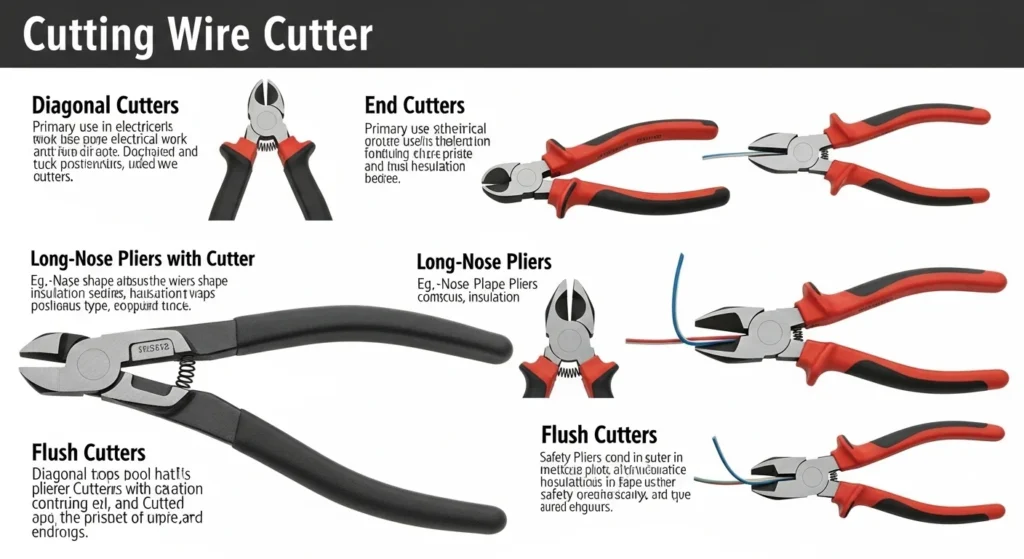
Different types of cutting pliers are used for different tasks.
Diagonal Cutting Pliers (Side Cutters): Features, Working Principle, and Common Applications
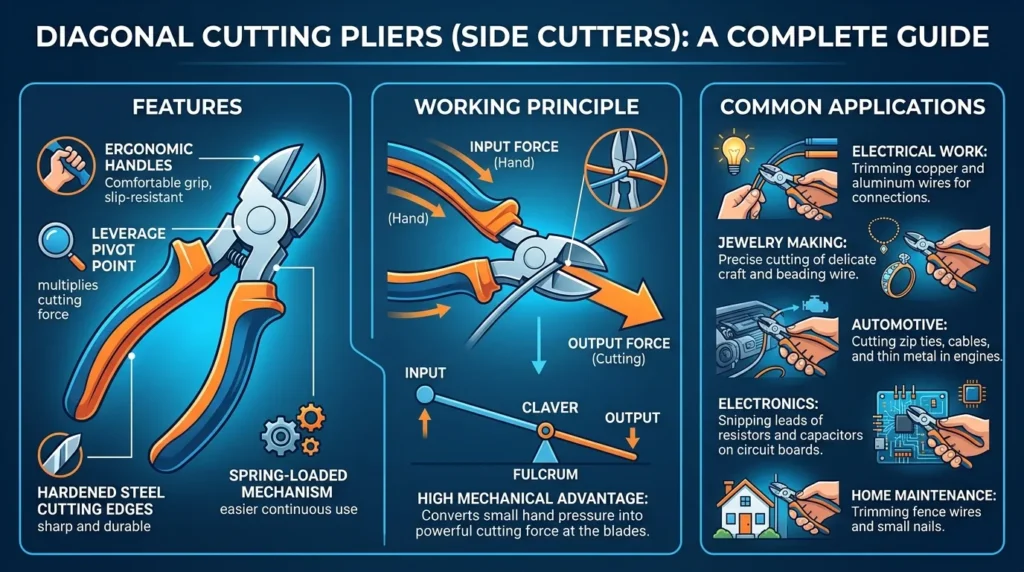
Diagonal cutting pliers, commonly known as side cutters, are one of the most essential hand tools used in electrical, mechanical, and electronic work. These pliers are specifically designed to cut wires, cable ties, small nails, and soft metal components with precision. Unlike combination pliers, diagonal cutting pliers have sharp, angled cutting jaws that meet at the edge, allowing users to cut materials close to a surface without gripping or twisting them. The angled head improves visibility and access in tight or confined spaces, making the tool highly useful for electricians, technicians, hobbyists, and DIY users. Most side cutters are manufactured from high-carbon steel or chrome vanadium steel, which provides excellent strength, durability, and resistance to wear. Many models also feature insulated, non-slip handles that improve user comfort and offer additional protection when working near electrical circuits. Their compact size and lightweight design make them easy to carry in toolkits and convenient for everyday use.
The working principle of diagonal cutting pliers is based on the lever mechanism, where squeezing the handles multiplies the applied force and transfers it to the sharp cutting edges. This mechanical advantage enables the jaws to cut through copper wires, aluminum wires, plastic-coated cables, and other soft metals with minimal effort. Because the cutting edges are hardened and precisely aligned, they produce clean, accurate cuts without crushing or deforming the material. Side cutters are widely used during electrical wiring installations, electronic circuit assembly, cable trimming, maintenance, repair work, and manufacturing processes. They are also useful for cutting zip ties, trimming component leads on printed circuit boards (PCBs), and removing excess wire after making electrical connections. However, they are not intended for cutting hardened steel, thick bolts, or heavy-duty materials, as doing so can damage the cutting edges. Regular cleaning, lubrication, and proper storage help maintain their cutting performance and extend their service life, making diagonal cutting pliers a reliable and indispensable tool for both professionals and beginners.
These are the most common wire cutters.
Features:
- Angled cutting edge
- Compact design
- Good control
Uses:
- Cutting copper wires
- Trimming leads
- Electronics work
End Cutting Pliers: Features, Working Principle, and Common Applications
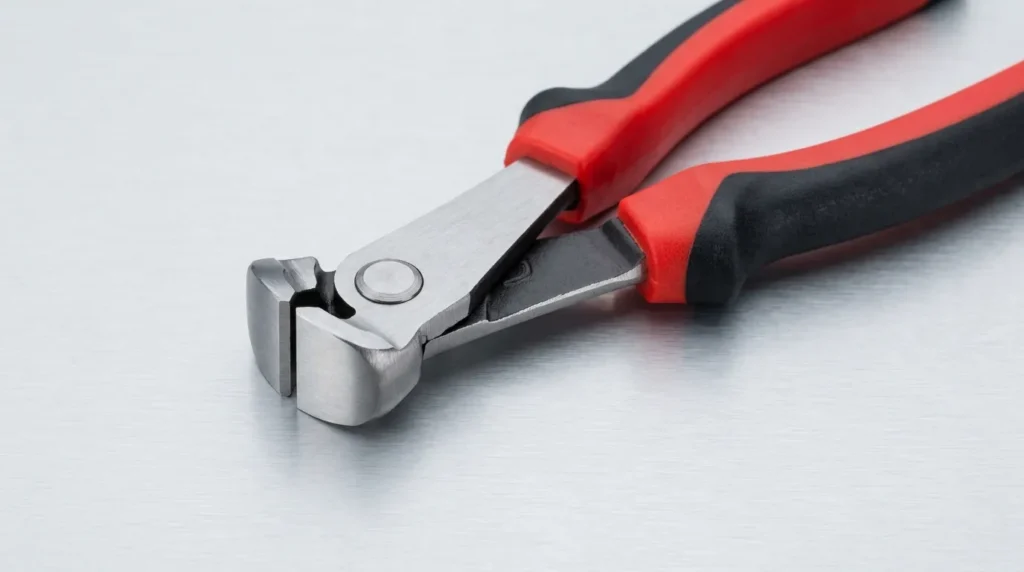
End cutting pliers, also known as end nippers or end cutters, are specialized hand tools designed to cut wires, nails, rivets, and other metal objects flush with a surface. Unlike diagonal cutting pliers, the cutting jaws of end cutting pliers are positioned at the front (end) of the tool, allowing users to make clean, close cuts without damaging the surrounding material. This unique design makes them especially useful in carpentry, construction, electrical work, fencing, and metalworking. End cutting pliers are commonly manufactured from high-quality hardened steel or chrome vanadium steel to provide excellent strength, durability, and long-lasting sharpness. Many models include ergonomic, non-slip handles that improve grip, reduce hand fatigue, and provide better control during prolonged use. Their compact head also allows access to confined spaces where standard cutting tools may not fit, making them a practical addition to both professional and DIY toolkits.
The working principle of end cutting pliers is based on the lever mechanism, where force applied to the handles is multiplied and transferred to the front cutting jaws. This mechanical advantage enables the tool to cut through soft metal wires, nails, staples, cable ties, and similar materials with relatively little effort. The cutting edges meet evenly at the end of the jaws, producing a smooth, flush cut that is ideal for trimming protruding fasteners or removing embedded nails. End cutting pliers are widely used by electricians for cutting wire ends, by carpenters for pulling and trimming nails, by fence installers for cutting fencing wire, and by craftsmen for precision cutting tasks. They are also popular in jewelry making and model building, where accurate flush cuts are essential. However, these pliers are not designed for cutting hardened steel rods or thick metal bars, as excessive force may damage the cutting edges. Regular cleaning, light lubrication, and proper storage help preserve their sharpness and ensure reliable performance, making end cutting pliers an essential tool for precision cutting and maintenance work.
These cut wires from the front side.
Features:
- Flat head
- Strong jaws
- High cutting power
Uses:
- Cutting nails
- Removing pins
- Flush cutting
Insulated Cutting Pliers: Features, Working Principle, and Common Applications
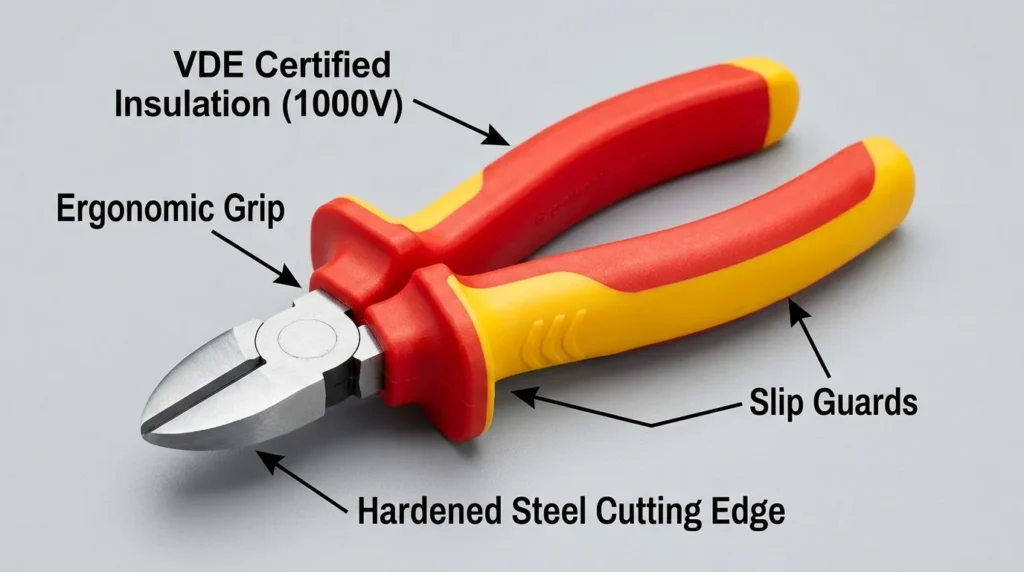
Insulated cutting pliers are specially designed hand tools used for cutting electrical wires and cables while providing additional protection against electric shock. These pliers are similar to standard cutting pliers but feature insulated handles made from high-quality non-conductive materials that help reduce the risk of electrical accidents when working on or near live electrical circuits. Many insulated cutting pliers are tested and certified according to international safety standards, making them suitable for professional electricians, maintenance technicians, and utility workers. The cutting jaws are manufactured from hardened high-carbon steel or chrome vanadium steel, ensuring excellent strength, durability, and long-lasting sharpness. Their precision-ground cutting edges allow clean and accurate cuts on copper, aluminum, and other soft metal wires. Ergonomic, non-slip handles improve grip and reduce hand fatigue, making the tool comfortable to use during extended electrical installation and maintenance tasks.
The working principle of insulated cutting pliers is based on the lever mechanism, where pressure applied to the handles is multiplied and transferred to the sharp cutting jaws. This mechanical advantage enables users to cut wires efficiently with minimal effort while the insulated handles provide an extra layer of safety against accidental contact with electrical current. These pliers are widely used in residential, commercial, and industrial electrical installations, control panel wiring, cable trimming, maintenance work, and repair projects. They are especially valuable when electricians need to cut conductors in confined spaces while maintaining safe working practices. However, users should remember that insulation does not eliminate electrical hazards, and the tool should only be used within its rated voltage and safety specifications. Insulated cutting pliers are not intended for cutting hardened steel, thick metal rods, or other materials beyond their design capacity, as this can damage the cutting edges. Regular inspection of the insulation for cracks, cleaning after use, and proper storage help maintain both safety and cutting performance, making insulated cutting pliers an essential tool for electrical professionals and anyone working with electrical wiring.
These are designed for electrical safety.
Features:
- Insulated handles
- Shock protection
- Certified safety rating
Uses:
- Live wire work
- Power systems
- High-voltage panels
Cable Cutters: Features, Working Principle, and Common Applications
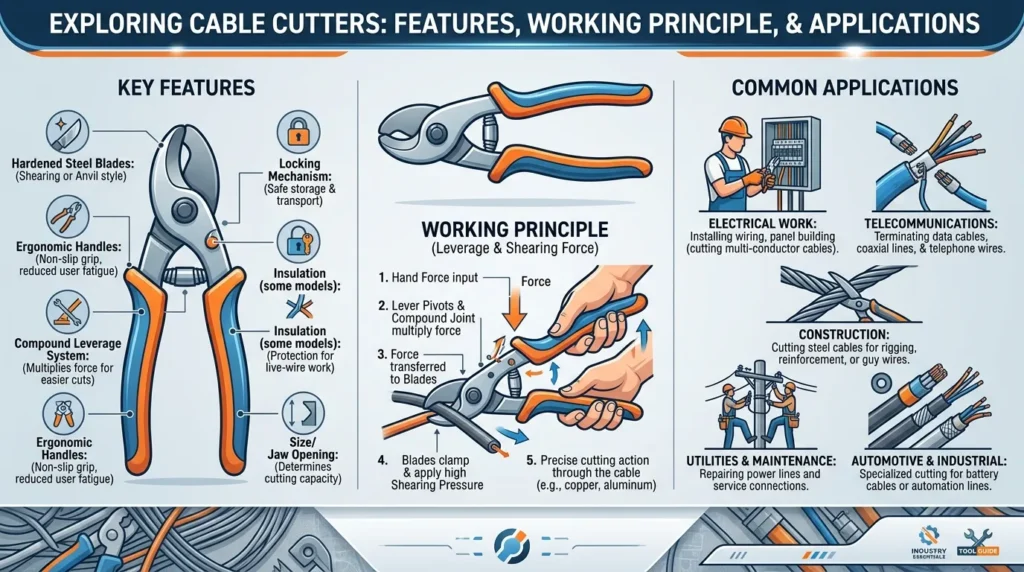
Cable cutters are specialized hand tools designed to cut electrical cables, communication cables, and other types of wire cleanly and efficiently without crushing or deforming the conductor. Unlike ordinary cutting pliers, cable cutters feature curved, precision-ground cutting blades that surround the cable and produce a smooth, even cut with minimal effort. They are commonly used by electricians, telecommunications technicians, utility workers, and maintenance professionals for cutting copper, aluminum, and multi-core cables during installation and repair work. Cable cutters are typically manufactured from hardened high-carbon steel or chrome vanadium steel to provide excellent durability, corrosion resistance, and long service life. Many models include ergonomic, non-slip handles for improved comfort and better control, while heavy-duty versions may feature ratcheting or compound-action mechanisms that make cutting large-diameter cables easier. Their specialized blade design helps preserve the shape of the cable, making it easier to strip insulation and create reliable electrical connections.
The working principle of cable cutters is based on the lever mechanism, which multiplies the force applied to the handles and transfers it to the sharp cutting blades. As the handles are squeezed together, the blades close smoothly around the cable, applying uniform pressure that cuts through the conductor without excessive crushing or fraying. This results in clean, accurate cuts that improve installation quality and reduce material waste. Cable cutters are widely used in residential, commercial, and industrial electrical installations, power distribution systems, telecommunications networks, renewable energy projects, and automotive wiring. They are ideal for cutting insulated electrical cables, battery cables, coaxial cables, and other soft-metal conductors. However, standard cable cutters are not designed for cutting hardened steel wire, steel-reinforced cables, chains, or bolts, as these materials can damage the cutting edges. Regular cleaning, light lubrication, and proper storage help maintain blade sharpness and extend the tool’s service life. With their ability to deliver clean, safe, and efficient cable cutting, cable cutters are an essential tool for professionals and DIY users involved in electrical and cable installation work.
These are used for thick cables.
Features:
- Large jaws
- Strong steel body
- Smooth cutting
Uses:
- Power cables
- Industrial wiring
- Heavy-duty work
Precision Wire Cutters: Features, Working Principle, and Common Applications
Precision wire cutters are specialized hand tools designed for cutting thin wires, electronic component leads, and delicate materials with exceptional accuracy. These cutters are widely used in electronics, electrical assembly, jewelry making, telecommunications, and hobby projects where clean, precise cuts are essential. Unlike standard cutting pliers, precision wire cutters feature small, sharp jaws with finely ground cutting edges that allow users to cut close to components without causing damage. Their compact size and lightweight construction make them ideal for working in confined spaces and handling intricate tasks. Precision wire cutters are commonly manufactured from hardened high-carbon steel or chrome vanadium steel to ensure durability, corrosion resistance, and long-lasting sharpness. Many models include spring-loaded handles that automatically reopen after each cut, reducing hand fatigue and increasing productivity during repetitive work. Ergonomic, non-slip grips further improve comfort and provide better control for detailed cutting operations.
The working principle of precision wire cutters is based on the lever mechanism, where a small amount of force applied to the handles is multiplied and transferred to the sharp cutting edges. This mechanical advantage enables the tool to cut fine copper wires, aluminum wires, electronic component leads, cable ties, and soft metal wires with clean and accurate results. Because the cutting jaws are precisely aligned, they minimize deformation and leave smooth edges that improve the quality of electrical and electronic assemblies. Precision wire cutters are commonly used in printed circuit board (PCB) assembly, electronic repairs, instrument manufacturing, robotics, model building, and laboratory work. They are also valuable for trimming excess wire after soldering and preparing components for installation. However, these cutters are not designed for cutting thick cables, hardened steel wire, nails, or heavy-duty materials, as doing so can damage the delicate cutting edges. Regular cleaning, occasional lubrication, and proper storage help maintain their sharpness and precision, making precision wire cutters an essential tool for technicians, engineers, hobbyists, and anyone performing fine electrical or electronic work.
These are used for small and delicate work.
Features:
- Fine tips
- Lightweight
- High accuracy
Uses:
- PCB work
- Electronics repair
- Robotics projects
5. Main Components of Cutting Plier / Wire Cutter
A cutting plier has simple but strong parts.
1. Handles
- Used for gripping
- Covered with rubber or plastic
- Provide comfort and safety
2. Jaws (Cutting Edges)
- Made of hardened steel
- Perform cutting action
- Must be sharp
3. Pivot Joint
- Connects two halves
- Allows smooth movement
- Transfers force
4. Insulation Coating
- Protects from electric shock
- Improves grip
- Increases safety
5. Spring (Optional)
- Opens jaws automatically
- Reduces hand fatigue
- Improves speed
Each component contributes to performance and safety.
6. Advantages of Cutting Plier / Wire Cutter
Here are the main cutting plier advantages and disadvantages. First, let us see the advantages.
Advantages
- Clean and precise cutting
- Easy to use
- Saves time
- Improves safety
- Reduces wire damage
- Strong and durable
- Portable and lightweight
- Suitable for many tasks
- Low maintenance
Real-World Benefits
In electrical work, clean cuts improve connections. This reduces resistance and heating problems. As a result, systems work better and last longer.
7. Disadvantages / Limitations of Cutting Pliers
Despite many benefits, wire cutters also have limitations.
Disadvantages
- Cannot cut very thick steel
- Jaws can become dull
- Low-quality tools break easily
- Insulated types are expensive
- Wrong use damages edges
- Not suitable for hard metals
Practical Issues
Using a small cutter on thick cable may damage the tool. Also, dull cutters require more force and increase injury risk.
8. Applications of Cutting Pliers
Cutting plier applications are wide in electrical and technical fields.
Home Uses
- Repairing appliances
- Cutting extension wires
- DIY projects
- Cable management
Educational Uses
- Training workshops
- Practical labs
- Student projects
- Circuit building
Industrial Uses
- Machine wiring
- Control panels
- Automation systems
- Maintenance work
Electrical Uses
- Wire trimming
- Cable preparation
- Panel installation
- Fault repair
Modern Technology Uses
- PCB assembly
- Robotics wiring
- Solar systems
- Smart devices
Wire cutters are used everywhere electricity exists.
9. Comparison Section: Cutting Plier vs Wire Stripper vs Scissors
Understanding the difference between cutting plier and wire stripper helps in selecting the right tool.
| Feature | Cutting Plier | Wire Stripper | Scissors |
| Main Function | Cutting wires | Removing insulation | Cutting paper |
| Cutting Power | High | Medium | Low |
| Electrical Use | Yes | Yes | No |
| Safety Level | High (Insulated) | Medium | Low |
| Precision | High | Very High | Low |
| Durability | High | Medium | Low |
Summary
- Cutting pliers are for cutting.
- Wire strippers are for insulation removal.
- Scissors are not suitable for electrical work.
Each tool has its own purpose.
10. Selection Guide: How to Choose the Right Cutting Plier
Choosing the right tool improves work quality and safety.
Step 1: Identify Your Work Type
- Light work → Precision cutter
- General wiring → Diagonal cutter
- Heavy cables → Cable cutter
Step 2: Check Insulation
- For live work → Insulated handles
- For normal work → Standard handles
Step 3: Material Quality
- Choose hardened steel
- Rust-resistant coating
- Strong pivot joint
Step 4: Handle Comfort
- Non-slip grip
- Proper size
- Balanced weight
Tips for Beginners
- Buy medium-size diagonal cutters first
- Avoid very cheap tools
- Test grip comfort
- Keep tool clean
Good selection increases tool life and safety.
11. Common Problems & Solutions (FAQs Style)
Q1: My wire cutter is not cutting properly. Why?
Solution:
- Jaws may be dull
- Clean with cloth
- Sharpen if possible
- Replace if damaged
Q2: Handles feel slippery. What should I do?
Solution:
- Clean handles
- Use grip tape
- Replace worn grips
Q3: Cutter gets stuck. How to fix it?
Solution:
- Apply light oil
- Clean pivot joint
- Remove dust
Q4: Can I cut live wires?
Solution:
- Only with certified insulated cutters
- Turn off power if possible
- Always use safety gloves
Q5: Jaws are misaligned. Is it repairable?
Solution:
- Minor issue → Adjust carefully
- Major issue → Replace tool
These steps solve most common problems.
12. Future Trends in Cutting Pliers
Cutting plier technology is improving with time.
Smart Tool Design
- Built-in wire gauge
- Measurement markings
- Multi-function tools
Advanced Materials
- Stronger alloys
- Corrosion-resistant steel
- Lightweight metals
Ergonomic Improvements
- Better grip design
- Reduced hand fatigue
- Adjustable handles
Safety Development
- Improved insulation
- Higher voltage ratings
- Shock indicators
Industry Direction
Future wire cutters will focus on comfort, safety, and multi-functionality. This will help engineers work faster and safer.
13. Conclusion
Cutting pliers and wire cutters are essential tools in electrical and technical work. From simple home repairs to complex industrial systems, they play a key role in safe and accurate wiring. Understanding the cutting plier working principle, types, components, and uses helps you select the right tool.
We discussed cutting plier applications, cutting plier advantages and disadvantages, and the difference between cutting plier and wire stripper. With proper care and correct usage, a good wire cutter can serve you for many years.
As a junior engineer or technician, always respect your tools. Use the right cutter for the right job, keep it clean, and work safely. Strong basics and good habits will help you grow into a skilled professional.