
Imagine a large thermal power plant producing electricity for thousands of homes. Inside the plant, boilers burn fuel such as coal, gas, or oil to generate steam. This steam drives turbines that produce electricity. During this process, a huge amount of heat escapes with the exhaust gases through the chimney. If this heat is not reused, the plant wastes valuable energy and burns more fuel than necessary.
To solve this problem, engineers use a device called an Air Preheater. This equipment captures heat from hot exhaust gases and uses it to warm the incoming air before it enters the furnace. Preheating the air improves combustion efficiency and reduces fuel consumption.
Air preheaters are widely used in thermal power plants, industrial boilers, furnaces, and large heating systems. They help improve efficiency, reduce operational costs, and make energy systems more sustainable.
For electrical students, engineers, technicians, and beginners, understanding the Air Preheater working principle, types, and Air Preheater applications is very important. In this article, you will learn how air preheaters work, their components, advantages, disadvantages, and their role in modern energy systems.
What is an Air Preheater?
An Air Preheater is a heat exchange device used in boilers and furnaces to preheat combustion air by using the heat from exhaust flue gases.
In simple terms, it transfers heat from hot gases leaving the boiler to the fresh air entering the furnace. This process increases combustion efficiency and reduces fuel consumption.
Simple Explanation
When fuel burns inside a boiler furnace, it produces hot gases. These gases normally leave through the chimney. Instead of wasting this heat, an air preheater captures part of it and transfers it to the air that will be used for combustion.
As a result, the incoming air becomes hot before entering the furnace, which improves the burning process.
Practical Example
In a coal-fired thermal power plant, air required for combustion is supplied by a forced draft fan. Before entering the furnace, this air passes through the air preheater, where it absorbs heat from flue gases. The heated air then enters the furnace and helps the coal burn more efficiently.
Air Preheater Working Principle
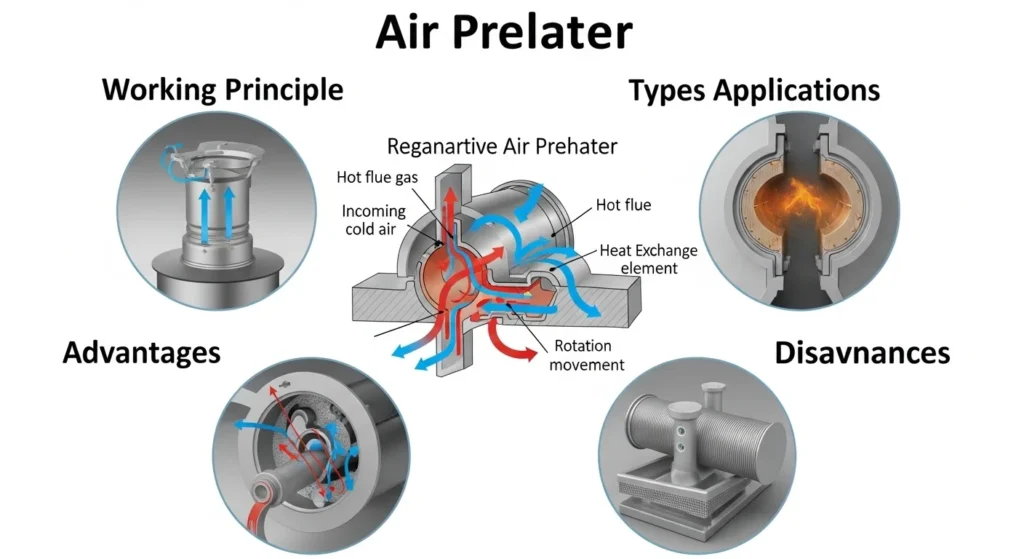
The Air Preheater working principle is based on heat transfer between hot exhaust gases and cold incoming air without mixing the two streams.
How an Air Preheater Works: Step-by-Step Process
An air preheater improves the efficiency of a boiler by recovering heat from hot flue gases and transferring it to the incoming combustion air. This process reduces fuel consumption, increases combustion efficiency, and minimizes heat loss. The working process can be explained in the following steps:
1. Hot Flue Gases Enter the Air Preheater
After fuel burns inside the boiler furnace, the hot flue gases produced during combustion flow toward the air preheater before leaving through the chimney. These gases still contain a significant amount of unused thermal energy, making them an ideal source for heat recovery.
2. Cold Combustion Air Is Supplied
A forced draft (FD) fan draws fresh atmospheric air into the air preheater. At this stage, the incoming air is relatively cool and not yet suitable for efficient combustion inside the furnace.
3. Heat Is Transferred Between the Two Air Streams
Inside the air preheater, the hot flue gases and cold combustion air pass through separate passages without mixing. Heat is transferred through specially designed metal plates, tubes, or rotating heat-transfer elements. This indirect heat exchange allows the incoming air to absorb thermal energy while keeping the gases and air completely separate.
4. Combustion Air Temperature Increases
As the cold air absorbs heat from the flue gases, its temperature rises significantly before entering the boiler furnace. The exact temperature increase depends on the type of air preheater, fuel used, and operating conditions.
5. Preheated Air Supports Efficient Combustion
The heated combustion air enters the furnace, where it mixes with the fuel. Because the air is already warm, the fuel ignites more quickly and burns more completely. This improves combustion efficiency, reduces fuel consumption, increases boiler performance, and lowers harmful emissions.
6. Flue Gases Leave at a Lower Temperature
After transferring much of their heat to the incoming air, the flue gases become cooler. They then pass through the remaining exhaust system and exit via the chimney. Lower exhaust gas temperatures indicate that more heat has been recovered instead of being wasted, improving the overall thermal efficiency of the boiler system.
Simple Analogy
Think of an air preheater like warming your hands near a heater before starting work. The warmer air entering the furnace makes the burning process faster and more efficient.
Types of Air Preheater
Air preheaters are classified based on their design and method of heat transfer.
What Is a Recuperative Air Preheater?
A recuperative air preheater is a type of heat exchanger that recovers waste heat from hot flue gases and transfers it to the incoming combustion air through fixed metal surfaces. In this design, the hot flue gases and cold air flow through separate passages and never mix directly. Heat is conducted through metal tubes or plates, allowing the incoming air to warm up before entering the boiler furnace.
Recuperative air preheaters are widely used in power plants, industrial boilers, steam generation systems, furnaces, and thermal power stations because they improve fuel efficiency and reduce energy losses. By preheating the combustion air, these heat exchangers help fuel burn more completely, increase boiler efficiency, lower fuel consumption, and reduce exhaust gas temperatures.
Depending on the application, a recuperative air preheater may use tubular, plate-type, or finned heat exchanger designs to maximize heat transfer. Their simple construction, reliable operation, and low maintenance requirements make them one of the most commonly used air preheaters in industrial heating systems.
Regenerative Air Preheater
A regenerative air preheater is a highly efficient heat recovery device that transfers heat from hot flue gases to incoming combustion air using a rotating heat storage element. Unlike a recuperative air preheater, which uses fixed heat-transfer surfaces, a regenerative air preheater stores heat in a rotating matrix made of metal plates or corrugated elements. As the matrix rotates, it first absorbs heat from the hot flue gases and then releases that stored heat to the incoming cold air.
This continuous heat storage and transfer process allows regenerative air preheaters to achieve very high thermal efficiency, making them ideal for large thermal power plants, utility boilers, and heavy industrial facilities where maximum energy recovery is essential.
Key Features of a Regenerative Air Preheater
- Uses a rotating heat storage matrix to absorb and transfer heat.
- Provides higher thermal efficiency than many conventional heat exchangers.
- Significantly reduces fuel consumption by recovering waste heat.
- Increases the temperature of combustion air before it enters the furnace.
- Lowers flue gas exhaust temperature, improving overall boiler efficiency.
- Commonly installed in large power plants, coal-fired boilers, and industrial steam generation systems.
- Well-suited for continuous, high-capacity industrial operations.
Tubular Air Preheater
A tubular air preheater is a type of recuperative air preheater that uses a bundle of metal tubes to transfer heat from hot flue gases to incoming combustion air. In this design, the hot flue gases usually flow through the tubes, while the cold combustion air passes around the outside of the tubes. The metal tube walls conduct heat efficiently without allowing the two air streams to mix.
Tubular air preheaters are widely used in industrial boilers, furnaces, steam generators, and thermal power plants because of their simple construction, reliable performance, and long service life. They are especially suitable for applications requiring continuous operation and minimal maintenance.
Key Features of a Tubular Air Preheater
- Uses a bundle of metal tubes as the heat-transfer surface.
- Hot flue gases flow inside the tubes, while combustion air flows around them.
- Prevents direct mixing of flue gases and combustion air.
- Strong, durable, and resistant to high temperatures.
- Offers reliable and consistent heat transfer.
- Requires relatively low maintenance.
- Commonly used in industrial boilers, furnaces, and power generation systems.
Rotary Air Preheater
A rotary air preheater is a type of regenerative air preheater that uses a large rotating heat-transfer element, also called a heat storage matrix, to recover waste heat from flue gases. As the rotor slowly turns, one section absorbs heat from the hot exhaust gases while another section transfers the stored heat to the incoming combustion air. This continuous rotation provides efficient heat recovery and improves the overall thermal efficiency of the boiler.
Because of its compact design and high heat-transfer efficiency, the rotary air preheater is the most commonly used air preheater in large thermal power plants and heavy industrial boiler systems.
Key Features of a Rotary Air Preheater
- Uses a rotating heat-transfer matrix to store and transfer heat.
- Provides excellent heat recovery and high thermal efficiency.
- Compact design saves installation space.
- Continuously transfers heat between flue gases and combustion air.
- Reduces fuel consumption and improves boiler performance.
- Lowers exhaust gas temperature, minimizing energy losses.
- Widely used in large power plants, utility boilers, and industrial steam generation systems.
Main Components of an Air Preheater and Their Functions
An air preheater is made up of several essential components that work together to recover waste heat from hot flue gases and transfer it to the incoming combustion air. Each component plays a specific role in ensuring efficient heat exchange, reliable operation, and long service life. Understanding these parts helps engineers, technicians, and students better understand how an air preheater improves boiler performance and energy efficiency.
Heat Transfer Surface
The heat transfer surface is the most important component of an air preheater because it is where heat exchange takes place. Hot flue gases transfer their thermal energy through metal surfaces to the incoming cold combustion air without the two streams mixing together. The efficiency of an air preheater largely depends on the design, material, and surface area of the heat transfer element.
Common heat transfer materials include:
- Steel plates
- Metal tubes
- Corrugated metal sheets
- Finned tubes
- Heat storage matrix elements (in rotary air preheaters)
A larger heat transfer area generally provides better heat recovery and improved thermal efficiency.
Casing or Housing
The casing, also called the housing, is the outer shell that encloses the entire air preheater. It protects the internal components from environmental conditions while maintaining proper airflow inside the unit. A well-designed casing also minimizes heat loss and ensures that both the flue gases and combustion air follow their intended flow paths.
Functions of the casing include:
- Protecting internal components from damage.
- Supporting the structural framework of the air preheater.
- Preventing unnecessary heat loss.
- Directing the flow of air and flue gases efficiently.
- Improving the overall safety and durability of the system.
Heat Storage Matrix (Rotating Element)
The heat storage matrix, commonly known as the rotating element, is the key component of a regenerative (rotary) air preheater. It consists of specially designed metal plates or corrugated elements mounted inside a slowly rotating rotor.
As the rotor turns, one section absorbs heat from the hot flue gases, while another section releases the stored heat to the incoming combustion air. This continuous cycle allows the air preheater to recover a large amount of waste heat with high efficiency.
Main functions include:
- Absorbing heat from flue gases.
- Storing thermal energy temporarily.
- Transferring heat to incoming combustion air.
- Improving overall heat recovery efficiency.
- Reducing fuel consumption and exhaust heat losses.
Sealing System
The sealing system prevents the unwanted mixing of hot flue gases and fresh combustion air inside the air preheater. Effective seals are particularly important in rotary air preheaters because the rotating element continuously moves between the gas and air sections.
Proper sealing improves thermal efficiency, reduces air leakage, and maintains stable boiler performance.
Functions of seals include:
- Preventing leakage between air and gas streams.
- Maintaining efficient heat transfer.
- Reducing pressure losses.
- Improving overall boiler efficiency.
- Extending equipment life by minimizing wear.
Drive System
The drive system is used primarily in rotary air preheaters to rotate the heat storage matrix at a controlled speed. It usually consists of an electric motor, gearbox, drive shaft, bearings, and control mechanisms.
A properly functioning drive system ensures continuous heat absorption and heat transfer during boiler operation.
Major components include:
- Electric motor
- Gearbox
- Drive shaft
- Bearings
- Speed control mechanism
These components work together to keep the rotor rotating smoothly and efficiently.
Air and Flue Gas Ducts
The air ducts and flue gas ducts provide controlled pathways for the movement of combustion air and exhaust gases through the air preheater. Their design ensures smooth airflow while minimizing pressure losses and maximizing heat transfer.
Properly designed ducts improve the efficiency of the entire boiler system by allowing consistent air and gas distribution.
Functions include:
- Directing fresh combustion air into the air preheater.
- Carrying hot flue gases through the heat exchange section.
- Maintaining smooth and balanced airflow.
- Reducing turbulence and pressure drop.
- Supporting efficient heat recovery.
Support Structure and Frame
The support structure provides mechanical strength and stability to the entire air preheater. It supports the weight of the casing, heat transfer elements, ducts, and rotating components while withstanding high temperatures and vibration during operation.
Its functions include:
- Supporting the complete air preheater assembly.
- Maintaining proper alignment of internal components.
- Reducing vibration during operation.
- Ensuring safe and stable installation.
- Increasing the equipment’s service life.
Inspection and Access Doors
Most industrial air preheaters include inspection doors or maintenance access panels that allow engineers and technicians to inspect, clean, repair, and maintain internal components without dismantling the entire unit.
Benefits include:
- Easy inspection of internal parts.
- Simplified cleaning and maintenance.
- Faster troubleshooting.
- Reduced maintenance downtime.
- Improved operational reliability.
Expansion Joints
Since air preheaters operate at high temperatures, their metal components expand and contract during operation. Expansion joints absorb this thermal movement, preventing excessive stress, cracking, or structural damage.
Functions include:
Improving operational safety.
Accommodating thermal expansion.
Reducing mechanical stress.
Preventing structural damage.
Increasing equipment durability.
Air Preheater Advantages
Understanding the Air Preheater advantages and disadvantages helps engineers decide whether to use this equipment in energy systems.
Advantages
- Improves boiler efficiency
- Reduces fuel consumption
- Recovers waste heat from flue gases
- Improves combustion performance
- Reduces exhaust gas temperature
- Lowers operating costs
- Increases overall thermal efficiency
Real-World Benefits
In large power plants, installing an air preheater can improve efficiency by 5–15%, resulting in major fuel savings.
Air Preheater Disadvantages / Limitations
Although air preheaters are very useful, they also have some limitations.
Limitations
- High initial installation cost
- Requires regular maintenance
- Possible corrosion from acidic flue gases
- Dust accumulation may reduce efficiency
- Air leakage in rotary air preheaters
Proper maintenance is essential to maintain good performance.
Applications of Air Preheaters in Industrial and Power Generation Systems
Air preheaters are widely used in industries that operate boilers, furnaces, kilns, and other high-temperature equipment. Their primary purpose is to recover waste heat from hot flue gases and use it to preheat incoming combustion air. This process improves combustion efficiency, reduces fuel consumption, lowers operating costs, and minimizes heat loss. Because of these benefits, air preheaters have become an essential component in many industrial and power generation applications.
Thermal Power Plants
One of the most common applications of an air preheater is in thermal power plants, especially coal-fired power stations. In these plants, boilers consume large amounts of fuel to generate steam for electricity production. An air preheater captures waste heat from the boiler’s flue gases and transfers it to the incoming combustion air before it enters the furnace.
Using preheated air improves fuel combustion, increases boiler efficiency, reduces exhaust gas temperature, and lowers fuel consumption. It also helps decrease greenhouse gas emissions by making the combustion process more complete and efficient.
Benefits in thermal power plants include:
- Improves overall boiler efficiency.
- Reduces coal or fuel consumption.
- Enhances combustion performance.
- Lowers stack (chimney) gas temperature.
- Increases power plant efficiency.
- Reduces operating costs and emissions.
Industrial Boilers
Air preheaters are extensively used in industrial boilers found in manufacturing plants, food processing facilities, textile mills, chemical industries, paper mills, and other industrial operations. These boilers produce steam or hot water for production processes and heating applications.
By preheating the combustion air, industrial boilers require less fuel to achieve the desired temperature. This not only saves energy but also increases the reliability and productivity of the entire steam generation system.
Applications in industrial boilers include:
- Steam generation systems.
- Process heating equipment.
- Food and beverage industries.
- Textile manufacturing.
- Paper and pulp industries.
- Chemical processing plants.
Advantages include:
- Lower fuel costs.
- Higher combustion efficiency.
- Reduced maintenance requirements.
- Improved boiler performance.
- Longer equipment lifespan.
Cement Industry
The cement industry operates large rotary kilns that require extremely high temperatures for clinker production. Air preheaters play a crucial role in improving kiln efficiency by recovering heat from exhaust gases and transferring it to the combustion air.
Preheated combustion air allows the fuel to burn more efficiently, reducing energy consumption while maintaining the high temperatures needed during cement manufacturing.
Benefits in cement plants include:
- Improves kiln thermal efficiency.
- Reduces fuel consumption.
- Increases clinker production efficiency.
- Lowers exhaust heat losses.
- Reduces overall production costs.
- Supports environmentally friendly operations.
Steel Industry
The steel industry relies heavily on high-temperature furnaces for melting, reheating, and heat treatment processes. Air preheaters help recover valuable waste heat from furnace exhaust gases and use it to warm the incoming combustion air.
This improves fuel utilization, maintains stable furnace temperatures, and reduces energy costs during steel production.
Common steel industry applications include:
- Reheating furnaces.
- Blast furnaces.
- Coke ovens.
- Heat treatment furnaces.
- Rolling mills.
Key benefits include:
- Higher furnace efficiency.
- Faster heating processes.
- Lower fuel consumption.
- Improved production capacity.
- Reduced operational expenses.
Waste Heat Recovery Systems
One of the most important applications of air preheaters is in waste heat recovery systems. Many industrial processes release large amounts of heat through exhaust gases. Instead of allowing this valuable energy to escape into the atmosphere, air preheaters recover it and transfer it to incoming combustion air.
This recovered energy significantly improves the overall thermal efficiency of industrial plants while reducing fuel requirements and carbon emissions.
Waste heat recovery systems are commonly used in:
- Thermal power plants.
- Industrial boilers.
- Cement manufacturing.
- Steel production.
- Glass manufacturing.
- Petrochemical plants.
- Oil refineries.
Advantages include:
- Maximizes energy recovery.
- Improves plant efficiency.
- Reduces fuel consumption.
- Lowers greenhouse gas emissions.
- Minimizes energy waste.
- Reduces operating costs.
Chemical and Petrochemical Industries
Chemical processing plants and petrochemical refineries use boilers, process heaters, and fired furnaces that require large amounts of combustion air. Air preheaters improve the efficiency of these systems by utilizing waste heat that would otherwise be lost.
This results in lower fuel costs, better process control, and improved energy efficiency throughout the plant.
Applications include:
- Process heaters.
- Fired heaters.
- Steam boilers.
- Refinery furnaces.
- Petrochemical processing units.
Oil Refineries
Oil refineries use numerous heating systems to process crude oil into valuable petroleum products. Air preheaters help recover waste heat from refinery furnaces and improve combustion efficiency.
Benefits include:
- Improved fuel economy.
- Stable furnace operation.
- Lower operating costs.
- Increased refinery efficiency.
- Reduced emissions.
Glass Manufacturing Industry
Glass production requires furnaces operating at extremely high temperatures. Air preheaters recover waste heat from furnace exhaust gases and use it to preheat combustion air, reducing fuel usage while maintaining consistent melting temperatures.
Advantages include:
- Higher furnace efficiency.
- Lower natural gas consumption.
- Improved product quality.
- Reduced production costs.
- Better energy utilization.
Pulp and Paper Industry
Paper mills use steam boilers extensively for paper production. Air preheaters improve boiler performance by increasing combustion efficiency and reducing energy losses.
Their use helps manufacturers lower fuel expenses while ensuring a continuous steam supply for industrial operations.
Food Processing Industry
Many food processing facilities use steam boilers for cooking, sterilization, drying, and cleaning processes. Installing air preheaters reduces fuel consumption and improves boiler efficiency, helping companies lower production costs without compromising product quality.
District Heating Systems
Large district heating plants use air preheaters to improve the efficiency of boilers supplying hot water or steam to residential and commercial buildings. By recovering waste heat, these systems deliver reliable heating while consuming less fuel and reducing environmental impact.
Comparison: Air Preheater vs Economizer
Understanding the difference between air preheater and economizer is important in boiler systems.
| Feature | Air Preheater | Economizer |
|---|---|---|
| Function | Heats combustion air | Heats feedwater |
| Heat Source | Flue gases | Flue gases |
| Purpose | Improve combustion | Improve boiler efficiency |
| Working Medium | Air | Water |
| Location | Before furnace | Before boiler |
Key Difference
The main difference between air preheater and economizer is that an air preheater heats incoming air while an economizer heats the boiler feedwater.
How to Select the Right Air Preheater: A Complete Buying and Selection Guide
Selecting the right air preheater is essential for achieving maximum boiler efficiency, reducing fuel consumption, and ensuring reliable long-term operation. The ideal air preheater depends on several technical and operational factors, including the type of boiler, fuel, operating conditions, available installation space, and maintenance requirements. Choosing the wrong type can lead to reduced heat recovery, higher operating costs, and increased maintenance.
Below are the most important factors to consider when selecting an air preheater.
1. Boiler Capacity
The size and capacity of the boiler determine the required size of the air preheater. Large utility boilers require high-capacity regenerative or rotary air preheaters, while smaller industrial boilers often use tubular or plate-type recuperative air preheaters.
Consider:
- Steam production capacity
- Flue gas flow rate
- Combustion air requirement
- Heat recovery capacity
Selecting an air preheater that matches the boiler capacity ensures efficient operation and optimal heat transfer.
2. Type of Fuel
Different fuels produce different flue gas temperatures, ash content, and corrosive compounds. The selected air preheater must be suitable for the specific fuel being burned.
Common fuel types include:
- Coal
- Natural gas
- Diesel fuel
- Heavy fuel oil
- Biomass
- Waste-derived fuels
For example, coal-fired boilers often require robust rotary air preheaters that can handle ash deposits, while natural gas systems generally experience less fouling and corrosion.
3. Operating Temperature
Operating temperature has a major impact on material selection and heat exchanger design. Air preheaters used in high-temperature applications require heat-resistant alloys capable of withstanding continuous thermal stress.
Key temperature considerations include:
- Flue gas inlet temperature
- Air outlet temperature
- Maximum operating temperature
- Thermal expansion requirements
Proper temperature selection improves durability and prevents premature equipment failure.
4. Heat Recovery Efficiency
One of the primary goals of an air preheater is to recover as much waste heat as possible. A high-efficiency air preheater reduces fuel consumption while increasing the overall thermal efficiency of the boiler.
Look for equipment that provides:
- High heat transfer efficiency
- Low pressure drop
- Maximum waste heat recovery
- Stable long-term performance
5. Maintenance Requirements
Industrial equipment should be easy to inspect, clean, and maintain. Choosing an air preheater with accessible components reduces maintenance costs and minimizes downtime.
Consider whether the design offers:
- Easy cleaning access
- Replaceable heat transfer elements
- Simple inspection procedures
- Low maintenance requirements
- Easy availability of spare parts
6. Available Installation Space
Some industrial plants have limited installation space. Compact air preheater designs are often preferred where space is restricted.
Before selecting an air preheater, evaluate:
- Available floor space
- Height limitations
- Duct arrangement
- Accessibility for maintenance
Proper planning helps avoid installation problems later.
7. Material Selection
The construction material significantly affects equipment life and corrosion resistance.
Common materials include:
- Carbon steel
- Stainless steel
- Alloy steel
- Heat-resistant steel
- Corrosion-resistant coatings
The correct material depends on operating temperature, fuel type, and flue gas composition.
Tips for Beginners
If you are selecting an air preheater for the first time, follow these practical recommendations:
- Select corrosion-resistant materials for longer service life.
- Choose a design that provides high heat recovery efficiency.
- Ensure proper sealing to minimize air leakage.
- Consider future maintenance costs before purchasing.
- Verify compatibility with the boiler and fuel type.
- Choose equipment from reputable manufacturers.
- Ensure sufficient access for cleaning and inspection.
- Compare efficiency, durability, and operating costs—not just the purchase price.
Following these guidelines will help maximize performance while reducing long-term operating expenses.
Common Air Preheater Problems and Their Solutions
Like any industrial heat exchanger, an air preheater may experience performance issues over time. Understanding the common problems, their causes, and recommended solutions helps maintain efficient and reliable operation.
1. Loss of Heat Transfer Efficiency
Problem
The air preheater does not transfer enough heat to the incoming combustion air.
Common Causes
- Dust accumulation
- Fly ash deposits
- Soot buildup
- Fouled heat transfer surfaces
- Poor maintenance
Solution
- Clean heat transfer surfaces regularly.
- Use soot blowers where applicable.
- Follow the manufacturer’s maintenance schedule.
- Inspect internal components during planned shutdowns.
Regular cleaning restores heat transfer efficiency and reduces fuel consumption.
2. Air Leakage
Problem
Fresh combustion air mixes with flue gases, reducing boiler efficiency.
Common Causes
- Damaged seals
- Worn rotating seals
- Improper installation
- Aging equipment
- Loose mechanical components
Solution
- Inspect seals periodically.
- Replace worn sealing elements.
- Adjust sealing clearances.
- Perform leakage tests during maintenance.
Proper sealing improves both efficiency and boiler performance.
3. Corrosion of Internal Components
Problem
Metal components begin to rust or corrode, reducing equipment life.
Common Causes
- Sulfur compounds in flue gases
- Acid condensation
- Moisture accumulation
- Low flue gas temperatures
Solution
- Use corrosion-resistant materials.
- Maintain proper operating temperatures.
- Prevent acid dew point corrosion.
- Apply protective coatings where necessary.
Preventing corrosion significantly extends equipment lifespan.
4. Reduced Air Outlet Temperature
Problem
The combustion air leaves the air preheater at a lower-than-expected temperature.
Common Causes
- Dirty heat transfer surfaces
- Heat transfer element damage
- Air leakage
- Reduced flue gas temperature
Solution
- Clean the heat exchanger thoroughly.
- Repair or replace damaged heat transfer elements.
- Check for leakage.
- Verify boiler operating conditions.
Maintaining clean heat transfer surfaces ensures consistent heating performance.
5. High Pressure Drop
Problem
The air or flue gas experiences excessive resistance while passing through the air preheater.
Common Causes
- Blocked passages
- Heavy ash deposits
- Damaged internal components
Solution
- Remove accumulated debris.
- Clean internal passages.
- Inspect for damaged components.
- Replace blocked heat transfer elements if necessary.
Reducing pressure drop improves airflow and lowers fan power consumption.
Future Trends in Air Preheater Technology
As industries continue to focus on energy efficiency, sustainability, and lower carbon emissions, air preheater technology is evolving rapidly. Modern engineering innovations are making these heat recovery systems more efficient, durable, and intelligent than ever before.
Advanced Heat-Resistant Materials
Researchers are developing stronger alloys and corrosion-resistant materials capable of operating at higher temperatures while resisting wear, oxidation, and acid corrosion.
Future materials will provide:
- Longer service life
- Higher heat transfer efficiency
- Better corrosion resistance
- Lower maintenance costs
Smart Monitoring and Digital Automation
Modern air preheaters increasingly incorporate smart sensors, Industrial Internet of Things (IIoT) technology, and automated monitoring systems. These systems continuously monitor operating conditions and alert operators before problems become serious.
Advanced monitoring systems can measure:
- Air temperature
- Flue gas temperature
- Pressure drop
- Heat transfer efficiency
- Rotor speed (rotary air preheaters)
- Air leakage
- Equipment vibration
Predictive maintenance helps reduce unexpected shutdowns and maintenance costs.
Improved Heat Recovery Designs
Manufacturers continue to develop innovative heat exchanger designs that maximize energy recovery while minimizing pressure loss.
Modern improvements include:
- Larger heat transfer surfaces
- Optimized airflow patterns
- Improved sealing technology
- Compact modular construction
- Enhanced rotary heat storage elements
These innovations increase thermal efficiency while reducing energy waste.
Integration with Energy-Efficient Industrial Systems
Future industrial facilities will place even greater emphasis on waste heat recovery and sustainable energy management. Air preheaters will become increasingly integrated with:
- High-efficiency boilers
- Combined heat and power (CHP) systems
- Waste heat recovery units
- Renewable energy plants
- Biomass combustion systems
- Smart industrial energy networks
This integration will improve overall plant efficiency while reducing greenhouse gas emissions.
Artificial Intelligence and Predictive Maintenance
Artificial Intelligence (AI) and machine learning are beginning to transform industrial maintenance. Future air preheaters will use AI to analyze operating data, detect early signs of equipment wear, and recommend maintenance before failures occur.
Potential benefits include:
- Reduced maintenance costs
- Improved equipment reliability
- Increased operating efficiency
- Longer equipment lifespan
- Better energy management
As digital technologies continue to evolve, AI-powered monitoring systems are expected to become a standard feature in modern air preheater installations.
Conclusion
An Air Preheater is an important heat recovery device used in boilers and furnaces to improve energy efficiency. It captures heat from exhaust gases and uses it to warm the air entering the combustion chamber. This process improves combustion, reduces fuel consumption, and increases overall system efficiency.
Understanding the Air Preheater working principle, components, and Air Preheater applications is essential for electrical and mechanical engineering students as well as technicians working in industrial environments.
Although air preheaters require maintenance and have some limitations, their advantages make them an essential part of modern power plants and industrial boilers. With advancements in materials, automation, and energy efficiency technologies, air preheaters will continue to play a key role in future energy systems.