
Imagine you are at home and you plug a mobile charger into a socket. Your phone starts charging smoothly. But one day, the charger becomes hot, charging is slow, or it stops working completely. You may wonder: What went wrong? Is the electricity weak? Is the wire damaged? Or is there a problem inside the charger?
The answer to these questions is connected to three basic electrical concepts: Voltage, Current, and Resistance.
These three terms are the foundation of all electrical and electronic systems. Every machine, device, and power system works based on their relationship. Without understanding them, it is very difficult to design circuits, repair faults, or work safely.
For students, technicians, engineers, and beginners, learning these concepts is the first step in electrical education. They help you understand how electricity flows, how much power is used, and why some devices fail.
In this article, you will learn what voltage, current, and resistance are, their working principle, types, components, advantages, applications, and future trends in simple and clear language.
2. What is Voltage, Current, and Resistance?
Definition
- Voltage (V): It is the difference in electrical potential energy per unit charge between two points (e.g., positive and negative terminals).
unit. (V) - Current (I): It is the flow of charge, specifically electrons in metal wires or ions in electrolytes. unit . Ampere (A)
Resistance (R): Resistance is the opposition to the flow of electric current within a conductor, acting as a measure of how difficult it is for electrons to move through a material.
The SI unit is the Ohm current
These three are connected by Ohm’s Law:
V = I × R
Simple Explanation
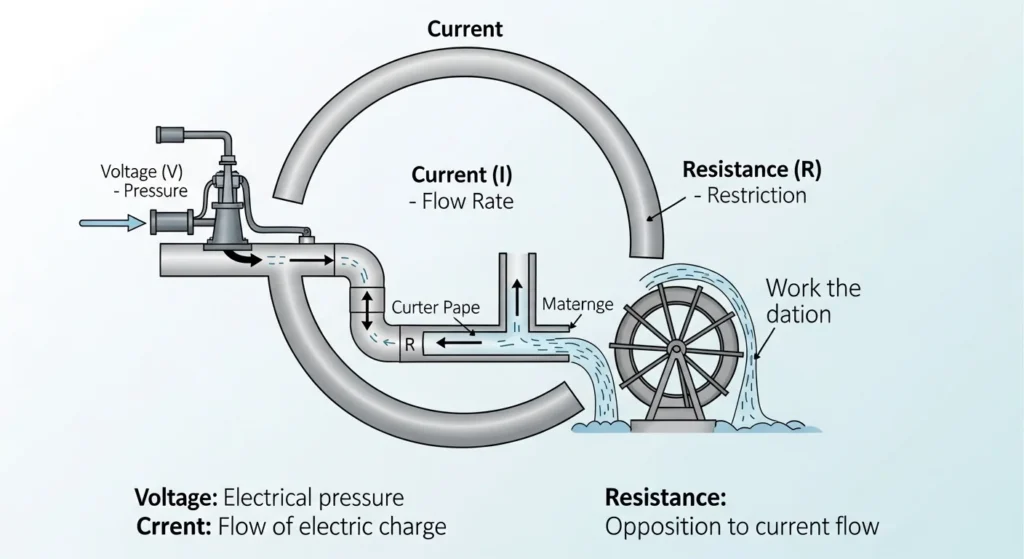
Think of electricity like water in pipes:
- Voltage = If a battery is 12V, it provides 12 volts of pressure to push current through the circuit.
- Current = If a bulb uses 2 Amperes, it means 2 Amperes of electric charge are flowing every second.
- Resistance = Higher resistance means less current will flow.
High current gives more flow.
Small current reduces flow.
This is how voltage, current, and resistance work together.
Practical Example
Suppose:
- Voltage = 12V
- Resistance = 6Ω
Using Ohm’s Law:
I = V / R = 12 / 6 = 2A
So, current is 2 amperes.
This shows how these values are connected in real circuits.
3. Working Principle
Step-by-Step Explanation
- Power source creates voltage.
- Voltage pushes electrons.
- Electrons move through wires.
- Resistance controls movement.
- Current flows in a closed circuit.
- Load uses electrical energy.
Easy Analogy
Imagine a water tank:
- Tank height = Voltage
- Water flow = Current
- Narrow pipe = Resistance
Higher tank → More pressure
Smaller pipe → Less flow
Key Points (Bullet Form)
- Voltage starts the flow
- Resistance controls speed
- Current is the result
- All three work together
- Circuit must be closed
This explains the topic working principle clearly.
4. Types / Classification
Voltage, current, and resistance have different types based on usage.
Types of Voltage
1. DC Voltage
- Flows in one direction
- Used in batteries and electronics
Example: Mobile battery (5V)
2. AC Voltage
- Changes direction
- Used in homes and industries
Example: Wall socket (220V)
Types of Current
1. Direct Current (DC)
- One-direction flow
- Stable
Used in electronics
2. Alternating Current (AC)
- Changes direction
- High efficiency
Used in power systems
Types of Resistance
1. Fixed Resistance
- Constant value
- Used in circuits
Example: Carbon resistor
2. Variable Resistance
- Adjustable value
- Used for control
Example: Volume knob
3. Non-Linear Resistance
- Value changes with voltage
- Used in electronics
Example: Diode
5. Main Components
1. Voltage Source
Provides electrical energy.
Examples:
- Battery
- Generator
- Power supply
2. Conductor
Carries current.
Examples:
- Copper wire
- Aluminum cable
3. Resistor
Controls current.
Examples:
- Fixed resistor
- Rheostat
4. Load
Uses electricity.
Examples:
- Bulb
- Fan
- Heater
5. Switch
Controls flow.
Example:
- ON/OFF switch
6. Measuring Instruments
Measure values.
Examples:
- Voltmeter
- Ammeter
- Multimeter
These components make electrical systems functional.
6. Advantages
Main Advantages
- Easy to understand system
- Helps in circuit design
- Improves safety
- Saves energy
- Prevents equipment damage
Real-World Benefits
- Proper wire selection
- Correct device rating
- Reduced faults
- Better performance
- Longer equipment life
These explain voltage, current, and resistance advantages and disadvantages.
7. Disadvantages / Limitations
Main Limitations
- Not accurate in non-linear circuits
- Affected by temperature
- Limited in complex systems
- Needs proper instruments
- Errors due to poor wiring
Practical Problems
- Heat losses
- Voltage drops
- Overcurrent damage
- Insulation failure
These are common limitations in real systems.
8. Applications
Home Applications
- Lighting systems
- Fans and appliances
- Chargers
- Extension boards
Industrial Applications
- Motors
- Control panels
- Power distribution
- Automation
Electronic Applications
- Mobile phones
- Computers
- Sensors
- Circuit boards
Renewable Energy
- Solar systems
- Wind generators
- Battery banks
Modern Technology Uses
- Electric vehicles
- Smart homes
- Data centers
- Robotics
These show wide topic applications.
9. Comparison Section: Voltage vs Current vs Resistance
Comparison Table
| Feature | Voltage (V) | Current (I) | Resistance (R) |
| Meaning | Electrical pressure | Flow of electrons | Opposition to flow |
| Unit | Volt (V) | Ampere (A) | Ohm (Ω) |
| Function | Pushes electrons | Transfers energy | Controls current |
| Role | Source force | Result | Control element |
| Dependency | Depends on I & R | Depends on V & R | Depends on V & I |
Explanation
Voltage pushes, current flows, and resistance controls.
All three are equally important.
This shows the difference between voltage, current, and resistance.
10. Selection Guide for Beginners
How to Choose Correct Values
Step 1: Know Your Device
Check voltage and current rating.
Step 2: Use Ohm’s Law
V = I × R
Step 3: Select Components
Choose proper wire and resistor.
Step 4: Check Safety Margin
Keep 20% extra rating.
Tips for Beginners
- Use multimeter regularly
- Avoid overloading
- Follow ratings
- Keep connections tight
- Practice calculations
11. Common Problems & Solutions (FAQs)
Q1: Why does my wire get hot?
Solution:
Current is too high. Use thicker wire.
Q2: Why is voltage low?
Solution:
Long cables or poor joints. Improve wiring.
Q3: Why does fuse blow?
Solution:
Overcurrent. Reduce load.
Q4: Why device is slow?
Solution:
Low voltage. Check supply.
Q5: Why resistance changes?
Solution:
Temperature effect. Use quality resistors.
12. Future Trends
New Technology
- Smart sensors
- Digital power meters
- AI-based monitoring
- Automatic protection
- Wireless measurement
Industry Direction
Future systems will be:
- Energy efficient
- Self-monitoring
- Environment-friendly
- Highly reliable
- Intelligent
Voltage, current, and resistance will remain the foundation.
13. Conclusion
Voltage, current, and resistance are the building blocks of electrical engineering. They explain how electricity is produced, controlled, and used in every system. In this article, we discussed their definition, working principle, types, components, advantages, disadvantages, applications, comparison, selection guide, common problems, and future trends.
For beginners and students, mastering these concepts is essential for safe and successful electrical work. They help in designing circuits, solving faults, and improving system efficiency. Without this knowledge, advanced electrical topics become very difficult.
As a senior engineer would advise: always respect voltage limits, control current properly, and manage resistance wisely. With strong basics, you can grow confidently in the electrical field.