
Imagine running a large industrial motor in a factory. The motor is working, but your electricity bill is surprisingly high even though the machine is not producing more useful output. You may wonder why this happens.
The answer is often related to reactive power. Reactive power plays a very important role in AC electrical systems. It is not useful work power, but it is necessary for the operation of magnetic devices like motors and transformers.
Understanding what is reactive power is essential for electrical students, engineers, and technicians working in power systems. Reactive power affects power factor, system efficiency, voltage stability, and transmission losses.
In this article, you will learn reactive power definition, reactive power working principle, types of reactive power, applications, advantages and disadvantages, and practical engineering examples.
Think of this as a practical guide from real electrical engineering experience.
What is Reactive Power?
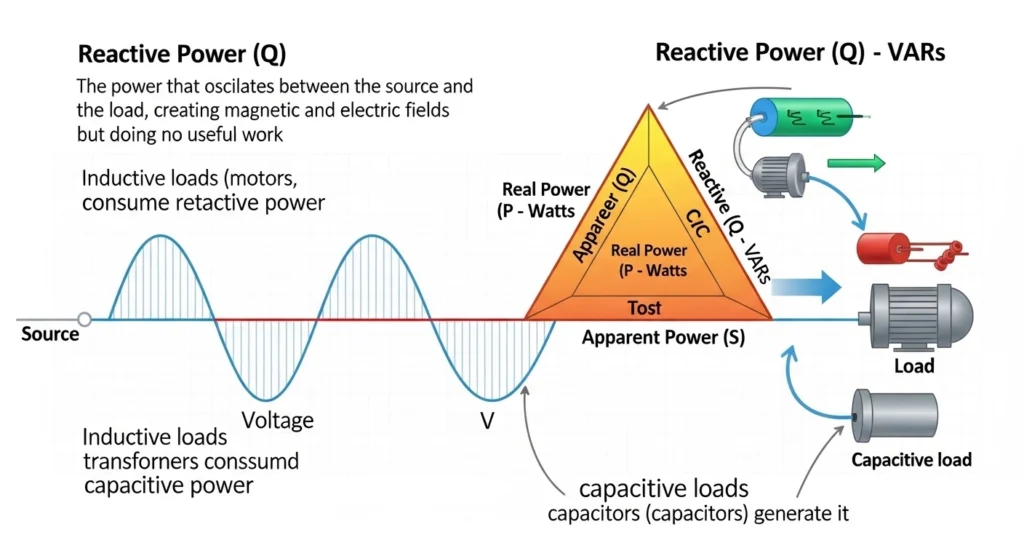
Reactive power is the power that flows back and forth between source and load without performing useful work.
Simple Definition
Reactive power is the power required to create and maintain magnetic and electric fields in AC electrical systems.
Easy Explanation
In AC circuits:
- Active power (kW) → Performs useful work
- Reactive power (kVAR) → Supports field formation
- Apparent power (kVA) → Total system power
Reactive power does not produce mechanical work but is necessary for system operation.
Practical Example
Induction motors require reactive power to create rotating magnetic fields. Without reactive power, motors cannot start or operate properly.
Reactive Power Working Principle
Reactive power working principle is based on energy storage and release.
Let’s understand step-by-step.
Step 1: Voltage and Current Phase Difference
- In inductive loads, current lags behind voltage.
- In capacitive loads, current leads voltage.
Step 2: Energy Storage
- Inductors store energy in magnetic fields.
- Capacitors store energy in electric fields.
Step 3: Back-and-Forth Energy Flow
- Energy is not consumed permanently.
- It moves between source and load.
Simple Analogy
Think of reactive power like a person pushing a swing:
- Energy is supplied continuously.
- But the swing does not move forward permanently.
That is reactive power working principle in simple words.
Types / Classification of Reactive Power
Reactive power is mainly classified into two types.
Inductive Reactive Power
- Produced by inductive loads.
Examples:
- Motors
- Transformers
- Inductors
Characteristics:
- Current lags voltage
- Causes low power factor
Capacitive Reactive Power
- Produced by capacitive loads.
Examples:
- Capacitor banks
- Power factor correction devices
Characteristics:
- Current leads voltage
- Improves power factor
Understanding difference between inductive and capacitive reactive power is important.
Main Components Related to Reactive Power
Inductors
- Store energy in magnetic fields
- Increase reactive power demand
Capacitors
- Supply reactive power locally
- Improve power factor
Transformers
- Consume reactive power
- Important in transmission systems
Transmission Lines
- Line capacitance and inductance affect reactive power flow.
Advantages of Reactive Power
Let us discuss reactive power advantages and disadvantages.
Advantages
- Supports magnetic field creation
- Maintains voltage stability
- Improves system performance
- Essential for motor operation
- Helps grid operation
- Enables AC power transmission
Real-world benefit: Without reactive power, industrial machines cannot operate efficiently.
Disadvantages / Limitations
- Increases current flow in system
- Causes transmission losses
- Reduces system efficiency if uncontrolled
- Increases electricity cost
- Produces heating in cables and transformers
Engineers must control reactive power carefully.
Reactive Power Applications
Reactive power applications are very important in power systems.
Industrial Applications
- Motor control systems
- Manufacturing plants
- Heavy machinery operation
Power System Applications
- Voltage regulation
- Grid stability
- Transmission efficiency
Commercial Applications
- Office buildings
- Hospitals
- Data centers
Modern Technology
- Smart grid systems
- Renewable energy integration
- Electric vehicle charging infrastructure
Comparison Section
Difference Between Active Power and Reactive Power
| Feature | Active Power (kW) | Reactive Power (kVAR) |
| Work Done | Yes | No |
| Energy Type | Real energy | Stored energy |
| Measurement Unit | Watt | VAR |
| Purpose | Useful output | Field support |
| Loss Contribution | Low | Can increase losses |
This table helps understand difference between active and reactive power.
Selection Guide
When managing reactive power:
- Measure load power factor
- Install capacitor banks if PF is low
- Avoid overcompensation
- Monitor harmonic distortion
- Use automatic correction systems
Beginner Tips
- Maintain power factor above 0.9
- Use APFC panels in industries
- Regularly check capacitor health
Common Problems & Solutions
Why is reactive power high in industries?
Cause:
- Large motor loads
- Inductive equipment
Solution:
- Install capacitor bank
Why does voltage fluctuate?
Cause:
- Poor reactive power management
Solution:
- Use voltage regulators
Why does capacitor fail?
Cause:
- Overvoltage
- Harmonics
- Temperature rise
Solution:
- Use harmonic filters
Future Trends
Reactive power management technology is improving.
Smart Reactive Power Control
- AI-based power factor management
- Real-time monitoring
Renewable Energy Systems
- Solar and wind systems need reactive power control.
Advanced Grid Technology
- Flexible AC Transmission Systems (FACTS)
- Dynamic reactive compensation
Future electrical networks will be more intelligent and efficient.
Conclusion
Reactive power is a fundamental concept in AC power systems. It supports magnetic and electric field formation but does not perform useful mechanical work. Understanding what is reactive power is essential for improving power factor, reducing losses, and maintaining system stability.
We discussed reactive power working principle, types of reactive power, applications, and advantages and disadvantages. Proper reactive power management improves electrical system efficiency and reduces operational cost.
As a junior engineer, always monitor load type, power factor, and harmonic effects. Strong knowledge of reactive power helps in designing modern power systems.
Keep learning and practicing real-world power engineering concepts.