
Imagine waking up early in the morning. You switch on the light, turn on the fan, charge your mobile phone, and make tea using an electric kettle. All these simple actions depend on one invisible power: electricity. Without electricity, modern life would stop. Homes would be dark, industries would close, and communication systems would fail.
Many beginners use electrical devices daily but do not understand how electricity works. This lack of basic knowledge can lead to unsafe practices, wrong connections, and equipment damage. For students, technicians, and engineers, learning the basics of electricity is the first step toward professional success.
This article, “What is Electricity? Basic Guide for Beginners,” will help you understand electricity in simple language. You will learn its definition, working principle, types, components, advantages, disadvantages, and applications. You will also discover practical tips, common problems, and future trends. By the end, you will have strong fundamental knowledge to build your electrical skills.
2. What is Electricity? Basic Guide for Beginners
Definition of Electricity
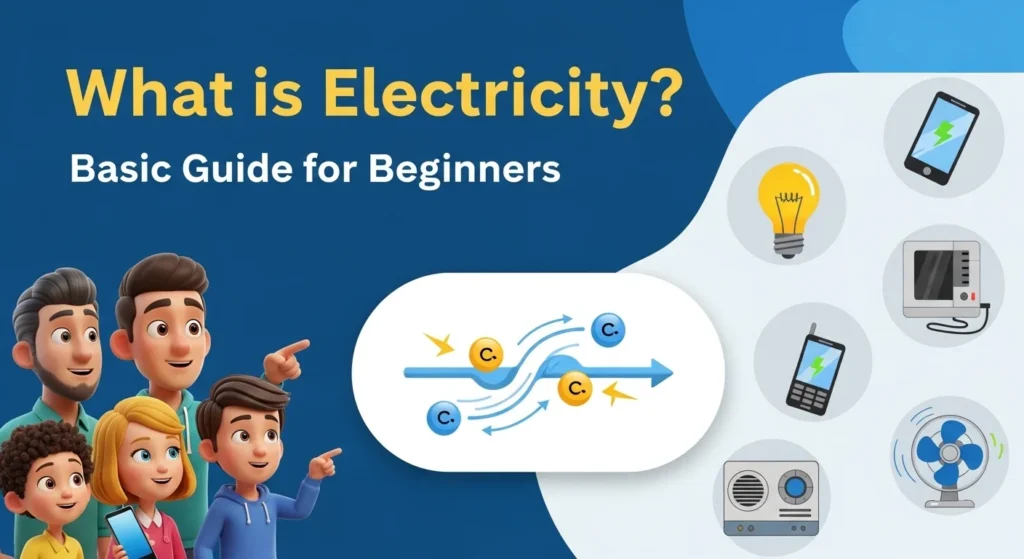
Electricity is a form of energy created by the movement of electric charges, mainly electrons, through a conductor such as a wire.
In simple words, electricity is the flow of tiny particles called electrons inside materials.
Simple Explanation
Every object is made of atoms. Inside atoms, there are electrons that can move. When these electrons move in one direction through a wire, electricity is produced.
Think of electricity like water flowing in a pipe.
- Water = Electrons
- Pipe = Wire
- Flow = Electric Current
When the flow starts, electrical energy becomes available.
Practical Example
When you plug your mobile charger into a socket, electrons start moving from the power station to your phone. This movement charges your battery. That is electricity in action.
3. Working Principle of Electricity
Step-by-Step Explanation
The electricity working principle is based on electron movement. Here is how it works:
- A power source creates pressure (voltage).
- This pressure pushes electrons.
- Electrons move through a wire.
- Devices use this energy.
- The circuit completes and returns.
Easy Analogy
Imagine a water tank connected to a pipe and a tap:
- Water tank = Power source
- Pressure = Voltage
- Pipe = Wire
- Flow = Current
- Tap = Electrical device
When you open the tap, water flows. Similarly, when you switch on, current flows.
Key Points (Bullet Format)
- Electricity needs a closed circuit.
- Voltage pushes electrons.
- Current is the flow of electrons.
- Resistance controls the flow.
- Energy is delivered to devices.
This process explains the electricity working principle.
4. Types / Classification of Electricity
Electricity is mainly classified into two types:
Static Electricity
Static electricity is electricity at rest.
Features:
- Charges do not move continuously.
- Stored on surfaces.
- Released suddenly.
Example:
When you rub a balloon on your hair and it sticks to the wall, that is static electricity.
Current Electricity
Current electricity is electricity in motion.
Features:
- Charges flow continuously.
- Used in homes and industries.
- Runs devices.
Example:
Power supply in houses is current electricity.
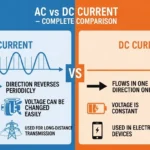
AC Electricity (Alternating Current)
AC changes direction again and again.
Features:
- Used in homes.
- Travels long distances easily.
- Efficient for power distribution.
Example:
Electricity from wall sockets.
DC Electricity (Direct Current)
DC flows in one direction only.
Features:
- Used in batteries.
- Stable output.
- Used in electronics.
Example:
Mobile batteries.
5. Main Components of Electrical System
Electricity systems work with important components:
1. Power Source
Provides electrical energy.
Examples:
- Power station
- Battery
- Solar panel
2. Conductors
Allow electricity to flow.
Examples:
- Copper wire
- Aluminum wire
3. Insulators
Stop electricity flow.
Examples:
- Plastic
- Rubber
- Glass
4. Load (Device)
Uses electrical energy.
Examples:
- Bulb
- Fan
- Motor
5. Switch
Controls the flow.
Function:
- ON/OFF control
6. Protection Devices
Protect system from damage.
Examples:
- Fuse
- MCB
- RCCB
Each part has a special function in electrical systems.
6. Advantages of Electricity
Electricity has many benefits in daily life.
Key Advantages (Bullet Points)
- Easy to use and control
- Clean energy at user end
- Fast transmission
- High efficiency
- Supports modern technology
- Improves living standards
- Saves time and labor
- Enables automation
Real-World Benefits
- Hospitals use electricity for life-saving machines.
- Industries use it for production.
- Homes use it for comfort.
These points show electricity advantages and disadvantages clearly.
7. Disadvantages / Limitations of Electricity
Although useful, electricity has some limitations.
Main Disadvantages
- Electric shock risk
- Fire hazards
- Power failure problems
- Expensive setup
- Needs skilled handling
- Environmental impact (generation)
Practical Concerns
Improper wiring can cause accidents. Poor maintenance can damage equipment. That is why safety is very important.
8. Applications of Electricity
Electricity applications cover almost every field.
Home Applications
- Lighting
- Fans
- Refrigerators
- Washing machines
- TVs
- Charging devices
Industrial Applications
- Motors
- Welding machines
- CNC machines
- Automation systems
- Compressors
Commercial Uses
- Offices
- Banks
- Shopping malls
- Data centers
Modern Technology Uses
- Smartphones
- Computers
- Internet systems
- Electric vehicles
- Robotics
These examples show wide electricity applications.
9. Comparison Section: AC vs DC Electricity
Understanding the difference between AC and DC is important.
Comparison Table
| Feature | AC (Alternating Current) | DC (Direct Current) |
| Direction | Changes repeatedly | One direction |
| Source | Power stations | Batteries |
| Distance | Long distance | Short distance |
| Usage | Homes, industries | Electronics |
| Cost | Low transmission cost | Higher cost |
Explanation
AC is better for power distribution. DC is better for electronic devices. This explains the difference between AC and DC.
10. Selection Guide for Beginners
Choosing the right electrical system is important.
How to Choose
For Home Use:
- Use AC supply
- Install safety devices
- Use standard wiring
For Electronics:
- Use DC supply
- Use regulated adapters
- Check voltage rating
For Solar Systems:
- Use hybrid systems
- Install inverter
- Use quality batteries
Beginner Tips
- Always check voltage.
- Use certified equipment.
- Follow safety rules.
- Avoid overloading.
- Consult experts.
11. Common Problems & Solutions (FAQs Style)
Q1: Why does my fuse blow frequently?
Solution:
Check for overload or short circuit. Reduce load and repair wiring.
Q2: Why do lights flicker?
Solution:
Loose connection or voltage problem. Tighten connections.
Q3: Why is my device heating?
Solution:
Overload or poor ventilation. Reduce load and improve airflow.
Q4: Why is there no power?
Solution:
Check MCB, fuse, and main supply.
Q5: Why do I get electric shock?
Solution:
Poor earthing. Install proper grounding system.
12. Future Trends in Electricity
Electricity technology is changing fast.
New Developments
- Smart grids
- Renewable energy systems
- Wireless charging
- Electric vehicles
- Energy storage systems
- AI-based power management
Industry Direction
Future electricity systems will be:
- More efficient
- Environment-friendly
- Digital controlled
- Cost-effective
Solar, wind, and battery systems will dominate future power generation.
13. Conclusion
Electricity is the backbone of modern life. From simple lighting to advanced machines, everything depends on it. In this basic guide, we explained what electricity is, its working principle, types, components, advantages, disadvantages, and applications. We also discussed AC vs DC, common problems, and future trends.
For beginners, understanding these fundamentals is very important. It helps you work safely, choose the right equipment, and grow professionally. As a student, technician, or engineer, strong basic knowledge will make you confident and skilled.
Keep learning, practicing, and following safety rules. With proper understanding, electricity can become your strongest professional tool and a path to long-term success.