
Imagine a technician checking the current of a modern industrial motor with a digital multimeter. The meter may show an RMS current of 10 A, but the current waveform may contain short, high-current pulses that reach 30 A or more. If the technician looks only at the RMS value, these short peaks may be missed. Crest factor helps reveal this difference.
Crest factor is an important electrical measurement used to understand the relationship between the peak value and RMS value of a waveform. It is especially useful when working with electronic power supplies, variable frequency drives, UPS systems, computers, LED lighting, battery chargers, and other nonlinear loads.
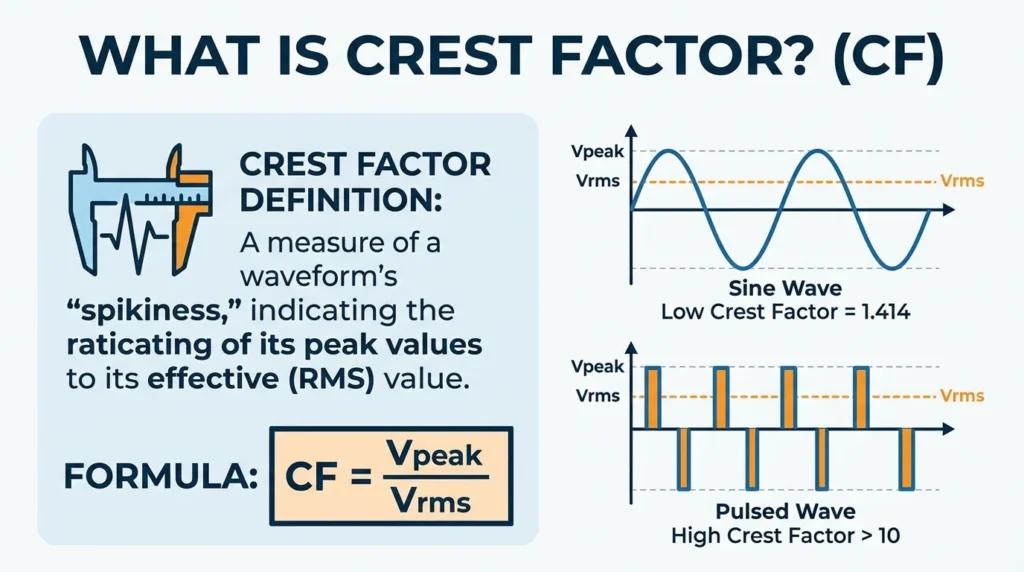
A normal sine wave has a crest factor of about 1.414. A waveform with sharp current spikes can have a much higher crest factor. This can place extra stress on electrical equipment even when the RMS current appears acceptable.
In this guide, you will learn what crest factor is, its formula, working principle, types, measurement methods, advantages, limitations, applications, comparison with related electrical values, troubleshooting, and future trends.
What Is Crest Factor?
Crest factor is the ratio of the maximum peak value of a waveform to its RMS value.
The basic formula is:
Crest Factor = Peak Value / RMS Value
For voltage:
CF = Vpeak / Vrms
For current:
CF = Ipeak / Irms
Crest factor has no unit because both peak and RMS values are measured in the same unit.
Simple Explanation
Crest factor tells you how large the highest point of a waveform is compared with its effective value.
For example, suppose an AC current has:
- RMS current = 10 A
- Peak current = 20 A
Then:
CF = 20 / 10
CF = 2
This means the highest current is twice the RMS current.
Crest Factor of a Sine Wave
For a pure sine wave:
Peak Value = RMS Value × √2
Therefore:
Crest Factor = √2
or approximately:
Crest Factor = 1.414
This value is often used as a reference when evaluating AC waveforms.
Why Crest Factor Matters
A high crest factor means the waveform contains relatively large peaks compared with its RMS value.
This can indicate:
- Short current pulses
- High switching activity
- Nonlinear loads
- Distorted waveforms
- Higher instantaneous electrical stress
A high crest factor does not automatically mean that a system is faulty. However, it can be an important warning sign when selecting or troubleshooting electrical equipment.
Crest Factor Working Principle
The crest factor working principle is based on comparing two characteristics of the same waveform:
- Its maximum instantaneous value
- Its RMS value
The process is simple.
Step 1: Measure the Waveform
First, measure the voltage or current waveform.
An oscilloscope or suitable power-quality instrument can show the actual waveform.
Step 2: Find the Peak Value
Identify the highest instantaneous value.
For example:
Peak current = 25 A
Step 3: Determine the RMS Value
The RMS value represents the effective value of the waveform.
For example:
RMS current = 10 A
Step 4: Calculate Crest Factor
Use:
CF = Peak / RMS
Therefore:
CF = 25 / 10
CF = 2.5
Step 5: Interpret the Result
A crest factor of 2.5 means the waveform’s peak current is 2.5 times its RMS current.
The value should then be considered along with the waveform shape, load type, equipment ratings, and operating conditions.
Easy Analogy
Think about traffic on a road.
Imagine that a road normally carries a steady flow of cars, but every few minutes a large group of cars passes through at once.
The average traffic may look acceptable, but the short bursts create extra pressure on the road.
A high crest factor is similar. The RMS value represents the overall effective level, while the peak shows the short high point.
Crest Factor Formula
The main formula is:
CF = Xpeak / Xrms
Where X can represent voltage or current.
Voltage Crest Factor
CFV = Vpeak / Vrms
Example:
If:
Vpeak = 325 V
and:
Vrms = 230 V
Then:
CFV = 325 / 230
CFV ≈ 1.41
This is close to the normal value for a sine wave.
Current Crest Factor
CFI = Ipeak / Irms
Example:
If:
Ipeak = 30 A
and:
Irms = 10 A
Then:
CFI = 30 / 10
CFI = 3
Rearranging the Formula
If crest factor and RMS value are known:
Peak Value = Crest Factor × RMS Value
For example:
If:
CF = 3
and:
Irms = 8 A
Then:
Ipeak = 3 × 8
Ipeak = 24 A
Types and Classification of Crest Factor
Crest factor is not normally divided into fixed equipment types. Instead, it is commonly classified according to the waveform being measured.
Sine Wave Crest Factor
A pure sine wave has:
CF = 1.414
This is the standard reference value for many AC systems.
For example, a 230 V RMS sine wave has a peak of approximately 325 V.
Square Wave Crest Factor
For an ideal symmetrical square wave:
Peak value = RMS value
Therefore:
CF = 1
A square wave has a constant magnitude during each part of its cycle, so its peak and RMS values are equal.
Triangle Wave Crest Factor
A symmetrical triangle wave has a crest factor of approximately:
CF = 1.732
The waveform rises and falls smoothly in a triangular shape.
Pulse Waveform Crest Factor
A waveform containing short pulses can have a much higher crest factor.
For example, a current waveform may have a low RMS value but very high short-duration peaks.
This is common in some:
- Switching power supplies
- Rectifier circuits
- Electronic loads
- Battery chargers
Distorted Waveform Crest Factor
A distorted waveform can have a crest factor that differs significantly from the normal sine-wave value.
Sharp peaks caused by nonlinear loads can increase crest factor.
Main Components of Crest Factor Measurement
Crest factor itself is not a physical component. It is a calculated characteristic of a waveform. However, several measurement components are involved in obtaining it.
Voltage Measurement Device
A suitable voltage probe or measuring instrument captures the voltage waveform.
The device must have an appropriate voltage rating.
Current Measurement Device
Current can be measured using:
- Current probes
- Current transformers
- Clamp meters
- Power analyzers
The measurement device must be suitable for the expected current and waveform.
RMS Measurement Circuit
The instrument determines the effective RMS value of the waveform.
True-RMS measurement is especially important for distorted waveforms.
Peak Detection
The instrument identifies the highest instantaneous value.
Fast peak detection is important because electrical peaks can occur for very short periods.
Processing System
Modern digital instruments use internal processing to calculate:
- Peak value
- RMS value
- Crest factor
- Frequency
- Harmonics
- Other waveform characteristics
Advantages of Crest Factor
Understanding crest factor provides several practical benefits.
- Identifies high waveform peaks: It shows when peak current or voltage is much higher than the RMS value.
- Improves equipment selection: Engineers can select equipment capable of handling expected peak conditions.
- Helps analyze nonlinear loads: High crest factors are common in many electronic loads.
- Supports power-quality analysis: It provides useful information about waveform shape.
- Helps protect equipment: High peaks can place extra stress on components.
- Useful for UPS selection: Crest factor is important when evaluating loads with high current peaks.
- Improves troubleshooting: Unexpected changes in crest factor can indicate changes in load behavior.
- Supports electrical design: Engineers can consider both effective and peak electrical values.
Disadvantages and Limitations of Crest Factor
Crest factor is useful, but it should not be used alone to judge the health of an electrical system.
It Does Not Show the Complete Waveform
Two waveforms can have the same crest factor but very different shapes.
An oscilloscope or waveform analyzer may be needed for deeper analysis.
It Does Not Show Energy Distribution
Crest factor compares peak and RMS values, but it does not tell you exactly how energy is distributed throughout the waveform.
Short Transients Can Affect the Result
A brief spike can significantly increase the measured crest factor.
The technician must determine whether the spike is normal, caused by switching, or a genuine electrical problem.
Measurement Equipment Matters
If the instrument cannot capture fast peaks correctly, the calculated crest factor may be inaccurate.
High Crest Factor Is Not Always a Fault
A high value may be normal for a particular application.
For example, some electronic loads naturally draw current in short pulses.
Crest Factor Applications
There are many important crest factor applications in electrical engineering.
UPS Systems
Uninterruptible power supplies often supply electronic equipment with nonlinear current demand.
Computers, servers, and other electronic equipment can draw current in pulses.
A UPS should therefore be capable of handling the load’s peak current without excessive voltage distortion.
Data Centers
Modern data centers contain large numbers of:
- Servers
- Network switches
- Power supplies
- Storage systems
These devices can create current waveforms with high peaks.
Crest factor helps engineers evaluate the electrical characteristics of these loads.
Variable Frequency Drives
VFDs use power electronic switching to control motor speed.
The input and output waveforms may not be simple sine waves.
Crest factor can help technicians evaluate waveform conditions during testing.
Switching Power Supplies
Switching power supplies commonly draw current in short pulses.
This can produce a high crest factor even when the RMS current is moderate.
LED Lighting
Modern LED drivers contain electronic circuits that can create nonlinear current waveforms.
Crest factor can therefore be useful when analyzing commercial lighting systems.
Battery Chargers
Some chargers use rectifiers and switching circuits that create pulsed current.
Measuring crest factor helps engineers understand the load characteristics.
Industrial Equipment
Industrial electronic equipment can produce distorted waveforms and high current peaks.
Power-quality testing can include crest factor along with:
- RMS voltage
- RMS current
- Harmonics
- Power factor
- Frequency
Home Electronics
Household equipment such as computers, televisions, chargers, and electronic appliances can produce nonsinusoidal current waveforms.
Crest factor provides another way to study these loads.
Crest Factor vs Related Electrical Values
Crest factor is often confused with peak value, RMS value, and form factor.
| Parameter | Meaning | Unit | Main Purpose |
|---|---|---|---|
| Peak value | Maximum instantaneous value | V or A | Finds highest electrical level |
| RMS value | Effective value | V or A | Represents effective AC magnitude |
| Crest factor | Peak-to-RMS ratio | None | Shows relative peak size |
| Peak-to-peak value | Difference between positive and negative peaks | V or A | Measures total waveform range |
| Form factor | RMS value divided by average rectified value | None | Describes waveform characteristics |
Difference Between Crest Factor and Peak Value
The difference between crest factor and peak value is important.
Peak value is an actual electrical quantity such as volts or amperes.
Crest factor is a ratio.
For example:
- Peak current = 30 A
- RMS current = 10 A
- Crest factor = 3
So, peak value tells you how high the waveform reaches, while crest factor tells you how high that peak is compared with the RMS value.
Crest Factor vs Form Factor
These two ratios describe different waveform characteristics.
Crest factor:
Peak / RMS
Form factor:
RMS / Average Rectified Value
They should not be treated as the same measurement.
Selection Guide: Choosing Equipment Based on Crest Factor
When selecting an electrical instrument or power system, consider crest factor carefully.
1. Identify the Load Type
Determine whether the load is:
- Resistive
- Inductive
- Capacitive
- Electronic
- Nonlinear
Electronic and nonlinear loads may produce higher current peaks.
2. Check the RMS Rating
Never ignore RMS voltage or current ratings.
RMS values are essential for evaluating heating and continuous electrical loading.
3. Check Peak Capability
Equipment must also withstand the expected instantaneous peak.
4. Choose True-RMS Instruments
For distorted waveforms, use a suitable true-RMS measuring instrument.
5. Check Crest Factor Capability
Some measurement instruments specify a maximum crest factor that they can measure accurately.
This is particularly important when testing pulsed or highly distorted signals.
6. Consider the Application
UPS systems, power analyzers, VFDs, data-center equipment, and electronic loads may require more careful peak-current analysis.
Beginner Tip
Do not judge a waveform only from its RMS value. If the equipment contains power electronics, check the waveform and peak current as well.
Common Problems and Solutions
Why is my crest factor higher than 1.414?
A value above 1.414 often indicates that the waveform is not a perfect sine wave or contains sharper peaks.
Possible causes include:
- Nonlinear loads
- Switching circuits
- Rectifiers
- Electronic power supplies
- Distortion
- Short-duration transients
What is the normal crest factor of a sine wave?
For an ideal sine wave:
CF = 1.414
Real electrical systems may show slightly different values because of waveform distortion.
Is a high crest factor dangerous?
Not necessarily.
A high crest factor indicates high peaks relative to RMS value. Whether it is a problem depends on the equipment, waveform, duration, and system ratings.
Why does crest factor increase when electronic loads are connected?
Many electronic loads use rectifiers and capacitors that draw current in short pulses instead of smoothly throughout the AC cycle.
These narrow pulses can increase the peak current and therefore increase crest factor.
Can crest factor be less than 1?
For a standard waveform, the peak value cannot be lower than its RMS value.
Therefore, the crest factor is normally 1 or greater.
An ideal square wave has a crest factor of 1.
Can a multimeter measure crest factor?
Some advanced digital multimeters and power-quality instruments can measure or calculate crest factor.
However, not every standard multimeter provides this function.
Always check the instrument specifications.
How can I reduce a high current crest factor?
Depending on the cause, solutions may include:
- Improving power-supply design
- Using suitable power-factor correction
- Adding appropriate filtering
- Selecting equipment designed for nonlinear loads
- Using properly designed power-quality equipment
The correct solution depends on the actual waveform and system design.
Future Trends in Crest Factor Measurement
Electrical systems are becoming more dependent on power electronics. This makes waveform analysis increasingly important.
Modern measurement equipment is moving toward faster digital sampling and better waveform capture.
Future power-quality instruments are expected to provide more automatic analysis of:
- Peak current
- RMS current
- Crest factor
- Harmonics
- Transients
- Power factor
- Voltage disturbances
Smart Monitoring
Industrial facilities can use permanently installed sensors to monitor electrical conditions continuously.
Instead of checking a machine manually once a month, monitoring systems can identify changes in waveform behavior over time.
Electric Vehicles
Electric vehicle chargers use advanced power electronics. Their current waveforms can contain switching effects and high-frequency components.
Crest factor can be one of several measurements used to evaluate charger and power-system performance.
Renewable Energy
Solar inverters and battery energy-storage systems also rely heavily on power electronics.
As these systems become more common, accurate monitoring of peak and RMS values will become increasingly important.
Advanced Power Analyzers
Modern analyzers can automatically calculate crest factor while displaying the actual waveform.
This makes troubleshooting easier for technicians and allows engineers to compare operating conditions over time.
Conclusion
Crest factor is the ratio of the peak value of a waveform to its RMS value. It provides a simple way to understand how large the maximum electrical peak is compared with the effective value.
For a pure sine wave, the crest factor is approximately 1.414. Square waves have a crest factor of 1, while waveforms containing narrow, high pulses can have much higher values.
Crest factor is particularly useful when working with UPS systems, switching power supplies, VFDs, LED drivers, battery chargers, data centers, renewable-energy equipment, and other nonlinear loads. It helps engineers and technicians understand peak-current stress that an RMS reading alone may not reveal.
The key lesson is simple: RMS tells you the effective level, peak tells you the highest point, and crest factor tells you how large that peak is compared with the RMS value.