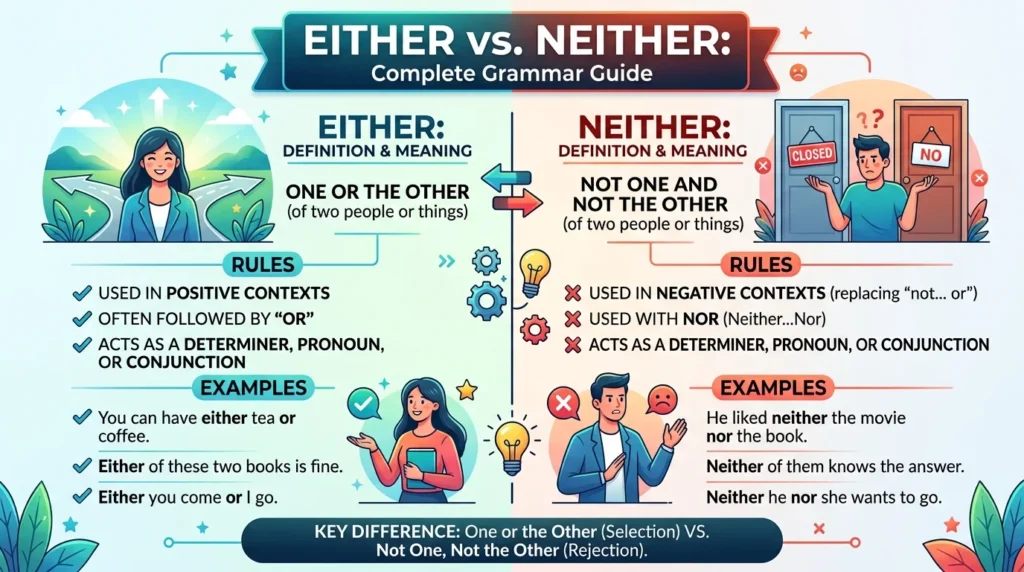

Choosing between either vs neither can be confusing because both words are used when talking about two choices or people. The main difference is simple: either usually refers to one of two options, while neither means not one and not the other.
For example, if someone asks, “Which shirt do you want?” you can say, “Either shirt is fine.” This means you are happy with one of the two shirts. But if you do not want either shirt, you can say, “Neither shirt is suitable.”
People often search for either vs neither because these words can work as determiners, pronouns, conjunctions, and adverbs. Their grammar also changes depending on the sentence. Another common question is whether to use either…or and neither…nor, and whether the verb after them should be singular or plural.
This guide explains the difference between either and neither, their meanings, grammar rules, common mistakes, everyday examples, British and American usage, and practical tips. By the end, you will know exactly when to use each word.
Either vs Neither – Quick Answer
The easiest way to remember the difference is:
- Either = one or the other of two choices.
- Neither = not one and not the other.
Examples With Either
You can choose either option.
This means you can choose option A or option B.
Either answer is acceptable.
This means both answers are possible choices, and choosing one is acceptable.
Examples With Neither
Neither option is available.
This means option A is unavailable and option B is unavailable.
Neither answer is correct.
This means both answers are incorrect.
Either…Or
Use either…or to present two alternatives.
You can either call me or send an email.
Neither…Nor
Use neither…nor to say that two alternatives are both excluded.
Neither John nor Sarah attended the meeting.
Simple Memory Trick
Think of the words this way:
Either = one of two
Neither = not one of two
The Origin of Either and Neither
The words either and neither have Old English and Germanic roots.
Either developed from older forms related to the idea of each of two or one or the other.
Neither developed from a combination meaning essentially not either. The prefix ne- historically carried a negative meaning.
Over centuries, their spellings and pronunciations changed as English developed.
Unlike words such as color/colour, there is no major British-American spelling difference between either and neither. Both varieties generally use the same spellings.
The main differences between British and American English involve pronunciation, grammar preferences, and sentence patterns, rather than spelling.
Why Are They Confusing?
The confusion usually comes from their similar appearance.
Compare:
- either → one or the other
- neither → not one or the other
The prefix ne- provides a useful clue because neither has a negative meaning.
British English vs American English Spelling
There is no standard spelling difference between British and American English for either and neither.
Both varieties spell them:
- either
- neither
| Feature | American English | British English |
|---|---|---|
| Spelling | either | either |
| Spelling | neither | neither |
| Either…or | Common | Common |
| Neither…nor | Common | Common |
| Pronunciation variation | Common | Common |
| Main difference | Usage and pronunciation | Usage and pronunciation |
Pronunciation Differences
One noticeable difference can be pronunciation.
Either is commonly pronounced in two ways:
- EE-ther
- EYE-ther
Both pronunciations are widely recognized.
Neither is also commonly pronounced in two ways:
- NEE-ther
- NYE-ther
These pronunciation differences are not strict US-versus-UK rules. Both pronunciations can be heard in different English-speaking regions.
Grammar Differences
British and American English can sometimes differ in preferences for collective nouns, agreement, and informal constructions, but the basic rules for either and neither remain largely the same.
For example:
Neither answer is correct.
This sentence is standard in both varieties.
Which Spelling Should You Use?
Because either and neither have the same spelling in major English varieties, you do not need to choose a US or UK spelling.
For US Audiences
Use:
- either
- neither
- either…or
- neither…nor
Example:
You can choose either option.
For UK Audiences
Use exactly the same spellings:
- either
- neither
- either…or
- neither…nor
Example:
You can choose either option.
For Commonwealth Countries
Countries such as Australia, Canada, and New Zealand also generally use either and neither.
For Global Audiences
Use either and neither according to their meaning and grammatical function.
The key issue is not spelling. It is using the correct word in the correct sentence.
Common Mistakes With Either vs Neither
Mistake 1: Using Neither When You Mean One of Two
❌ Neither option is acceptable; you can choose one.
If one option is acceptable, use:
✅ Either option is acceptable.
Mistake 2: Using Either for Two Rejected Options
❌ Either answer is correct.
If both answers are incorrect, say:
✅ Neither answer is correct.
Mistake 3: Confusing Either…Or With Neither…Nor
Use:
Either…or for alternatives.
You can either stay here or come with us.
Use:
Neither…nor when both choices are excluded.
Neither the manager nor the assistant was available.
Mistake 4: Creating a Double Negative
A common error is using neither with another negative word.
❌ I don’t like neither option.
Standard English usually prefers:
✅ I like neither option.
Or:
✅ I don’t like either option.
Both express that the two options are not liked.
Mistake 5: Using “Nor” With Either
❌ Either John nor David came.
✅ Either John or David came.
Remember:
either → or
neither → nor
Mistake 6: Incorrect Verb Agreement
With either and neither used directly before a singular noun, the verb is normally singular.
✅ Neither answer is correct.
✅ Either option is suitable.
Either vs Neither in Everyday Examples
In Emails
Either:
Please choose either date for the meeting.
Neither:
Neither date is available this week.
In News Articles
Either:
The company could either expand its factory or open a new facility.
Neither:
Neither company agreed to the proposed changes.
On Social Media
Either:
Either one looks great!
Neither:
Neither option works for me.
In Formal Writing
Either:
The applicant may submit either document as proof of identity.
Neither:
Neither proposal meets the required standards.
In Everyday Conversation
Either:
You can sit on either side.
Neither:
Neither restaurant is open today.
With Either…Or
We can either take the bus or walk.
With Neither…Nor
Neither the bus nor the train is running.
Either vs Neither – Google Trends and Usage Data
Search interest for either vs neither is usually connected to grammar questions, English learning, writing, and language education.
Unlike spelling pairs such as mold vs mould, the search demand is not mainly divided between countries based on spelling. Both the United States and the United Kingdom use the same spellings.
People commonly search for questions such as:
- either vs neither
- either or neither
- either and neither rules
- either neither grammar
- either or neither examples
- neither nor meaning
- either or meaning
Why People Search for These Words
The words are common in everyday English, but their grammar can be difficult for learners.
Search interest often comes from:
- English students
- ESL learners
- Teachers
- Writers
- Students preparing for exams
- People checking professional writing
Country and Context
Because the spelling is the same in US and UK English, geographic spelling differences have little effect on search behavior.
Instead, search demand is mainly connected to grammar education and language learning.
Google Trends data can change over time, so exact popularity should be checked for a specific country and date range when current search-volume information is required.
Either vs Neither Comparison Table
| Feature | Either | Neither |
|---|---|---|
| Basic meaning | One or the other | Not one and not the other |
| Number of choices | Two | Two |
| Positive meaning | Usually yes | No |
| Common pair | Either…or | Neither…nor |
| Example | Either answer is acceptable. | Neither answer is acceptable. |
| Pronoun use | Either is fine. | Neither is correct. |
| Determiner use | Either option | Neither option |
| Spelling US | Either | Neither |
| Spelling UK | Either | Neither |
Either as a Determiner
Either book will help you.
This means one of the two books will help you.
Either as a Pronoun
Either is fine with me.
This means either one of the two choices is acceptable.
Either as an Adverb
In negative sentences, either can mean “also.”
I don’t like coffee either.
Here, either does not refer directly to two choices.
Neither as a Determiner
Neither student passed the test.
This means both students failed.
Neither as a Pronoun
Neither is suitable.
This means both options are unsuitable.
Neither as an Adverb
I don’t like it either.
A related negative structure can be:
Neither do I.
This means “I also do not.”
FAQs About Either vs Neither
1. What is the difference between either and neither?
Either means one or the other of two choices. Neither means not one and not the other.
2. Is it either or neither?
It depends on the meaning.
Use either when one of two choices is possible or acceptable.
Use neither when both choices are rejected or do not apply.
3. What is the difference between either…or and neither…nor?
Either…or gives two alternatives.
You can either call or email me.
Neither…nor rejects both alternatives.
You can neither call nor email me.
4. Is either always positive and neither always negative?
Generally, either presents a choice or possibility, while neither has a negative meaning. However, either can also appear in negative sentences.
I don’t want either option.
5. Should I say “neither of them is” or “neither of them are”?
In formal standard English, neither of them is is generally preferred because neither is grammatically singular.
Neither of them is available.
In informal speech, plural agreement can sometimes be heard.
6. Can either be used for more than two choices?
Traditionally, either refers to one of two choices. In informal modern English, people sometimes use it more broadly, but for clear formal writing, use either for two alternatives.
7. Can neither be used for more than two things?
Traditionally, neither refers to two things. If you are referring to three or more things, none is usually the better choice.
8. Is “I don’t like neither” correct?
In standard English, avoid this double negative.
Use:
I don’t like either.
Or:
I like neither.
9. Do British and American English spell either and neither differently?
No. Both British and American English use either and neither.
10. How can I remember the difference?
Use this simple rule:
Either = one of two.
Neither = zero of two.
Conclusion
Understanding either vs neither becomes much easier when you focus on their basic meanings. Either means one or the other of two choices, while neither means not one and not the other. The two words are commonly used as determiners, pronouns, and parts of the structures either…or and neither…nor.
Remember these simple patterns: either goes with or, while neither goes with nor. For example, “You can either stay or leave” presents two choices, while “Neither option is suitable” means both options are unsuitable.
There is no major British-American spelling difference for these words. Both varieties use either and neither, although pronunciation can vary.
For clear writing, always choose the word based on your intended meaning. If one of two choices is possible, use either. If both are excluded, use neither. This simple rule will help you use these common words correctly in everyday, academic, and professional English.