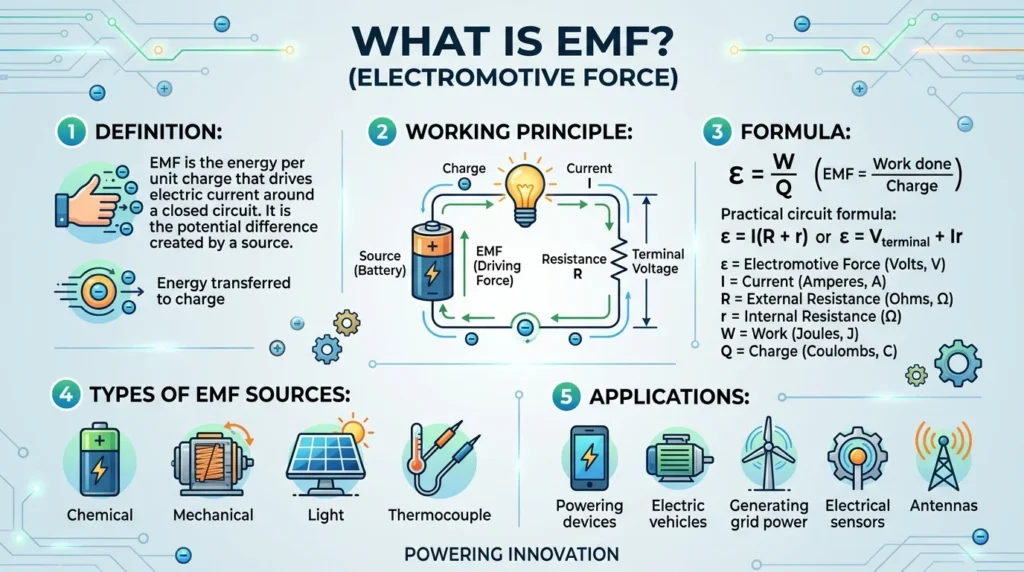

When you start a car, the battery provides electrical energy to the starter motor. Inside the battery, chemical energy is converted into electrical energy. The force that causes charges to move around the electrical circuit is related to electromotive force, or EMF.
EMF is one of the most important basic concepts in electrical engineering. It helps explain how batteries, generators, transformers, motors, and other electrical devices produce or transfer electrical energy. Although the word “force” is used in its name, EMF is not actually a mechanical force. It is the energy supplied per unit charge by an electrical source.
Students and beginners often confuse EMF with voltage. The two are closely related, but they are not always exactly the same. Understanding this difference is important when studying circuits, generators, batteries, and electromagnetic induction.
In this guide, you will learn what EMF is, its formula, working principle, types, components, advantages and limitations, practical applications, the difference between EMF and voltage, common problems, and modern developments in electrical systems.
What Is EMF?
EMF (electromotive force) is the energy supplied by an electrical source to move one unit of electric charge around a complete circuit.
The standard symbol for EMF is:
E or ε
Its SI unit is the volt (V).
Despite its name, electromotive force is not a physical force like mechanical force. Instead, it describes the electrical energy supplied to charges by a source such as a battery or generator.
Simple Definition
In simple terms:
EMF is the electrical energy provided by a source to each coulomb of charge.
The formula is:
E = W / Q
Where:
- E = EMF in volts
- W = energy supplied in joules
- Q = charge in coulombs
Since:
1 volt = 1 joule / 1 coulomb
EMF is measured in volts.
Practical Example
Consider a 12 V battery.
Ideally, its EMF means the battery can supply approximately 12 joules of energy to each coulomb of charge.
When the battery supplies current to a load, the terminal voltage can be lower than its EMF because of internal resistance.
EMF Working Principle
The EMF working principle depends on the type of electrical source.
A source must convert another form of energy into electrical energy to provide EMF.
For example:
- A battery converts chemical energy into electrical energy.
- A generator converts mechanical energy into electrical energy.
- A solar cell converts light energy into electrical energy.
- A thermocouple converts thermal energy into electrical energy.
Step-by-Step Working
Step 1: Energy Enters the Source
An energy source provides energy to the electrical system.
For a battery, this energy comes from chemical reactions.
Step 2: Charge Separation Occurs
The source creates a difference in electrical potential between its terminals.
One terminal becomes relatively positive and the other relatively negative.
Step 3: EMF Provides Energy
The source supplies energy to electric charges.
This energy allows charges to move through the external circuit when a complete path is available.
Step 4: Current Flows
When a load is connected, current flows through the circuit.
The electrical energy supplied by the source is converted into other forms, such as:
- Heat
- Light
- Mechanical motion
- Sound
- Stored chemical energy
Step 5: Energy Returns Through the Circuit
The complete circuit allows charge to return to the source, where the source can continue supplying energy.
Easy Analogy
Think of a water pump.
A pump raises water to a higher pressure so that water can flow through pipes.
Similarly, an electrical source provides energy to charges, creating the electrical conditions needed for current to flow.
The pump is not the water itself. In the same way, EMF is not the electric charge. It represents the energy supplied to the charge.
EMF Formula
The basic EMF formula is:
E = W / Q
Where:
- E = EMF
- W = work or energy supplied
- Q = charge
For a battery with internal resistance, the relationship between EMF and terminal voltage depends on whether the battery is supplying or receiving current.
Battery Supplying Current
When a battery supplies current:
E = V + Ir
Where:
- E = EMF
- V = terminal voltage
- I = current
- r = internal resistance
Therefore:
V = E − Ir
This shows why the measured terminal voltage of a battery can fall when it supplies a large current.
Battery Being Charged
When a battery is being charged:
E = V − Ir
or:
V = E + Ir
The exact relationship depends on the direction of current and the circuit arrangement.
Types of EMF
EMF can be classified according to how electrical energy is produced.
Chemical EMF
Chemical EMF is produced by chemical reactions.
Common examples include:
- Batteries
- Cells
- Lead-acid batteries
- Lithium-ion batteries
- Alkaline cells
Inside a battery, chemical reactions create a potential difference between the terminals.
For example, a car battery uses chemical reactions to provide electrical energy to the starter motor and other vehicle systems.
Magnetic or Induced EMF
Induced EMF is produced when the magnetic flux linked with a conductor or coil changes.
This is explained by Faraday’s law of electromagnetic induction.
The basic equation is:
E = −N(dΦ/dt)
Where:
- E = induced EMF
- N = number of turns
- Φ = magnetic flux
- t = time
The negative sign represents the direction described by Lenz’s law.
Generators and transformers depend heavily on induced EMF.
Motional EMF
Motional EMF occurs when a conductor moves through a magnetic field.
For a simple case:
E = Bℓv
Where:
- B = magnetic flux density
- ℓ = effective conductor length
- v = conductor velocity
This principle is used in electrical generators.
Thermal EMF
Thermal EMF occurs when two different conductors experience a temperature difference.
This is the basic principle behind thermocouples.
Thermal EMF is widely used for temperature measurement in industrial systems.
Photovoltaic EMF
Photovoltaic EMF is produced when light interacts with semiconductor materials.
This principle is used in:
- Solar cells
- Solar panels
- Photovoltaic systems
Sunlight provides the energy needed to generate electrical output.
Main Components Involved in EMF Production
EMF itself is not a physical component. Different electrical sources use different components to create or maintain EMF.
Energy Source
An energy source provides the original energy.
Examples include:
- Chemical energy
- Mechanical energy
- Solar energy
- Thermal energy
Conductors
Conductors provide a path for electrical charge.
Copper and aluminum are commonly used because they have good electrical conductivity.
Magnetic Field
Generators and many induction-based devices use magnetic fields to produce EMF.
The magnetic field can come from:
- Permanent magnets
- Electromagnets
- Field windings
Coil or Conductor
A coil or conductor interacts with the magnetic field.
Changing magnetic flux through the coil can produce induced EMF.
Terminals
Terminals provide connection points between the electrical source and the external circuit.
Internal Resistance
Real electrical sources have some internal resistance.
It causes a voltage drop when current flows and affects the terminal voltage.
Advantages of EMF
Understanding and using EMF provides many practical benefits.
- Enables electrical energy production: EMF allows electrical sources to deliver energy to circuits.
- Supports power generation: Generators use electromagnetic induction to produce electrical energy.
- Makes batteries useful: Chemical EMF allows batteries to power electrical devices.
- Supports renewable energy: Solar cells generate electrical output from sunlight.
- Enables transformer operation: Transformers rely on induced EMF to transfer electrical energy.
- Helps circuit analysis: EMF is essential for understanding voltage sources and electrical networks.
- Supports temperature measurement: Thermal EMF allows thermocouples to measure temperature.
- Works across many technologies: Different forms of EMF allow energy conversion from chemical, mechanical, thermal, and light energy.
Disadvantages and Limitations of EMF
EMF itself is not normally described as having “disadvantages” because it is a physical electrical concept. However, practical sources that produce EMF have limitations.
Internal Resistance
Real batteries and sources have internal resistance.
This can reduce terminal voltage when current increases.
Energy Losses
Electrical sources can lose energy through:
- Heat
- Resistance
- Magnetic losses
- Chemical losses
- Mechanical friction
EMF Can Vary
The EMF of some sources can change with operating conditions.
For example, battery voltage can be affected by:
- Temperature
- State of charge
- Age
- Load current
- Battery condition
Measurement Can Be Misunderstood
Students sometimes treat EMF and terminal voltage as exactly the same thing.
For an ideal source, they can be equal. In a real source under load, they may differ.
Source Ratings Have Limits
Every practical source has limits on:
- Maximum current
- Maximum voltage
- Temperature
- Operating time
- Energy capacity
EMF Applications
There are many important EMF applications in electrical engineering.
Batteries
Batteries use chemical reactions to generate EMF.
They are used in:
- Cars
- Mobile phones
- Laptops
- UPS systems
- Emergency lighting
- Industrial control systems
Electrical Generators
Generators use electromagnetic induction to produce EMF.
They are used in:
- Power stations
- Backup generators
- Wind turbines
- Hydroelectric plants
- Industrial power systems
Transformers
Transformers use changing magnetic flux to induce EMF in their windings.
They are essential for:
- Power transmission
- Power distribution
- Voltage conversion
- Electrical isolation
Solar Panels
Solar cells produce EMF when light energy interacts with semiconductor material.
Solar systems are widely used for:
- Residential electricity
- Industrial power
- Remote installations
- Battery charging
- Grid-connected generation
Motors
Motors are designed primarily to convert electrical energy into mechanical energy, but their rotating conductors can also produce back EMF.
Back EMF opposes the applied voltage and plays an important role in motor operation.
Thermocouples
Thermocouples use thermal EMF to measure temperature.
They are common in:
- Industrial furnaces
- Boilers
- HVAC systems
- Manufacturing equipment
- Process control
EMF vs Voltage
One of the most important concepts for beginners is the difference between EMF and voltage.
| Feature | EMF | Voltage |
|---|---|---|
| Meaning | Energy supplied per unit charge by a source | Potential difference between two points |
| Symbol | E or ε | V |
| Unit | Volt | Volt |
| Source | Usually associated with an energy source | Can exist across any two circuit points |
| Measurement | Often measured under open-circuit conditions | Usually measured across circuit points |
| Example | Battery’s ideal source voltage | Voltage across a resistor |
| Under load | Can differ from terminal voltage | Changes according to circuit conditions |
Difference Between EMF and Voltage
The difference between EMF and voltage becomes clear when considering a real battery.
Suppose a battery has:
EMF = 12 V
and internal resistance causes a voltage drop when current flows.
If the current is:
I = 2 A
and internal resistance is:
r = 0.5 Ω
Then:
Ir = 2 × 0.5 = 1 V
The terminal voltage is:
V = E − Ir
V = 12 − 1
V = 11 V
So the source has a 12 V EMF, but its terminal voltage under this load is 11 V.
EMF vs Potential Difference
EMF and potential difference are closely related but describe different ideas.
EMF represents energy supplied per unit charge by a source.
Potential difference represents energy transferred or changed per unit charge between two points.
For example, a resistor has a voltage drop because electrical energy is converted into heat.
A battery provides energy to the charges, while the resistor uses some of that energy.
Selection Guide: Choosing an EMF Source
When selecting a practical electrical source, consider the following factors.
1. Required Voltage
Choose a source with the appropriate voltage for the circuit.
2. Current Requirement
Check how much current the load needs.
A source must safely provide the required current.
3. Energy Capacity
For batteries, consider capacity and operating time.
4. Operating Environment
Temperature, humidity, vibration, and installation conditions can affect source performance.
5. Efficiency
Consider how efficiently the source converts its original energy into electrical energy.
6. Maintenance
Some sources require regular maintenance.
For example, certain industrial batteries require inspection and maintenance, while other battery technologies require much less routine attention.
Beginner Tip
Never select a battery or power source based only on voltage. Check current capability, energy capacity, temperature range, safety requirements, and the application’s operating conditions.
Common Problems and Solutions
Why is the battery’s terminal voltage lower than its EMF?
The most common reason is internal resistance.
When current flows, a voltage drop occurs inside the battery:
V = E − Ir
Does EMF cause current to flow?
EMF provides energy to charges, but current requires a complete electrical path.
An open circuit can have EMF and voltage without continuous current flow.
Is EMF the same as voltage?
No. They are closely related, but EMF represents energy supplied per unit charge by a source, while voltage generally refers to potential difference between two points.
Why does a battery voltage fall under load?
A real battery has internal resistance and chemical limitations. When current increases, the internal voltage drop increases.
What causes induced EMF?
A changing magnetic flux produces induced EMF in a conductor or coil.
This is the basic principle of electromagnetic induction.
Why does a motor produce back EMF?
As a motor rotates, its conductors move through a magnetic field. This produces an induced voltage that opposes the applied voltage.
This is called back EMF.
How can EMF be measured?
A source’s EMF is commonly determined under open-circuit conditions, where little or no current flows through the external circuit. Accurate measurements require suitable instruments and safe procedures.
Future Trends in EMF Technology
Modern electrical systems are changing the way EMF is generated, controlled, and measured.
Renewable Energy
Solar and wind power systems increasingly use advanced power electronics to convert variable energy sources into stable electrical power.
Advanced Batteries
New battery technologies are being developed to provide:
- Higher energy density
- Faster charging
- Longer service life
- Better thermal performance
- Improved safety
Electric Vehicles
Electric vehicles depend on battery EMF to supply energy to power electronic systems and traction motors.
Advanced battery management systems monitor cell voltage, temperature, current, and state of charge.
Smart Power Systems
Modern power systems use digital sensors and monitoring equipment to track electrical conditions in real time.
This allows engineers to identify abnormal voltage conditions and improve system reliability.
Advanced Generators
Modern generators are becoming more efficient and are increasingly integrated with renewable energy and smart-grid technologies.
Energy Harvesting
Small amounts of electrical energy can be produced from:
- Heat
- Light
- Vibration
- Motion
These methods can provide power for sensors and low-energy electronic devices.
Conclusion
EMF (electromotive force) is the energy supplied per unit charge by an electrical source. It is measured in volts and is essential for understanding batteries, generators, transformers, solar cells, motors, and many other electrical systems.
EMF is not a mechanical force. Instead, it describes the ability of a source to provide energy to electric charges. In a real battery, EMF can be higher than the terminal voltage because internal resistance causes a voltage drop when current flows.
The main forms include chemical, induced, motional, thermal, and photovoltaic EMF. Each converts a different form of energy into electrical energy.
For electrical students and technicians, the key lesson is simple: EMF provides energy to charges, while voltage describes the electrical potential difference between points. Understanding this difference makes circuit analysis and electrical troubleshooting much easier.