
Have you ever wondered how to describe how, when, where, or how often an action happens? An adverb helps you add this extra information to a sentence. For example, in “She runs quickly,” the word quickly tells us how she runs. In “He arrived yesterday,” yesterday tells us when he arrived.
Many people search for “what is a adverb?” because they are unsure about the meaning, spelling, and correct use of adverbs. There is also a small grammar mistake in the search phrase itself. The correct form is “What is an adverb?” because adverb begins with a vowel sound.
Learning adverbs is useful for students, teachers, writers, and anyone who wants to improve English grammar. Adverbs can describe verbs, adjectives, other adverbs, phrases, and sometimes whole sentences. They can show manner, time, place, frequency, degree, and more.
This guide explains what an adverb is, where the word comes from, how it works in British and American English, common mistakes, everyday examples, usage trends, and simple rules you can remember.
What Is a Adverb? – Quick Answer
The grammatically correct question is “What is an adverb?”
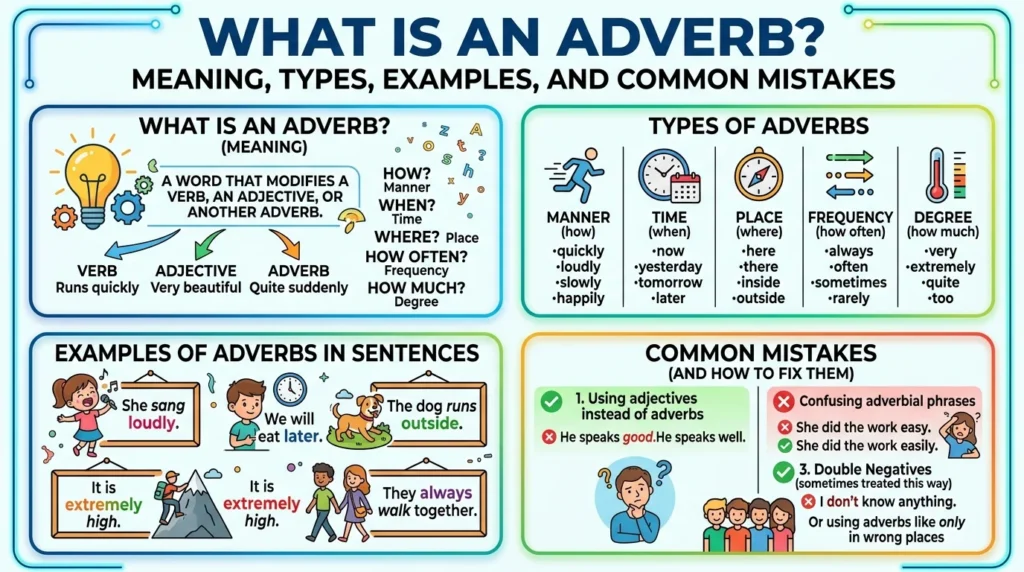
An adverb is a word that gives more information about a verb, adjective, another adverb, phrase, or sometimes a whole sentence. It can tell us how, when, where, how often, or to what degree something happens.
Simple Examples
- She sings beautifully. → How does she sing?
- He arrived early. → When did he arrive?
- Please sit here. → Where should you sit?
- I always drink water. → How often?
- The movie was very good. → To what degree?
Adverb in a Sentence
She speaks quietly.
Here:
- She = pronoun
- speaks = verb
- quietly = adverb
The adverb quietly tells us how she speaks.
The Origin of Adverb
The word adverb has a long history. It comes from the Latin word adverbium, which was formed from ad-, meaning “to,” “toward,” or “in addition,” and verbum, meaning “word” or “verb.” Oxford traces the English word to Late Middle English.
The basic idea is that an adverb adds information to a verb or another part of a sentence.
Over time, English grammar developed a wider understanding of adverbs. Today, adverbs do much more than describe verbs. They can modify adjectives, other adverbs, phrases, clauses, and whole sentences.
For example:
- quickly → modifies a verb
- very → modifies an adjective
- really → modifies another adverb
- fortunately → can comment on a whole sentence
This is why modern grammar treats adverbs as a broad word class rather than simply “words that describe verbs.”
Why Do People Write “a adverb”?
The phrase “a adverb” is grammatically incorrect.
Use an before adverb because the word begins with a vowel sound:
- ❌ What is a adverb?
- ✅ What is an adverb?
The same rule applies to similar words:
- an adjective
- an adverb
- an article
- an example
The correct keyword for natural English is therefore “What is an adverb?”
British English vs American English Spelling
There is no major spelling difference between British and American English for the word adverb. Both varieties use the spelling adverb.
The same is true for most common adverbs:
- quickly
- slowly
- carefully
- usually
- always
- never
- recently
However, some adverbs made from adjectives can reflect spelling differences in the adjective they come from.
For example:
| British English | American English | Meaning |
|---|---|---|
| adverb | adverb | A word that adds information |
| quickly | quickly | In a fast way |
| carefully | carefully | With care |
| usually | usually | In most cases |
| travelling quickly | traveling quickly | Moving quickly |
| cancelled immediately | canceled immediately | Stopped immediately |
| colourfully | colorfully | In a colorful way |
The word adverb itself does not change spelling between British and American English.
Pronunciation Difference
The spelling stays the same, but pronunciation can vary slightly.
Oxford gives British and American pronunciations for adverb, reflecting differences in the vowel sound used in the two varieties.
So:
British: adverb
American: adverb
The spelling is identical.
Which Spelling Should You Use?
Because adverb has the same spelling in British and American English, you can use adverb regardless of your audience.
For a US Audience
Use standard American English throughout your article, school assignment, website, or business document.
Example:
The adverb “quickly” modifies the verb “ran.”
For a UK Audience
Use standard British English.
Example:
The adverb “carefully” modifies the verb “worked.”
The word adverb remains unchanged.
For a Global Audience
Use adverb. It is the standard spelling understood in English-speaking countries around the world.
The more important issue is consistency. If your website targets US readers, follow US English spelling throughout the page. If it targets UK readers, follow UK English conventions.
Common Mistakes With What Is a Adverb?
Adverbs can be confusing because they have many forms and positions. Here are some common mistakes.
Mistake 1: Using “a” Instead of “an”
❌ What is a adverb?
✅ What is an adverb?
Use an because adverb begins with a vowel sound.
Mistake 2: Thinking Every Adverb Ends in -ly
Many adverbs end in -ly, but not all do.
Examples:
- quickly
- slowly
- carefully
- quietly
But these are also adverbs:
- fast
- hard
- often
- never
- very
- well
- here
- today
Cambridge notes that many manner adverbs are formed by adding -ly to adjectives, but some adverbs have the same form as adjectives, such as fast, right, wrong, and straight.
Mistake 3: Confusing Adjectives and Adverbs
An adjective normally describes a noun.
An adverb can modify a verb, adjective, another adverb, or other sentence elements.
Compare:
- She is a careful driver.
- She drives carefully.
Careful describes the noun driver.
Carefully describes the verb drives.
Mistake 4: Using “Good” Instead of “Well”
In many contexts, good is an adjective and well is an adverb.
❌ She sings good.
✅ She sings well.
However, grammar depends on the sentence, so “good” and “well” should not be treated as interchangeable in every situation.
Mistake 5: Assuming Adverbs Only Describe Verbs
Adverbs can modify more than verbs.
Examples:
- very cold → modifies an adjective
- really quickly → modifies an adverb
- Fortunately, we arrived on time. → comments on the sentence
Cambridge explains that adverbs can add information about verbs, adjectives, other adverbs, clauses, and whole sentences.
What Is an Adverb in Everyday Examples?
Adverbs appear in everyday communication. You can find them in emails, news reports, social media posts, school writing, and professional documents.
In Emails
Adverbs can make an email more precise.
Please reply quickly.
We will soon send the updated document.
She carefully reviewed the report.
These adverbs tell the reader how or when an action happens.
In News Articles
News writing often uses adverbs to provide information about events.
The company recently announced a new policy.
Officials quickly responded to the situation.
The team successfully completed the project.
In Social Media
Adverbs are common in casual posts.
I finally finished my project!
We had a really great day.
She performed beautifully on stage.
In Formal Writing
Academic and professional writing can also use adverbs.
The results were carefully analyzed.
The issue was previously discussed.
The system successfully completed the test.
Use adverbs when they add useful information. Avoid adding them just to make a sentence longer.
Types of Adverbs
Adverbs can be grouped by the type of information they provide.
Adverbs of Manner
These tell us how something happens.
Examples:
- quickly
- slowly
- carefully
- quietly
- loudly
- professionally
Example:
She completed the task carefully.
Adverbs of Time
These tell us when something happens.
Examples:
- today
- yesterday
- soon
- now
- recently
- already
Example:
We arrived yesterday.
Adverbs of Place
These tell us where something happens.
Examples:
- here
- there
- nearby
- upstairs
- outside
Example:
Please wait outside.
Adverbs of Frequency
These tell us how often something happens.
Examples:
- always
- usually
- often
- sometimes
- rarely
- never
Example:
He usually walks to work.
Adverbs of Degree
These tell us how much or to what degree something happens.
Examples:
- very
- extremely
- quite
- too
- almost
- completely
Example:
The test was extremely difficult.
Cambridge identifies time, place, manner, degree, focusing, evaluative, viewpoint, and linking uses among the ways adverbs function in English.
Adverb Variations Compared Side by Side
| Form | Example | What It Shows |
|---|---|---|
| Quickly | He ran quickly. | Manner |
| Slowly | She walked slowly. | Manner |
| Today | We met today. | Time |
| Here | Come here. | Place |
| Always | He always studies. | Frequency |
| Very | It is very cold. | Degree |
| Never | She never complains. | Frequency |
| Carefully | They worked carefully. | Manner |
| Recently | We recently moved. | Time |
| Really | He is really happy. | Degree |
What Is an Adverb? – Google Trends & Usage Data
The search phrase “what is an adverb?” belongs to a common educational and grammar-search topic. People usually search for this type of phrase when studying English grammar, preparing for school tests, improving writing, or checking a grammar rule.
Google Trends is useful for comparing search interest across countries and time periods, but its data is relative rather than a direct count of searches. Search interest can also change because of school terms, exams, language-learning demand, and educational content.
For SEO, the most useful related searches include:
- what is an adverb
- what is an adverb?
- adverb definition
- examples of adverbs
- types of adverbs
- adverb examples
- adverb meaning
- what are adverbs
The exact popularity of these phrases can vary by country and time. English-learning markets, school-focused searches, and countries where English is widely taught can generate strong interest in grammar questions.
For content creators, it is better to target the natural phrase “what is an adverb?” while naturally covering related searches such as adverb definition, types, examples, and common mistakes.
FAQs About What Is an Adverb?
1. What is an adverb?
An adverb is a word that gives more information about a verb, adjective, another adverb, phrase, or sometimes a whole sentence.
Example:
She ran quickly.
2. What is the correct phrase: “a adverb” or “an adverb”?
The correct phrase is “an adverb.”
Use an because adverb begins with a vowel sound.
3. What are some examples of adverbs?
Common examples include:
- quickly
- slowly
- carefully
- always
- never
- often
- today
- here
- very
- well
4. Do all adverbs end in -ly?
No. Many adverbs end in -ly, but some do not.
Examples of adverbs without -ly include fast, hard, often, never, here, today, and well.
5. What does an adverb describe?
An adverb can give more information about a verb, adjective, another adverb, phrase, clause, or sentence.
6. What is the difference between an adjective and an adverb?
An adjective usually describes a noun.
An adverb can describe or modify a verb, adjective, another adverb, or other parts of a sentence.
Example:
She is a quick runner.
She runs quickly.
7. Is “adverb” spelled differently in British and American English?
No. Adverb has the same spelling in both British and American English.
Conclusion
An adverb is a word that adds useful information to a sentence. It can tell us how, when, where, how often, or to what degree something happens. Examples include quickly, yesterday, here, always, and very.
One important point is that the common search phrase “what is a adverb?” is grammatically incorrect. The correct form is “What is an adverb?” because adverb begins with a vowel sound.
Adverbs do not always end in -ly, and they can modify more than verbs. They can describe adjectives, other adverbs, phrases, clauses, and whole sentences. British and American English also use the same spelling, adverb.
For students and writers, the best way to learn adverbs is to study their function in real sentences. Look for words that answer questions such as how, when, where, how often, and how much. With regular practice, adverbs become much easier to identify and use correctly.