
Imagine you are repairing an electric crane in a workshop. The operator tells you that the motor must lift heavy loads smoothly and provide strong starting torque. In another situation, you are working on a small electric toy car that needs steady speed control.
Both machines use DC motors — but not the same type.
This is why understanding the Types of DC Motor is very important. Different DC motors are designed for different tasks. Some provide high starting torque, some give constant speed, and others are compact for small electronic devices.
As an electrical student or technician, choosing the wrong motor type can cause overheating, poor performance, or mechanical failure. Knowing the correct motor type improves efficiency, safety, and reliability.
In this article, you will learn the Types of DC Motor, DC motor working principle, classifications, components, applications, advantages and disadvantages, comparison between types, selection guide, and troubleshooting tips. I will explain everything clearly, just like a senior engineer guiding a junior in practical field work.
2. What is Types of DC Motor?
The term Types of DC Motor refers to the different classifications of direct current (DC) motors based on how their field windings are connected.
Simple Definition
A DC motor is an electrical machine that converts direct current electrical energy into mechanical energy.
DC motors are classified mainly according to how the field winding is connected with the armature winding.
Simple Explanation
When DC supply is applied, the motor produces rotation. But the way we connect the field coil changes torque, speed, and performance.
Practical Example
- A crane uses a DC series motor for high starting torque.
- A lathe machine may use a DC shunt motor for constant speed.
- Modern battery-operated devices often use permanent magnet DC motors.
Each type has its own purpose.
3. DC Motor Working Principle
The DC motor working principle is based on the principle that a current-carrying conductor placed in a magnetic field experiences a force.
This is known as Fleming’s Left-Hand Rule.
Step-by-Step Working
- DC supply is given to the motor.
- Current flows through the armature winding.
- Magnetic field is produced by field winding or magnets.
- Interaction between magnetic field and armature current produces force.
- Force creates torque.
- The rotor starts rotating.
Easy Analogy
Think of pushing a rotating door.
- Your hand is like electric current.
- The door frame is like magnetic field.
- When both interact, the door rotates.
In the same way, electric current and magnetic field interact to produce motion.
4. Types / Classification
The main Types of DC Motor are classified based on field connection.
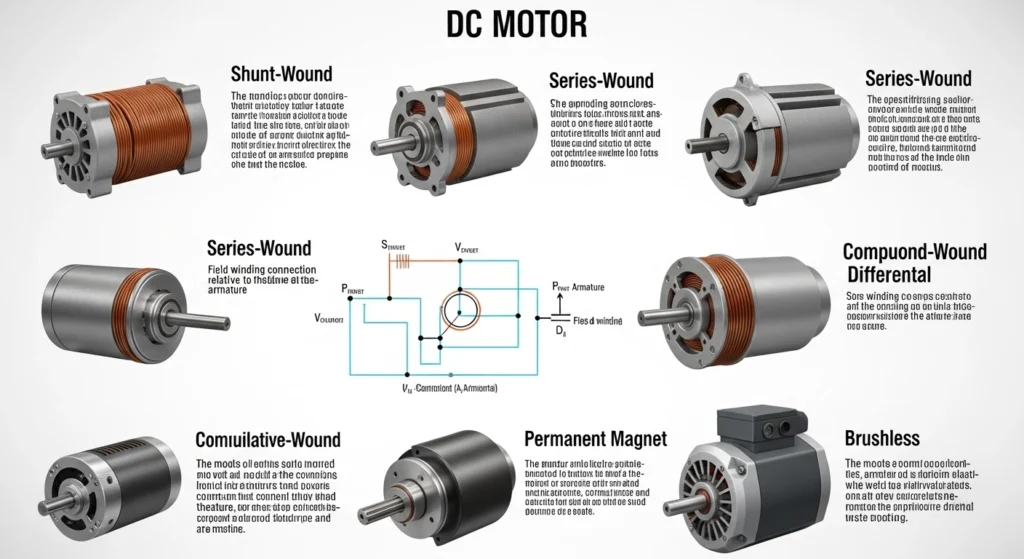
4.1 DC Series Motor
In this type, the field winding is connected in series with the armature.
Key Features
- High starting torque
- Speed varies with load
- Cannot run without load
Where Used
- Cranes
- Electric traction
- Elevators
This motor is powerful at starting but dangerous at no-load condition.
4.2 DC Shunt Motor
In this motor, the field winding is connected parallel (shunt) with the armature.
Key Features
- Almost constant speed
- Medium starting torque
- Good speed regulation
Where Used
- Lathes
- Fans
- Conveyors
This motor is suitable for applications requiring stable speed.
4.3 DC Compound Motor
This motor combines both series and shunt windings.
It is further divided into two types:
(a) Cumulative Compound Motor
- Series field supports shunt field
- High starting torque
- Better speed control
(b) Differential Compound Motor
- Series field opposes shunt field
- Rarely used
- Unstable performance
Compound motors offer balanced performance.
4.4 Permanent Magnet DC Motor (PMDC)
In this motor, permanent magnets create the magnetic field instead of field winding.
Key Features
- Compact size
- No field winding
- Low maintenance
Where Used
- Toys
- Wiper motors
- Small battery devices
4.5 Separately Excited DC Motor
Field winding is powered from a separate DC source.
Key Features
- Excellent speed control
- Used in laboratories
- Industrial control systems
Provides precise control of speed and torque.
5. Main Components
Understanding parts helps in maintenance.
5.1 Armature
- Rotating part
- Carries current
- Produces torque
5.2 Field Winding
- Produces magnetic field
- Mounted on stator
5.3 Commutator
- Converts AC induced in armature into DC
- Maintains unidirectional torque
5.4 Brushes
- Made of carbon
- Supply current to armature
5.5 Shaft
- Transfers mechanical power
Each component is essential for smooth motor operation.
6. Types of DC Motor Advantages
Understanding the Types of DC Motor advantages and disadvantages is important for selection.
Advantages
- High starting torque (Series motor)
- Good speed control (Shunt motor)
- Simple construction
- Easy speed variation
- Suitable for battery operation
- Reliable performance
Real-World Benefits
- Smooth lifting in cranes
- Stable operation in machines
- Compact design in electronics
7. Disadvantages / Limitations
- Brushes require maintenance
- Sparking at commutator
- Not suitable for very high-speed applications
- Higher cost compared to some AC motors
- Limited use in modern heavy industries
Because of brush wear, maintenance is necessary.
8. Types of DC Motor Applications
The Types of DC Motor applications vary according to design.
DC Series Motor Applications
- Cranes
- Hoists
- Electric trains
DC Shunt Motor Applications
- Machine tools
- Printing machines
- Fans
Compound Motor Applications
- Elevators
- Rolling mills
PMDC Motor Applications
- Automotive systems
- Robotics
- Home appliances
DC motors are widely used in battery-powered and industrial systems.
9. Comparison Section
Difference Between DC Series Motor and DC Shunt Motor
Many students ask about the difference between DC series motor and DC shunt motor.
| Feature | DC Series Motor | DC Shunt Motor |
|---|---|---|
| Field Connection | Series | Parallel |
| Starting Torque | Very High | Moderate |
| Speed Regulation | Poor | Good |
| No-Load Speed | Very High (Dangerous) | Safe |
| Application | Cranes | Lathes |
This difference between DC series motor and DC shunt motor helps in correct selection.
10. Selection Guide
Choosing the correct DC motor depends on application.
1. Load Requirement
- Heavy load start → Series motor
- Constant speed → Shunt motor
2. Speed Control
- Precise control → Separately excited motor
3. Power Source
- Battery → PMDC motor
4. Maintenance Capability
- Low maintenance needed → PMDC
5. Budget
Consider cost and availability.
Always check motor rating before installation.
11. Common Problems & Solutions
Q1: Motor sparking at brushes?
Reason: Worn brushes.
Solution: Replace brushes.
Q2: Motor overheating?
Reason: Overload.
Solution: Reduce load.
Q3: Speed fluctuating?
Reason: Loose field connection.
Solution: Check wiring.
Q4: Motor not starting?
Reason: Open circuit.
Solution: Test continuity.
Q5: Excessive noise?
Reason: Bearing issue.
Solution: Replace bearings.
Routine inspection prevents major failure.
12. Future Trends
Although AC motors dominate heavy industries, DC motors are still evolving.
Brushless DC Motors (BLDC)
- No brushes
- High efficiency
- Low maintenance
Electric Vehicles
- Advanced DC drive systems
Robotics
- Precise DC motor control
Smart Controllers
- Digital speed control systems
Modern designs focus on efficiency and reduced maintenance.
13. Conclusion
The Types of DC Motor play an important role in electrical engineering. Each type — Series, Shunt, Compound, PMDC, and Separately Excited — is designed for specific performance requirements.
Understanding the DC motor working principle, applications, and the difference between DC series motor and DC shunt motor helps engineers make correct decisions.
Each motor type has its own advantages and disadvantages. Selecting the right motor ensures efficiency, reliability, and long service life.
As an electrical professional, mastering DC motor fundamentals will strengthen your practical knowledge and improve your ability to design and maintain electrical systems confidently.