
Electricity being generated at a power plant at 11kV. If we send that same voltage directly to homes, it will not be efficient for long-distance transmission. On the other hand, if we send extremely high voltage directly into houses, it would be dangerous. So how do we safely increase and decrease voltage levels? The answer is a transformer.
The transformer working principle is one of the most important concepts in electrical engineering. Whether you are a student, technician, or engineer, understanding how a transformer works helps you design safe power systems, troubleshoot faults, and select proper equipment.
In this article, you will learn what a transformer is, the transformer working principle in simple steps, types of transformers, components, transformer applications, transformer advantages and disadvantages, and practical troubleshooting tips. By the end, you will clearly understand how transformers transfer electrical energy efficiently without direct electrical connection.
2. What is Transformer Working Principle?
Clear Definition
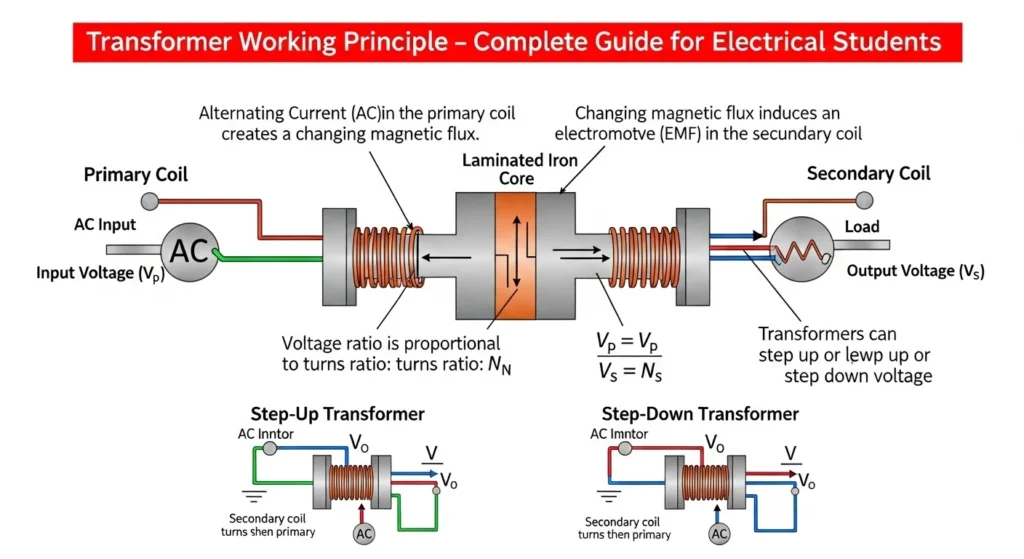
The transformer working principle is based on electromagnetic induction, where electrical energy is transferred from one coil to another through a magnetic field without direct electrical connection.
Simple Explanation
A transformer changes voltage level:
- Increase voltage → Step-up transformer
- Decrease voltage → Step-down transformer
It works only on AC (Alternating Current).
Practical Example
At a power station:
- Voltage is increased to reduce transmission losses.
- Near your home, voltage is reduced to 220V or 230V.
- Your appliances operate safely.
All this happens because of the transformer working principle.
3. Transformer Working Principle (Step-by-Step)
The transformer working principle is based on Faraday’s Law of Electromagnetic Induction.
Let’s understand step by step.
Step 1: AC Supply to Primary Coil
- Alternating current flows through the primary winding.
- A changing magnetic field is created around it.
Step 2: Magnetic Flux in Core
- The magnetic field passes through the iron core.
- The core guides magnetic flux efficiently.
Step 3: Induced Voltage in Secondary Coil
- The changing magnetic field cuts the secondary winding.
- According to electromagnetic induction, voltage is induced.
Important Points
- No direct wire connection between primary and secondary.
- Energy transfer happens through magnetic flux.
- Frequency remains the same.
- Only voltage and current change.
Easy Analogy
Think of two people holding a rope:
- One person shakes the rope.
- The other person feels movement without direct touch.
Similarly, magnetic flux transfers energy between coils.
4. Types / Classification of Transformers
Transformers are classified based on function and construction.
Step-Up Transformer
- Increases voltage.
- Decreases current.
- Used in power transmission.
Example: Power plant transformer.
Step-Down Transformer
- Decreases voltage.
- Increases current.
- Used in distribution systems.
Example: Pole-mounted transformer near houses.
Isolation Transformer
- Same input and output voltage.
- Provides electrical isolation.
- Improves safety.
Power Transformer
- Used in power generation stations.
- High voltage handling capacity.
- Operates at full load.
Distribution Transformer
- Used near consumer areas.
- Operates at varying load.
- Supplies homes and small industries.
5. Main Components of Transformer
Understanding components helps you understand the transformer working principle better.
1. Core
- Made of laminated silicon steel.
- Provides magnetic path.
- Reduces energy losses.
2. Primary Winding
- Connected to input supply.
- Creates magnetic field.
3. Secondary Winding
- Delivers output voltage.
- Receives induced voltage.
4. Insulation
- Prevents short circuit.
- Ensures safety.
5. Transformer Oil (In large transformers)
- Cooling purpose.
- Insulation support.
6. Tank and Bushings
- Protect internal components.
- Provide external connection.
Each part plays a critical role in energy transfer.
6. Transformer Advantages and Disadvantages
Advantages
- No moving parts
- High efficiency (95–99%)
- Long service life
- Low maintenance
- Safe voltage conversion
- Reliable power transfer
Real-World Benefits
- Enables long-distance transmission
- Reduces power losses
- Protects appliances
- Essential in every power system
Disadvantages / Limitations
- Works only with AC supply
- Large size (for high ratings)
- Cooling required for large units
- Initial cost can be high
- Oil leakage risk in oil-filled transformers
Understanding transformer advantages and disadvantages helps in proper system design.
7. Transformer Applications
Transformer applications are everywhere.
Home Applications
- Voltage reduction for houses
- Adapters and chargers
- Doorbell transformers
Industrial Applications
- Heavy machinery supply
- Motor control systems
- Welding machines
Modern Technology Applications
- Renewable energy systems
- Solar inverters
- Electric vehicle charging stations
- Smart grids
Transformers are the backbone of electrical distribution.
8. Comparison Section
Difference Between Step-Up and Step-Down Transformer
| Feature | Step-Up | Step-Down |
| Voltage | Increases | Decreases |
| Current | Decreases | Increases |
| Primary Turns | Fewer | More |
| Secondary Turns | More | Fewer |
| Application | Transmission | Distribution |
Difference Between Transformer and Generator
| Feature | Transformer | Generator |
| Function | Changes voltage | Generates electricity |
| Moving Parts | No | Yes |
| Energy Conversion | Electrical to electrical | Mechanical to electrical |
| Principle | Electromagnetic induction | Electromagnetic induction |
The difference between transformer and generator is mainly energy conversion type.
9. Selection Guide
Choosing the right transformer is important.
1. Check Voltage Rating
- Input voltage
- Output voltage
2. Check Power Rating (kVA)
Choose slightly higher than load requirement.
3. Cooling Type
- Air-cooled
- Oil-cooled
4. Installation Area
- Indoor
- Outdoor
5. For Beginners
- Read nameplate details
- Understand load calculation
- Ensure proper protection devices
Always match transformer rating with system load.
10. Common Problems & Solutions (FAQs)
Q1: Why does a transformer overheat?
Reason:
- Overloading
- Poor cooling
- Short circuit
Solution:
- Reduce load
- Improve ventilation
- Inspect insulation
Q2: Why does transformer make humming sound?
Reason:
- Magnetic vibration in core
Solution:
- Tighten core bolts
- Proper mounting
Q3: Why does voltage drop at output?
Reason:
- Overload
- Internal winding fault
Solution:
- Measure load
- Test winding resistance
Q4: Can transformer work on DC?
No. Transformer working principle requires changing magnetic field. DC does not produce changing flux.
11. Future Trends
Electrical industry is evolving rapidly.
1. Smart Transformers
- Real-time monitoring
- Digital sensors
2. Energy Efficient Design
- Low-loss core material
- Improved insulation
3. Compact Transformers
- Smaller size
- High performance
4. Renewable Integration
- Solar and wind power compatibility
- Smart grid technology
Transformers are becoming smarter and more efficient.
12. Conclusion
The transformer working principle is one of the most important foundations in electrical engineering. It allows safe and efficient voltage conversion using electromagnetic induction without direct electrical connection. From power plants to household adapters, transformer applications are everywhere.
Understanding the transformer working principle, transformer advantages and disadvantages, and the difference between related systems like generator and step-up transformers builds strong technical knowledge. As a student or technician, always focus on practical learning, load calculation, and safety.
Mastering transformers will strengthen your electrical career and improve your system design skills.