
Sometimes, the word lazy is not strong enough to explain what you mean. A person may be inactive, unwilling to work, slow to act, or simply taking a break. Each situation can call for a different word. This is why people search for synonyms for lazy when writing essays, emails, stories, reports, or everyday messages.
Using the right synonym also helps you control your tone. For example, idle can sound neutral, while indolent is more formal. Words such as inactive may describe a lack of activity without directly attacking someone’s character. On the other hand, words such as sluggish often describe slow movement or low energy.
This guide explains more than 55 alternatives to lazy in simple English. You will learn what each word means and when to use it. You will also see examples for emails, news, social media, academic writing, and formal situations. The guide covers British and American English spelling, common mistakes, word origins, and useful differences between similar terms. By the end, you will know how to choose a synonym that fits your meaning and audience.
Synonyms for Lazy – Quick Answer
Lazy usually describes someone who does not want to work, make an effort, or stay active. It can also describe something that moves slowly or lacks energy.
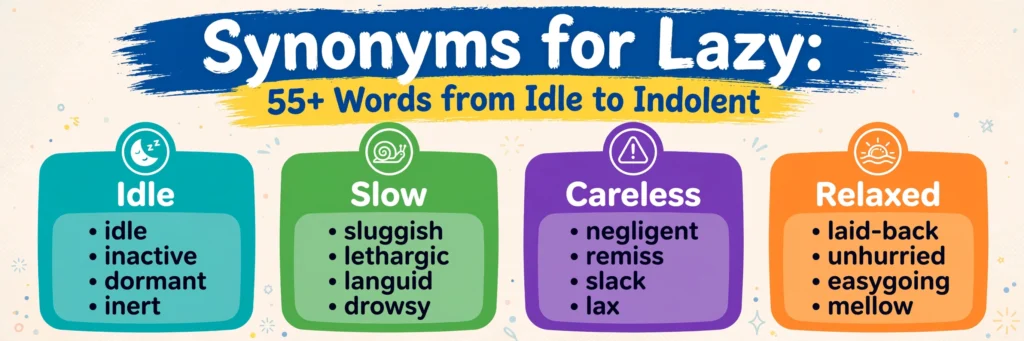
Common synonyms for lazy include:
- Idle – not working or active
- Inactive – not doing much activity
- Indolent – avoiding work or effort
- Sluggish – slow-moving or lacking energy
- Lethargic – having very little energy
- Unmotivated – lacking motivation
- Inert – unable or unwilling to move or act
- Careless – not giving enough attention
- Shiftless – lacking ambition or purpose
- Work-shy – avoiding work
Examples
- He is too lazy to finish the task.
- He is idle while everyone else is working.
- She felt lethargic after a long day.
- The employee seemed unmotivated.
- The machine remained inactive for several hours.
The best synonym depends on whether you mean a lack of effort, energy, movement, or motivation.
The Origin of Synonyms for Lazy
The word lazy has an interesting history. Its exact origin is uncertain, but it appeared in English around the 16th century. It was used to describe someone who was unwilling to work or make an effort.
Over time, lazy became a common everyday adjective. It can describe people, animals, actions, habits, and even movement.
Its synonyms come from many different language roots. Idle comes from Old English and has long been associated with being inactive or not working. Indolent comes from Latin indolentia, which is connected with a lack of pain and later developed the meaning of avoiding effort.
Sluggish is linked to the word slug, suggesting slow or inactive movement. Lethargic comes through Latin and Greek and relates to a state of low energy and reduced activity.
These different histories explain why the words do not always have exactly the same meaning. Some describe behavior, some describe energy, and others describe motivation.
British English vs American English Spelling
The spelling of lazy is the same in British and American English.
There is no standard British spelling such as lazey. The correct spelling is lazy in both varieties.
Most common synonyms also keep the same spelling across British and American English.
| Word | British English | American English | Difference |
|---|---|---|---|
| Lazy | lazy | lazy | No difference |
| Idle | idle | idle | No difference |
| Inactive | inactive | inactive | No difference |
| Indolent | indolent | indolent | No difference |
| Sluggish | sluggish | sluggish | No difference |
| Lethargic | lethargic | lethargic | No difference |
| Unmotivated | unmotivated | unmotivated | No difference |
| Inert | inert | inert | No difference |
| Careless | careless | careless | No difference |
| Shiftless | shiftless | shiftless | No difference |
Why do some English words have spelling differences?
British and American English sometimes use different spellings because of historical development and different language traditions.
For example:
- British: labour
- American: labor
- British: centre
- American: center
However, lazy does not have this type of spelling difference. The same spelling works for both audiences.
Which Spelling Should You Use?
You can use lazy in both American and British English. The spelling does not need to change.
The more important decision is which synonym fits your audience.
For US English
Simple words are usually best:
- Lazy
- Idle
- Inactive
- Sluggish
- Unmotivated
These words are easy to understand in everyday communication.
For UK and Commonwealth English
The same words are widely understood. Lazy, idle, and inactive are common choices.
The phrase work-shy is also useful in British English when describing someone who avoids work.
For Global English
Choose simple and familiar words. Lazy, inactive, and unmotivated are generally easier for international readers than shiftless or indolent.
In professional writing, avoid harsh labels when a neutral description is more accurate.
Common Mistakes with Synonyms for Lazy
Using the wrong synonym can change the meaning of your sentence.
1. Confusing “lazy” with “tired”
Lazy means unwilling to make an effort.
Tired means lacking energy because of physical or mental exhaustion.
Incorrect:
She is lazy because she worked for twelve hours.
Better:
She is tired because she worked for twelve hours.
2. Using “lethargic” to mean lazy in every situation
Lethargic usually describes low energy or sluggishness. It does not always mean that someone refuses to work.
Example:
I felt lethargic after the long journey.
3. Confusing “idle” with “lazy”
Idle means not active or not being used. It does not always criticize someone.
Example:
The workers were idle because the machine had stopped.
This does not necessarily mean the workers were lazy.
4. Using “inactive” as a direct insult
Inactive is usually neutral. It simply means not active.
Example:
The account has been inactive for six months.
5. Using “indolent” in casual conversation
Indolent is formal and can sound harsh.
Instead of:
You are indolent.
A casual speaker might say:
You are being lazy.
Synonyms for Lazy in Everyday Examples
The best synonym changes with the situation.
In Emails
Professional emails should avoid unnecessary insults. Neutral words are usually better.
Instead of:
John is lazy.
Write:
John has not been completing his assigned tasks.
Or:
The project has been delayed because several tasks remain incomplete.
In News Writing
News writing often uses neutral descriptions.
The factory remained idle during the afternoon.
Economic activity was sluggish during the quarter.
These examples describe a situation without making a personal judgment.
On Social Media
Casual language is more common.
I am too lazy to cook today.
Feeling lazy this Sunday!
My brain is moving at a sluggish speed today.
In Formal Writing
Formal writing may use words such as:
- Indolent
- Inactive
- Inert
- Unmotivated
- Sluggish
Example:
The report identified a lack of motivation among some employees.
This is often more professional than simply calling employees lazy.
In Academic Writing
Academic writing should be precise and objective.
Instead of:
Students are lazy.
Write:
Some students may lack motivation to complete the assigned work.
This avoids making a broad judgment about an entire group.
Synonyms for Lazy – Comparison Table
| Synonym | Main Meaning | Tone | Example |
|---|---|---|---|
| Lazy | Avoiding effort or work | Direct | He is lazy. |
| Idle | Not active or working | Neutral | The workers were idle. |
| Inactive | Not active | Neutral | The account is inactive. |
| Indolent | Avoiding effort | Formal | He was considered indolent. |
| Sluggish | Slow or lacking energy | Neutral | Business activity was sluggish. |
| Lethargic | Very low energy | Neutral/Formal | She felt lethargic. |
| Unmotivated | Lacking motivation | Neutral | He seems unmotivated. |
| Inert | Not moving or acting | Formal | The material remained inert. |
| Shiftless | Lacking ambition | Negative | He was described as shiftless. |
| Work-shy | Avoiding work | Negative | He was known as work-shy. |
| Careless | Not giving enough attention | Negative | His careless work caused errors. |
| Slothful | Habitually lazy | Formal/Negative | The character was slothful. |
55+ Synonyms for Lazy
Here are useful alternatives, depending on context:
Idle, inactive, indolent, sluggish, lethargic, unmotivated, inert, shiftless, work-shy, slothful, sluggish, listless, apathetic, passive, unenergetic, unproductive, inefficient, careless, negligent, lax, lackadaisical, lethargic, sleepy, inactive, dormant, resting, relaxed, laid-back, easygoing, slow-moving, slow, sluggish, spiritless, lifeless, languid, torpid, supine, procrastinating, reluctant, unwilling, uninterested, unconcerned, indifferent, disengaged, unambitious, aimless, inactive, loafing, lounging, loafing around, taking it easy, dragging one’s feet, dragging one’s heels, shirking, avoiding work, work-averse, and lacking initiative.
Not all of these words are exact synonyms. Some describe low energy, while others describe a lack of motivation, effort, or activity.
Synonyms for Lazy – Google Trends & Usage Data
Interest in synonyms for lazy can vary by country, education level, and writing purpose. People often search for this phrase when they need better vocabulary for essays, English lessons, workplace writing, or creative content.
The word lazy is much more common in everyday English than formal alternatives such as indolent, slothful, or shiftless.
Simple words such as lazy, idle, inactive, and unmotivated have broad usage. More advanced words often appear in books, academic writing, literature, and formal descriptions.
Search interest may also vary between English-speaking countries and countries where English is widely learned as a second language. Students often search for synonym lists to expand vocabulary and avoid repeating the same word.
Google Trends results can change over time. For accurate country-level comparisons, check the keyword over a selected period and compare the same search terms.
FAQs About Synonyms for Lazy
1. What is the best synonym for lazy?
Idle is one of the closest general synonyms. Other choices include inactive, indolent, sluggish, and unmotivated, depending on the meaning.
2. What is a formal word for lazy?
Indolent is a common formal synonym. Slothful and shiftless can also describe a person who avoids work or effort.
3. What is a polite way to say lazy?
Use neutral phrases such as unmotivated, inactive, or lacking initiative. These can sound more professional than calling someone lazy.
4. Is “idle” the same as “lazy”?
Not always. Idle means not active or working, while lazy usually suggests an unwillingness to make an effort.
5. Is “lethargic” a synonym for lazy?
It can be similar in some contexts, but lethargic mainly means having very little energy. A tired person can be lethargic without being lazy.
6. What is the opposite of lazy?
Common opposites include active, hardworking, energetic, diligent, industrious, motivated, and productive.
7. Is lazy spelled differently in British English?
No. Lazy has the same spelling in standard British and American English.
Conclusion
The word lazy is simple and useful, but it does not always express the exact meaning you need. Choosing the right synonym can make your writing more accurate and professional. Use idle when someone or something is not active, and use inactive for a neutral description. Choose unmotivated when the main issue is a lack of drive. Sluggish and lethargic are better when you want to describe slow movement or low energy. For formal writing, indolent and slothful can work, but they may sound judgmental.
There is no British-American spelling difference for lazy. The same spelling works for both audiences. The key is choosing a word that matches your meaning, tone, and context.
For everyday speech, simple words are usually best. In professional or academic writing, neutral descriptions can be more respectful than labels. Instead of calling someone lazy, explain the behavior when possible. This approach makes your writing clearer, fairer, and easier to understand.