
Imagine a situation where a powerful lightning strike occurs near a building. Within a fraction of a second, a huge voltage spike travels through the electrical lines and reaches sensitive equipment such as computers, control panels, and communication devices. Without protection, this sudden surge can instantly damage or destroy expensive equipment.
This is where Surge Protection Devices (SPDs) become extremely important. In modern electrical systems, equipment like PLCs, computers, smart appliances, and industrial control systems are highly sensitive to voltage spikes. Even a small surge can cause serious damage or reduce equipment life.
Electrical engineers and technicians must understand how surge protection works because voltage surges occur more often than many people realize. Lightning strikes, switching operations, and faults in the power grid can all create sudden voltage spikes.
In this article, you will learn the Surge Protection Devices working principle, different types of SPDs, their main components, and real-world Surge Protection Devices applications. We will also explore the Surge Protection Devices advantages and disadvantages, troubleshooting tips, and how to select the right device for electrical systems. This knowledge will help electrical students, engineers, and technicians design safer and more reliable power systems.
2. What are Surge Protection Devices?
Surge Protection Devices (SPDs) are electrical safety devices designed to protect electrical equipment from voltage spikes or transient surges.
A surge occurs when the voltage in an electrical system suddenly increases above the normal level for a very short time. This high voltage can damage electrical circuits, insulation, and electronic components.
Simple Explanation
A surge protection device works like a safety valve for electricity. When excess voltage appears in the system, the SPD redirects that extra energy safely to the ground.
Practical Example
Consider a home with computers, televisions, and routers. If lightning strikes nearby, the voltage in the power line can suddenly increase. Without a surge protection device, this spike could damage the electronics. However, if an SPD is installed in the electrical panel or power strip, it diverts the excess voltage and protects the equipment.
3. Surge Protection Devices Working Principle
The Surge Protection Devices working principle is based on detecting abnormal voltage and quickly diverting it away from sensitive equipment.
Normally, an SPD remains inactive during standard operating voltage. But when a voltage surge occurs, it immediately creates a low-resistance path to ground.
Step-by-Step Working Process
- Normal OperationDuring normal voltage conditions, the SPD does not interfere with the electrical system.
- Voltage Surge OccursA lightning strike, switching operation, or fault causes a sudden increase in voltage.
- Surge DetectionThe SPD senses the voltage exceeding its safe limit.
- Energy DiversionThe device quickly redirects the excess energy to the grounding system.
- Return to NormalOnce the surge disappears, the SPD returns to standby mode.
Simple Analogy
Think of surge protection devices like a pressure relief valve in a water system. When water pressure becomes too high, the valve opens to release the pressure and protect the pipes.
Similarly, SPDs release excess electrical energy to protect equipment.
4. Types of Surge Protection Devices
Surge protection devices are classified based on their installation location and protection level.
Type 1 Surge Protection Device
Type 1 SPDs are installed at the main service entrance of a building.
Features:
- Protect against direct lightning strikes
- Installed between utility supply and building panel
- Handles very high surge currents
Typical use: Industrial buildings and large facilities.
Type 2 Surge Protection Device
Type 2 SPDs are installed in distribution panels inside buildings.
Features:
- Protect against indirect lightning surges
- Protect internal electrical circuits
- Most commonly used in homes and offices
Example use: Residential distribution boards.
Type 3 Surge Protection Device
Type 3 SPDs provide point-of-use protection.
Features:
- Installed near sensitive equipment
- Protect computers, TVs, and electronic devices
- Often built into power strips
Example use: Office equipment protection.
Combined Type SPD
Some modern SPDs combine multiple protection levels in one device.
Features:
- Multi-stage protection
- Suitable for complex systems
- Used in modern electrical installations
5. Main Components of Surge Protection Devices
Understanding SPD components helps technicians troubleshoot and maintain protection systems.
Metal Oxide Varistor (MOV)
The MOV is the most important component in many SPDs.
Function:
- Absorbs excess voltage
- Diverts surge current to ground
Gas Discharge Tube (GDT)
GDTs protect against high-energy surges.
Function:
- Creates a spark gap during high voltage
- Conducts surge current safely to ground
Thermal Disconnect
This safety component disconnects the SPD if it overheats.
Function:
- Prevents fire hazards
- Protects the SPD from failure
Indicator Lights
Most modern SPDs include status indicators.
Function:
- Show operational condition
- Indicate when replacement is required
Ground Connection
A proper grounding path is essential for SPD operation.
Function:
- Safely dissipates surge energy into the earth.
6. Surge Protection Devices Advantages
The Surge Protection Devices advantages and disadvantages must be understood before designing protection systems.
Advantages
• Protect sensitive electronic equipment
• Prevent costly electrical damage
• Increase equipment lifespan
• Improve system reliability
• Reduce downtime in industrial systems
• Protect against lightning surges
• Easy to install and maintain
For industries with expensive equipment, SPDs provide essential protection.
7. Disadvantages / Limitations
Although SPDs are very useful, they also have limitations.
• Cannot protect against long-term overvoltage
• Must be properly grounded to work effectively
• Limited lifespan after repeated surges
• Requires proper selection and installation
• Cheap devices may provide weak protection
Because of these limitations, proper system design is important.
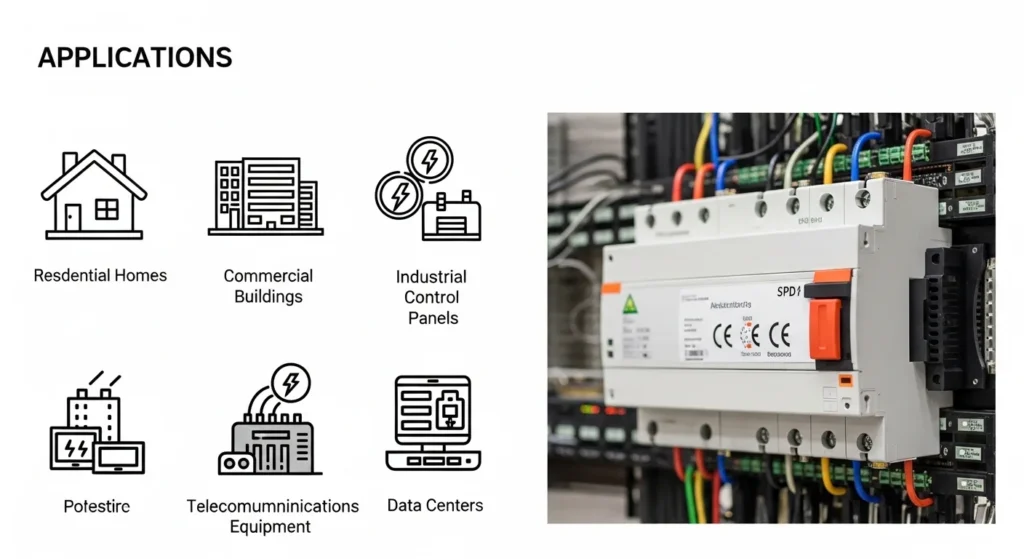
8. Surge Protection Devices Applications
There are many Surge Protection Devices applications across modern electrical systems.
Residential Applications
- Protection of home appliances
- Protection of televisions and computers
- Protection of smart home devices
Industrial Applications
- PLC control panels
- Industrial automation systems
- Motor drives and VFDs
- Manufacturing machines
Commercial Applications
- Office equipment
- Data centers
- Telecommunication systems
- CCTV and security systems
Renewable Energy Systems
SPDs are also used in:
- Solar power systems
- Wind power installations
- Battery storage systems
They protect inverters and controllers from surge damage.
9. Comparison Section
Difference Between Surge Protection Device and Lightning Arrester
| Feature | Surge Protection Device | Lightning Arrester |
|---|---|---|
| Purpose | Protect electrical equipment | Protect power lines and buildings |
| Installation | Inside electrical panels | Outside buildings or substations |
| Protection level | Medium voltage surges | Very high lightning currents |
| Applications | Homes, offices, industries | Transmission lines and substations |
| Response speed | Very fast | Designed for lightning discharge |
Understanding the difference between surge protection device and lightning arrester helps engineers design effective protection systems.
10. Selection Guide
Choosing the right SPD is important for proper protection.
Voltage Rating
The SPD must match the system voltage.
Examples:
- 230V single phase
- 400V three phase
Surge Current Rating
This rating indicates how much surge current the device can handle.
Higher rating = better protection.
Installation Location
Choose SPD type based on location:
- Service entrance → Type 1
- Distribution panel → Type 2
- Equipment level → Type 3
Response Time
Good SPDs respond in nanoseconds, protecting sensitive electronics.
Certification
Always select certified devices from reliable manufacturers.
11. Common Problems & Solutions
Why does an SPD fail?
Repeated surge events can damage internal components.
Solution:
Inspect the device regularly and replace when necessary.
Why is surge protection not working?
Often the issue is poor grounding.
Solution:
Ensure proper earthing system.
Can SPDs protect against lightning strikes?
They can protect against indirect lightning surges.
Solution:
Combine SPDs with lightning protection systems.
How often should SPDs be replaced?
Typically every 5–10 years, depending on surge exposure.
12. Future Trends
Surge protection technology continues to evolve with modern electrical systems.
Smart Surge Protection
Future SPDs will include:
- IoT monitoring
- Remote diagnostics
- Failure alerts
Improved Materials
Advanced semiconductor materials are improving surge absorption capability.
Integration with Smart Grids
Modern power systems require intelligent protection devices that communicate with grid systems.
Renewable Energy Protection
As solar and wind installations grow, SPDs designed specifically for renewable energy systems are becoming more common.
13. Conclusion
Surge Protection Devices play a vital role in modern electrical systems. With the increasing use of sensitive electronic equipment, protection against voltage surges has become more important than ever.
In this guide, we explored the Surge Protection Devices working principle, major types, components, and real-world Surge Protection Devices applications. We also discussed the Surge Protection Devices advantages and disadvantages, troubleshooting techniques, and selection guidelines.
For electrical engineers, technicians, and students, understanding surge protection is essential for designing reliable power systems. A properly selected and correctly installed SPD can prevent costly equipment damage and improve system safety.
As electrical systems continue to evolve with smart grids and renewable energy technologies, surge protection will remain a critical part of electrical engineering practice.