
Imagine a 3D printer creating a detailed object layer by layer. Each tiny movement must be extremely precise. The printer head moves a small distance, stops, then moves again with perfect accuracy. This precise movement is made possible by a device called a stepper motor.
Stepper motors are widely used in modern electronics, automation systems, robotics, and industrial machines. Unlike normal electric motors that rotate continuously, a stepper motor moves in small controlled steps. This allows engineers to control the exact position, speed, and rotation angle of a machine.
For electrical students, technicians, and engineers, understanding stepper motors is very important. Many modern devices rely on accurate motion control systems, and stepper motors play a key role in achieving this precision.
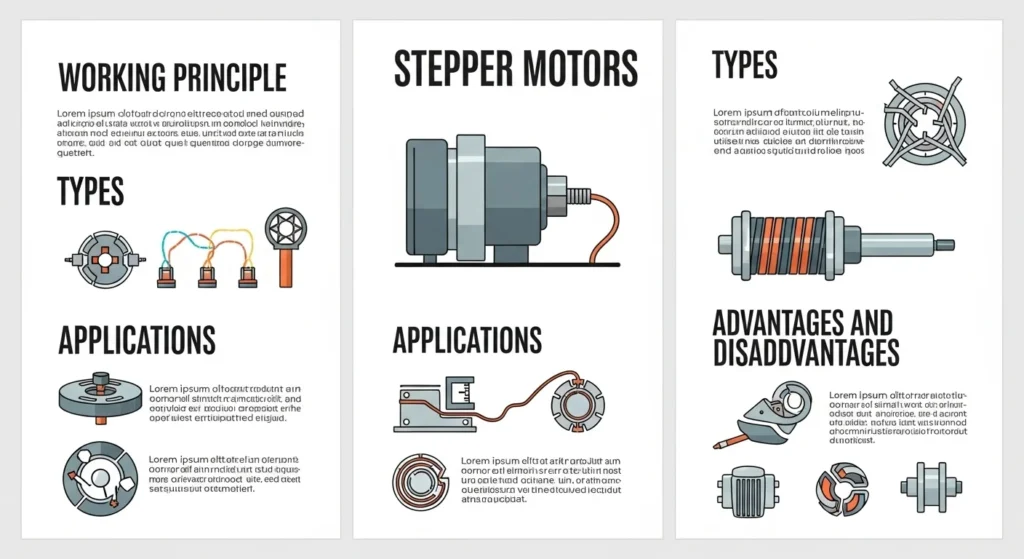
In this article, you will learn what a stepper motor is, the stepper motor working principle, different types of stepper motors, major components, and practical stepper motor applications. We will also discuss stepper motor advantages and disadvantages, common problems, and future trends. This guide is written in simple language so beginners can clearly understand this important electrical machine.
2. What is a Stepper Motor?
Definition
A stepper motor is an electric motor that divides one complete rotation into many small steps. Each electrical pulse moves the motor shaft by a fixed angle.
This allows precise control of position and speed without using complex feedback systems.
Simple Explanation
In simple words, a stepper motor does not rotate continuously like a normal motor. Instead, it rotates step by step.
Every electrical signal sent to the motor moves it slightly forward.
For example:
- One pulse = one step
- Ten pulses = ten steps
Because of this, engineers can control the exact rotation angle of the motor.
Practical Example
Stepper motors are commonly used in:
- 3D printers
- CNC machines
- Robotics
- Camera positioning systems
In a CNC machine, the stepper motor moves the cutting tool very accurately. This ensures precise cutting and shaping of materials.
3. Stepper Motor Working Principle
The stepper motor working principle is based on electromagnetic attraction between the stator and rotor.
The motor contains coils that become electromagnets when electricity flows through them.
Step-by-Step Operation
- Electrical Pulse Input
A controller sends electrical pulses to the motor windings.
- Magnetic Field Generation
When current flows through a coil, it produces a magnetic field.
- Rotor Attraction
The rotor aligns with the energized magnetic field.
- Sequential Coil Activation
Another coil is energized, creating a new magnetic field.
- Step Movement
The rotor moves slightly to align with the new field.
- Continuous Steps
Repeating this process rotates the motor step by step.
Simple Analogy
Think of stepping stones across a river.
Instead of jumping across in one motion, you step carefully from one stone to another. A stepper motor moves in the same controlled way.
4. Types of Stepper Motors
Stepper motors are classified based on their design and operation.
Permanent Magnet Stepper Motor
This type uses a permanent magnet rotor.
Features:
- Simple construction
- Moderate torque
- Low cost
Permanent magnet stepper motors are commonly used in small devices such as printers and scanners.
Variable Reluctance Stepper Motor
This motor uses a soft iron rotor without permanent magnets.
Features:
- High speed capability
- Simple structure
- Low rotor inertia
However, torque output is usually lower compared to other types.
Hybrid Stepper Motor
Hybrid stepper motors combine features of permanent magnet and variable reluctance motors.
Features:
- High precision
- High torque
- Excellent performance
Hybrid stepper motors are widely used in robotics, CNC machines, and automation systems.
5. Main Components of a Stepper Motor
A stepper motor consists of several important parts.
Stator
The stator is the stationary part of the motor.
Functions:
- Holds the electromagnetic coils
- Creates magnetic fields when energized
Rotor
The rotor is the rotating part inside the motor.
Functions:
- Aligns with magnetic fields
- Produces step-by-step movement
Windings
Windings are copper coils placed around the stator poles.
Functions:
- Generate magnetic fields
- Control motor rotation
Shaft
The shaft is connected to the rotor and delivers mechanical motion to external devices.
Functions:
- Transfers rotational motion
- Drives mechanical systems
Controller / Driver
A stepper motor driver controls the electrical pulses supplied to the motor.
Functions:
- Controls direction
- Controls speed
- Controls step position
6. Stepper Motor Advantages
Stepper motors provide many practical benefits in motion control systems.
Stepper motor advantages include:
- Precise position control
- Simple control system
- No feedback sensor required
- Reliable and durable operation
- Good low-speed torque
- Easy digital control using microcontrollers
These advantages make stepper motors ideal for automation and robotics.
7. Stepper Motor Disadvantages / Limitations
Despite their benefits, stepper motors also have some limitations.
Stepper motor disadvantages include:
- Lower efficiency compared to some motors
- Limited high-speed performance
- Possible vibration during operation
- Can lose steps under heavy load
- Generates heat during continuous operation
Engineers must consider these limitations when selecting motors for specific applications.
8. Stepper Motor Applications
Stepper motors are widely used in many industries and technologies.
Industrial Applications
- CNC machines
- Industrial automation systems
- Robotic arms
- Packaging machines
Home and Office Applications
- Printers
- Scanners
- Plotters
- Security cameras
Modern Technology Applications
Stepper motors are essential in modern technology systems such as:
- 3D printers
- Medical equipment
- Camera stabilization systems
- Automated laboratory machines
These stepper motor applications require precise control and reliable performance.
9. Comparison Section
Difference Between Stepper Motor and Servo Motor
| Feature | Stepper Motor | Servo Motor |
|---|---|---|
| Control | Open-loop control | Closed-loop control |
| Accuracy | Good | Very high |
| Cost | Lower | Higher |
| Speed | Moderate | High |
| Feedback System | Usually not required | Required |
Understanding the difference between stepper motor and servo motor helps engineers choose the correct motor for specific applications.
10. Selection Guide
Choosing the correct stepper motor is important for reliable system performance.
Important Selection Factors
- Required torque
- Step angle accuracy
- Operating speed
- Power supply voltage
- Driver compatibility
Tips for Beginners
- Select a motor with sufficient torque margin
- Use a proper motor driver
- Avoid overloading the motor
- Ensure proper cooling and ventilation
Correct motor selection improves performance and reliability.
11. Common Problems & Solutions
Q1: Why does a stepper motor vibrate?
Stepper motors may vibrate due to resonance or incorrect drive signals.
Solution:
- Use microstepping drivers
- Adjust operating speed
Q2: Why does the motor lose steps?
Step loss occurs when the motor cannot handle the load.
Solution:
- Reduce load
- Use a higher torque motor
Q3: Why does the motor overheat?
Overheating can occur due to continuous high current.
Solution:
- Reduce current settings
- Improve cooling
Q4: Why is the motor not rotating?
Possible causes include wiring issues or driver failure.
Solution:
- Check connections
- Verify controller signals
12. Future Trends
Stepper motor technology continues to evolve with modern automation systems.
Smart Motor Drivers
Advanced drivers improve efficiency and reduce vibration.
Integration with Robotics
Stepper motors are increasingly used in robotic systems requiring precise positioning.
Energy Efficient Designs
New motor designs reduce power consumption and heat generation.
Miniature Precision Motors
Compact stepper motors are being developed for medical devices and portable electronics.
These developments will expand the role of stepper motors in future technologies.
13. Conclusion
Stepper motors are essential components in modern motion control systems. Unlike conventional motors, they rotate in precise steps, allowing accurate control of position, speed, and movement. This unique capability makes them ideal for applications that require high precision.
In this article, we explained what a stepper motor is, the stepper motor working principle, its different types, and major components. We also discussed stepper motor advantages and disadvantages, along with practical stepper motor applications in industries, robotics, and automation systems.
Understanding the operation of stepper motors helps electrical students, engineers, and technicians design efficient control systems. With proper selection, installation, and maintenance, stepper motors provide reliable and accurate performance.
As automation, robotics, and smart manufacturing continue to grow, the importance of stepper motors will increase even further. Learning about this technology is a valuable step for anyone entering the electrical or electronics engineering field.