
Imagine a situation where the electricity suddenly goes out in your home during a hot summer evening. Lights turn off, fans stop working, and important appliances like refrigerators and routers shut down. In such situations, many households and small businesses rely on generators to restore power quickly. One of the most common solutions used in homes and small offices is a single phase generator.
Single phase generators are widely used because they are simple, reliable, and suitable for small to medium electrical loads. These generators provide power to everyday appliances such as lights, fans, televisions, computers, and small motors. For electricians, technicians, and engineering students, understanding single phase generator types is essential for selecting the right power solution.
Different types of single phase generators are designed for different applications. Some are portable and ideal for homes, while others are used in small commercial facilities or construction sites.
In this article, you will learn what a single phase generator is, the single phase generator working principle, different types, key components, advantages and disadvantages, applications, and how to choose the right generator for specific electrical needs.
2. What is Single Phase Generator Types?
A single phase generator is an electrical machine that converts mechanical energy into electrical energy and produces a single alternating current (AC) output.
In simple terms, it generates electricity that flows through one alternating voltage waveform.
Simple Explanation
Unlike three phase systems that produce three separate electrical waves, a single phase generator produces only one electrical wave. This makes it suitable for smaller electrical loads.
Practical Example
Many homes use small portable generators during power outages. These generators power lights, fans, refrigerators, and televisions. These are typical examples of single phase generators in daily life.
Understanding single phase generator types and applications helps technicians choose the correct generator for residential or light commercial power needs.
3. Working Principle
The single phase generator working principle is based on electromagnetic induction, which is the fundamental principle used in most electrical generators.
Step-by-Step Working Process
- A mechanical source such as an engine or turbine rotates the generator shaft.
- The rotor inside the generator creates a rotating magnetic field.
- This magnetic field cuts through the stator windings.
- The movement of the magnetic field induces voltage in the stator coil.
- A single alternating current is produced at the generator output.
Simple Analogy
Imagine moving a magnet near a copper wire. The movement of the magnetic field can create electricity in the wire.
In the same way, a rotating magnetic field inside a generator creates electrical energy.
This process explains how the single phase generator working principle produces usable electrical power.
4. Types / Classification
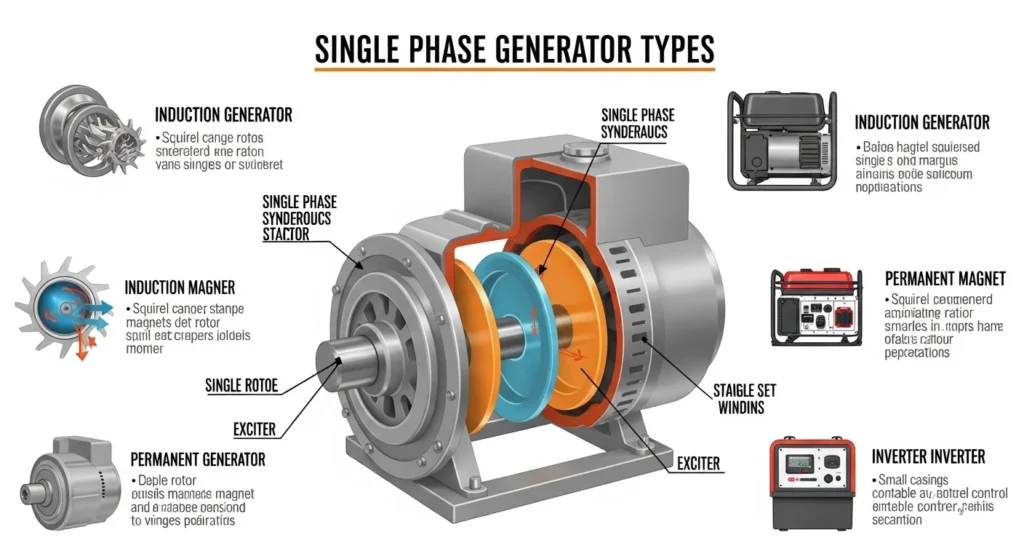
There are several single phase generator types, each designed for different uses and power capacities.
Portable Single Phase Generator
Portable generators are small and easy to move.
Features:
- Lightweight design
- Gasoline-powered engine
- Used for home backup power
These generators are commonly used during power outages.
Inverter Single Phase Generator
Inverter generators use modern electronics to produce clean and stable electricity.
Features:
- Stable voltage output
- Quiet operation
- Fuel efficient
These generators are ideal for sensitive devices such as laptops and mobile chargers.
Diesel Single Phase Generator
Diesel generators are widely used for continuous operation.
Features:
- High durability
- Lower fuel consumption for long usage
- Suitable for small commercial facilities
They are commonly used in small shops and workshops.
Gasoline Single Phase Generator
Gasoline generators are very common for home use.
Features:
- Easy to start
- Affordable price
- Suitable for light loads
They are widely used for residential backup power.
Standby Single Phase Generator
Standby generators automatically start when the main power supply fails.
Features:
- Automatic operation
- Permanent installation
- Reliable backup system
These generators are commonly used in homes and small offices.
5. Main Components
A single phase generator contains several important parts that work together to produce electricity.
Stator
The stator is the stationary part of the generator.
It contains the coil windings where electricity is produced.
Rotor
The rotor is the rotating part that produces the magnetic field.
It spins inside the stator.
Engine
The engine provides mechanical power to rotate the generator shaft.
Fuel System
The fuel system supplies gasoline or diesel to the engine.
Voltage Regulator
The voltage regulator maintains stable output voltage.
Cooling System
Cooling components prevent overheating during operation.
6. Advantages
Understanding single phase generator advantages and disadvantages helps users evaluate generator performance.
Advantages
- Simple and easy to operate
- Lower cost compared to three phase generators
- Ideal for home and small business use
- Portable models are available
- Suitable for light electrical loads
- Easy maintenance
Because of these advantages, single phase generators are widely used in residential environments.
7. Disadvantages / Limitations
Despite their benefits, single phase generators also have some limitations.
Disadvantages
- Limited power output
- Not suitable for heavy industrial machines
- Less efficient for large loads
- Voltage fluctuations may occur with overload
These limitations make them less suitable for large factories or heavy industrial systems.
8. Applications
The single phase generator applications are mainly found in homes, small businesses, and temporary power systems.
Residential Applications
- Home backup power
- Lighting systems
- Fans and household appliances
Small Commercial Applications
- Small shops
- Restaurants
- Offices
Construction Sites
Portable generators are used to operate small tools and equipment.
Outdoor Events
Single phase generators provide electricity for lighting and sound systems.
9. Comparison Section
Many beginners ask about the difference between single phase and three phase generators.
| Feature | Single Phase Generator | Three Phase Generator |
|---|---|---|
| Power Capacity | Lower | Higher |
| Efficiency | Moderate | High |
| Applications | Homes and small businesses | Large industries |
| Cost | Lower | Higher |
| Installation | Simple | More complex |
This comparison helps users choose the correct generator for their electrical needs.
10. Selection Guide
Choosing the correct single phase generator type requires proper planning.
Important Factors
- Total electrical load
- Type of appliances used
- Fuel type (gasoline or diesel)
- Portability requirements
- Budget
Tips for Beginners
- Calculate total wattage of appliances.
- Choose a generator with slightly higher capacity than required.
- Select models with automatic voltage regulation.
- Ensure proper safety features.
Proper selection ensures efficient and reliable power supply.
11. Common Problems & Solutions
Q1: Why does the generator fail to start?
This may happen due to low fuel or a weak battery.
Solution: Check the fuel level and battery condition.
Q2: Why does the generator produce unstable voltage?
This may occur due to a faulty voltage regulator.
Solution: Inspect and repair the voltage regulator.
Q3: Why does the generator overheat?
Overheating may occur if the generator is overloaded.
Solution: Reduce electrical load and allow proper ventilation.
Q4: Why is the generator producing unusual noise?
Noise may indicate mechanical wear or loose parts.
Solution: Inspect internal components and perform maintenance.
12. Future Trends
Modern single phase generator technology continues to improve.
Smart Generators
Many generators now include digital displays and remote monitoring systems.
Hybrid Power Systems
Some generators are designed to work with solar power systems.
Improved Fuel Efficiency
Manufacturers are developing engines that consume less fuel and produce lower emissions.
These improvements will make generators more efficient and environmentally friendly.
13. Conclusion
Single phase generators play an important role in providing reliable backup power for homes, small businesses, and portable electrical systems. Their simple design, easy operation, and affordable cost make them a popular choice for residential electricity needs.
Understanding single phase generator types, the single phase generator working principle, and their applications helps electricians and technicians select the right generator for different situations. While these generators are not suitable for heavy industrial loads, they perform extremely well in smaller power systems.
With improvements in generator technology, modern single phase generators are becoming more efficient, quieter, and more reliable. For students and professionals entering the electrical field, learning about generator systems is an important step toward understanding modern power generation and distribution.