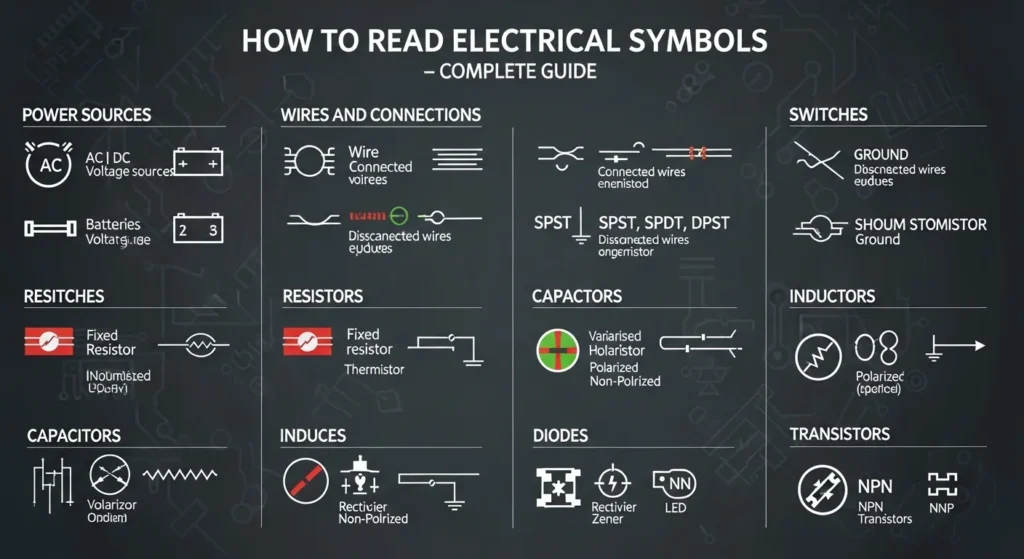

You are standing in front of an electrical control panel with a printed circuit diagram in your hand. The paper is full of lines, circles, zigzag shapes, and strange markings. You know the system should control motors and lights, but you cannot understand what those symbols mean. Without understanding the drawing, you cannot troubleshoot or install the system correctly.
This is where learning How to Read Electrical Symbols becomes essential.
Electrical symbols are the universal language of electrical engineering. Whether you are working on home wiring, industrial panels, or automation systems, you must understand circuit symbols to do your job properly and safely.
If you misread a symbol, you may connect wires incorrectly, damage equipment, or create a serious safety risk.
In this article, you will learn:
- What electrical symbols are
- The How to Read Electrical Symbols working principle
- Different types of electrical symbols
- Their applications in real projects
- Common mistakes and solutions
By the end, you will be able to confidently read basic electrical drawings like a professional.
2. What is How to Read Electrical Symbols?
Definition
How to Read Electrical Symbols refers to the ability to understand and interpret standard graphical signs used in electrical diagrams to represent components and connections.
These symbols represent real electrical devices such as switches, resistors, motors, transformers, and circuit breakers.
Simple Explanation
Think of electrical symbols like road signs.
- A red octagon means STOP.
- A triangle means warning.
Similarly:
- A zigzag line means resistor.
- A circle with “M” means motor.
- Two parallel lines mean capacitor.
Each symbol has a fixed meaning.
Practical Example
When you see this in a diagram:
- Battery symbol → Power source
- Switch symbol → On/Off control
- Bulb symbol → Load
If you can identify these correctly, you can understand the whole circuit.
3. Working Principle
How to Read Electrical Symbols Working Principle
Electrical drawings follow standard rules. Symbols replace real components to make diagrams simple and clear.
Step-by-Step Process
- Identify the power source.
- Follow the line connections.
- Recognize each symbol.
- Understand component function.
- Analyze current flow direction.
Easy Analogy
Imagine reading a map:
- Roads = Wires
- Cities = Components
- Direction arrows = Current flow
If you know map symbols, you can reach your destination.
If you know circuit symbols, you can understand the system.
Key Principles
- Symbols are standardized
- Lines represent wires
- Junction dots mean connection
- No dot means crossing without connection
This explains the How to Read Electrical Symbols working principle.
4. Types / Classification
Electrical symbols are classified based on their function.
Power Source Symbols
Power source symbols are graphical representations used in electrical and electronic circuit diagrams to show different types of electrical energy sources. These symbols help engineers, electricians, technicians, and students easily understand circuit connections and identify how electrical power is supplied to a system. Standardized symbols are important because they make circuit diagrams simple, universal, and easy to read across different countries and industries.
The most common power source symbols include the DC power source symbol and the AC power source symbol. A DC source, such as a battery or cell, is usually represented by long and short parallel lines. The longer line indicates the positive terminal, while the shorter line shows the negative terminal. AC power sources are commonly represented by a circle containing a sine wave symbol, indicating alternating current supply.
Other important symbols include generators, solar cells, and variable power supplies. In electronic circuits, symbols may also represent voltage sources, current sources, and ground connections. These symbols are used in electrical wiring diagrams, control panels, electronic schematics, and industrial systems.
Power source symbols help reduce confusion and improve communication in electrical design and troubleshooting. Without standardized symbols, circuit diagrams would become difficult to understand and maintain.
In conclusion, power source symbols are essential components of electrical and electronic diagrams that represent different types of energy supplies and help simplify circuit analysis, design, and maintenance.
These represent supply sources.
- Battery
- AC supply
- DC supply
- Generator
Used at the start of diagrams.
Passive Component Symbols
Passive component symbols are standard graphical representations used in electrical and electronic circuit diagrams to identify passive components such as resistors, capacitors, and inductors. These components are called “passive” because they do not generate electrical energy; instead, they store, control, or dissipate energy within a circuit. Standard symbols help engineers, students, and technicians easily understand circuit layouts and connections.
The most common passive component symbol is the resistor symbol, which is represented by a zigzag line or rectangular box depending on the standard used. Resistors are used to limit or control the flow of electric current. The capacitor symbol consists of two parallel lines and represents a component that stores electrical energy in an electric field. Polarized capacitors usually include a positive sign to indicate polarity.
Another important passive component is the inductor, represented by a series of curved loops or coils. Inductors store energy in the form of a magnetic field and are commonly used in filters, transformers, and AC circuits. Variable resistors, variable capacitors, and special passive devices also have unique symbols in circuit diagrams.
Passive component symbols are widely used in schematic diagrams, PCB designs, industrial circuits, and educational materials. These symbols simplify circuit analysis and make troubleshooting easier for technicians and engineers.
In conclusion, passive component symbols are essential for representing electrical and electronic components clearly in circuit diagrams, helping users understand, design, and maintain electrical systems efficiently.
These control current flow.
- Resistor
- Capacitor
- Inductor
- Fuse
These components limit, store, or filter energy.
Switching Device Symbols
Switching device symbols are standard graphical representations used in electrical and electronic circuit diagrams to show devices that control the flow of electric current. These symbols help engineers, electricians, technicians, and students understand how circuits are connected and operated. Switching devices are essential because they can open, close, or change the path of current in a circuit.
The most common switching device symbol is the switch symbol. A simple switch is represented by a break in a line with a movable contact. When the switch is closed, current flows through the circuit, and when it is open, the circuit is disconnected. Different types of switches such as single-pole single-throw (SPST), single-pole double-throw (SPDT), push-button switches, and selector switches have unique symbols.
Other important switching device symbols include relays, circuit breakers, and contactors. A relay symbol usually includes a coil and switching contacts, showing that it operates electrically. Circuit breaker symbols represent protective switching devices used to disconnect circuits during faults or overload conditions.
Switching device symbols are widely used in electrical wiring diagrams, control circuits, industrial automation systems, and electronic schematics. Standardized symbols make circuit diagrams easier to read, design, and troubleshoot.
In conclusion, switching device symbols are important parts of electrical and electronic diagrams that represent devices used to control and protect electrical circuits efficiently and safely.
Used to control circuits.
- SPST switch
- Push button
- Relay
- Circuit breaker
These symbols are common in control panels.
Load Symbols
Load symbols are standard graphical representations used in electrical and electronic circuit diagrams to show devices or equipment that consume electrical power. A load is any component that uses electrical energy to perform useful work such as producing light, heat, motion, or sound. These symbols help engineers, electricians, technicians, and students understand how electrical energy is used within a circuit.
Common load symbols include lamps, motors, heaters, fans, and speakers. For example, a lamp symbol is usually represented by a circle with a filament-like mark inside, indicating a lighting load. A motor symbol is commonly shown as a circle with the letter “M,” representing an electrical machine that converts electrical energy into mechanical energy. Heater symbols often use zigzag or coil shapes to represent heat-producing devices.
Load symbols are important in electrical schematics because they clearly identify the components that consume power. They are widely used in household wiring diagrams, industrial control systems, automation circuits, and electronic designs. By using standardized symbols, circuit diagrams become easier to read, troubleshoot, and maintain.
Different loads may operate on AC or DC supply depending on the application. In industrial systems, heavy loads such as motors and compressors require special symbols and protective devices.
In conclusion, load symbols are essential parts of electrical diagrams that represent power-consuming devices and help simplify circuit design, analysis, and maintenance in electrical and electronic systems.
Represent electrical devices.
- Lamp
- Motor
- Heater
- Buzzer
Loads consume electrical energy.
Protection Device Symbols
Protection device symbols are standard graphical representations used in electrical and electronic circuit diagrams to identify devices that protect circuits, equipment, and users from electrical faults and dangerous conditions. These symbols help engineers, electricians, technicians, and students easily understand safety components used in electrical systems.
The most common protection device symbol is the fuse symbol. A fuse protects a circuit by melting its internal wire when excessive current flows, disconnecting the circuit and preventing damage. Another important symbol is the circuit breaker symbol, which represents an automatic switching device that disconnects the power supply during overloads or short circuits.
Other protection device symbols include earthing symbols, surge protectors, lightning arresters, and thermal overload relays. The earthing symbol shows the connection between electrical equipment and the ground for safety against electric shock. Surge protection symbols represent devices that protect circuits from sudden voltage spikes caused by lightning or switching operations.
Protection device symbols are widely used in electrical wiring diagrams, industrial control panels, substations, electronic circuits, and power distribution systems. Standardized symbols make it easier to design, install, troubleshoot, and maintain safe electrical systems.
These devices are extremely important because they help prevent electrical fires, equipment damage, overheating, and electric shock accidents.
In conclusion, protection device symbols are essential elements of electrical and electronic diagrams that represent safety devices used to protect electrical systems, equipment, and human life from electrical faults and hazards.
Used for safety.
- MCB
- RCCB
- Fuse
- Earth symbol
These prevent damage and shock.
Control and Automation Symbols
Control and automation symbols are standard graphical representations used in electrical, industrial, and automation circuit diagrams to show control devices and automated system components. These symbols help engineers, technicians, electricians, and students understand how machines and control systems operate. They are widely used in factories, industrial plants, automation systems, and electrical control panels.
Common control and automation symbols include push buttons, relays, timers, contactors, sensors, programmable logic controllers (PLCs), and indicator lamps. A push-button symbol represents a manually operated switch used to start or stop a machine. Relay and contactor symbols show electrically operated switches used to control high-power circuits automatically. Timer symbols represent devices that control operations based on time delay.
Sensors are also important automation components and have special symbols depending on their type, such as proximity sensors, temperature sensors, and pressure sensors. PLC symbols are used in modern automation systems to represent programmable controllers that manage industrial processes automatically.
Control and automation symbols make electrical diagrams easier to read, design, troubleshoot, and maintain. They also help standardize industrial drawings so technicians worldwide can understand the same circuit diagrams.
These symbols are commonly found in motor control circuits, conveyor systems, robotic systems, manufacturing plants, and smart building automation.
In conclusion, control and automation symbols are essential parts of industrial and electrical diagrams that represent devices used to control, monitor, and automate machines and processes efficiently and safely.
Used in industrial systems.
- Contactor
- Timer
- Limit switch
- PLC
Important in motor control circuits.
5. Main Components
Understanding symbols requires knowing major parts of a diagram.
1. Lines (Conductors)
Represent wires connecting components.
2. Junction Dot
Indicates electrical connection.
3. Reference Numbers
Help identify components.
4. Labels and Ratings
Show voltage, current, or power values.
5. Legend / Key Table
Explains symbol meanings.
Each element improves clarity and accuracy.
6. Advantages
How to Read Electrical Symbols Advantages
- Easy circuit understanding
- Faster troubleshooting
- Accurate installation
- Reduced wiring mistakes
- Improved safety
- Better communication among engineers
- Saves time in projects
These points show the How to Read Electrical Symbols advantages and disadvantages clearly.
7. Disadvantages / Limitations
There are some limitations.
- Beginners feel confused initially
- Different countries may use slight variations
- Complex industrial drawings are difficult
- Requires practice
- Misinterpretation can cause errors
However, practice removes these difficulties.
8. Applications
How to Read Electrical Symbols Applications
Home Wiring
- Switchboard layout
- Lighting circuits
- Socket connections
Industrial Use
- Motor control circuits
- Control panels
- Power distribution systems
Electronics
- PCB diagrams
- Electronic devices
Modern Technology
- Solar systems
- Smart homes
- Automation systems
Electrical symbols are used in every electrical project.
9. Comparison Section
Difference Between Electrical Symbols and Wiring Diagrams
| Feature | Electrical Symbols | Wiring Diagram |
| Purpose | Represent components | Show actual connections |
| Detail Level | Basic representation | Detailed layout |
| Usage | Circuit understanding | Installation guide |
| Appearance | Simplified | Realistic wiring path |
| Complexity | Simple to moderate | Can be complex |
Understanding the difference between electrical symbols and wiring diagram is important for beginners.
10. Selection Guide
How to Learn and Choose the Right Diagram
1. Start with Basic Symbols
Learn common symbols first.
2. Use Standard Charts
Refer to IEC or ANSI standard charts.
3. Practice Simple Circuits
Start with lamp and switch diagrams.
4. Study Motor Control Circuits
Move to advanced diagrams gradually.
5. Use Simulation Software
Practice safely before real installation.
Tips for Beginners
- Memorize common symbols
- Follow current path
- Check legend table
- Avoid assumptions
- Practice daily
11. Common Problems & Solutions
Q1: I cannot understand where the circuit starts.
Solution: Locate power source symbol first.
Q2: Lines cross but do not connect. Why?
Answer: Only connected if a dot is present.
Q3: Why are some symbols different in books?
Cause: Different standards (IEC or ANSI).
Q4: How to avoid mistakes?
Solution: Double-check legend and ratings.
Q5: Can I learn without practical work?
Yes, but practical experience improves confidence.
12. Future Trends
Electrical drawing technology is evolving.
New Developments
- Digital circuit diagrams
- Smart CAD software
- 3D electrical modeling
- AI-based error detection
- Cloud-based design sharing
Industry Direction
- Paperless documentation
- Smart electrical panels
- Automated schematic generation
- Integrated IoT systems
Learning symbol reading will remain essential, even with modern tools.
13. Conclusion
Understanding How to Read Electrical Symbols is a fundamental skill for every electrical student and technician. Symbols are the universal language of electrical systems. Without this knowledge, it is impossible to read circuit diagrams correctly.
By learning basic symbols, understanding current flow, and practicing simple circuits, you can quickly improve your confidence. This skill helps in installation, troubleshooting, maintenance, and system design.
Although beginners may find diagrams confusing at first, regular practice makes them easy to understand. As a senior engineer, I strongly recommend mastering electrical symbols before working on real systems.
Keep learning, practicing, and reviewing diagrams daily. Strong basics lead to strong professional skills.