
Ohm’s LawImagine you are repairing a small electric fan at home. You connect it to a power supply, but it does not work properly. Sometimes it runs slowly, and sometimes it stops. You start wondering: Is the voltage correct? Is the wire too thin? Is there too much resistance in the circuit?
This is where Ohm’s Law becomes very important.
Ohm’s Law is one of the most basic and powerful rules in electrical engineering. It helps you understand the relationship between voltage, current, and resistance. Whether you are a student, technician, engineer, or beginner, you will use Ohm’s Law in almost every electrical task.
Without this knowledge, it is difficult to design safe circuits, select correct components, or fix electrical problems. Many beginners make mistakes simply because they do not apply Ohm’s Law properly.
In this article, “Ohm’s Law Explained with Examples,” you will learn its definition, working principle, types, components, advantages, disadvantages, applications, and future trends. By the end, you will be able to use Ohm’s Law confidently in real-life electrical work.
2. What is Ohm’s Law?
Definition
Ohm’s Law states that:
The current flowing through a conductor is directly proportional to the voltage and inversely proportional to the resistance.
In simple form:
V = I × R
Where:
- V = Voltage (Volts)
- I = Current (Amperes)
- R = Resistance (Ohms)
Simple Explanation
Ohm’s Law shows how voltage, current, and resistance are connected.
- More voltage → More current
- More resistance → Less current
If you control one value, the other two change automatically.
Practical Example
Suppose:
- Voltage = 10V
- Resistance = 5Ω
Using Ohm’s Law:
I = V / R = 10 / 5 = 2A
So, the current will be 2 amperes.
This is a basic example of Ohm’s Law in practice.
3. Working Principle of Ohm’s Law
Step-by-Step Explanation
- A power source supplies voltage.
- Voltage pushes electrons through the wire.
- Resistance slows down electron flow.
- Current flows according to resistance.
- Circuit completes and energy is used.
Easy Analogy
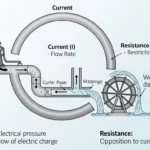
Think of water flowing in a pipe:
- Voltage = Water pressure
- Current = Water flow
- Resistance = Pipe size
If pressure increases, water flows more.
If pipe is narrow, water flows less.
Key Points (Bullet Form)
- Voltage is the driving force
- Resistance controls flow
- Current is the result
- All three are connected
- Formula: V = I × R
This explains the Ohm’s Law working principle clearly.
4. Types / Classification of Ohm’s Law
Ohm’s Law can be applied in different ways based on circuit conditions.
Basic Ohm’s Law
This is the standard form:
V = I × R
Used in simple DC circuits.
Example: Battery + Resistor + Bulb
Ohm’s Law for Current Calculation
Formula:
I = V / R
Used when voltage and resistance are known.
Example:
12V supply, 6Ω resistor
I = 12 / 6 = 2A
Ohm’s Law for Resistance Calculation
Formula:
R = V / I
Used when voltage and current are known.
Example:
V = 20V, I = 4A
R = 20 / 4 = 5Ω
Ohm’s Law in AC Circuits
In AC circuits, resistance is replaced by impedance (Z):
V = I × Z
Used in motors and transformers.
5. Main Components in Ohm’s Law Circuits
1. Voltage Source
Provides electrical pressure.
Examples:
- Battery
- Generator
- Power supply
2. Conductor (Wire)
Carries current.
Examples:
- Copper wire
- Aluminum cable
3. Resistor (Resistance)
Controls current flow.
Examples:
- Fixed resistor
- Variable resistor
4. Load
Uses electrical energy.
Examples:
- Bulb
- Motor
- Heater
5. Switch
Controls ON/OFF.
Example:
- Wall switch
6. Measuring Instruments
Measure values.
Examples:
- Voltmeter
- Ammeter
- Multimeter
All these components help apply Ohm’s Law practically.
6. Advantages of Ohm’s Law
Main Advantages
- Simple and easy formula
- Helps in circuit design
- Improves safety
- Saves time in calculations
- Useful for troubleshooting
Real-World Benefits
- Helps select correct wire size
- Prevents overload
- Protects devices
- Improves efficiency
- Reduces equipment damage
These points explain Ohm’s Law advantages and disadvantages clearly.
7. Disadvantages / Limitations of Ohm’s Law
Main Limitations
- Not valid for non-linear devices
- Does not work well with semiconductors
- Not accurate in high-temperature conditions
- Limited in complex circuits
- Not suitable for vacuum tubes
Practical Problems
Ohm’s Law does not work properly in:
- Diodes
- Transistors
- LEDs
- Integrated circuits
In these cases, advanced laws are needed.
8. Applications of Ohm’s Law
Home Applications
- Selecting bulbs
- Checking wiring
- Choosing adapters
- Preventing short circuits
Industrial Applications
- Motor control
- Panel design
- Load calculation
- Power distribution
Electronic Applications
- Circuit design
- PCB testing
- Power supplies
- Device repair
Renewable Energy Applications
- Solar system design
- Battery sizing
- Inverter selection
Modern Technology Uses
- Electric vehicles
- Smart devices
- Data centers
- Automation systems
These examples show wide Ohm’s Law applications.
9. Comparison Section: Ohm’s Law vs Kirchhoff’s Law
Comparison Table
| Feature | Ohm’s Law | Kirchhoff’s Law |
| Purpose | Relation of V, I, R | Loop and node analysis |
| Complexity | Simple | More complex |
| Usage | Basic circuits | Complex networks |
| Formula | V = IR | KVL, KCL |
| Level | Beginner | Advanced |
Explanation
Ohm’s Law is used first in learning.
Kirchhoff’s Law is used for advanced circuits.
This shows the difference between Ohm’s Law and Kirchhoff’s Law.
10. Selection Guide for Beginners
How to Use Ohm’s Law Correctly
Step 1: Identify Values
Find V, I, and R.
Step 2: Choose Formula
- For current → I = V / R
- For voltage → V = I × R
- For resistance → R = V / I
Step 3: Check Units
- Volts (V)
- Amperes (A)
- Ohms (Ω)
Step 4: Verify Result
Check if value is practical.
Tips for Beginners
- Always use multimeter
- Double-check units
- Avoid wrong polarity
- Start with low voltage
- Practice daily examples
11. Common Problems & Solutions (FAQs)
Q1: Why is my resistor heating?
Solution:
Current is too high. Use higher resistance.
Q2: Why does my bulb burn quickly?
Solution:
Excess voltage. Reduce supply.
Q3: Why is current very low?
Solution:
High resistance. Check connections.
Q4: Why is voltage dropping?
Solution:
Thin wires. Use thicker cables.
Q5: Why is my calculation wrong?
Solution:
Wrong units. Convert properly.
12. Future Trends in Electrical Laws and Applications
New Technology
- Smart measurement systems
- AI-based monitoring
- Digital multimeters
- Automatic fault detection
- Cloud-based analysis
Industry Direction
Future electrical systems will be:
- More intelligent
- More efficient
- Self-diagnosing
- Energy-saving
- Highly reliable
Ohm’s Law will remain the foundation of all these systems.
13. Conclusion
Ohm’s Law is the backbone of electrical engineering. It explains the simple but powerful relationship between voltage, current, and resistance. In this article, we discussed its definition, working principle, types, components, advantages, disadvantages, applications, comparison, selection guide, common problems, and future trends.
For beginners, mastering Ohm’s Law is the first step toward becoming a skilled electrician, technician, or engineer. It helps in designing safe circuits, solving faults, and improving system performance. Without this basic knowledge, advanced topics become difficult.
As a senior engineer would advise: practice calculations daily, use measuring tools properly, and always respect safety rules. With strong basics in Ohm’s Law, you can build a successful career in the electrical field.