
You are repairing a fan at home. The fan suddenly stops working. You check the plug, the switch, and the wiring, but everything looks normal. Now the real question is: Is voltage reaching the fan? Is the winding open? Is there a short circuit? Without the right tool, you are only guessing.
This is where a multimeter becomes your best friend.
A multimeter is one of the most important tools for any electrical student, technician, or engineer. Whether you are testing a battery, checking a socket, measuring resistance, or troubleshooting a control panel, this device gives you accurate information in seconds.
Understanding Multimeter Uses and Working Principle is essential for safe and professional electrical work. It helps prevent wrong connections, saves time, and improves fault diagnosis.
In this article, you will learn:
- What a multimeter is
- The Multimeter Uses and Working Principle
- Types of multimeters
- Advantages and disadvantages
- Practical applications
- Common mistakes and solutions
Let us start with the basics.
2. What is Multimeter Uses and Working Principle?
Definition
Multimeter Uses and Working Principle refers to understanding how a multimeter operates and how it is used to measure electrical quantities like voltage, current, and resistance.
A multimeter is a measuring instrument that combines multiple functions into one device.
Simple Explanation
Think of a multimeter as a doctor’s diagnostic tool for electrical circuits.
- It checks voltage (electrical pressure).
- It checks current (electrical flow).
- It checks resistance (opposition to flow).
Without measurement, you cannot diagnose electrical problems.
Practical Example
If your car battery is weak:
- Use multimeter
- Set to DC voltage
- Measure battery terminals
If reading is below 12V, battery needs charging.
That is the practical power of this tool.
3. Working Principle
Multimeter Uses and Working Principle Explained
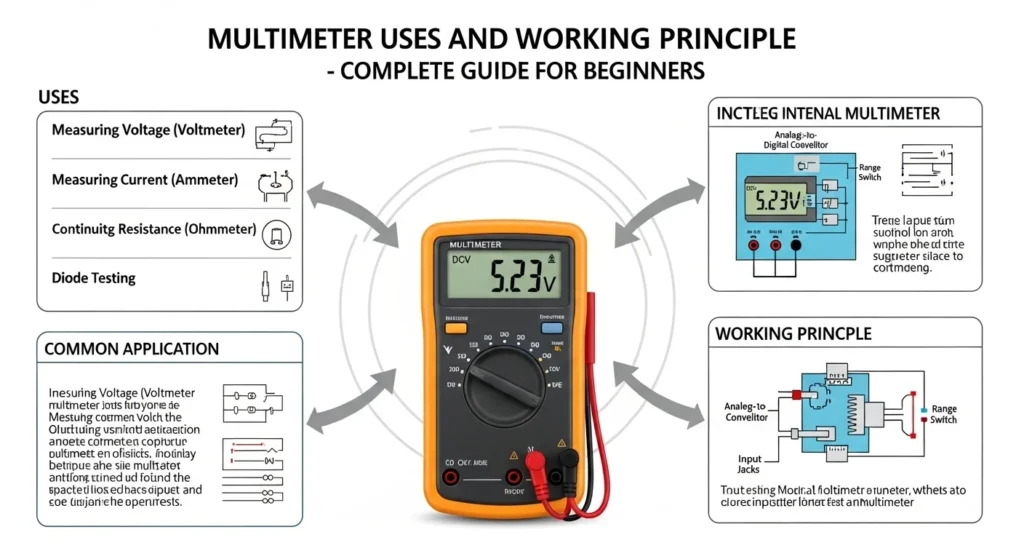
A multimeter works by connecting probes to a circuit and measuring electrical parameters.
Step-by-Step Explanation
- Select measurement type (Voltage, Current, Resistance).
- Set proper range.
- Insert probes into correct ports.
- Touch probes to test points.
- Read value on display.
How It Measures Voltage
- Connected in parallel.
- Measures potential difference.
- Does not interrupt circuit.
How It Measures Current
- Connected in series.
- Current flows through meter.
- Uses internal shunt resistor.
How It Measures Resistance
- Sends small internal voltage.
- Measures current flow.
- Calculates resistance using Ohm’s law.
Easy Analogy
Imagine checking water system:
- Voltage = Water pressure
- Current = Water flow
- Resistance = Pipe blockage
Multimeter checks all three.
Key Principles
- Must select correct function.
- Must choose correct range.
- Wrong setting can damage meter.
This explains the Multimeter Uses and Working Principle clearly.
4. Types / Classification
Analog Multimeter
Description:
- Uses needle display
- Moving coil mechanism
Features:
- Affordable
- Requires manual reading
- Less accurate
Best For:
- Basic testing
- Educational purposes
Digital Multimeter (DMM)
Description:
- Uses digital display
- Electronic measurement system
Features:
- High accuracy
- Easy to read
- Auto-ranging available
Best For:
- Professional use
- Industrial troubleshooting
Clamp Multimeter
Description:
- Measures current without breaking circuit
- Uses clamp sensor
Features:
- Safe for high current
- Non-contact measurement
Best For:
- Industrial panels
- Motor testing
Auto-Ranging Multimeter
Description:
- Automatically selects range
Features:
- Beginner-friendly
- Prevents wrong range errors
5. Main Components
1. Display Screen
Shows measured values.
2. Selector Switch
Chooses measurement type.
3. Input Terminals
Ports for probe connection.
4. Test Probes
Red (positive) and black (common).
5. Internal Circuit
Contains resistors, ADC converter, shunt resistor.
6. Fuse
Protects meter from overload.
Each component ensures safe and accurate measurement.
6. Advantages
Multimeter Uses and Working Principle Advantages
- Measures multiple parameters
- Portable and compact
- Saves time
- Improves safety
- Accurate troubleshooting
- Cost-effective
- Essential for maintenance
These points show Multimeter Uses and Working Principle advantages and disadvantages clearly.
7. Disadvantages / Limitations
- Wrong settings may damage meter
- Cheap meters give inaccurate results
- Analog reading errors possible
- Limited high-frequency testing
- Requires basic knowledge
Despite limitations, it remains essential.
8. Applications
Multimeter Uses and Working Principle Applications
Home Applications
- Checking socket voltage
- Testing batteries
- Identifying blown fuses
- Checking appliance faults
Industrial Applications
- Motor testing
- Control panel troubleshooting
- Power supply testing
- Maintenance inspection
Automotive Applications
- Battery voltage check
- Alternator testing
- Fuse diagnosis
Modern Technology
- Solar panel voltage check
- EV battery systems
- Smart devices testing
Multimeter is used everywhere electricity exists.
9. Comparison Section
Difference Between Analog and Digital Multimeter
| Feature | Analog Multimeter | Digital Multimeter |
| Display | Needle | LCD Screen |
| Accuracy | Medium | High |
| Reading | Manual scale | Direct number |
| Cost | Low | Medium |
| Ease of Use | Moderate | Easy |
| Durability | Moderate | High |
Understanding the difference between analog and digital multimeter helps in proper selection.
10. Selection Guide
How to Choose the Right Multimeter
1. Determine Purpose
- Home use → Basic DMM
- Industrial use → True RMS DMM
2. Check Accuracy
Higher accuracy for professional work.
3. Safety Rating
CAT III or CAT IV for industrial use.
4. Features Needed
- Auto-ranging
- Backlight
- Continuity buzzer
- Clamp feature
5. Budget
Do not compromise safety for low cost.
Tips for Beginners
- Always start with highest range
- Never measure resistance on live circuit
- Check probe condition
- Replace blown fuse immediately
- Follow safety precautions
11. Common Problems & Solutions
Q1: Multimeter shows zero voltage. Why?
Cause: Wrong setting
Solution: Select correct voltage mode
Q2: Fuse inside meter blows frequently?
Cause: Measuring current incorrectly
Solution: Check range and connection
Q3: Reading fluctuates?
Cause: Loose probe contact
Solution: Hold probes firmly
Q4: No display?
Cause: Dead battery
Solution: Replace battery
Q5: Can I measure AC current directly?
Only if meter supports AC current or use clamp meter.
12. Future Trends
Multimeter technology is evolving.
New Developments
- Bluetooth-enabled multimeters
- Smartphone integration
- Wireless data logging
- Smart diagnostic features
- True RMS advanced measurement
Industry Direction
- AI-based fault analysis
- Cloud data storage
- Integration with IoT systems
- Safer high-voltage measurement tools
Future multimeters will be smarter, faster, and safer.
13. Conclusion
Understanding Multimeter Uses and Working Principle is fundamental for every electrical professional. A multimeter is not just a tool; it is a diagnostic partner that helps you identify problems quickly and safely.
From measuring voltage and current to checking resistance and continuity, it plays a vital role in home repairs, industrial maintenance, and modern technology systems.
Choosing the right multimeter and using it correctly ensures accurate results and prevents accidents. Always follow proper settings and safety precautions while testing.
As a senior engineer, I strongly recommend mastering multimeter basics before handling complex electrical systems. Strong measurement skills build strong troubleshooting confidence.
Practice regularly and respect electrical safety at all times.