
You are repairing a fan at home. The fan suddenly stops working. You check the plug, the switch, and the wiring, but everything looks normal. Now the real question is: Is voltage reaching the fan? Is the winding open? Is there a short circuit? Without the right tool, you are only guessing.
This is where a multimeter becomes your best friend.
A multimeter is one of the most important tools for any electrical student, technician, or engineer. Whether you are testing a battery, checking a socket, measuring resistance, or troubleshooting a control panel, this device gives you accurate information in seconds.
Understanding Multimeter Uses and Working Principle is essential for safe and professional electrical work. It helps prevent wrong connections, saves time, and improves fault diagnosis.
In this article, you will learn:
- What a multimeter is
- The Multimeter Uses and Working Principle
- Types of multimeters
- Advantages and disadvantages
- Practical applications
- Common mistakes and solutions
Let us start with the basics.
2. What is Multimeter Uses and Working Principle?
Definition
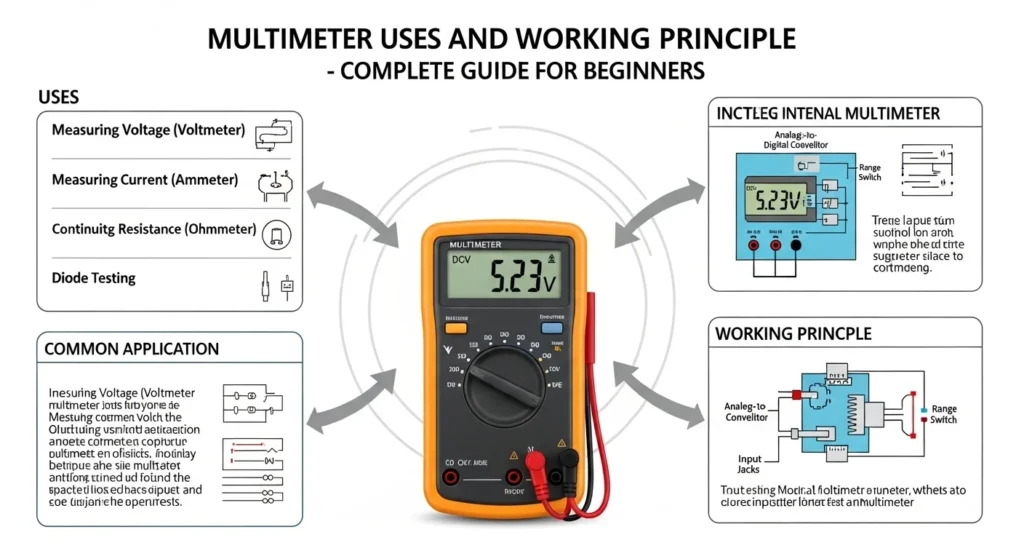
Multimeter Uses and Working Principle refers to understanding how a multimeter operates and how it is used to measure electrical quantities like voltage, current, and resistance.
A multimeter is a measuring instrument that combines multiple functions into one device.
Simple Explanation
Think of a multimeter as a doctor’s diagnostic tool for electrical circuits.
- It checks voltage (electrical pressure).
- It checks current (electrical flow).
- It checks resistance (opposition to flow).
Without measurement, you cannot diagnose electrical problems.
Practical Example
If your car battery is weak:
- Use multimeter
- Set to DC voltage
- Measure battery terminals
If reading is below 12V, battery needs charging.
That is the practical power of this tool.
3. Working Principle
Multimeter Working Principle
A multimeter is a versatile electrical measuring instrument used to test voltage, current, resistance, and other electrical parameters in circuits and electronic devices. The multimeter working principle is based on measuring the flow of electricity and converting it into a readable value on the display. Depending on the selected function, the multimeter uses different internal circuits to measure voltage, current, or resistance accurately. Before taking any measurement, the user selects the desired measurement mode, connects the test probes correctly, and places them on the appropriate test points. The meter then processes the electrical signal and displays the measured value instantly. Modern digital multimeters use electronic circuits and microprocessors for high accuracy, while analog multimeters use a moving pointer to indicate readings.
Step-by-Step Working Process
- Select the Measurement Function
- Turn the rotary selector to the required function such as AC voltage, DC voltage, AC current, DC current, or resistance.
- Choose the Appropriate Measurement Range
- Select the correct measurement range if using a manual-ranging multimeter. Auto-ranging multimeters adjust the range automatically.
- Connect the Test Probes
- Insert the black probe into the COM terminal.
- Insert the red probe into the correct input terminal based on the selected measurement.
- Place the Probes on the Circuit
- Touch the probes to the appropriate test points while following the correct measurement method.
- Measure the Electrical Parameter
- The multimeter detects the electrical signal, processes it using its internal circuitry, and displays the measured value on the screen.
- Read and Record the Result
- Observe the displayed reading and compare it with the expected value to determine whether the circuit is operating correctly.
How a Multimeter Measures Different Electrical Quantities
How a Multimeter Measures Voltage
Voltage measurement determines the electrical potential difference between two points in a circuit. To measure voltage, the multimeter is connected in parallel with the component or power source being tested. Since the multimeter has a very high internal resistance in voltage mode, it draws only a tiny amount of current and does not significantly affect the circuit’s operation.
Working Steps
- Select AC or DC voltage mode.
- Connect the probes in parallel across the circuit.
- The multimeter senses the voltage difference.
- Internal electronic circuits process the signal.
- The measured voltage is displayed on the screen.
How a Multimeter Measures Current
Current measurement determines the amount of electrical current flowing through a circuit. Unlike voltage measurement, the multimeter must be connected in series so that the entire circuit current passes through the meter. A low-resistance internal shunt resistor allows the multimeter to measure current safely by detecting the voltage drop across the resistor.
Working Steps
- Select the current measurement function.
- Move the red probe to the current input terminal if required.
- Open the circuit and connect the multimeter in series.
- Current flows through the internal shunt resistor.
- The meter calculates and displays the current value.
How a Multimeter Measures Resistance
Resistance measurement determines how much a component opposes the flow of electrical current. During this test, the multimeter uses its internal battery to send a small current through the component. By measuring the resulting voltage and current, it calculates the resistance using Ohm’s Law.
Working Steps
- Turn off power to the circuit.
- Select the resistance (Ω) function.
- Place the probes across the component.
- The multimeter sends a small test current.
- Internal circuits calculate the resistance.
- The resistance value is displayed on the screen.
Note: Never measure resistance on a live circuit, as it may damage the multimeter and produce incorrect readings.
Simple Analogy
Imagine a household water system to understand how a multimeter works:
- Voltage is like the water pressure pushing water through the pipes.
- Current is like the amount of water flowing through the pipes.
- Resistance is like a blockage or narrow section that restricts water flow.
A multimeter acts like a diagnostic tool that measures all three conditions to determine whether the electrical system is operating properly.
Key Principles of Multimeter Operation
- Always select the correct measurement function before testing.
- Choose the appropriate measurement range or use an auto-ranging multimeter.
- Connect the probes to the correct input terminals.
- Measure voltage in parallel with the circuit.
- Measure current in series with the circuit.
- Turn off circuit power before measuring resistance.
- Never exceed the multimeter’s maximum voltage or current rating.
- Use insulated probes and follow electrical safety procedures during testing.
Understanding the multimeter working principle helps electrical students, engineers, and technicians perform accurate measurements, troubleshoot electrical faults efficiently, and work safely with electrical and electronic circuits.
4. Types / Classification
Analog Multimeter
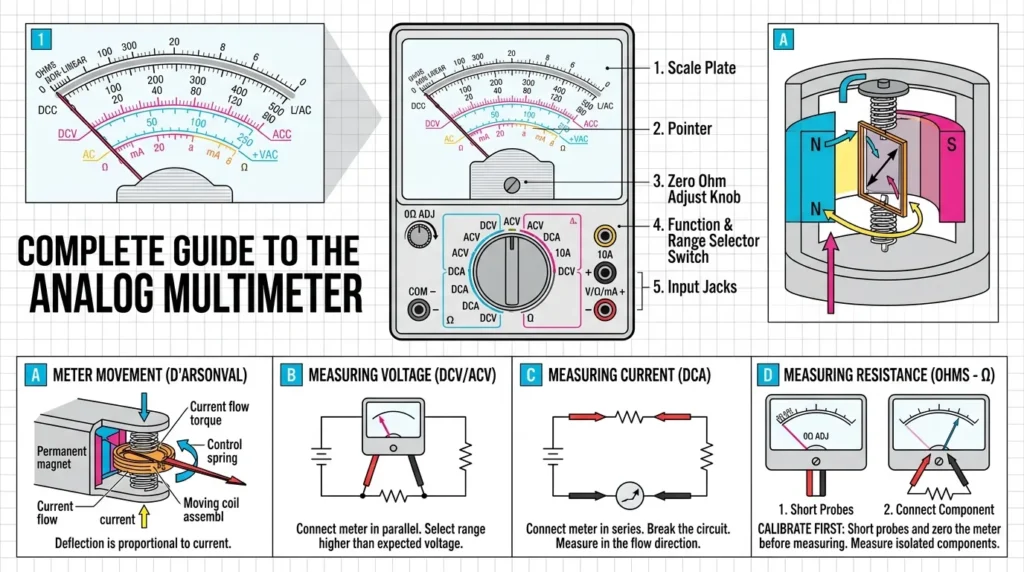
An Analog Multimeter is a basic electrical measuring instrument used to measure voltage, current, and resistance in electrical and electronic circuits. It shows readings using a moving pointer (needle) on a printed scale instead of a digital display. Because of its simple structure and easy operation, it is widely used by students, electricians, and technicians for basic testing and troubleshooting work.
The working of an analog multimeter is based on the movement of a coil in a magnetic field. When electrical current flows through the internal coil, it creates a magnetic effect that moves the needle across the scale. The position of the needle directly shows the value of the measured quantity. This makes it very useful for observing continuous changes in voltage or current.
An analog multimeter can measure both AC and DC voltage, current, and resistance. It is commonly used in electrical labs, workshops, and repair centers. It also helps in checking batteries, wires, switches, and simple electronic components. The selector switch allows users to choose different measurement ranges for safe and accurate readings.
One of the main advantages of an analog multimeter is that it clearly shows fluctuations in readings, which helps in understanding unstable signals. It also does not require external power for voltage and current measurement. However, it has some limitations such as lower accuracy compared to digital multimeters and the possibility of reading errors due to parallax effect.
In conclusion, the analog multimeter is a simple, durable, and useful measuring device that plays an important role in basic electrical testing and learning applications.
Description:
- Uses needle display
- Moving coil mechanism
Features:
- Affordable
- Requires manual reading
- Less accurate
Best For:
- Basic testing
- Educational purposes
Digital Multimeter (DMM)
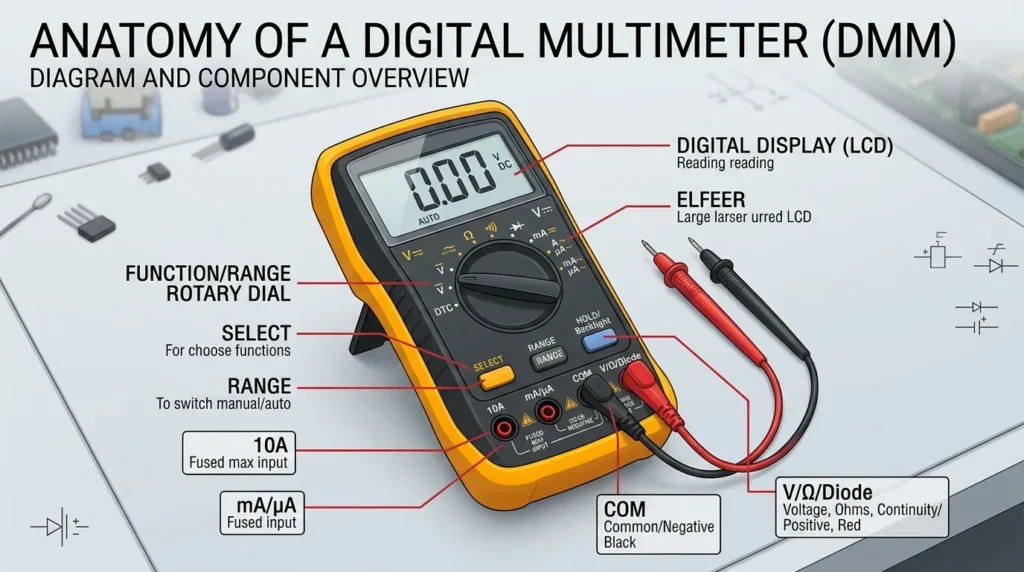
A Digital Multimeter (DMM) is an advanced electrical measuring instrument used to measure voltage, current, resistance, and other electrical parameters with high accuracy. It displays readings in digital form on an LCD or LED screen, making it easier to read compared to analog meters. Due to its precision, speed, and reliability, a DMM is widely used by electricians, engineers, technicians, and students in electrical and electronic work.
The working of a digital multimeter is based on converting analog electrical signals into digital values using an internal Analog-to-Digital Converter (ADC). When a measurement is taken, the input signal (voltage, current, or resistance) is processed, converted into digital data, and then shown on the display screen. This ensures accurate and fast readings.
A digital multimeter can measure various electrical quantities such as AC voltage, DC voltage, AC current, DC current, resistance, continuity, and sometimes frequency, capacitance, and temperature. The selector dial allows users to choose the required measurement mode easily and safely.
One of the main advantages of a digital multimeter is its high accuracy and clear display. It eliminates reading errors that are common in analog meters, such as parallax error. It is also more compact, portable, and often includes additional features like auto-ranging and data hold functions.
However, a DMM also has some limitations. It requires a battery for operation, and in some cases, very fast fluctuations in readings may not be easily visible compared to analog meters. It is also slightly more expensive than basic analog instruments.
In conclusion, the digital multimeter (DMM) is a modern, accurate, and user-friendly measuring device that plays a vital role in electrical testing, troubleshooting, and maintenance in both educational and industrial applications.
Description:
- Uses digital display
- Electronic measurement system
Features:
- High accuracy
- Easy to read
- Auto-ranging available
Best For:
- Professional use
- Industrial troubleshooting
Clamp Multimeter
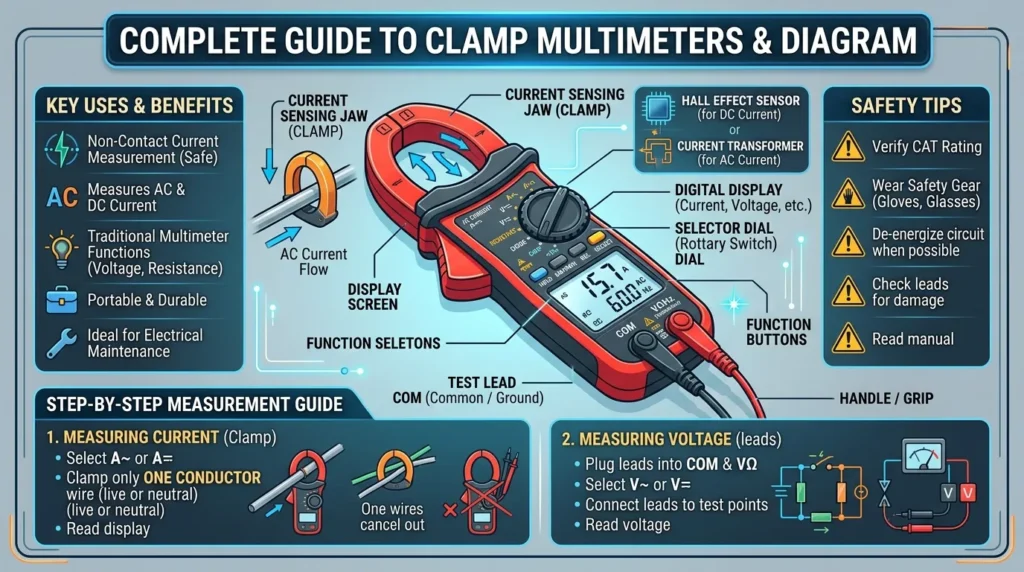
A Clamp Multimeter is a special type of electrical measuring instrument used to measure current in a conductor without making direct contact with the wire. It is also known as a clamp meter because it has a jaw-like clamp that easily opens and surrounds the cable to measure current safely. This makes it very useful for electricians, technicians, and engineers working in live electrical systems.
The working principle of a clamp multimeter is based on electromagnetic induction. When an electric current flows through a conductor, it creates a magnetic field around it. The clamp sensor detects this magnetic field and converts it into a readable current value on the display. Some advanced models can also measure voltage, resistance, frequency, and continuity.
A clamp multimeter mainly consists of a digital display, clamp jaws, function selector switch, and control buttons. The jaws are placed around a single conductor, and the instrument measures the current without breaking the circuit. This makes it much safer compared to traditional meters.
One of the biggest advantages of a clamp multimeter is safety, because users do not need to disconnect wires or touch live parts. It is also very convenient for measuring high current in industrial machines, motors, and distribution panels. Modern clamp meters are compact, portable, and provide fast digital readings.
However, clamp multimeters also have some limitations. They may not provide highly accurate readings for very low current values, and proper placement around a single conductor is required for correct measurement. Incorrect usage can lead to wrong readings.
In conclusion, a clamp multimeter is a safe, fast, and efficient tool used for measuring current in electrical systems without direct contact. It is widely used in industrial maintenance, power distribution, and electrical troubleshooting applications.
Description:
- Measures current without breaking circuit
- Uses clamp sensor
Features:
- Safe for high current
- Non-contact measurement
Best For:
- Industrial panels
- Motor testing
Auto-Ranging Multimeter
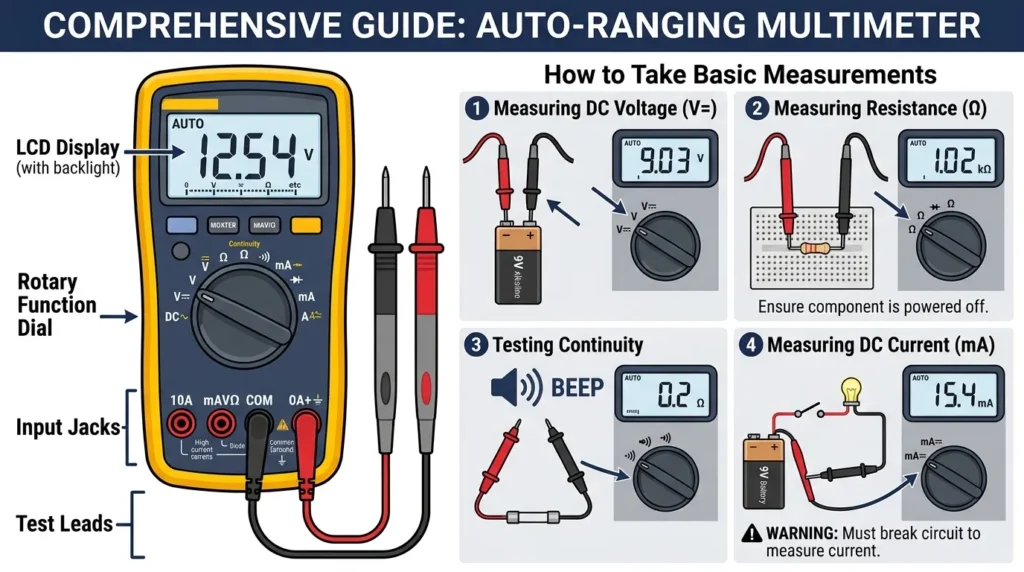
An Auto-Ranging Multimeter is an advanced type of digital multimeter that automatically selects the correct measurement range for voltage, current, or resistance. Unlike manual multimeters, where the user must choose the range, an auto-ranging multimeter detects the signal level and adjusts itself instantly. This makes it very easy to use, especially for beginners and field technicians.
The working of an auto-ranging multimeter is based on an internal microprocessor and Analog-to-Digital Converter (ADC) system. When a measurement is taken, the device first senses the input signal, analyzes its value, and then automatically selects the most suitable range for accurate reading. The final result is displayed clearly on the digital screen.
An auto-ranging multimeter can measure AC/DC voltage, AC/DC current, resistance, continuity, and in many models, additional parameters like capacitance, frequency, and temperature. The automatic range selection reduces the chances of incorrect settings and improves measurement efficiency.
One of the main advantages of an auto-ranging multimeter is its ease of use. Users do not need technical knowledge to set measurement ranges manually. It also reduces human error, saves time, and provides more accurate readings. This makes it ideal for students, electricians, and technicians working on complex circuits.
However, there are some limitations. Auto-ranging multimeters are usually more expensive than manual ones. They may also take slightly more time to stabilize readings because the device is continuously selecting the correct range. In some situations, experienced users may prefer manual range selection for faster control.
In conclusion, an auto-ranging multimeter is a smart and user-friendly measuring device that simplifies electrical testing. Its automatic range selection, accuracy, and convenience make it highly useful in modern electrical and electronic applications.
Description:
- Automatically selects range
Features:
- Beginner-friendly
- Prevents wrong range errors
Main Components of a Multimeter
A multimeter consists of several important components that work together to measure electrical parameters accurately and safely. Each part performs a specific function, ensuring reliable measurements of voltage, current, resistance, and other electrical values. Understanding these components helps electrical students, engineers, and technicians use the instrument correctly and maintain its performance.
1. Display Screen
The display screen is the output section of the multimeter where all measurement results are shown. Modern digital multimeters use a large LCD or LED display that provides clear and accurate readings, while analog multimeters use a moving pointer and calibrated scale. Many advanced digital multimeters also display additional information such as battery status, measurement units, polarity, and warning indicators.
Functions
- Displays measured electrical values
- Shows voltage, current, resistance, and continuity readings
- Indicates measurement units such as V, A, Ω, Hz, and others
- Displays low battery and overload warnings
- Provides easy-to-read digital measurements
2. Selector Switch (Rotary Dial)
The selector switch, also called the rotary dial, allows the user to choose the desired measurement function and range. It is the primary control used before taking any measurement. Depending on the multimeter model, the selector switch can be used to measure AC voltage, DC voltage, AC current, DC current, resistance, continuity, diode testing, capacitance, frequency, and temperature.
Functions
- Selects the measurement type
- Chooses the appropriate measurement range
- Switches between AC and DC measurements
- Prevents incorrect measurement settings
- Enables different testing functions
3. Input Terminals
The input terminals are the connection ports where the test probes are inserted. Most digital multimeters have three or four terminals, each designed for a specific measurement purpose. Connecting the probes to the correct terminal is essential for obtaining accurate readings and preventing damage to the meter.
Common Input Terminals
- COM Terminal – Common (black probe) connection
- VΩ Terminal – Used for voltage, resistance, continuity, diode, and frequency measurements
- mA/μA Terminal – Used for measuring small currents
- 10A or 20A Terminal – Used for measuring high currents
Functions
- Provides secure probe connections
- Routes electrical signals to internal circuits
- Supports different measurement functions
- Protects the meter from incorrect connections
4. Test Probes
The test probes are insulated leads used to connect the multimeter to the electrical circuit under test. A standard multimeter includes a red probe and a black probe. The black probe is connected to the COM terminal, while the red probe is connected to the appropriate measurement terminal.
Functions
- Transfer electrical signals from the circuit to the multimeter
- Allow safe contact with electrical test points
- Provide accurate voltage, current, and resistance measurements
- Enable testing in hard-to-reach locations
Probe Colors
- Red Probe: Positive or measurement probe
- Black Probe: Common or reference probe
5. Internal Circuit
The internal circuit is the heart of the multimeter. It processes the electrical signals received from the test probes and converts them into readable values displayed on the screen. Modern digital multimeters use precision electronic components to ensure high accuracy and reliable performance.
Main Internal Components
- Precision resistors
- Shunt resistor
- Analog-to-Digital Converter (ADC)
- Microprocessor
- Signal conditioning circuits
- Voltage divider network
Functions
- Processes electrical signals
- Converts analog signals into digital values
- Calculates voltage, current, and resistance
- Maintains measurement accuracy
- Protects sensitive electronic components
6. Fuse
The fuse is an important safety component that protects both the multimeter and the user from excessive current. If the measured current exceeds the meter’s safe operating limit, the fuse blows automatically and disconnects the circuit, preventing damage to the internal electronics.
High-quality digital multimeters often include separate fuses for low-current and high-current measurement ranges.
Functions
- Protects the multimeter from overload
- Prevents damage to internal circuits
- Improves user safety
- Disconnects excessive current automatically
- Reduces the risk of electrical accidents
7. Internal Battery
The internal battery supplies power to the digital display and internal electronic circuits. It also provides the small test voltage required for resistance, continuity, and diode testing.
Functions
- Powers the digital display
- Operates the internal electronic circuits
- Supplies test voltage during resistance measurements
- Supports continuity and diode testing
8. Protective Housing
The protective housing forms the outer body of the multimeter. It protects the internal components from dust, moisture, accidental impacts, and everyday wear. Most modern multimeters feature durable plastic construction with rubber protective covers for improved grip and shock resistance.
Functions
- Protects internal electronic components
- Improves durability
- Provides electrical insulation
- Enhances user safety
- Increases resistance to accidental drops
9. Printed Circuit Board (PCB)
The Printed Circuit Board (PCB) holds and connects all the electronic components inside the multimeter. It provides electrical pathways between the resistors, ADC, microprocessor, display, and other internal parts.
Functions
- Supports electronic components
- Provides electrical connections
- Ensures stable circuit operation
- Improves measurement reliability
Each of these components plays a vital role in ensuring that a multimeter delivers safe, accurate, and reliable electrical measurements. Together, they enable technicians, engineers, and students to troubleshoot electrical systems efficiently and perform precise testing in residential, commercial, and industrial applications.
6. Advantages
Multimeter Uses and Working Principle Advantages
- Measures multiple parameters
- Portable and compact
- Saves time
- Improves safety
- Accurate troubleshooting
- Cost-effective
- Essential for maintenance
These points show Multimeter Uses and Working Principle advantages and disadvantages clearly.
7. Disadvantages / Limitations
- Wrong settings may damage meter
- Cheap meters give inaccurate results
- Analog reading errors possible
- Limited high-frequency testing
- Requires basic knowledge
Despite limitations, it remains essential.
Multimeter Applications
Understanding multimeter applications is essential for anyone working with electrical or electronic systems. A multimeter is one of the most versatile testing instruments because it can measure voltage, current, resistance, continuity, and other electrical parameters. It is widely used by electricians, engineers, technicians, students, mechanics, and maintenance professionals to diagnose faults, verify electrical connections, and ensure equipment operates safely and efficiently. From simple household repairs to complex industrial maintenance, a multimeter is an indispensable tool wherever electricity is used.
Home Applications
A multimeter is extremely useful for household electrical maintenance and troubleshooting. It helps homeowners and technicians quickly identify electrical problems without replacing parts unnecessarily.
Common Home Applications
- Checking wall socket voltage
- Testing household batteries
- Identifying blown fuses
- Troubleshooting electrical appliances
- Checking extension cords for continuity
- Testing light switches and electrical outlets
- Verifying power supply to home equipment
- Inspecting doorbells and low-voltage circuits
- Checking electrical wiring connections
- Testing home inverter and UPS systems
These applications help improve electrical safety and reduce repair costs in residential environments.
Industrial Applications
In industrial facilities, multimeters play a vital role in preventive maintenance, equipment inspection, and fault diagnosis. They help technicians quickly detect electrical problems and minimize production downtime.
Common Industrial Applications
- Electric motor testing
- Motor winding resistance measurement
- Control panel troubleshooting
- Power supply testing
- Electrical maintenance inspections
- Transformer testing
- Generator maintenance
- Industrial machine diagnostics
- Cable continuity testing
- Checking overload protection devices
- Monitoring voltage and current levels
- Commissioning new electrical installations
Industrial technicians rely on multimeters to ensure electrical systems operate safely and efficiently.
Automotive Applications
Modern vehicles contain complex electrical and electronic systems that require accurate testing. A multimeter is one of the most important diagnostic tools used by automotive technicians.
Common Automotive Applications
- Checking car battery voltage
- Testing alternator charging voltage
- Diagnosing blown fuses
- Measuring starter motor voltage
- Testing vehicle wiring harnesses
- Checking ignition system voltage
- Inspecting sensors and switches
- Testing relays
- Verifying charging system performance
- Diagnosing electrical faults in vehicles
These tests help identify electrical issues quickly and improve vehicle reliability.
Electronics Applications
Electronic technicians use multimeters to assemble, repair, and troubleshoot electronic circuits and devices.
Common Electronics Applications
- Testing resistors
- Measuring capacitor voltage
- Checking diode operation
- Testing transistors
- Verifying continuity on printed circuit boards (PCBs)
- Inspecting power adapters
- Troubleshooting electronic circuits
- Repairing consumer electronics
Renewable Energy Applications
With the increasing use of renewable energy systems, multimeters have become essential tools for installation and maintenance.
Common Renewable Energy Applications
- Solar panel voltage testing
- Solar battery inspection
- Charge controller testing
- Inverter voltage measurement
- Wind turbine electrical testing
- Battery bank maintenance
- Renewable energy system troubleshooting
These measurements ensure renewable energy systems operate efficiently and safely.
Modern Technology Applications
As technology advances, multimeters are increasingly used to test and maintain smart electrical systems and electronic devices.
Common Modern Applications
- Electric vehicle (EV) battery system testing
- Smart home device troubleshooting
- IoT sensor testing
- USB power supply testing
- Laptop and computer power diagnostics
- Mobile phone charger testing
- LED lighting system maintenance
- Smart appliance inspection
Modern digital multimeters often include advanced functions such as frequency, capacitance, temperature, and duty cycle measurements, making them suitable for today’s sophisticated electronic systems.
Educational and Laboratory Applications
Multimeters are widely used in schools, colleges, universities, and research laboratories to teach electrical and electronic principles.
Common Educational Applications
- Electrical experiments
- Electronics laboratory testing
- Student practical training
- Circuit analysis
- Engineering projects
- Research and development work
They help students understand electrical concepts through accurate real-time measurements.
Communication and Telecommunications Applications
Telecommunication engineers use multimeters to maintain communication equipment and network infrastructure.
Common Applications
- Testing communication power supplies
- Checking backup batteries
- Inspecting network equipment
- Troubleshooting telecom circuits
- Measuring DC power systems
HVAC Applications
Heating, Ventilation, and Air Conditioning (HVAC) technicians use multimeters for diagnosing electrical faults in climate control systems.
Common HVAC Applications
- Testing compressors
- Measuring thermostat voltage
- Checking blower motors
- Inspecting control circuits
- Verifying capacitor operation
Why Multimeters Are Essential
A multimeter is one of the most valuable electrical testing instruments because it combines multiple measurement functions in a single portable device. Whether working in a home, factory, workshop, laboratory, vehicle, or renewable energy installation, a multimeter provides fast, accurate, and reliable measurements that help diagnose faults, improve safety, and ensure the efficient operation of electrical and electronic systems. Simply put, wherever electricity exists, a multimeter is an essential tool for testing, troubleshooting, and maintenance.
9. Comparison Section
Difference Between Analog and Digital Multimeter
| Feature | Analog Multimeter | Digital Multimeter |
| Display | Needle | LCD Screen |
| Accuracy | Medium | High |
| Reading | Manual scale | Direct number |
| Cost | Low | Medium |
| Ease of Use | Moderate | Easy |
| Durability | Moderate | High |
Understanding the difference between analog and digital multimeter helps in proper selection.
Selection Guide: How to Choose the Right Multimeter
Choosing the right multimeter is essential for obtaining accurate measurements, ensuring user safety, and improving troubleshooting efficiency. The ideal multimeter depends on your application, measurement requirements, working environment, and budget. Whether you are a beginner, electrician, technician, or electrical engineer, selecting the appropriate multimeter will make electrical testing safer and more reliable.
1. Determine Your Purpose
The first step is to identify where and how you will use the multimeter. Different applications require different features and performance levels.
Home Use
For basic household electrical work, a standard digital multimeter (DMM) is usually sufficient.
Suitable for:
- Checking wall socket voltage
- Testing household batteries
- Measuring resistance
- Checking fuses
- Troubleshooting home appliances
Industrial Use
Industrial environments require more advanced multimeters capable of handling higher voltages and providing greater measurement accuracy.
Recommended Features:
- True RMS measurement
- High safety ratings
- Wide measurement range
- Rugged construction
- Advanced diagnostic functions
2. Check Measurement Accuracy
Measurement accuracy is one of the most important factors when selecting a multimeter. Higher accuracy ensures more reliable readings, especially in professional electrical and electronic applications.
Choose:
- Basic accuracy for household maintenance
- High-precision models for industrial maintenance
- Professional-grade multimeters for laboratory and engineering work
Accurate measurements help reduce troubleshooting errors and improve equipment reliability.
3. Verify the Safety Rating
Electrical safety should never be overlooked. Always select a multimeter with an appropriate CAT (Category) safety rating based on the environment in which it will be used.
| Safety Category | Typical Application |
|---|---|
| CAT I | Electronic devices and low-energy circuits |
| CAT II | Household appliances and portable equipment |
| CAT III | Building wiring, distribution panels, and industrial equipment |
| CAT IV | Utility service entrances and outdoor electrical installations |
For industrial work, choose a CAT III or CAT IV rated multimeter to ensure maximum protection.
4. Consider Essential Features
Modern digital multimeters include many useful features that improve convenience, accuracy, and safety.
Recommended Features
- Auto-ranging
- True RMS measurement
- Backlit display
- Continuity buzzer
- Diode testing
- Capacitance measurement
- Frequency measurement
- Temperature measurement
- Data Hold function
- Min/Max recording
- Auto power-off
- Low battery indicator
- Non-contact voltage detection (NCV)
- Clamp meter capability (if required)
Choose only the features that match your daily work requirements.
5. Measurement Range
Ensure the multimeter supports the voltage, current, and resistance ranges required for your application.
Check the specifications for:
- AC voltage range
- DC voltage range
- AC current range
- DC current range
- Resistance range
- Frequency range
- Capacitance range
- Temperature range (if needed)
A wider measurement range provides greater flexibility for different testing tasks.
6. Build Quality and Durability
If you frequently work in industrial or outdoor environments, choose a multimeter designed for demanding conditions.
Look for:
- Durable protective housing
- Shock-resistant rubber casing
- Dust-resistant construction
- Moisture-resistant design
- Strong rotary selector switch
- High-quality test leads
A rugged multimeter offers a longer service life and better protection against accidental drops.
7. Display Quality
A clear display makes electrical measurements faster and easier to read.
Choose a multimeter with:
- Large LCD display
- Bright backlight
- High-resolution digits
- Easy-to-read measurement symbols
- Good visibility in low-light environments
8. Battery Life
Battery life is especially important for technicians who use a multimeter daily.
Consider models with:
- Low power consumption
- Auto power-off feature
- Long-lasting batteries
- Easy battery replacement
9. Budget
Price should not be the only deciding factor. A reliable, high-quality multimeter provides better accuracy, improved safety, and a longer operating life.
General Recommendation
- Beginners: Basic digital multimeter
- Electricians: Mid-range True RMS multimeter
- Industrial technicians: Professional-grade CAT III/CAT IV multimeter
- Engineers: Advanced multimeter with multiple testing functions
Never compromise on safety to save money.
Tips for Beginners
If you are new to using a multimeter, following a few basic practices will help you obtain accurate readings while staying safe.
- Always begin with the highest measurement range if using a manual-ranging multimeter.
- Verify that the selector switch is set to the correct measurement function before testing.
- Connect the test probes to the correct input terminals.
- Measure voltage in parallel with the circuit.
- Measure current in series with the circuit.
- Never measure resistance on a live circuit.
- Inspect the test probes for damage before every use.
- Replace a blown fuse immediately with the correct rated fuse.
- Avoid exceeding the multimeter’s maximum voltage or current limits.
- Wear appropriate personal protective equipment (PPE) when working on high-voltage systems.
- Store the multimeter in a clean, dry place when not in use.
- Read the manufacturer’s operating manual before using advanced functions.
By selecting the right multimeter and following these safety tips, electrical students, technicians, engineers, and maintenance professionals can perform accurate measurements, troubleshoot electrical faults efficiently, and work safely in residential, commercial, industrial, and electronic applications.
Common Problems & Solutions
Even the best multimeters can produce incorrect readings if they are used improperly or if certain components become faulty. Understanding common problems and their solutions helps users troubleshoot issues quickly, maintain measurement accuracy, and extend the life of the instrument. Below are some of the most frequently encountered multimeter problems and practical ways to solve them.
Q1: Why does the multimeter show zero voltage?
Possible Causes
- Incorrect measurement function selected
- Wrong measurement range
- Loose or damaged test probes
- Blown internal fuse
- No voltage present in the circuit
Solution
- Select the correct AC or DC voltage mode.
- Verify the measurement range.
- Check that the probes are connected to the correct terminals.
- Inspect the test leads for damage.
- Test the multimeter on a known live voltage source to confirm proper operation.
Q2: Why does the multimeter fuse blow frequently?
Possible Causes
- Measuring current while the probes are connected incorrectly
- Measuring excessive current beyond the meter’s rating
- Using the wrong input terminal
- Short circuit during testing
Solution
- Always connect the probes to the correct current terminal.
- Select the appropriate current range before measurement.
- Never exceed the multimeter’s maximum current rating.
- Replace the blown fuse only with the manufacturer’s recommended fuse.
Q3: Why are the readings unstable or fluctuating?
Possible Causes
- Loose probe contact
- Dirty or oxidized terminals
- Weak battery
- Electrical interference
- Poor circuit connection
Solution
- Hold the probes firmly against the test points.
- Clean the probe tips and input terminals.
- Replace the battery if it is weak.
- Ensure stable electrical connections.
- Avoid measuring near strong electromagnetic interference when possible.
Q4: Why is there no display on the multimeter?
Possible Causes
- Dead battery
- Faulty power switch
- Loose battery connections
- Internal circuit failure
Solution
- Replace the battery with a new one.
- Check the battery terminals for corrosion.
- Ensure the rotary selector is fully engaged.
- If the problem persists, have the multimeter inspected by a qualified technician.
Q5: Can I measure AC current directly?
Answer
Yes, but only if your multimeter supports AC current measurement and the probes are connected correctly. The meter must be connected in series with the circuit. For measuring high AC currents safely and conveniently, a clamp meter is generally the better choice because it measures current without disconnecting the circuit.
Q6: Why does the resistance measurement always show “OL” or infinity?
Possible Causes
- Open circuit
- Damaged component
- Resistance exceeds the selected range
- Incorrect measurement method
Solution
- Ensure the circuit power is OFF.
- Check the component connections.
- Select a higher resistance range if necessary.
- Replace faulty components if required.
Q7: Why is the continuity buzzer not working?
Possible Causes
- Blown fuse
- Weak battery
- Damaged test probes
- Open circuit
Solution
- Replace the battery.
- Inspect the fuse.
- Test the probes for continuity.
- Verify that the circuit is properly connected.
Q8: Why are the measurements inaccurate?
Possible Causes
- Low battery
- Incorrect range selection
- Meter requires calibration
- Damaged probes
Solution
- Install a fresh battery.
- Select the appropriate measurement range.
- Calibrate the multimeter according to the manufacturer’s recommendations.
- Replace worn or damaged test leads.
Future Trends in Multimeter Technology
Multimeter technology continues to evolve with advances in electronics, digital communication, and smart diagnostic systems. Modern multimeters are becoming more accurate, intelligent, and user-friendly, allowing technicians and engineers to perform faster and safer electrical testing.
Bluetooth-Enabled Multimeters
Many professional digital multimeters now include Bluetooth connectivity, allowing measurement data to be transmitted wirelessly to smartphones, tablets, or computers.
Benefits
- Wireless monitoring
- Remote measurements
- Easy report generation
- Improved technician safety
Smartphone Integration
Modern multimeters can connect to mobile applications that display, record, and analyze measurement data in real time.
Features
- Live measurement display
- Data recording
- Trend analysis
- Automatic report generation
- Remote equipment monitoring
Wireless Data Logging
Advanced multimeters can store thousands of measurements and automatically transfer the data for later analysis.
Advantages
- Long-term monitoring
- Maintenance record keeping
- Easier troubleshooting
- Reduced manual data entry
Smart Diagnostic Features
Next-generation multimeters include intelligent diagnostic functions that simplify electrical troubleshooting.
New Features
- Automatic measurement selection
- Intelligent fault detection
- Guided troubleshooting
- Visual warning indicators
- Predictive maintenance support
These features help technicians diagnose problems more quickly and accurately.
Advanced True RMS Technology
Future True RMS multimeters will provide even greater accuracy when measuring complex AC waveforms generated by variable frequency drives (VFDs), solar inverters, UPS systems, and industrial automation equipment.
Benefits
- Higher measurement accuracy
- Better performance on distorted waveforms
- Improved industrial reliability
- More precise power analysis
AI-Based Fault Analysis
Artificial Intelligence (AI) is expected to play a significant role in future electrical testing instruments.
Potential Features
- Automatic fault identification
- Predictive equipment maintenance
- Intelligent troubleshooting recommendations
- Pattern recognition for electrical faults
- Faster diagnostic processes
Cloud-Based Data Storage
Cloud connectivity will enable technicians and engineers to securely store measurement records online for easy access from any location.
Advantages
- Centralized data storage
- Secure backup
- Team collaboration
- Remote maintenance support
- Historical performance analysis
Integration with IoT Systems
Future multimeters will integrate seamlessly with Internet of Things (IoT) platforms and smart industrial systems.
Applications
- Smart factories
- Building management systems
- Industrial automation
- Energy management systems
- Remote equipment monitoring
Safer High-Voltage Measurement
Manufacturers continue to improve safety by developing multimeters with enhanced insulation, higher CAT safety ratings, and advanced overload protection.
Future Safety Improvements
- Improved electrical insulation
- Enhanced overload protection
- Better arc-flash resistance
- Non-contact measurement technologies
- Increased user protection in high-voltage environments
As electrical systems become more intelligent and connected, future multimeters will be smarter, faster, safer, and more accurate, helping electrical students, engineers, technicians, and maintenance professionals perform reliable testing with greater efficiency and confidence.
13. Conclusion
Understanding Multimeter Uses and Working Principle is fundamental for every electrical professional. A multimeter is not just a tool; it is a diagnostic partner that helps you identify problems quickly and safely.
From measuring voltage and current to checking resistance and continuity, it plays a vital role in home repairs, industrial maintenance, and modern technology systems.
Choosing the right multimeter and using it correctly ensures accurate results and prevents accidents. Always follow proper settings and safety precautions while testing.
As a senior engineer, I strongly recommend mastering multimeter basics before handling complex electrical systems. Strong measurement skills build strong troubleshooting confidence.
Practice regularly and respect electrical safety at all times.