
Imagine entering a small office or bedroom during a hot summer afternoon. Outside, the temperature is extremely high, but inside the room the air feels cool and comfortable. You look around and notice a small unit mounted on the wall quietly cooling the space. That cooling system is most likely a mini split air conditioner.
Mini split air conditioners have become very popular in modern homes, apartments, offices, and small commercial buildings. Unlike traditional air conditioning systems, they do not require large duct networks. This makes them easier to install and more energy efficient in many situations.
For electrical students, engineers, and technicians, understanding mini split systems is important because they combine electrical control systems, refrigeration cycles, and mechanical components. These systems are a practical example of how electrical engineering works together with HVAC technology.
In this article, you will learn the mini split air conditioner working principle, types, components, advantages, disadvantages, and real-world applications. We will also explain the difference between mini split air conditioner and central air conditioning systems. By the end of this guide, you will clearly understand how mini split systems work and why they are widely used today.
What is a Mini Split Air Conditioner?
A mini split air conditioner is a ductless cooling system designed to cool individual rooms or specific areas of a building. The system mainly consists of two units:
- Indoor unit (evaporator)
- Outdoor unit (compressor and condenser)
These two units are connected through refrigerant pipes, electrical wiring, and control cables.
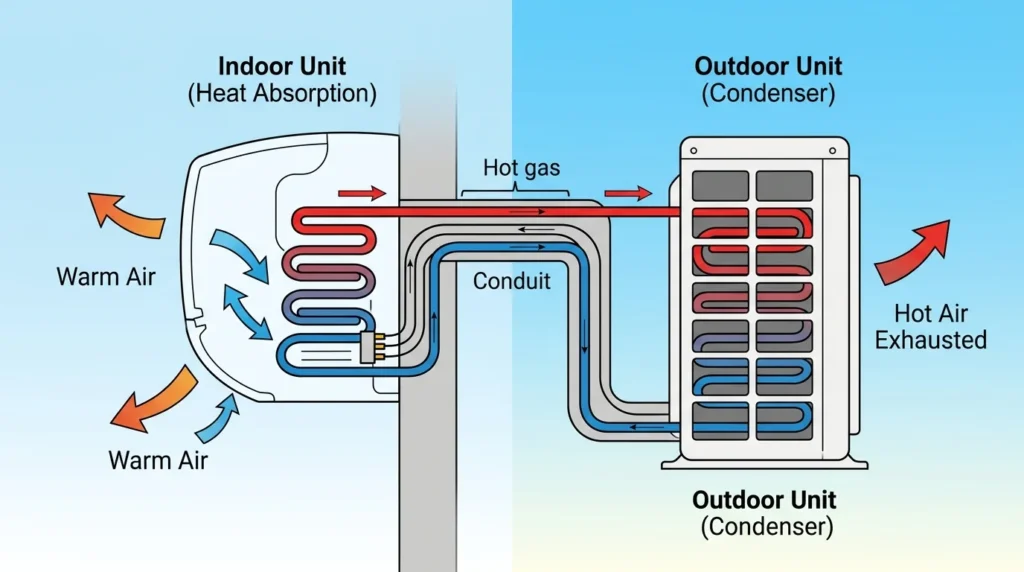
The indoor unit is installed inside the room to deliver cool air, while the outdoor unit releases heat to the outside environment.
Simple Explanation
A mini split system works like a direct cooling system for one room or zone. Instead of sending cool air through ducts across the building, it cools the air directly inside the room where the unit is installed.
Practical Example
Suppose a house has one bedroom that becomes very hot during summer. Installing a complete central air conditioning system may be expensive and unnecessary. In this case, a mini split unit can be installed easily to cool only that room.
This flexibility is one reason why mini split systems are widely used.
Mini Split Air Conditioner Working Principle
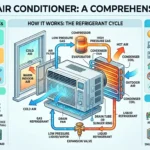
The mini split air conditioner working principle is based on the refrigeration cycle, which removes heat from indoor air and releases it outside the building.
The system does not actually create cold air. Instead, it removes heat from the room.
Step-by-Step Working Process
- Warm air enters the indoor unit
A fan pulls warm air from the room and passes it over the evaporator coil.
- Heat transfer to refrigerant
The evaporator contains cold refrigerant. When warm air passes over the coil, the refrigerant absorbs heat from the air.
- Refrigerant evaporates
As the refrigerant absorbs heat, it changes from liquid to low-pressure gas.
- Compression process
The compressor in the outdoor unit compresses the refrigerant gas. This increases both its pressure and temperature.
- Heat release through condenser
The hot refrigerant flows through the condenser coil where outdoor air removes the heat.
- Condensation
The refrigerant cools down and changes back into liquid form.
- Expansion valve operation
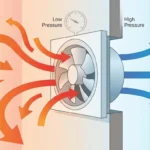
The expansion valve reduces the refrigerant pressure and temperature.
- Cycle repeats
The cooled refrigerant returns to the evaporator, and the cooling process continues.
Simple Analogy
You can think of this system as a heat transfer machine that moves heat from inside the room to the outside environment.
Types of Mini Split Air Conditioners
Mini split systems are available in different configurations depending on installation style and building design.
Wall-Mounted Mini Split
This is the most common type used in homes.
The indoor unit is installed on a wall near the ceiling.
Key features:
- Easy installation
- Low cost
- Ideal for bedrooms and small offices
Ceiling Cassette Mini Split
In this system, the indoor unit is installed inside the ceiling.
Air flows in four directions, providing uniform cooling across the room.
Common applications include:
- Offices
- Restaurants
- Conference rooms
Floor-Mounted Mini Split
These units are installed near the floor instead of the wall.
Advantages include:
- Suitable for rooms with limited wall space
- Easier maintenance access
Multi-Zone Mini Split System
A multi-zone system connects multiple indoor units to one outdoor unit.
Each room can have separate temperature control.
These systems are commonly used in:
- Large homes
- Hotels
- Office buildings
Main Components of a Mini Split Air Conditioner
Understanding the components helps technicians troubleshoot and maintain the system effectively.
Compressor
The compressor is located in the outdoor unit.
Functions:
- Compresses refrigerant gas
- Increases refrigerant pressure and temperature
- Circulates refrigerant throughout the system
Condenser Coil
The condenser coil releases heat from the refrigerant into the outdoor air.
A fan helps remove the heat efficiently.
Evaporator Coil
The evaporator coil is installed inside the indoor unit.
Functions:
- Absorbs heat from indoor air
- Converts liquid refrigerant into gas
Expansion Valve
This device reduces the refrigerant pressure before it enters the evaporator coil.
Lower pressure produces a lower temperature refrigerant.
Indoor Fan (Blower)
The indoor fan circulates cool air throughout the room.
It helps distribute conditioned air evenly.
Control System
Modern mini split air conditioners include electronic control systems that manage:
- Temperature settings
- Compressor operation
- Fan speed
- System protection
Refrigerant Pipes
Copper pipes connect the indoor and outdoor units.
They transport refrigerant during the cooling cycle.
Mini Split Air Conditioner Advantages
Understanding mini split air conditioner advantages and disadvantages helps engineers choose the correct system for different applications.
Key Advantages
- High energy efficiency
- No ductwork required
- Quiet operation
- Easy installation
- Individual room temperature control
- Flexible placement options
- Reduced energy loss compared to duct systems
Real-World Benefits
Because there are no ducts, mini split systems avoid energy losses that often occur in traditional duct systems.
Disadvantages / Limitations
Despite many advantages, mini split systems also have some limitations.
Common Disadvantages
- Higher initial cost than window air conditioners
- Indoor unit may affect room appearance
- Professional installation required
- Refrigerant leakage can reduce performance
- Limited cooling capacity compared to large central systems
These factors should be considered during system design.
Mini Split Air Conditioner Applications
The mini split air conditioner applications are increasing in modern buildings.
Residential Applications
Mini split systems are commonly used in:
- Bedrooms
- Living rooms
- Apartments
- Small houses
Commercial Applications
In commercial environments, they are used in:
- Offices
- Restaurants
- Shops
- Clinics
Technical and Industrial Applications
Mini split units are also used for cooling sensitive equipment such as:
- Server rooms
- Communication equipment rooms
- Laboratories
These spaces require stable temperature control.
Difference Between Mini Split Air Conditioner and Central AC
Understanding the difference between mini split air conditioner and central air conditioning systems is important for HVAC design.
| Feature | Mini Split Air Conditioner | Central Air Conditioner |
|---|---|---|
| Duct System | Not required | Required |
| Installation | Easier | More complex |
| Cooling Area | Individual rooms | Whole building |
| Energy Efficiency | High | Moderate |
| Cost | Moderate | Higher installation cost |
| Temperature Control | Zone-based | Single system control |
Mini split systems are usually better for small spaces or room-by-room cooling.
Selection Guide
Choosing the right mini split system requires careful planning.
Important Selection Factors
Cooling Capacity
Cooling capacity is measured in BTU. The unit should match the room size.
Energy Efficiency Rating
Higher efficiency ratings reduce electricity consumption.
Inverter Technology
Inverter compressors adjust speed based on cooling demand, improving efficiency.
Number of Zones
Select single-zone or multi-zone systems depending on building layout.
Installation Location
Indoor units should be placed where airflow is not blocked.
Beginner Tip
Always calculate the cooling load before selecting an air conditioner.
Common Problems and Solutions
Technicians often face common mini split system issues.
Why is the mini split not cooling properly?
Possible causes include:
- Dirty air filters
- Low refrigerant level
- Blocked condenser coil
Solution: Clean filters and inspect refrigerant charge.
Why is water leaking from the indoor unit?
Cause:
Blocked condensate drain pipe.
Solution:
Clean the drainage line to allow proper water flow.
Why does the unit make unusual noise?
Possible reasons include loose mounting brackets or fan obstruction.
Solution:
Inspect the installation and tighten loose components.
Why does the system turn on and off frequently?
Possible cause:
Faulty temperature sensor or control board issue.
Solution:
Check thermostat sensors and electrical controls.
Future Trends
The HVAC industry continues to develop new technologies.
Smart HVAC Systems
Modern mini split systems can connect with smart home devices and allow remote control using mobile applications.
Energy Optimization Technology
Advanced systems automatically adjust cooling based on room occupancy.
Environmentally Friendly Refrigerants
New refrigerants are being developed to reduce environmental impact.
Improved Inverter Compressors
Future compressors will provide higher efficiency and lower power consumption.
These technologies will make mini split systems more efficient and environmentally sustainable.
Conclusion
Mini split air conditioners have become an important part of modern cooling technology. Their ductless design allows efficient cooling of individual rooms while reducing installation complexity.
In this article, we explained the mini split air conditioner working principle, types, components, advantages, disadvantages, and applications. Understanding these systems helps electrical engineers and technicians design better HVAC solutions.
We also discussed the difference between mini split air conditioner and central air conditioning systems, which helps determine the right system for different building requirements.
For students and technicians, learning about mini split systems provides valuable knowledge of refrigeration cycles, electrical control systems, and HVAC engineering. With proper installation and maintenance, these systems offer reliable and energy-efficient cooling for many years.