
Imagine an electrician installing a ceiling fan or repairing wiring on a high wall. Without a safe way to reach that height, the job becomes difficult and dangerous. In such situations, one simple tool becomes extremely important — the ladder.
A ladder is one of the most commonly used tools in electrical work, construction, and maintenance. Electricians, technicians, engineers, and even homeowners rely on ladders every day to reach elevated areas safely. Whether installing lights, fixing cable trays, or performing maintenance work, ladders make high places accessible.
Understanding ladders is more important than many beginners think. Choosing the wrong ladder can lead to accidents, while selecting the right one improves safety and efficiency at work.
In this article, you will learn everything about ladders in simple and practical language. We will discuss the ladder working principle, different types of ladders, ladder applications, major components, advantages, disadvantages, and how to select the right ladder. By the end of this guide, electrical students, engineers, and technicians will clearly understand how ladders work and how to use them safely in real-world situations.
2. What is a Ladder?
A ladder is a vertical or inclined structure used to climb up or down between different heights. It typically consists of two side rails connected by horizontal steps called rungs.
The basic purpose of a ladder is to provide temporary access to elevated areas such as ceilings, roofs, electrical panels, or tall machines.
Simple Explanation
A ladder works like a portable staircase. Instead of building permanent stairs, a ladder allows a person to reach higher places quickly and safely.
Practical Example
Suppose an electrician needs to install LED lights on a warehouse ceiling that is 4 meters high. Without a ladder, reaching that height would be impossible. By placing a ladder against the wall or opening it as a step ladder, the electrician can safely climb and perform the task.
3. Ladder Working Principle
The ladder working principle is based on stability, balance, and weight distribution. When a person climbs a ladder, their weight transfers through the ladder structure to the ground.
A ladder works safely when these forces are balanced.
Step-by-Step Explanation
- Placement on a stable surface
The ladder must be placed on a firm and level ground. - Angle positioning
For leaning ladders, the correct angle is usually about 75 degrees. - Weight distribution
The person’s weight travels through the ladder rungs to the side rails and then to the ground. - Friction support
Rubber feet or anti-slip pads create friction with the floor to prevent sliding. - Structural strength
The side rails carry the load and prevent bending or collapsing.
Simple Analogy
Think of a ladder like a bridge for climbing. The side rails act as support beams, while the rungs act like steps that allow a person to move upward safely.
4. Types of Ladders
There are many types of ladders used in electrical and industrial work. Each type is designed for specific situations.
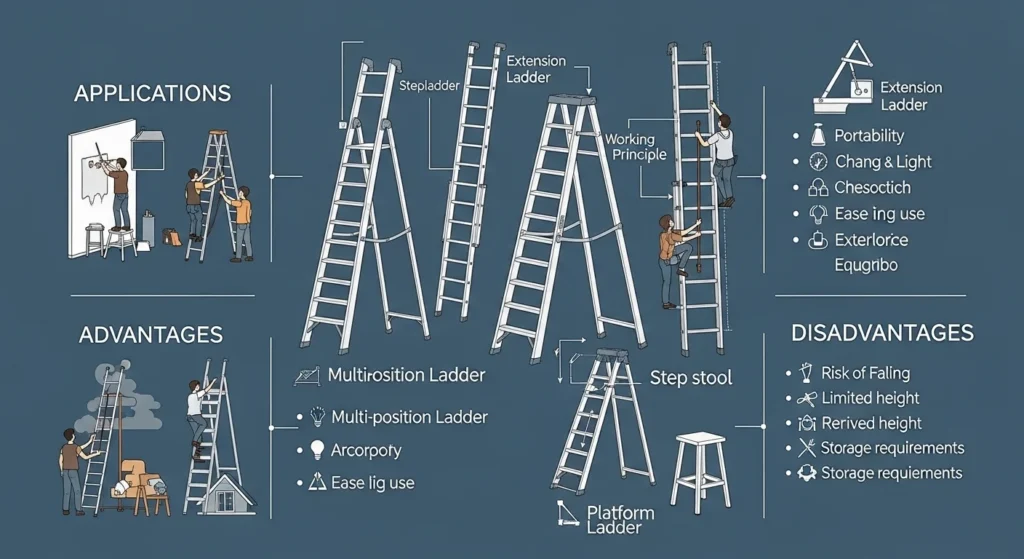
Step Ladder
A step ladder is a self-supporting ladder shaped like the letter “A”. It does not need to lean against a wall.
Features:
- Portable and easy to move
- Common in indoor electrical work
- Often made of aluminum or fiberglass
Example use: Installing ceiling lights.
Extension Ladder
An extension ladder consists of two or more sections that slide to increase height.
Features:
- Adjustable height
- Used for tall buildings
- Requires wall support
Example use: Exterior building maintenance.
Straight Ladder
A straight ladder is a single long ladder that must lean against a wall or structure.
Features:
- Simple design
- Lightweight
- Easy to transport
Example use: Roof access.
Platform Ladder
A platform ladder includes a standing platform near the top where the worker can stand comfortably.
Features:
- Provides better balance
- Suitable for long-duration work
- Common in warehouses
Fiberglass Ladder
A fiberglass ladder is specially designed for electrical work.
Features:
- Non-conductive material
- High electrical safety
- Strong and durable
Electricians prefer fiberglass ladders because they reduce electric shock risk.
5. Main Components of a Ladder
Understanding ladder components helps technicians inspect and use ladders safely.
Side Rails
These are the two long vertical supports of the ladder.
They carry most of the weight and provide structural strength.
Rungs
Rungs are horizontal steps used for climbing.
They connect the two side rails and support the user’s feet.
Feet
Ladder feet are located at the bottom and prevent slipping.
They often include rubber pads for better grip.
Spreaders
Spreaders are metal bars used in step ladders.
They keep the ladder open and stable.
Locks
Extension ladders use locking mechanisms to secure the extended section.
6. Ladder Advantages
The ladder advantages and disadvantages are important to understand before using them in professional work.
Advantages
- Easy to use and portable
- Quick access to elevated areas
- No electricity required
- Available in many sizes and materials
- Low cost compared to scaffolding
- Lightweight and easy to transport
- Suitable for indoor and outdoor work
For electricians, ladders provide fast access to wiring, lighting, and ceiling equipment.
7. Disadvantages / Limitations
Although ladders are useful tools, they also have some limitations.
- Limited working height
- Risk of falling if used incorrectly
- Not suitable for heavy equipment lifting
- Requires stable ground
- Long working hours can cause fatigue
Because of these limitations, larger construction projects often use scaffolding or lifts instead of ladders.
8. Ladder Applications
There are many ladder applications across different industries.
Home Applications
- Cleaning roofs
- Changing light bulbs
- Painting walls
- Installing fans
Electrical Applications
- Installing ceiling wiring
- Fixing cable trays
- Mounting CCTV cameras
- Maintenance of lighting systems
Industrial Applications
- Machine maintenance
- Warehouse shelving access
- Equipment installation
- Inspection of pipelines
Construction Applications
- Wall painting
- Structural inspection
- Plumbing work
- Building maintenance
Because of these uses, ladders are essential tools for electricians and technicians.
9. Comparison Section
Difference Between Ladder and Scaffolding
| Feature | Ladder | Scaffolding |
|---|---|---|
| Structure | Portable climbing tool | Temporary work platform |
| Height access | Limited | Very high |
| Stability | Moderate | Very stable |
| Setup time | Very quick | Longer setup |
| Best use | Short tasks | Long construction work |
| Cost | Low | Higher |
This difference between ladder and scaffolding shows that ladders are better for quick jobs, while scaffolding is better for long projects.
10. Selection Guide
Choosing the correct ladder is important for safety and efficiency.
Height Requirement
Always select a ladder that extends at least 1 meter above the working surface.
Material Selection
Common ladder materials include:
- Aluminum (lightweight)
- Fiberglass (electrical safety)
- Steel (heavy-duty)
Electricians usually choose fiberglass ladders.
Load Capacity
Check the ladder load rating before buying.
Typical categories include:
- Light duty
- Medium duty
- Heavy duty
- Industrial duty
Safety Features
Look for ladders with:
- Anti-slip feet
- Wide rungs
- Locking mechanisms
- Stable base
11. Common Problems & Solutions
Why does a ladder slip?
This usually happens due to smooth surfaces or damaged ladder feet.
Solution:
Use rubber pads or place the ladder on a non-slippery surface.
Why does a ladder wobble?
Wobbling occurs when the ladder is placed on uneven ground.
Solution:
Adjust the ladder position or use ladder stabilizers.
Can ladders conduct electricity?
Metal ladders can conduct electricity.
Solution:
Use fiberglass ladders for electrical work.
How often should ladders be inspected?
Ladders should be checked before every use.
Look for:
- Cracks
- Loose rungs
- Bent rails
12. Future Trends
Although ladders are simple tools, modern designs are improving safety and efficiency.
Smart Ladders
Some new ladders include sensors that detect instability.
Lightweight Materials
Advanced materials such as carbon fiber may make ladders lighter and stronger.
Foldable Multi-Purpose Ladders
Modern ladders can transform into:
- step ladders
- scaffolding platforms
- extension ladders
Improved Safety Design
Manufacturers are developing ladders with:
- wider steps
- better grip surfaces
- stronger locking systems
These innovations will make ladder use safer for technicians and engineers.
13. Conclusion
A ladder may look like a simple tool, but it plays a critical role in electrical work, construction, and maintenance. From installing lights to performing building inspections, ladders allow technicians to safely reach elevated areas.
In this guide, we explored the ladder working principle, different ladder types, components, ladder applications, and the ladder advantages and disadvantages. We also discussed how to choose the right ladder and how to avoid common safety problems.
For electrical students and technicians, understanding ladders is not just about climbing safely. It is about selecting the correct ladder for each job and using it responsibly.
Always remember that safety comes first. A properly selected and correctly used ladder can prevent accidents and make your work faster, easier, and more efficient.
Continuous learning about tools like ladders helps engineers and technicians become more professional and confident in the field.