
Imagine you are installing a generator for a house, workshop, or small factory. The generator rating plate shows 20 kVA, but the electrical load you calculated for your equipment is in kilowatts (kW). Many beginners get confused at this point and ask a common question: How do we convert kVA to kW?
This is where understanding the kVA to kW formula becomes very important. In electrical engineering, generators, transformers, and UPS systems are usually rated in kVA (kilovolt-ampere). However, most electrical devices such as heaters, motors, lighting systems, and appliances consume real power, which is measured in kW (kilowatts).
Because of this difference, electrical engineers and technicians must use a simple formula to convert apparent power (kVA) into real usable power (kW). This conversion helps in selecting the correct generator size, transformer rating, and electrical equipment capacity.
In this article, you will learn the kVA to kW formula, its working principle, practical examples, types of power involved, important components of the formula, advantages and disadvantages of using the calculation, real-world kVA to kW applications, troubleshooting tips, and how this concept is used in modern electrical systems.
2. What is kVA to kW Formula?
The kVA to kW formula is used to convert apparent power (kVA) into real power (kW) in an electrical system.
Clear Definition
The kVA to kW formula calculates the actual usable electrical power from the apparent power supplied by generators or transformers.
Basic Formula
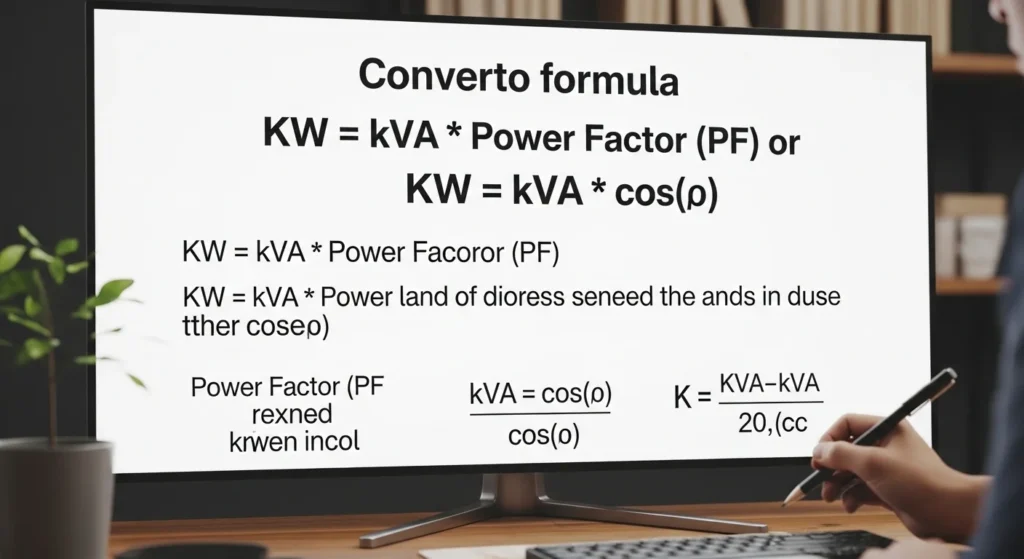
kW = kVA × Power Factor (PF)
Where:
- kW = Real power (actual usable power)
- kVA = Apparent power (total supplied power)
- Power Factor = Efficiency of the electrical system
Simple Explanation
Electrical systems do not convert all supplied power into useful work. Some power is lost due to magnetic fields, inductive loads, and electrical inefficiencies. The power factor represents how efficiently the power is used.
Practical Example
If a generator has a rating of:
10 kVA with power factor 0.8
Then:
kW = 10 × 0.8 = 8 kW
This means the generator can supply 8 kW of real usable power.
3. kVA to kW Working Principle
The kVA to kW working principle is based on the relationship between three types of electrical power:
- Apparent Power (kVA)
- Real Power (kW)
- Reactive Power (kVAR)
Step-by-Step Explanation
- Electrical source provides apparent power
Generators and transformers supply power measured in kVA. - Loads consume real power
Electrical devices convert energy into useful work such as heat, light, or motion. - Reactive power appears in inductive loads
Motors and transformers create magnetic fields that consume reactive power. - Power factor shows efficiency
Power factor indicates how much of the supplied power becomes useful work. - Formula converts supplied power into usable power
Using the formula:
kW = kVA × Power Factor
Easy Analogy
Think of kVA like a water pipe capacity and kW like the actual water used by machines. Not all water from the pipe is used efficiently, just like electrical power.
4. Types / Classification
Understanding the types of power helps explain the kVA to kW formula more clearly.
Apparent Power (kVA)
Apparent power is the total power supplied by an electrical source.
Features:
- Combination of real and reactive power
- Used to rate generators and transformers
- Measured in kVA
Real Power (kW)
Real power is the actual useful power that performs work.
Examples:
- Running electric motors
- Lighting systems
- Heating appliances
Reactive Power (kVAR)
Reactive power supports magnetic fields in electrical equipment.
Examples:
- Electric motors
- Transformers
- Inductive loads
Reactive power does not perform useful work but is necessary for system operation.
5. Main Components
The kVA to kW formula includes several important electrical components.
Apparent Power (kVA)
This is the total electrical power supplied by a generator or transformer.
Real Power (kW)
Real power represents the actual useful energy consumed by electrical devices.
Power Factor (PF)
Power factor measures how efficiently electrical power is used.
Typical values:
- Resistive loads: PF = 1
- Industrial loads: PF = 0.8
- Motors: PF = 0.7 – 0.9
Electrical Load
The electrical load determines how much real power is required in a system.
6. Advantages of Using the kVA to kW Formula
Understanding kVA to kW advantages and disadvantages helps engineers use this formula effectively.
Advantages
- Helps select the correct generator size
- Simplifies electrical power calculations
- Improves electrical system design
- Prevents equipment overloading
- Useful for transformer and UPS sizing
- Essential for electrical planning
Real-World Benefits
Electrical engineers use this formula daily when designing power systems for homes, factories, and commercial buildings.
7. Disadvantages / Limitations
Although useful, the kVA to kW formula has some limitations.
Disadvantages
- Requires accurate power factor value
- Power factor changes with load conditions
- Does not account for system losses
- Different loads have different efficiencies
- Simplified calculation may not represent complex systems
Despite these limitations, it remains a fundamental electrical calculation.
8. kVA to kW Applications
The kVA to kW applications are widely used in electrical engineering and power system design.
Generator Sizing
Engineers convert kVA ratings to kW to determine usable generator power.
Transformer Selection
Transformers are rated in kVA, but load requirements are usually calculated in kW.
UPS Systems
UPS capacity calculations require converting kVA into kW.
Industrial Electrical Systems
Factories calculate real power demand using this formula.
Residential Power Planning
Electricians estimate power consumption in homes using kW calculations.
9. Comparison Section
Understanding the difference between kVA and kW helps clarify electrical power concepts.
| Feature | kVA | kW |
|---|---|---|
| Meaning | Apparent Power | Real Power |
| Unit | Kilovolt-ampere | Kilowatt |
| Includes | Real + Reactive power | Only useful power |
| Used for | Generator rating | Load calculation |
| Depends on power factor | Yes | No |
Both units are essential for electrical system design.
10. Selection Guide
When using the kVA to kW formula, engineers must consider several factors.
Important Factors
- Power factor of the load
- Type of electrical equipment
- Total load demand
- Safety margin for generators
Tips for Beginners
- Always check the power factor value.
- Use 0.8 power factor as a standard estimate.
- Include extra capacity for future loads.
- Avoid running generators at full capacity.
These practices help ensure safe electrical system operation.
11. Common Problems & Solutions
Q1: Why is generator power lower than its kVA rating?
Because the generator rating includes apparent power, but real usable power depends on the power factor.
Solution: Use the kVA to kW formula to calculate actual power.
Q2: Why does power factor affect electrical efficiency?
Low power factor means more energy is wasted in reactive power.
Solution: Improve power factor using capacitors.
Q3: Why do motors reduce power factor?
Electric motors create magnetic fields that increase reactive power.
Solution: Use power factor correction equipment.
Q4: Why is generator overload common?
Many users misunderstand the difference between kVA and kW.
Solution: Always convert kVA to kW before calculating load.
12. Future Trends
Electrical power systems are evolving with modern technologies.
Smart Power Monitoring
Smart meters and monitoring systems automatically calculate real power consumption.
Power Factor Correction Systems
Modern industries use automatic capacitors to improve power factor.
Energy Management Systems
Advanced systems optimize electrical efficiency in buildings and factories.
Renewable Energy Integration
Solar and wind systems require accurate power calculations including kVA and kW conversions.
These technologies make electrical power systems more efficient and reliable.
13. Conclusion
The kVA to kW formula is one of the most important calculations in electrical engineering. It helps convert apparent power (kVA) into real usable power (kW) using the power factor of the system. This simple formula allows engineers and technicians to properly size generators, transformers, and electrical equipment.
Understanding the kVA to kW working principle, applications, and advantages and disadvantages is essential for anyone working with electrical systems. Without this knowledge, it is easy to overload equipment or miscalculate electrical demand.
For electrical students and beginners, mastering this formula provides a strong foundation for learning power system design, load calculations, and electrical planning. By applying the correct power factor and understanding the relationship between kVA and kW, engineers can design safer, more efficient, and reliable electrical systems.