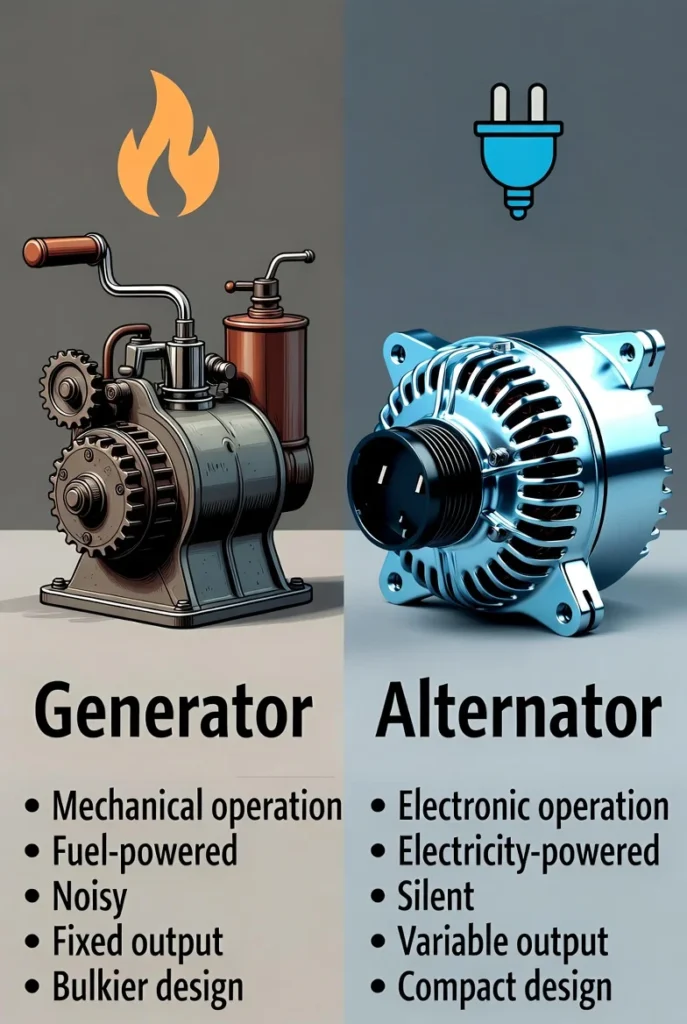

Imagine driving an old classic car on a long road trip. The battery starts draining because the lights, radio, and wipers are on, but the engine is idling at a stoplight. In older vehicles with a generator, charging might be weak or stop at low speeds, risking a dead battery. Switch to a modern car with an alternator, and it keeps charging efficiently even at idle, powering everything smoothly. This everyday scenario shows why understanding the difference between a generator and an alternator matters so much.
The topic of generator vs alternator is key in electrical engineering and automotive work. Both convert mechanical energy to electrical energy, but their designs lead to big differences in performance, efficiency, and use. Knowing these helps students, engineers, technicians, and beginners choose the right device, avoid common mistakes, and improve systems safely.
In this article, you’ll learn clear definitions, the generator vs alternator working principle, types, main components, advantages and disadvantages, applications, and a direct comparison. We’ll cover selection tips, troubleshooting, and future trends. By the end, you’ll confidently explain and apply these concepts in real projects or repairs
What is Generator vs Alternator?
Generator vs alternator refers to two devices that produce electricity from mechanical motion, but they differ mainly in output type and design.
A generator is a broad term for any machine converting mechanical energy into electrical energy. It can produce direct current (DC) or alternating current (AC). In common use, especially older contexts, “generator” often means a DC generator or dynamo.
An alternator is a specific type of generator that always produces alternating current (AC). It uses a rotating magnetic field around stationary windings.
A practical example: In a car, the alternator charges the battery and powers accessories while the engine runs. An old tractor might use a DC generator for similar tasks, but with less efficiency at low speeds.
Working Principle
The generator vs alternator working principle relies on electromagnetic induction: moving a conductor in a magnetic field creates current.
Both use Faraday’s law, but the setup differs.
Think of a bicycle dynamo (a small generator). Pedaling spins wires in a fixed magnet field, lighting the bulb.
- Generator (DC type): The armature (wire coils) rotates inside a stationary magnetic field. This induces AC in the armature. A commutator (split rings) and brushes flip connections to make DC output. Like switching direction to keep current one way.
- Alternator: The rotor (with electromagnets) spins inside a stationary stator (wire coils). This creates AC directly in the stator. Slip rings and brushes supply power to the rotor field. Diodes rectify AC to DC if needed (like in cars).
Step-by-step for alternator:
- Engine spins rotor.
- Rotor creates rotating magnetic field.
- Field cuts stator coils, inducing AC.
- Rectifier converts to DC for battery/loads.
This design makes alternators more efficient.
Types / Classification
Generators and alternators come in types based on use, output, and design.
DC Generators
These produce direct current. Common in older vehicles or simple setups. They use commutators for DC output.
AC Generators (Synchronous)
Large power plants use these. They produce AC at fixed frequency, matching grid needs.
Automotive Alternators
Used in modern cars. They output AC, rectified to DC. Compact and high-output.
Brushless Alternators
No brushes or slip rings. Excitation via another small generator. Low maintenance, used in industrial sets.
Permanent Magnet Alternators
Use strong magnets instead of electromagnets. Efficient for wind turbines or small devices.
Portable Generators
Combine engine and alternator (often AC output). For backup power.
Main Components
Both share basics, but details vary.
The rotor spins to create motion. In alternators, it’s the field (electromagnet); in DC generators, it’s the armature.
The stator holds windings. In alternators, it’s stationary for output; in generators, it provides the field.
Brushes and rings: Alternators use slip rings (smooth, less wear); generators use commutators (segmented, more wear).
Rectifier (diodes) in alternators converts AC to DC.
Voltage regulator controls output to match needs, preventing overcharge.
Bearings support rotation smoothly.
Housing protects parts.
Advantages
- Higher Efficiency: Alternators produce more power with less waste, especially at low speeds.
- Better Low-Speed Performance: Alternators charge batteries even at idle; generators struggle.
- Compact and Lightweight: Alternators fit modern designs better.
- Higher Output: Deliver more amps for the same size.
- Less Maintenance: Slip rings wear slower than commutators.
- Reliable Charging: Consistent voltage under varying loads.
These generator vs alternator advantages make alternators dominant today.
Disadvantages / Limitations
DC generators can self-excite without battery and handle spikes better.
Alternators need initial excitation (often from battery) and are sensitive to reverse polarity or spikes.
Generators may be simpler in basic setups but heavier and larger.
Both require mechanical drive, so no output when stopped.
High initial cost for quality units.
Alternators need rectification, adding complexity.
Applications
In homes, portable generators (with alternators) provide backup during outages.
Industries use large AC generators for power plants or standby sets.
Modern cars rely on alternators to charge batteries and run electronics.
Trucks and heavy vehicles use high-output alternators.
Renewable energy: Wind turbines use permanent magnet alternators.
Aviation: Some older planes used generators; modern ones prefer alternators.
Comparison Section
Here’s a clear table comparing generator (focusing on DC type) vs alternator:
| Feature | Generator (DC) | Alternator (AC, often rectified) |
| Output Current | DC | AC (converted to DC) |
| Rotating Part | Armature | Rotor (field) |
| Stationary Part | Field magnets | Stator windings |
| Commutator/Slip Rings | Commutator (high wear) | Slip rings (low wear) |
| Efficiency | Lower | Higher |
| Low-Speed Output | Poor | Good |
| Size/Weight | Larger/heavier | Smaller/lighter |
| Maintenance | Higher (brush/commutator) | Lower |
| Output Power | Lower for size | Higher for size |
The difference between generator and alternator is clear: alternators win in most modern uses.
Selection Guide
Choose based on needs. For vehicles, pick alternator for better charging.
For backup power, select generator set with alternator head for AC output.
Calculate required amps: Add loads like lights, fridge.
Consider speed range: Alternators suit variable RPM.
For beginners, start with automotive alternators – easy to find and understand.
Check voltage (12V/24V) and mounting.
Look for brushless if low maintenance is key.
Always match to engine power.
Common Problems & Solutions
Q: No charging at idle?
A: Likely generator issue. Upgrade to alternator or check regulator.
Q: Battery drains while running?
A: Faulty rectifier in alternator. Test diodes; replace if bad.
Q: Noisy operation?
A: Worn bearings or loose belt. Inspect and tighten/replace.
Q: Overcharging battery?
A: Bad voltage regulator. Replace it.
Q: Sparks or wear?
A: Commutator problem in generator. Clean or switch to alternator.
Q: Low output?
A: Weak field excitation. Check connections and regulator.
These fix most issues quickly.
Future Trends
Alternators evolve with permanent magnets for higher efficiency and no excitation needs.
Brushless designs grow in renewables and EVs.
Smart regulators with sensors optimize charging.
Integration with hybrid systems blends alternator functions with motors.
Efficiency pushes toward higher outputs in smaller packages.
The shift continues to alternators in all sectors.
Conclusion
We’ve explored generator vs alternator, from basics and working principles to types, components, advantages and disadvantages, and applications. Alternators outperform in efficiency, size, and modern needs, while generators suit specific legacy or simple cases.
As a senior electrical engineer, I’ve seen alternators transform vehicle and backup systems. Start small – test a car alternator or study diagrams. Hands-on work builds real skill.
Keep learning; the electrical field advances fast. Master these basics, and you’ll handle power challenges with confidence