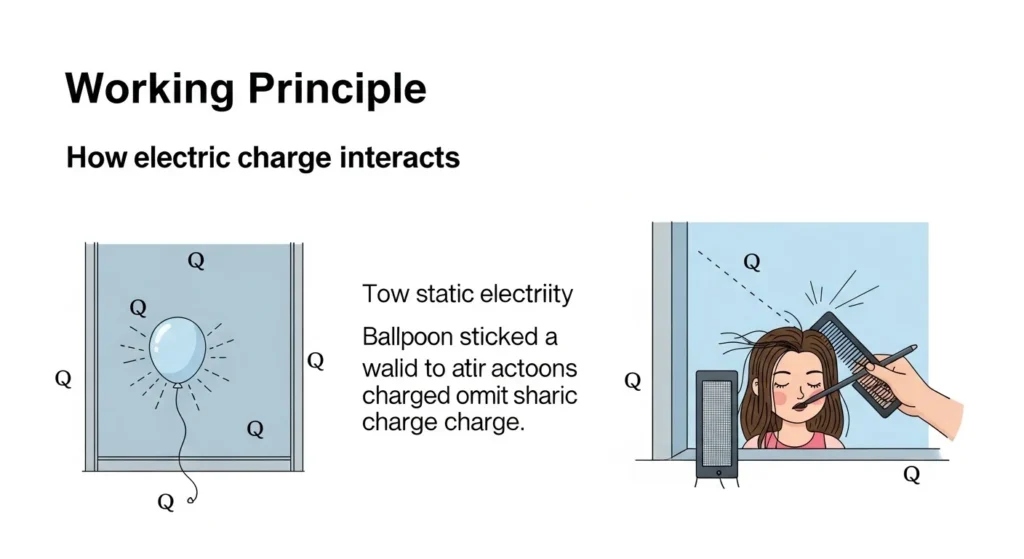

Imagine rubbing a plastic comb on dry hair and then bringing it close to small pieces of paper. Surprisingly, the paper pieces jump toward the comb and stick to it. This simple everyday experiment demonstrates an important concept in electricity called electric charge.
Electric charge is the fundamental property responsible for almost all electrical and electronic phenomena. From lighting a bulb in your home to operating smartphones, computers, and industrial machines, electric charge plays a critical role in modern technology.
For electrical students, technicians, and engineers, understanding what is electric charge is essential because it forms the foundation of electrical engineering concepts such as current, voltage, electric fields, and circuits.
In this article, you will learn the electric charge working principle, its types, important characteristics, advantages and disadvantages, and real-world electric charge applications. The goal is to explain this concept in simple and clear language, just like a senior electrical engineer guiding a beginner.
2. What is Electric Charge?
Definition
Electric charge is a fundamental property of matter that causes it to experience a force when placed in an electric or magnetic field.
It is responsible for electrical attraction and repulsion between objects.
Electric charge is measured in a unit called Coulomb (C).
Simple Explanation
In simple terms, electric charge is the property of particles that allows them to create electrical forces. When objects have charge, they can either attract or repel other charged objects.
Every atom contains charged particles:
- Electrons (negative charge)
- Protons (positive charge)
The movement of electrons is what produces electric current in electrical systems.
Practical Example
When you rub a balloon on your hair, electrons transfer from your hair to the balloon. The balloon becomes negatively charged and can attract small objects like paper pieces.
This demonstrates the basic behavior of electric charge.
3. Electric Charge Working Principle
The electric charge working principle is based on the interaction between charged particles. Charges create forces that cause attraction or repulsion.
Step-by-Step Explanation
- Atoms contain charged particles
Every material is made of atoms containing electrons and protons.
- Charge imbalance occurs
When electrons move from one object to another, a charge imbalance occurs.
- Objects become charged
- Losing electrons → positive charge
- Gaining electrons → negative charge
- Electrical force acts
Charged objects interact with each other through electric forces.
Basic Rules of Electric Charge
- Like charges repel each other
- Opposite charges attract each other
Easy Analogy
Think of electric charge like magnets:
- Two north poles push away from each other
- A north pole and south pole attract
Similarly, electric charges follow attraction and repulsion rules.
4. Types of Electric Charge
Electric charge is mainly classified into two basic types.
Positive Charge
A positive charge occurs when an object loses electrons.
Characteristics:
- Deficiency of electrons
- Represented by a (+) sign
- Usually associated with protons
Example: Glass rubbed with silk becomes positively charged.
Negative Charge
A negative charge occurs when an object gains extra electrons.
Characteristics:
- Excess electrons
- Represented by a (–) sign
- Electrons carry negative charge
Example: Plastic rubbed with wool becomes negatively charged.
Neutral Charge
An object is electrically neutral when it contains equal numbers of protons and electrons.
Most materials in normal conditions are neutral.
5. Main Components of Electric Charge
Electric charge is closely related to the structure of atoms.
Electrons
Electrons are negatively charged particles that move around the atom.
Function:
- Responsible for electric current
- Easily transferred between materials
Protons
Protons carry positive charge and remain fixed inside the atomic nucleus.
Function:
- Determine the positive charge of atoms
Atomic Nucleus
The nucleus contains protons and neutrons.
Function:
- Maintains atomic structure
- Holds positive charge
Electric Field
An electric field is the region around a charged object where electric force acts.
Function:
- Influences nearby charges
- Enables interaction between charged bodies
6. Advantages of Electric Charge
Understanding electric charge provides many technological benefits.
Advantages include:
- Forms the basis of electrical engineering
- Enables electricity generation and transmission
- Supports electronic device operation
- Essential for industrial automation systems
- Helps design sensors and control systems
- Enables electrostatic technologies
Electric charge is the starting point for studying all electrical systems.
7. Disadvantages / Limitations
While electric charge is essential, it can also create challenges.
Electric charge disadvantages include:
- Static electricity can damage sensitive electronics
- High charge accumulation can cause electrical sparks
- Electrostatic discharge may damage microchips
- Uncontrolled charges may lead to electrical hazards
Proper grounding and insulation are necessary to manage these risks.
8. Electric Charge Applications
Electric charge has numerous applications in home, industry, and modern technology.
Home Applications
- Television and electronic devices
- Air purifiers using electrostatic filters
- Photocopiers and laser printers
Industrial Applications
- Electrostatic painting
- Dust removal in power plants
- Electrostatic precipitators
Modern Technology Applications
- Semiconductor devices
- Integrated circuits
- Capacitors and energy storage devices
- Touchscreen technology
These electric charge applications demonstrate its importance in modern electrical engineering.
9. Comparison Section
Difference Between Electric Charge and Electric Current
| Feature | Electric Charge | Electric Current |
|---|---|---|
| Definition | Property of particles | Flow of electric charge |
| Unit | Coulomb | Ampere |
| Nature | Static or stored | Moving charge |
| Example | Charged balloon | Current in wire |
Understanding the difference between electric charge and electric current is important for beginners in electrical engineering.
10. Selection Guide (Learning Path for Beginners)
For students starting electrical engineering, learning electric charge is the first step.
Beginner Tips
- Start with atomic structure concepts
- Learn the relationship between charge, voltage, and current
- Practice simple electrostatic experiments
- Study Coulomb’s law and electric fields
Recommended Study Order
- Electric charge
- Electric field
- Voltage
- Current
- Resistance
This learning path builds a strong electrical engineering foundation.
11. Common Problems & Solutions
Q1: Why do objects become electrically charged?
Objects become charged when electrons transfer between materials due to friction or contact.
Q2: Why do like charges repel?
Like charges repel because the electric force between similar charges pushes them apart.
Q3: Why do we feel static shocks sometimes?
Static shocks occur when accumulated charge suddenly discharges through the body.
Q4: How can electrostatic problems be prevented?
Solutions include:
- Proper grounding
- Using anti-static materials
- Maintaining humidity levels
12. Future Trends
The role of electric charge is expanding in modern technology.
Nanotechnology
Researchers are studying charge behavior at extremely small scales.
Energy Storage Systems
Advanced batteries and supercapacitors depend on charge movement.
Quantum Electronics
Quantum devices rely on precise control of electric charge.
Semiconductor Innovation
Microprocessors and integrated circuits are continuously improving through advanced charge control.
Understanding electric charge will remain essential for future electrical engineers.
13. Conclusion
Electric charge is one of the most fundamental concepts in electrical engineering. It explains how electrical forces occur and how electricity is generated, stored, and transmitted. Every electrical system, from simple circuits to advanced electronic devices, operates because of the movement and interaction of electric charges.
In this article, we discussed what is electric charge, its working principle, types, components, advantages and disadvantages, and practical applications. We also explored the difference between electric charge and electric current to help beginners understand the concept more clearly.
For electrical students and technicians, mastering the basics of electric charge builds the foundation for studying circuits, electronics, power systems, and advanced electrical technologies. With a strong understanding of this topic, learners can progress confidently toward more complex electrical engineering concepts.